
Blog

Data Center Cooling That Matches the Heat Load
A data center can have plenty of installed cooling capacity and still run hot at the racks. The usual cause is not simply a lack of tonnage or CFM. It is a mismatch between the actual heat load, the air path, equipment layout, fan static-pressure capability, and the control strategy. For conventional IT rooms, high-density compute clusters, and crypto mining operations, data center cooling must move heat out of the equipment zone reliably, not merely circulate air around it.
The engineering ques
…
13th Aug 2026

Future of Immersion Cooling for Data Centers
A 30 kW rack once signaled an unusually demanding data center load. For high-density AI, HPC, and cryptocurrency mining operations, that number can now be a starting point. The future of immersion cooling is being driven by this simple engineering reality: air cannot economically carry away unlimited heat, especially where equipment must run continuously at high utilization.
Immersion systems place servers, ASIC miners, or other electronics into a dielectric fluid that does not conduct
…
2nd Aug 2026

AI HPC Data Centers Need Better Airflow
A 30 kW rack used to get attention. In many AI HPC data centers, that number now looks conservative. Training clusters, GPU-heavy inference nodes, and tightly packed high-performance compute environments can push rack densities into a range where old comfort-zone cooling assumptions fail fast. When heat spikes, uptime, hardware life, and power efficiency all start moving in the wrong direction.
For operators, engineers, and design teams, the real question is not whether these facilities need mor
…
1st Jul 2026

Crypto Mining & Data Center Cooling Experts
Heat is not a side issue in mining and compute environments - it is often the reason performance drops, hardware fails early, and operating costs climb. Crypto Mining & Data Center Cooling Experts look at the full thermal picture, not just fan size, because hash rate stability and equipment life depend on airflow path, static pressure, intake conditions, exhaust strategy, and control logic working together.
Too many facilities try to solve high temperatures by adding more fans wherever space
…
1st Jul 2026
Crypto Mining Heat Removal Guide
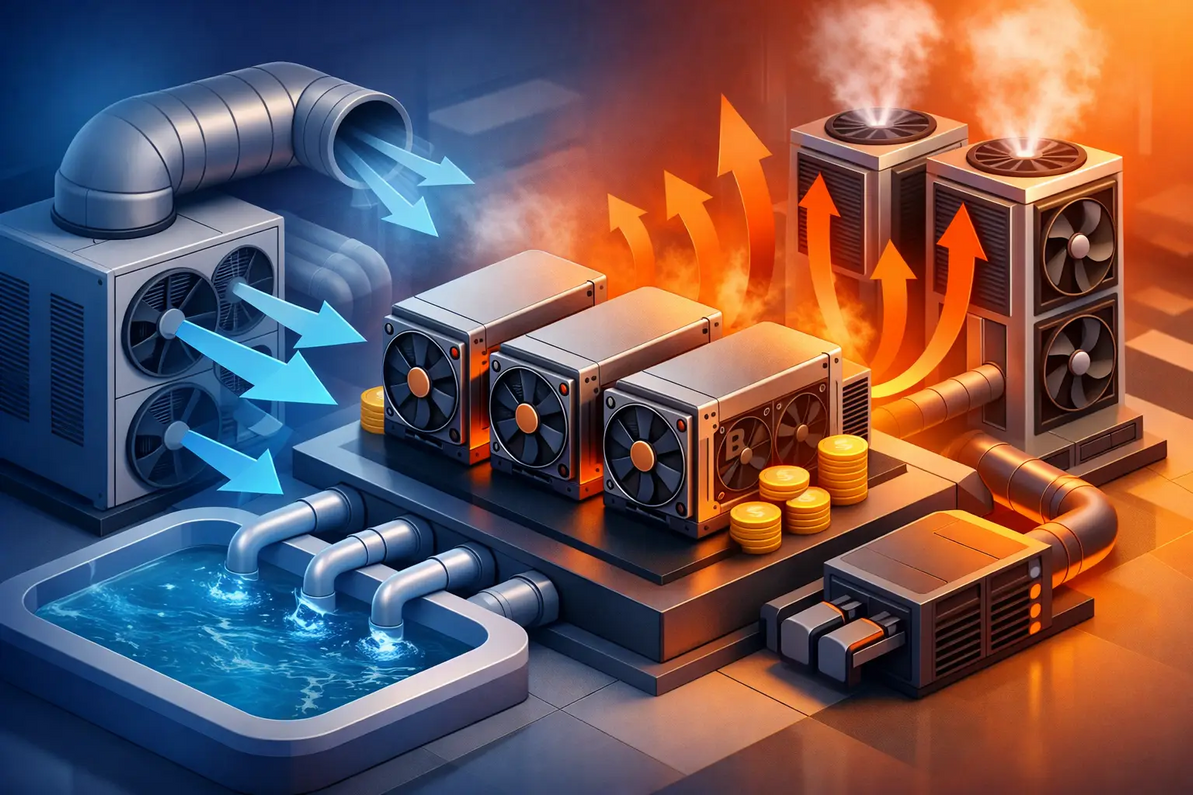
A mining room that runs 10 to 20 degrees hotter than planned usually does not have a miner problem. It has an air management problem. This crypto mining heat removal guide is built for operators, facility managers, engineers, and installers who need practical ventilation design decisions based on heat load, airflow path, static pressure, and uptime.
Mining hardware converts most of its electrical input into heat. That means every kilowatt you install becomes a cooling problem that must be remove
…
27th Jun 2026