
Crypto Mining Heat Removal Guide
A mining room that runs 10 to 20 degrees hotter than planned usually does not have a miner problem. It has an air management problem. This crypto mining heat removal guide is built for operators, facility managers, engineers, and installers who need practical ventilation design decisions based on heat load, airflow path, static pressure, and uptime.
Mining hardware converts most of its electrical input into heat. That means every kilowatt you install becomes a cooling problem that must be removed continuously, not occasionally. If the room cannot move that heat out at the same rate it is produced, inlet temperatures rise, fan speeds ramp up, dust loading gets worse, and equipment reliability starts to fall.
What a crypto mining heat removal guide should solve
The first job is not picking a fan. The first job is understanding the heat source, the room, and the airflow path. A proper mining cooling design starts with total connected load in kilowatts, expected operating load, room dimensions, outside design temperatures, altitude, filter resistance, and the path for discharge air.
In crypto mining, heat removal is rarely just about CFM on a product page. You need usable airflow at the actual static pressure of the system. Intake louvers, filters, duct transitions, evaporative media, dampers, and discharge hoods all add resistance. If the fan curve does not match the system curve, nameplate airflow becomes marketing, not performance.
That is why two mining buildings with the same number of ASICs can need very different solutions. One may work with high-volume exhaust and gravity intake. Another may require powered make-up air, pressure control, filtration strategy, and compartmentalized hot aisle discharge. It depends on climate, building leakage, equipment density, and whether the operation is trying to run simple air cooling, immersion, or hybrid cooling.
Start with heat load, not fan size
A common mistake is estimating fan quantity before calculating the actual heat rejection requirement. If your mining load is 500 kW, you are dealing with a very large and constant heat source. That load must be removed every hour the site is operating. From there, the design question becomes how much air must move across the space to maintain acceptable inlet temperatures under peak outdoor conditions.
Temperature rise matters. If you allow a higher rise from intake to exhaust, required airflow drops. That can reduce first cost, but it may also tighten equipment operating margins in hot weather. If you design for a lower temperature rise, airflow requirements increase, fan horsepower can increase, and intake and discharge openings must be larger. There is no universal right answer. The right answer is what balances capital cost, operating cost, miner reliability, and the site climate.
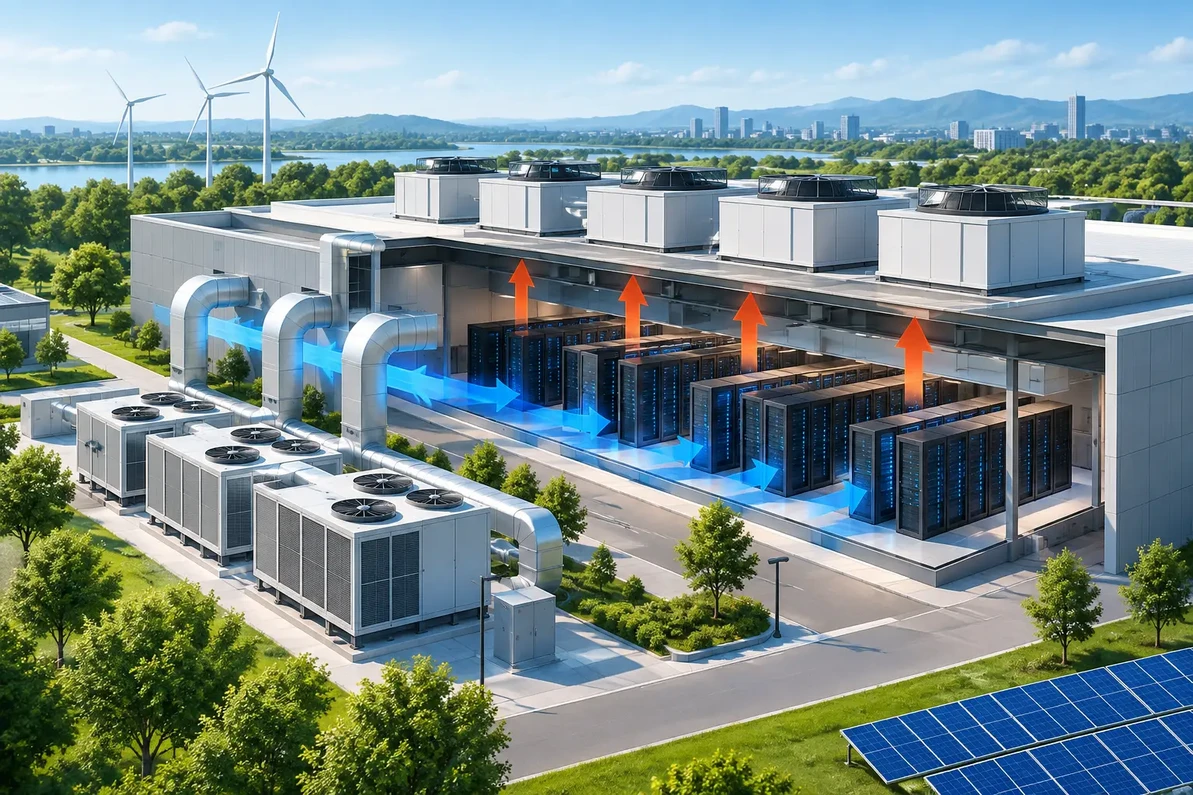
For many mines, the practical target is controlled directional airflow rather than trying to make the entire room uniformly cool. Pull cooler outside air directly to the miners. Move heated discharge air away from the inlets immediately. If hot exhaust recirculates, even a high-CFM system can underperform.
Why hot air recirculation causes most failures
When operators say the room has enough fans but machines are still overheating, recirculation is usually involved. Hot exhaust loops back to the miner intake because the room lacks separation, the discharge point is too close to intake openings, or the structure creates dead zones.
This is especially common in retrofits. Warehouses, containers, and light industrial buildings are often repurposed for mining without a full airflow study. The result is short-circuiting air patterns, stratification at the ceiling, and localized hot spots near wall lines or corners. In those cases, adding more fan capacity without changing the airflow path may only increase turbulence.
Air-cooled mining: exhaust, make-up air, and pressure balance
Most air-cooled facilities rely on a coordinated system of exhaust fans and intake or make-up air openings. The exhaust side removes heat. The intake side prevents the building from pulling too deep into negative pressure, which can starve airflow, increase infiltration through unintended openings, and reduce system control.
Negative pressure is not automatically bad. In many mining applications, a slight negative building pressure helps direct air inward through planned intake locations. The problem comes when pressure drop gets too high. Then fans operate inefficiently, doors become difficult to open, outside contaminants enter through cracks, and actual airflow falls below design.
A well-engineered setup matches exhaust capacity with enough free intake area or powered make-up air to keep pressure within a workable range. Filters need the same attention. Filtration protects equipment, but every filter bank adds static pressure. If filter loading over time is ignored, airflow can drop significantly after installation.
Fan selection is about fan curve, motor, and duty cycle
Mining is not a light-duty application. The fans must be selected for continuous service, expected ambient conditions, and actual static pressure. Motor type, horsepower, housing material, and control strategy all matter. A fan that looks economical upfront can become expensive if it loses performance under load or requires frequent maintenance in dusty conditions.
Variable frequency drives can be useful where seasonal conditions change or staged operation is needed. They allow better pressure control and can reduce unnecessary power draw during cooler weather. But VFDs do not fix poor duct design or undersized openings. Controls should support the design, not compensate for a weak one.
Crypto mining heat removal guide for room layout
Layout affects cooling as much as equipment selection. Racks should be arranged to support a clean intake side and a defined hot discharge side. If miners face each other or exhaust into mixed open space, heat management becomes harder immediately.
Containment is often worth considering, especially at higher densities. Even simple partitions, baffles, or directed plenums can reduce recirculation and improve inlet consistency. The point is not making the room look sophisticated. The point is making airflow predictable.
Ceiling height also changes the design. In taller spaces, heat can stratify above the occupied equipment zone, which sounds harmless until it rolls back down or burdens the exhaust path. In lower spaces, velocity and throw become more critical because there is less room for air to separate naturally.
Outdoor climate has to be part of layout planning too. In dry regions, evaporative pre-cooling may help reduce intake temperatures. In humid climates, that same approach may add complexity without enough payoff. In very hot regions, air cooling alone may require larger equipment and tighter design tolerances than the budget expects.
When immersion or hydro cooling makes sense
There is a point where simple ventilation becomes less practical. Higher density deployments, extreme outdoor temperatures, noise restrictions, and tighter building footprints can push a project toward immersion or hydro cooling. These systems change the heat removal method, but they do not eliminate the engineering. They shift it.
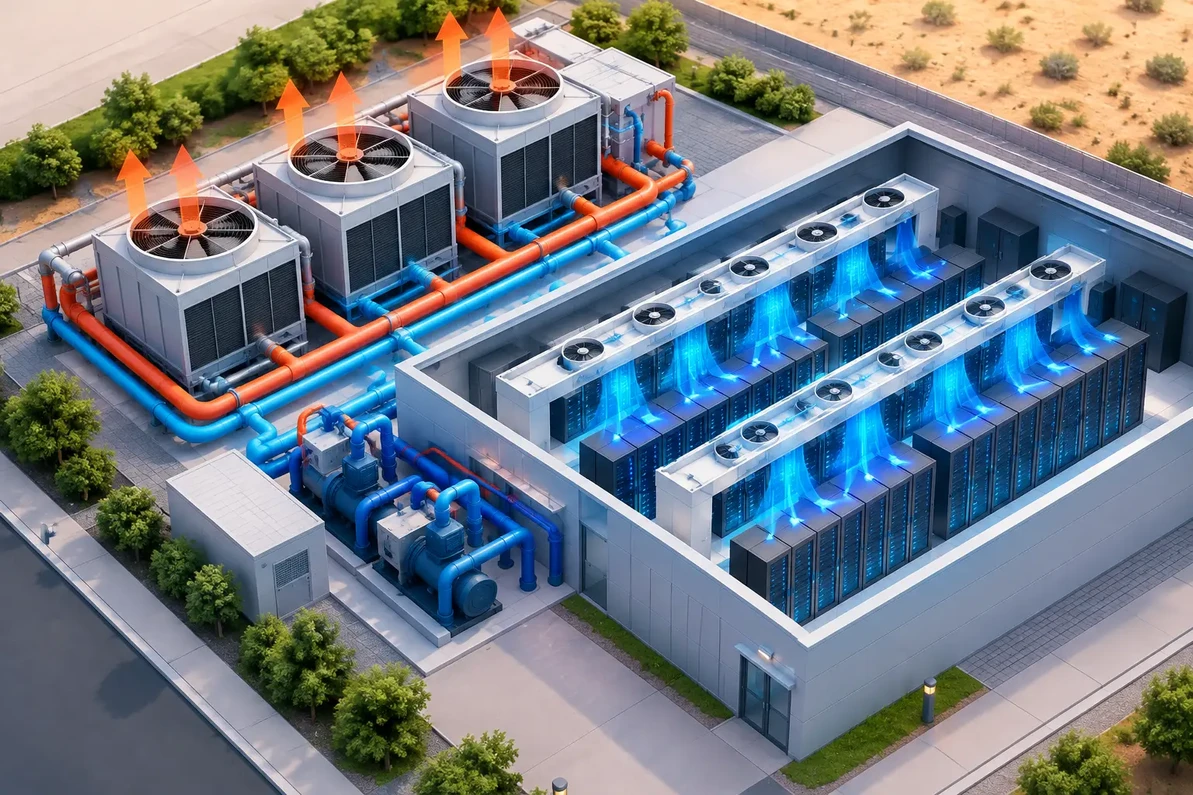
With immersion, heat is moved into fluid and then rejected through heat exchangers, dry coolers, or other secondary systems. That can reduce airborne dust exposure and stabilize chip temperatures. It also introduces fluid management, pump selection, heat exchanger sizing, and maintenance considerations that air-cooled rooms do not have.
The trade-off is straightforward. Immersion can improve thermal control and density, but first cost and system complexity are higher. For some operations, that is a smart move. For others, especially where outside air can be used effectively most of the year, a well-designed exhaust and make-up air system remains the better return.
Common design mistakes that cost uptime
The biggest errors are usually predictable. Intake openings are undersized. Exhaust fans are chosen by free-air CFM only. Filters are added without recalculating static pressure. Hot discharge air is released too close to intake points. The room is treated like general ventilation rather than process cooling.
Another common problem is planning around average weather instead of design-day conditions. A mining site may run acceptably in spring and fail in August. That is not a surprise event. It is a design miss. The system has to be evaluated at the hottest realistic operating condition, with dirty filters, full load, and real-world building leakage.
Noise is another issue operators sometimes ignore until late in the project. High airflow and high velocity can create serious sound concerns inside and outside the facility. If local restrictions matter, fan type, discharge orientation, attenuation, and building placement should be reviewed early.
What to gather before sizing a solution
If you want a meaningful ventilation recommendation, collect the operating facts first. Total kW load, miner model count, room dimensions, ceiling height, desired inlet temperature, site elevation, outdoor design temperatures, intake and discharge wall locations, and whether filtration is required all affect the answer.
Photos and simple sketches help more than most buyers expect. They show structural limitations, obstructions, mounting options, and possible recirculation risks. In retrofit projects, they also reveal whether the building can support the required intake area or whether powered make-up air and revised discharge strategy are needed.
For buyers comparing options, ask a basic engineering question: what airflow will this fan deliver at my static pressure, not at zero static. That one question eliminates many bad selections.
A good heat removal plan is not about chasing the largest fan or the lowest price. It is about matching the system to the load, the building, and the climate so miners see stable inlet air and the facility holds performance through the worst operating hours. If you are evaluating a new build or correcting an underperforming site.
Factory Fans Direct - Crypto Mining & Data Center Cooling Experts Contact Mike Miller VP Engineering at Factory Fans Direct for a FREE Project Evaluation 888-849-1233 | Mike@FactoryFansDirect.com
Recent Posts
-

AI Mega Factories Use Edmonds ecoPOWER Hybrid Ventilation
AI Mega Factories use Edmonds ecoPOWER Hybrid Turbine Ventilation because heat rejection cannot be t …4th Oct 2026 -
AI Cooling for High-Heat Facilities
A server aisle running 12°F hotter than its neighboring aisle, a crypto container recirculating exha …4th Oct 2026 -
AI Ventilation: Better Control Starts With Data
A warehouse can look adequately ventilated on paper and still have a 15-degree temperature differenc …4th Oct 2026