
Future of Immersion Cooling for Data Centers
A 30 kW rack once signaled an unusually demanding data center load. For high-density AI, HPC, and cryptocurrency mining operations, that number can now be a starting point. The future of immersion cooling is being driven by this simple engineering reality: air cannot economically carry away unlimited heat, especially where equipment must run continuously at high utilization.
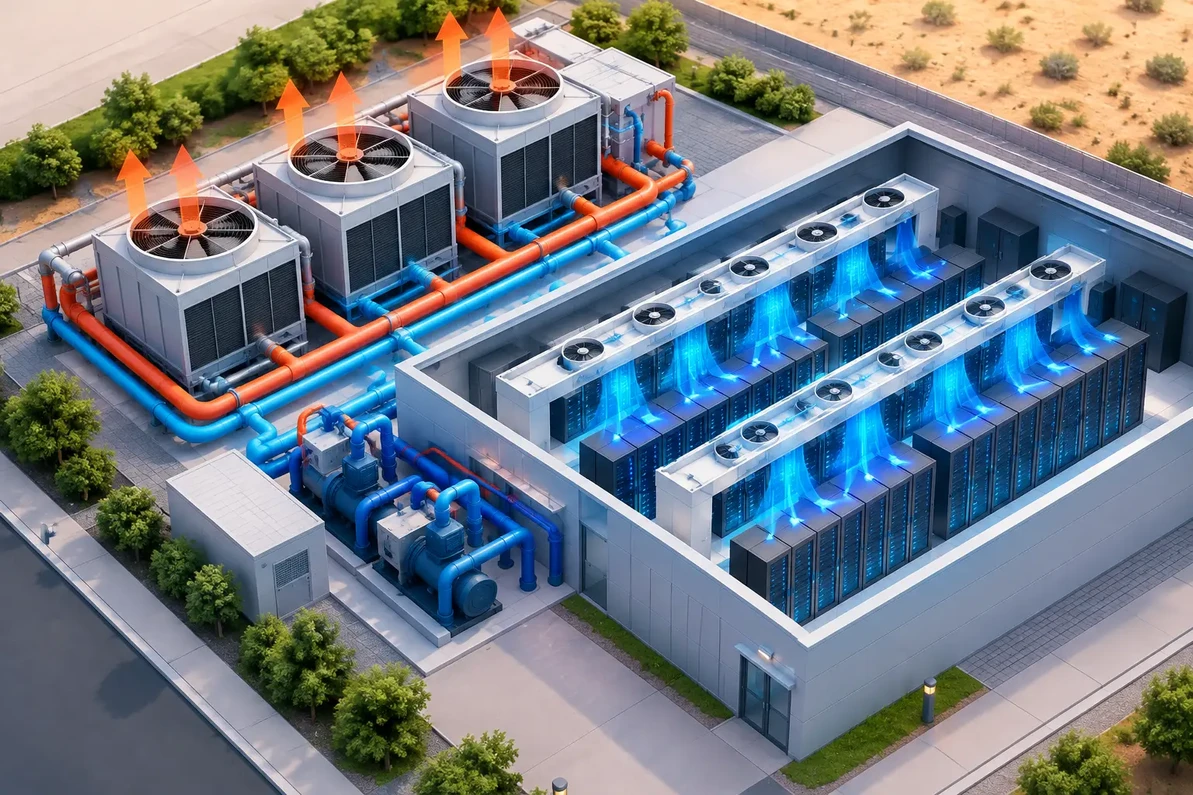
Immersion systems place servers, ASIC miners, or other electronics into a dielectric fluid that does not conduct electricity. Heat transfers directly from components into the fluid, then through a heat exchanger or cooling distribution system to an external heat-rejection loop. The result can be dramatically less dependence on high-volume server fans and traditional room air conditioning.
That does not mean ventilation disappears. It changes role. A well-designed immersion installation still needs a complete facility heat-rejection strategy, mechanical-room ventilation, make-up air where required, building exhaust, and controls that account for the full operating load.
Why the Future of Immersion Cooling Is a Heat-Rejection Question
The strongest argument for immersion cooling is not that it eliminates heat. It moves heat more efficiently from the chip to a controlled liquid loop. Every watt consumed by computing equipment ultimately becomes heat that must leave the facility. A 1 MW mining or data center load creates approximately 3.41 million BTU per hour of heat. Whether equipment is air-cooled or immersed, that heat still has to be rejected outdoors, recovered for a useful process, or transferred to another system.
This distinction matters when evaluating vendor claims and planning a retrofit. The tank may reduce equipment-level fan energy, noise, and localized hot spots, but it does not remove the need to size dry coolers, fluid coolers, cooling towers, chillers, pumps, pipework, and outdoor airflow systems correctly.
For many operators, the practical choice is between rejecting heat with outdoor air through exhaust and make-up air, rejecting it through a closed liquid loop, or using a hybrid approach. Local climate, water availability, electrical cost, available roof or yard space, operating hours, and power density all affect the answer.
Single-Phase and Two-Phase Systems Are Not the Same Decision
Most immersion projects begin with a choice between single-phase and two-phase cooling. Both can support high equipment density, but their operating requirements and service considerations are different.
Single-phase immersion uses a dielectric fluid that remains liquid. The fluid circulates through tanks and heat exchangers, carrying heat to a secondary water-glycol loop or another external heat-rejection system. It is generally the more familiar approach for mining deployments because the system architecture is comparatively straightforward, fluid management is more predictable, and equipment can be serviced without managing vapor-condensation cycles.
Two-phase immersion uses a dielectric fluid that boils at a low temperature when it contacts hot components. Vapor rises, condenses on a cooled surface, and returns to the bath as liquid. This can deliver excellent temperature uniformity and very high heat transfer, particularly for dense computing hardware. It also introduces more specialized fluids, containment requirements, component compatibility questions, and long-term service planning.
Neither method is automatically better. A large cryptocurrency operation with standardized ASIC equipment may prioritize tank capacity, field service access, fluid cost, and outdoor heat rejection. A specialized HPC deployment may place a greater value on maximum rack density and tightly controlled component temperatures. The right selection depends on the load profile and the operating team’s ability to maintain the system.
Higher Power Density Will Change Building Layouts
Traditional air-cooled data halls require aisles, containment strategies, raised-floor or overhead distribution, and substantial room volume for air movement. Immersion allows more computing capacity in less white-space area, which can improve the economics of an existing building. But it also concentrates thermal load into fewer locations.
That concentration has consequences. A facility may need larger liquid headers, redundant pumps, carefully designed electrical distribution, spill containment, equipment-handling space, and accessible paths for tank maintenance. The outdoor heat-rejection equipment can become the controlling footprint, not the server room itself.
Operators should avoid designing around tank count alone. Start with actual electrical demand, expected growth, diversity factor, maximum ambient conditions, and the desired redundancy level. Then calculate heat rejection at full load. A system that performs well during a mild 70-degree day may lose capacity during a 100-degree summer afternoon if dry cooler selection, condenser airflow, or control staging was underestimated.
Airflow Still Matters Around an Immersion Deployment
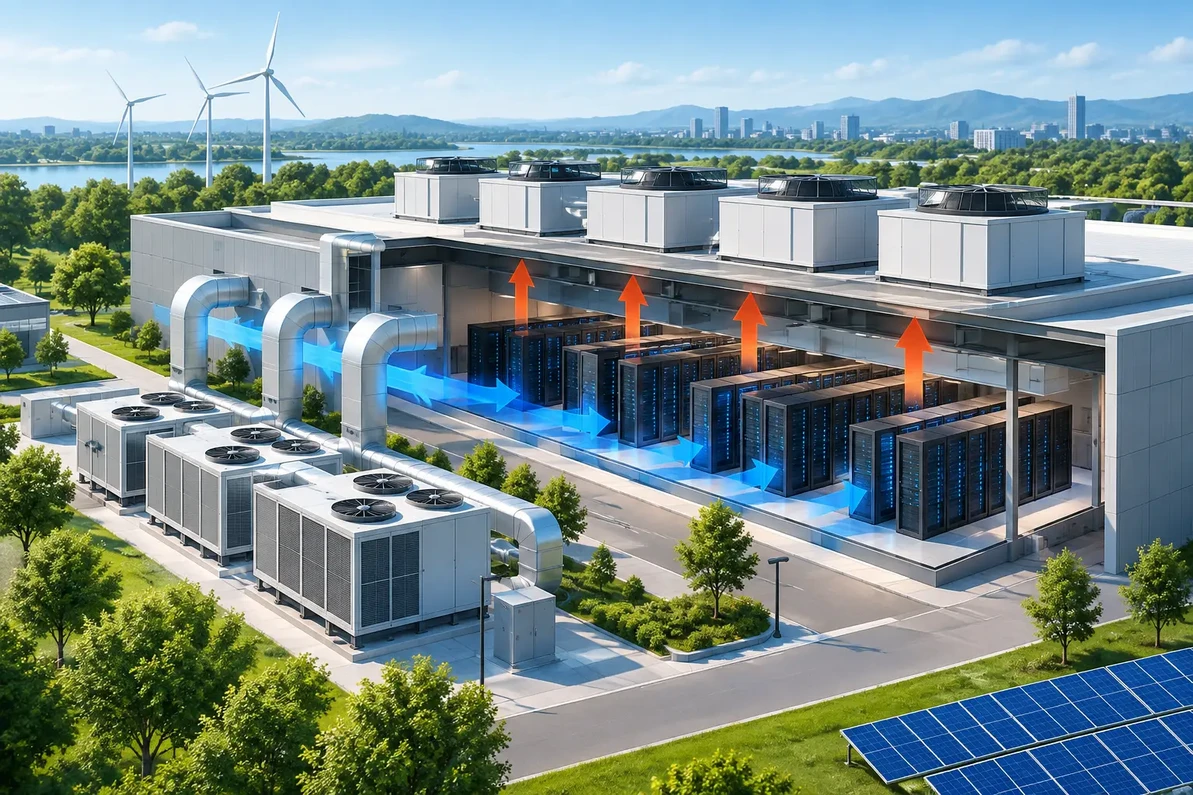
Immersion reduces the need to force air through individual servers or miners, but airflow remains an engineering requirement throughout the site. Pumps, switchgear, transformers, power supplies, heat exchangers, and supporting mechanical equipment all release heat. Electrical rooms and service areas need acceptable ambient temperatures, and outdoor heat-rejection equipment needs unrestricted discharge and intake airflow.
For crypto mining sites, this is often misunderstood. Replacing air-cooled miners with immersion tanks can reduce dust ingestion and fan-related failures at the machine level. However, the facility may still require substantial ventilation for ancillary spaces, dry-cooler yards, container enclosures, and power infrastructure. Recirculation from hot exhaust air back into heat-rejection equipment can quickly reduce capacity.
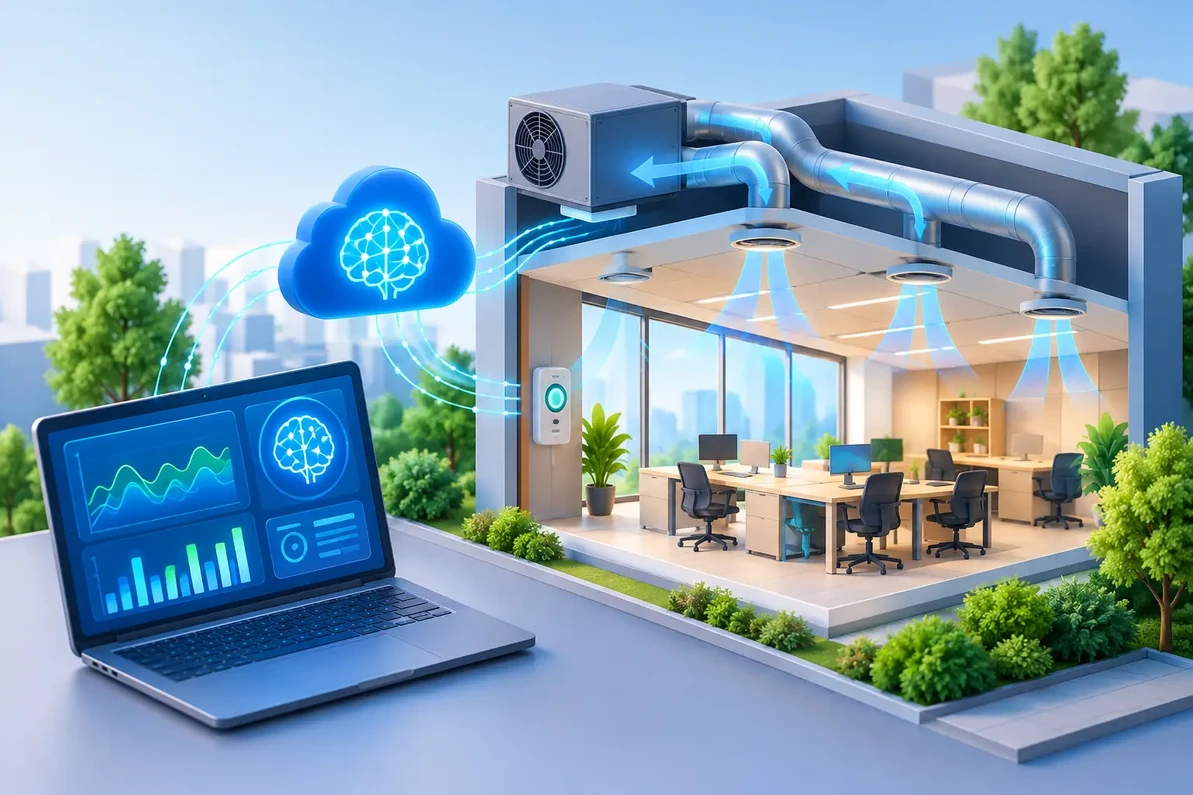
A ventilation design should evaluate CFM, static pressure, intake and discharge locations, weather protection, louvers, pressure relief, and control integration. In some applications, variable frequency drives can stage exhaust or supply equipment based on measured temperature, differential pressure, or fluid-loop conditions instead of running every fan at full speed continuously.
Energy Efficiency Claims Need a Full-System Review
Immersion cooling can lower IT fan power and reduce the energy required to maintain equipment inlet temperatures. Those are meaningful gains. The total efficiency result, however, depends on pumps, fans, fluid temperatures, heat exchanger approach temperatures, climate, and whether mechanical refrigeration is required.
A well-engineered system may use warm-water loops and dry coolers for much of the year, reducing or avoiding compressor operation. In hotter climates, peak outdoor conditions can require more fan horsepower, larger heat exchangers, adiabatic support, or supplemental chilling. Water-constrained locations may favor dry cooling even when evaporative systems offer better peak efficiency.
Heat reuse is another emerging part of the equation. Immersion systems can deliver a more consistent and useful heat stream than dispersed server exhaust. Facilities near greenhouses, process-water demands, district heating networks, or certain agricultural operations may be able to use part of that heat. The project only works when heat demand matches the computing load in timing, temperature, distance, and reliability. A heat-reuse concept should never be used to justify undersized primary heat rejection.
Serviceability and Risk Management Will Separate Good Projects From Expensive Ones
The future of immersion cooling will not be decided by thermal performance alone. It will be decided by how reliably systems can be operated, serviced, insured, and expanded.
Before specifying tanks and fluid, operators should confirm hardware compatibility, manufacturer warranty terms, fluid sampling requirements, filtration practices, leak response procedures, lifting and maintenance access, spare pump strategy, and emergency power logic. They should also identify what happens during a pump failure, a control-system fault, a utility interruption, or a sudden loss of outdoor heat-rejection capacity.
Fluid handling deserves particular attention. Dielectric fluids are not interchangeable, and contamination can affect thermal performance and long-term equipment condition. Tank lids, drip management, hose connections, filtration, labeling, storage, and technician training should be part of the initial scope rather than an afterthought.
Code compliance and local authority requirements also vary. Fire protection, electrical clearances, secondary containment, seismic requirements, chemical documentation, and rooftop equipment loading all need early review. A fast equipment purchase without coordinated mechanical, electrical, and structural design can create delays that cost more than the original cooling equipment.
Plan the Cooling System as a Facility, Not a Product
For new data center and mining capacity, immersion cooling is likely to become more common where air-cooled equipment reaches a practical limit. It is especially compelling for high-density deployments, hot or dusty environments, and operations looking to reduce machine-level fan failures and noise. It is less compelling where loads are modest, equipment changes frequently, service staff are limited, or the site cannot economically support the required liquid heat-rejection infrastructure.
The best projects begin with a site-specific heat-load model, not a generic tank recommendation. Calculate the maximum kW load, establish redundancy expectations, map the heat path from electronics to outdoors, and verify airflow around every supporting component. Then match fans, exhaust equipment, make-up air, controls, and heat-rejection equipment to the actual design conditions.
Factory Fans Direct provides free project evaluations for crypto mining and data center cooling applications. Contact Mike Miller, VP Engineering, at 888-849-1233 to review the ventilation and heat-rejection side of an immersion cooling project before equipment decisions become expensive field changes.
Factory Fans Direct - Crypto Mining & Data Center Cooling Experts Contact Mike Miller VP Engineering at Factory Fans Direct for a FREE Project Evaluation 888-849-1233 | Mike@FactoryFansDirect.com
Recent Posts
-

AI Mega Factories Use Edmonds ecoPOWER Hybrid Ventilation
AI Mega Factories use Edmonds ecoPOWER Hybrid Turbine Ventilation because heat rejection cannot be t …4th Oct 2026 -
AI Cooling for High-Heat Facilities
A server aisle running 12°F hotter than its neighboring aisle, a crypto container recirculating exha …4th Oct 2026 -
AI Ventilation: Better Control Starts With Data
A warehouse can look adequately ventilated on paper and still have a 15-degree temperature differenc …4th Oct 2026