AI Mega Factories Use Edmonds ecoPOWER Hybrid Ventilation
AI Mega Factories use Edmonds ecoPOWER Hybrid Turbine Ventilation because heat rejection cannot be treated as an afterthought when computing density, power demand, and uptime expectations continue to climb. Large AI training campuses, inference facilities, advanced manufacturing plants, and high-load crypto operations need a ventilation strategy that works during changing weather, changing internal heat loads, and changing operating schedules.
The Edmonds ecoPOWER Hybrid Rooftop Ventilator is designed for that type of operating environment. It combines wind-driven turbine ventilation with a high-performance EC brushless DC motor for continuous powered operation when natural wind energy is not enough. This is a true hybrid ventilator, not a solar-powered fan. When wind conditions are favorable, the ventilator operates through wind energy. When controlled exhaust is required, the EC motor provides dependable mechanical assistance.
For facility teams working toward LEED, net-zero, or practical energy-reduction targets, this operating concept matters. It gives the building a path to passive exhaust when conditions support it without sacrificing ventilation performance when conditions do not.
Why AI Mega Factories Need a Hybrid Roof Exhaust Strategy
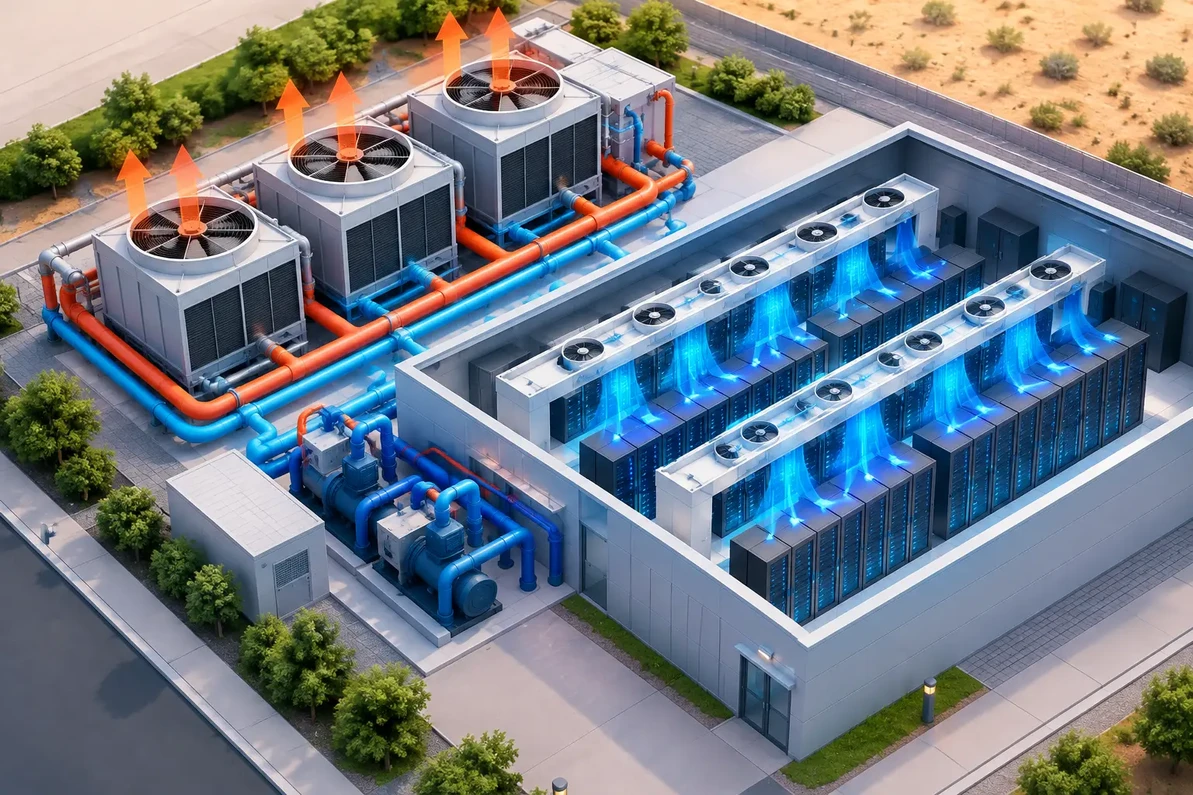
AI mega factories create concentrated heat loads that can strain every part of the building envelope. GPU clusters, power distribution equipment, UPS rooms, transformers, network hardware, battery systems, and cooling infrastructure all add sensible heat. Even facilities that use liquid cooling, immersion cooling, or direct-to-chip cooling still need to manage heat in electrical rooms, support spaces, corridors, service zones, and large-volume building areas.
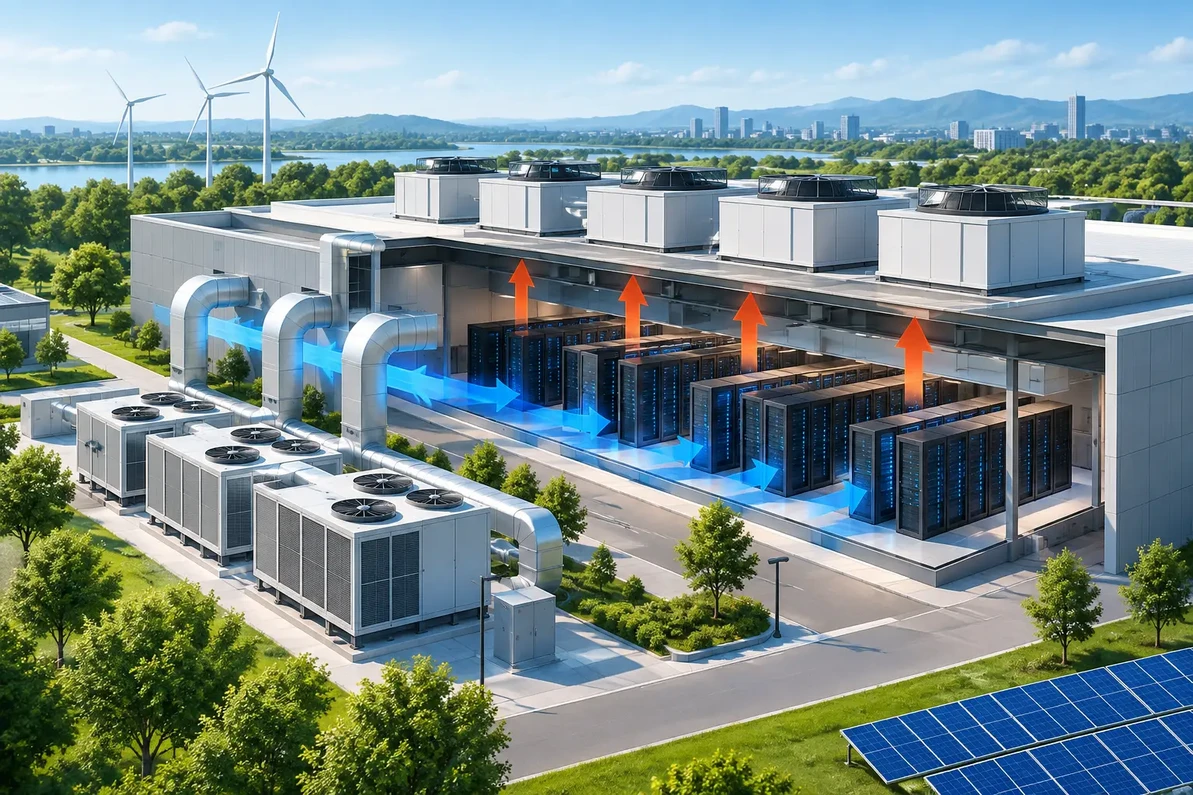
Mechanical cooling handles part of the load, but it is not always the only answer. Roof-mounted exhaust can remove accumulated hot air, reduce heat stratification, and support pressure management when designed as part of the total airflow plan. The objective is not simply to install more fans. The objective is to establish a controlled air path from make-up air intake through the heat-producing zone and out through properly selected roof exhaust equipment.
That distinction is critical. Exhaust capacity without make-up air can pull a facility negative, increase door resistance, draw untreated outdoor air through unwanted openings, and reduce actual fan performance. Likewise, a roof turbine selected only by throat size or catalog appearance may not deliver the CFM required at the site’s static pressure and prevailing wind conditions.
Edmonds ecoPOWER addresses a common gap between passive ventilation and fully powered roof exhaust. Conventional wind turbines can provide useful airflow when wind is available, but their output naturally changes with weather. Fully powered exhaust fans provide predictability, but they consume electrical energy whenever they operate. A hybrid system uses both operating modes to better match the real conditions at the roofline.
How Edmonds ecoPOWER Hybrid Turbine Ventilation Works
The ecoPOWER ventilator uses aerodynamic turbine operation to convert wind energy into exhaust airflow. In favorable wind conditions, this supports passive, low-energy ventilation. Its EC brushless DC motor can provide continuous powered rotation when wind speed falls below what the facility requires or when a control strategy calls for active ventilation.
This dual-mode operation is especially useful in facilities where roof heat gain and internal heat generation do not follow a simple schedule. A data center may experience changing IT loads. A crypto mining facility may ramp equipment by market conditions, curtailment programs, or electrical capacity. A manufacturing plant may run several shifts one week and reduced production the next. The ventilation equipment must respond to the actual building condition, not just the calendar.
EC motor technology also supports efficient speed control. Rather than treating ventilation as an on-or-off function, a well-designed system can modulate exhaust performance to maintain target temperatures, pressure relationships, or air-change requirements. The appropriate control sequence depends on the application, available sensors, make-up air design, and whether the exhaust system is serving general heat removal, equipment rooms, process air, or a combination of these needs.
The Engineering Question Is Not Just CFM
CFM is essential, but it is only one part of the selection process. AI facilities and other high-heat operations require a review of total heat load, roof geometry, ceiling height, building leakage, intake location, pressure losses, and operational redundancy. A fan that moves high airflow in free air may produce substantially less airflow once installed against real system resistance.
A proper evaluation should examine the following conditions:
- Internal sensible heat from servers, mining rigs, transformers, lighting, motors, and production equipment
- Required exhaust CFM at the estimated static pressure, not only free-air performance
- Make-up air quantity, intake velocity, filtration, weather protection, and air distribution
- Roof curbs, duct transitions, backdraft protection, and structural installation requirements
- Control requirements, including thermostats, pressure sensors, variable-speed controls, and building automation interfaces
- Redundancy planning for critical spaces where a single ventilation failure could create a thermal event
For some AI facilities, ecoPOWER units may be a valuable part of the general building exhaust strategy while precision cooling systems handle the white space. For other projects, especially warehouses, electrical support buildings, enclosures, equipment shelters, or mixed-use industrial campuses, hybrid rooftop ventilation may carry a larger share of the heat-removal load.
The application determines the answer. A high-density server hall with strict temperature and humidity tolerances should not rely on roof ventilation alone. A large support area with intermittent heat buildup may benefit substantially from hybrid exhaust combined with properly sized make-up air. Engineering the system around the actual heat map is the difference between useful ventilation and expensive roof hardware that does not solve the problem.
Better Energy Decisions Without Giving Up Control
Energy efficiency claims must be connected to operating conditions. A wind-driven mode can reduce electrical demand when ambient conditions and wind speed support turbine operation. The powered EC mode maintains ventilation when passive airflow is insufficient. That practical balance can reduce unnecessary motor runtime compared with an exhaust strategy that runs at full speed regardless of weather.
This is also why ecoPOWER is relevant to net-zero building conversations. Net-zero design is not achieved by applying a label to a product. It requires reduced loads, measured operating performance, appropriate controls, and a building strategy that uses available natural energy where possible. Hybrid ventilation supports that approach by making use of wind energy while retaining mechanical performance when the facility needs it.
For architects and consulting engineers, the specification discussion should include required airflow range, design wind assumptions, motor electrical characteristics, control method, sound expectations, curb compatibility, roof layout, and maintenance access. For owners and operations leaders, the conversation should focus on delivered CFM, energy use, control response, maintenance intervals, and how the equipment supports continuity of operations.
Where Hybrid Rooftop Ventilation Fits Best
Edmonds ecoPOWER is well suited to large-volume commercial and industrial structures where heat rises and roof-level exhaust can support a clear airflow path. Typical applications include AI support buildings, warehouse operations, manufacturing plants, distribution centers, agricultural facilities, equipment enclosures, electrical rooms, and crypto mining buildings.
It can also be effective where conventional roof exhaust is needed but owners want a lower-energy operating profile when wind conditions are favorable. However, it is not a substitute for a complete cooling design where critical equipment requires tightly controlled supply-air temperature, humidity, particulate control, or redundancy at the rack level.
The strongest projects combine equipment selection with a complete ventilation review. That includes identifying heat sources, confirming airflow direction, designing make-up air, evaluating static pressure, and selecting controls that respond to actual conditions. AI-enabled monitoring can improve this further by trending temperatures, fan status, pressure, weather conditions, and equipment load so the facility team can identify performance changes before they become downtime risks.
Factory Fans Direct provides free project evaluation for commercial and industrial ventilation applications, including AI data center support spaces, warehouses, manufacturing, and crypto mining operations. Contact Mike Miller, VP Engineering, at 888-849-1233 for equipment selection and ventilation design guidance.
The practical next step is to start with the heat load and airflow path, then select roof ventilation that can perform in both favorable and unfavorable weather. That is how a hybrid turbine becomes a measurable operating asset rather than just another item on the roof plan.
Factory Fans Direct/Edmonds US - Hybrid Commercial & Industrial Ventilation & Cooling Experts | Contact Mike Miller VP Engineering at Factory Fans Direct for a FREE Project Evaluation 888-849-1233 | Mike@FactoryFansDirect.com
Recent Posts
-

AI Mega Factories Use Edmonds ecoPOWER Hybrid Ventilation
AI Mega Factories use Edmonds ecoPOWER Hybrid Turbine Ventilation because heat rejection cannot be t …4th Oct 2026 -
AI Cooling for High-Heat Facilities
A server aisle running 12°F hotter than its neighboring aisle, a crypto container recirculating exha …4th Oct 2026 -
AI Ventilation: Better Control Starts With Data
A warehouse can look adequately ventilated on paper and still have a 15-degree temperature differenc …4th Oct 2026