
AI Ventilation: Better Control Starts With Data
A warehouse can look adequately ventilated on paper and still have a 15-degree temperature difference between the loading dock and the back storage bays. A crypto mining container can have high-CFM exhaust fans but still recirculate hot discharge air into intake paths. A greenhouse can meet an air-exchange target while creating crop-level temperature swings that affect plant development. AI ventilation is intended to solve these operational gaps by using live conditions, equipment feedback, and control logic to make better airflow decisions.
The key word is decisions. Artificial intelligence does not replace ventilation engineering, fan curves, static-pressure calculations, make-up air requirements, or a properly designed discharge path. It adds an operating layer that can respond to changing heat loads, weather, occupancy, equipment status, and energy conditions faster than a fixed thermostat or manual fan switch.
What AI Ventilation Actually Does
AI ventilation combines sensors, controls, and mechanical equipment into a system that can interpret conditions and adjust operation. Depending on the application, the system may monitor dry-bulb temperature, relative humidity, dew point, differential pressure, carbon dioxide, particulate levels, power consumption, motor speed, vibration, and inlet-to-outlet temperature rise.
That data is useful only when it produces an appropriate command. An AI-enabled controller may ramp variable frequency drives, stage exhaust fans, modulate motorized intake louvers, control make-up air units, adjust evaporative cooling, or send an alarm when actual performance no longer matches the expected operating pattern.
A conventional control sequence might start all exhaust fans at 85°F. An AI-supported sequence can recognize that outside air is already hot, that one production line has shut down, that rooftop wind is reducing natural draft, and that a specific zone is rising faster than the rest of the building. It can then run the right fan bank at the right speed instead of treating the entire facility as one temperature zone.
This distinction matters because ventilation equipment is often oversized in practice to compensate for poor control, uncertain load assumptions, or difficult airflow paths. Better data can reduce unnecessary runtime, but it cannot correct a fan selected below its required CFM at operating static pressure.
Start With Airflow Engineering, Not Software
The strongest AI ventilation projects begin with a mechanical baseline. Before selecting sensors or a control platform, define the heat load, contaminant load, desired air changes, building pressure target, intake and discharge locations, and operating schedule. For data centers and crypto mining operations, calculate equipment heat rejection and confirm whether air cooling, immersion cooling, hydro cooling, containment, or a combined approach is appropriate.
Fan performance must be evaluated at real static pressure, not free-air CFM. Louvers, light traps, filters, dampers, ductwork, guards, roof curbs, and restrictive wall openings all add resistance. A fan rated at 30,000 CFM in open air may move substantially less once installed in a system. If an AI controller responds to rising temperature by increasing fan speed, but the intake opening is undersized, the result may be more noise and motor energy with limited cooling improvement.
Pressure control is equally critical. Excessive negative pressure can pull unconditioned air, dust, odors, and moisture through unwanted building openings. Too much positive pressure can interfere with exhaust performance or push humid air into wall cavities. In cultivation facilities, pressure relationships between rooms can be as important as total airflow because odor containment, pathogen management, and environmental consistency are operational requirements.
AI works best when it is given a system that has been properly matched: fan capacity, inlet area, discharge path, motor type, controls, and thermal load. It is a high-value control tool, not a substitute for mechanical design.
Where AI Ventilation Produces the Most Value
Data centers and crypto mining cooling
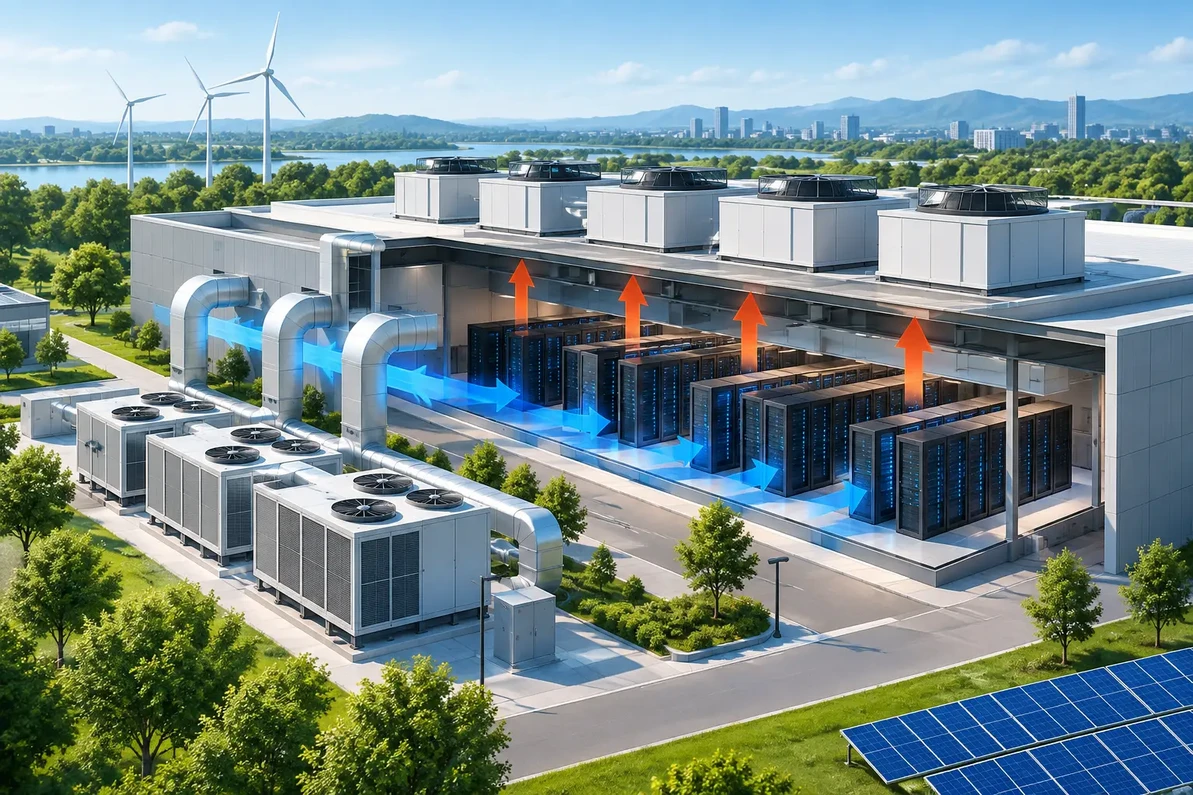
Data centers and crypto mining sites face rapidly changing thermal loads. Server utilization, miner status, ambient temperature, filter loading, and fan failures can change conditions in minutes. AI-based monitoring can compare rack or aisle temperatures with supply and exhaust temperatures, then adjust fan speed, containment controls, or supplemental cooling before a hot spot becomes an uptime event.
For air-cooled mining installations, the controller should also account for recirculation. More exhaust CFM is not automatically better if hot air is short-circuiting back to the inlet side. Sensor placement at intakes, discharge areas, and equipment rows reveals whether the cooling problem is insufficient capacity, poor separation, restrictive intake area, or localized equipment concentration.
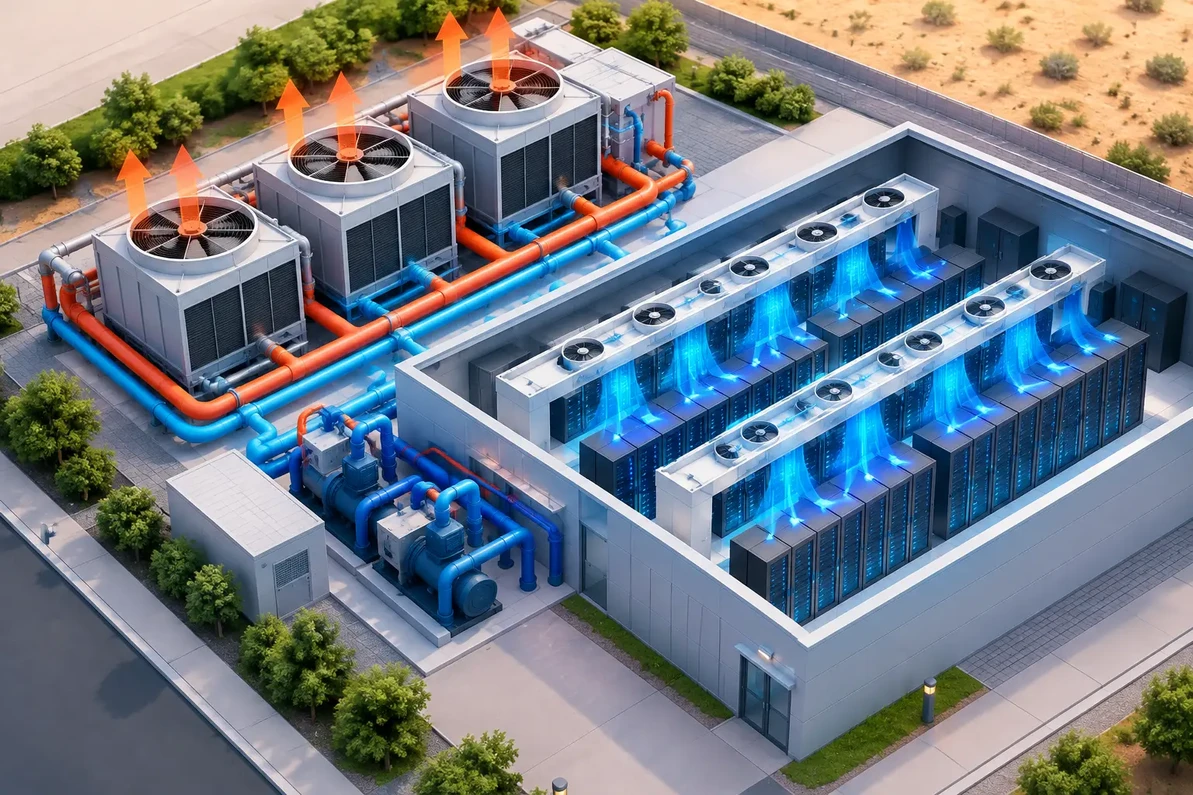
Immersion and hydro cooling can reduce the amount of heat handled directly by room air, but they do not eliminate heat rejection. The thermal load moves to heat exchangers, fluid loops, and external rejection equipment. AI controls can coordinate those systems based on fluid temperature, ambient conditions, and power demand. The right strategy depends on density, climate, available water, operating cost, and maintenance capabilities.
Warehouses, manufacturing, and distribution
Industrial buildings frequently experience uneven loads from process equipment, forklift traffic, dock doors, welding, ovens, packaging lines, or seasonal product storage. Fixed-speed exhaust systems commonly operate at one setting regardless of whether the facility is at full production or reduced activity.
AI ventilation can use zone temperatures, occupancy signals, production status, and outdoor conditions to stage equipment more precisely. A VFD-driven exhaust fan may run at a lower speed during light load periods and ramp when process heat rises. Because fan energy generally drops sharply as speed is reduced, this approach can provide meaningful electrical savings when the system is designed for variable operation.
There is a trade-off. Lower speed is beneficial only while the facility still meets air quality, heat removal, and pressure requirements. Controls should include minimum ventilation rates, high-temperature overrides, safety interlocks, and manual operating capability. Facility teams need to understand the sequence of operation rather than treat the system as a black box.
Greenhouses and specialty cultivation
Greenhouse ventilation is affected by solar gain, outside temperature, humidity, wind, crop transpiration, shade systems, and evaporative cooling. Cannabis and hemp cultivation add tighter environmental targets, odor control requirements, and often room-by-room pressure management.
AI control can use trend data to anticipate rather than merely react to temperature and humidity movement. For example, it may open venting stages earlier when solar radiation and leaf-zone temperature indicate a fast afternoon rise. It can also coordinate exhaust, intake shutters, circulation fans, dehumidification, and supplemental cooling to avoid a control conflict where one piece of equipment adds moisture while another works harder to remove it.
Sensor accuracy and placement are decisive. A sensor mounted near a wet wall, heater discharge, roof peak, or direct sunlight will produce misleading data. Crop-zone sensing, calibrated instruments, and multiple measurement points provide a much better operating picture than one thermostat at the end of the building.
Equipment That Makes Intelligent Control Possible
Not every ventilation product needs a complex AI platform. The appropriate level of control depends on the consequences of temperature drift, energy cost, staffing, and system complexity. Still, several equipment choices make data-driven operation more effective:
- EC motors and VFD-compatible motors for controllable fan speed
- Variable frequency drives sized and programmed for the motor and load
- Motorized intake louvers or dampers that open in coordination with exhaust
- Reliable temperature, humidity, pressure, airflow, and power sensors
- Make-up air equipment that prevents damaging negative pressure
- A control panel with local override, alarms, data logging, and remote access
The control architecture should fail safely. If communications drop, sensor values become implausible, or the AI service is unavailable, the ventilation system needs a defined fallback sequence. High-temperature and life-safety functions should never depend solely on cloud access or an automated model.
AI Ventilation and Net-Zero Operating Goals
Energy-efficient ventilation is not simply a matter of using fewer watts. It is the ability to deliver the required airflow and thermal performance with the least unnecessary energy. Variable-speed control, demand-based staging, and fault detection can support that goal when the underlying system is correctly designed.
For rooftop applications, Edmonds ecoPOWER Hybrid ventilators offer a different but complementary strategy. These units combine wind-driven operation with a high-performance EC brushless DC motor for continuous operation. They are not solar powered. Their hybrid design allows wind operation when conditions support it while maintaining powered ventilation when required, making them suitable for LEED and Net-Zero-focused projects where dependable airflow still matters.
For AI-controlled facilities, the useful question is not whether every component has artificial intelligence. The useful question is whether the complete system reduces waste while preserving temperature control, pressure balance, equipment uptime, and occupant or process protection.
A Practical Path to a Better System
Begin with a project evaluation that documents the facility layout, heat sources, current equipment, electrical availability, operating schedules, and performance complaints. Measure temperatures and pressures in more than one location. Review fan cut sheets, motor data, curb or wall openings, intake restrictions, and discharge placement before assuming the problem is a controls problem.
Then establish measurable targets: maximum allowable equipment inlet temperature, desired room differential pressure, humidity range, air-change requirement, motor runtime, and energy use per operating hour. Those targets give the AI control sequence a real job to perform and give the facility team a way to verify results.
Factory Fans Direct provides commercial and industrial ventilation design guidance, factory-direct equipment options, and free project evaluations for facilities that need ventilation matched to actual heat load and static pressure. Contact Mike Miller, VP Engineering, at 888-849-1233 for a FREE Project Evaluation.
The best AI ventilation system is not the one with the most dashboards. It is the one that keeps the air moving where it must, identifies trouble before it becomes downtime, and gives the operator clear control over what happens next.
Factory Fans Direct/Edmonds US - Hybrid Commercial & Industrial Ventilation & Cooling Experts | Contact Mike Miller VP Engineering at Factory Fans Direct for a FREE Project Evaluation 888-849-1233 | Mike@FactoryFansDirect.com
Recent Posts
-

AI Mega Factories Use Edmonds ecoPOWER Hybrid Ventilation
AI Mega Factories use Edmonds ecoPOWER Hybrid Turbine Ventilation because heat rejection cannot be t …4th Oct 2026 -
AI Cooling for High-Heat Facilities
A server aisle running 12°F hotter than its neighboring aisle, a crypto container recirculating exha …4th Oct 2026 -
AI Ventilation: Better Control Starts With Data
A warehouse can look adequately ventilated on paper and still have a 15-degree temperature differenc …4th Oct 2026