AI Cooling for High-Heat Facilities
A server aisle running 12°F hotter than its neighboring aisle, a crypto container recirculating exhaust, or a greenhouse losing crop consistency at mid-afternoon all point to the same operational problem: cooling is reacting too slowly or operating without enough information. AI cooling gives facility operators a way to make ventilation, exhaust, make-up air, and mechanical cooling respond to actual conditions instead of fixed schedules and manual guesses.
For high-heat facilities, the opportunity is not simply to add artificial intelligence to a thermostat. The practical goal is to measure heat load, airflow, static pressure, outdoor conditions, and equipment status, then adjust the system before temperature excursions become downtime, lost production, or damaged equipment.
What AI Cooling Actually Controls
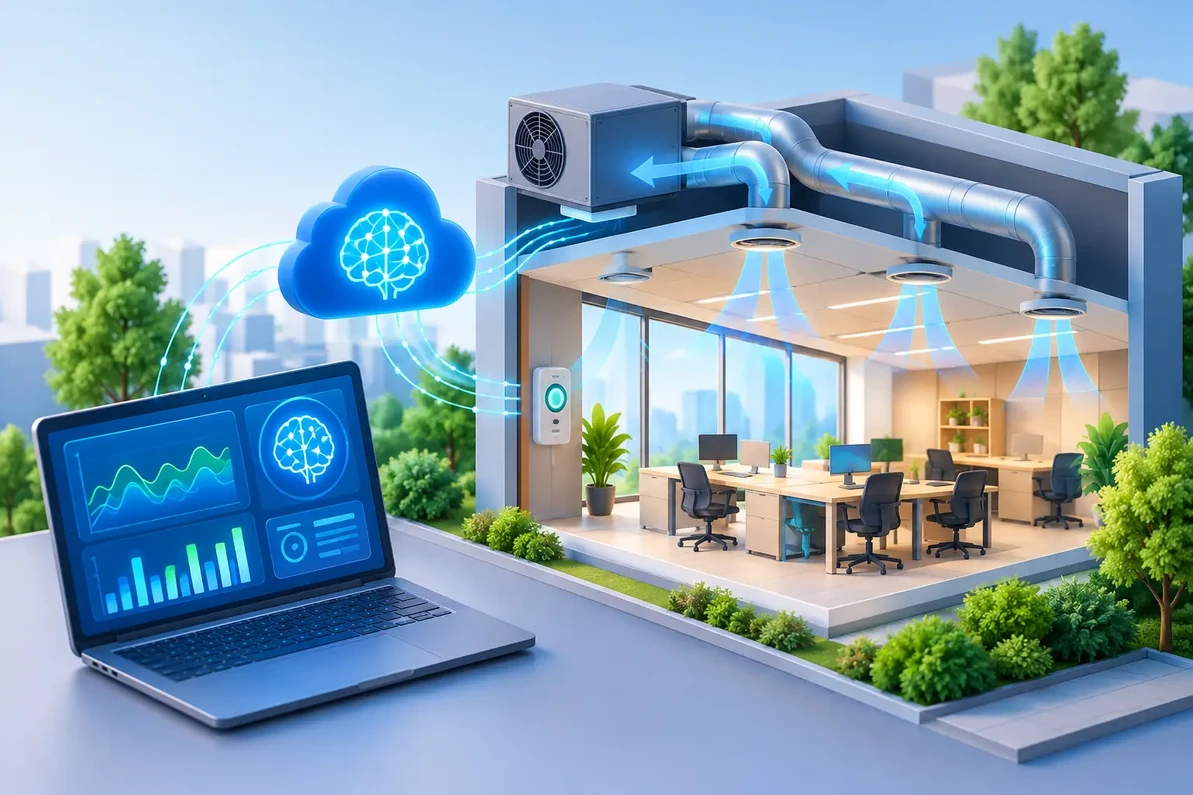
AI cooling is a control strategy, not a single fan, chiller, or software product. It combines field data with automated decision-making. Sensors report conditions such as dry-bulb temperature, humidity, differential pressure, return-air temperature, rack inlet temperature, motor current, fan speed, and power consumption. The control platform uses those inputs to determine how ventilation equipment should operate.
In a well-designed installation, AI may command variable frequency drives, EC motors, dampers, evaporative equipment, exhaust fans, make-up air units, circulation fans, or mechanical cooling stages. It can increase exhaust when a heat plume develops, slow fans when ambient conditions improve, or identify a failing motor before airflow performance drops below the required level.
The distinction matters. A smart controller cannot correct undersized ductwork, a blocked intake, poor containment, or an exhaust fan selected without accounting for static pressure. Artificial intelligence can optimize the equipment it controls, but the airflow system still has to be engineered for the required CFM, pressure, temperature range, and duty cycle.
Why Fixed-Speed Cooling Wastes Capacity
Many facilities still operate cooling equipment on simple on-off controls or fixed fan speeds. That approach may be adequate for a lightly loaded building with stable conditions. It is rarely efficient for data centers, crypto mining sites, manufacturing floors, cultivation facilities, or warehouses where heat loads change by hour, season, production schedule, and outdoor weather.
A fixed-speed exhaust fan may move enough air during peak heat, but it can over-ventilate during lower-load periods. That wastes fan energy and can pull in excessive outdoor air that must later be conditioned. On the other hand, a fan that is sized only for average conditions may allow heat accumulation during a hot day, a production surge, or an equipment failure.
AI-based controls can work from a performance target rather than a rigid speed setting. For example, a system can maintain a target equipment inlet temperature, a maximum room temperature, or a specific pressure relationship between hot and cold zones. When conditions change, the controls can ramp equipment in stages rather than running every component at full output.
Fan affinity laws make variable-speed control particularly valuable. A modest reduction in fan speed can create a significant reduction in electrical demand, although the exact savings depend on the system curve, motor efficiency, controls, and static pressure. The objective is not to run fans slowly at all times. It is to run the correct equipment at the correct speed for the actual load.
Applying AI Cooling to Data Centers and Crypto Mining
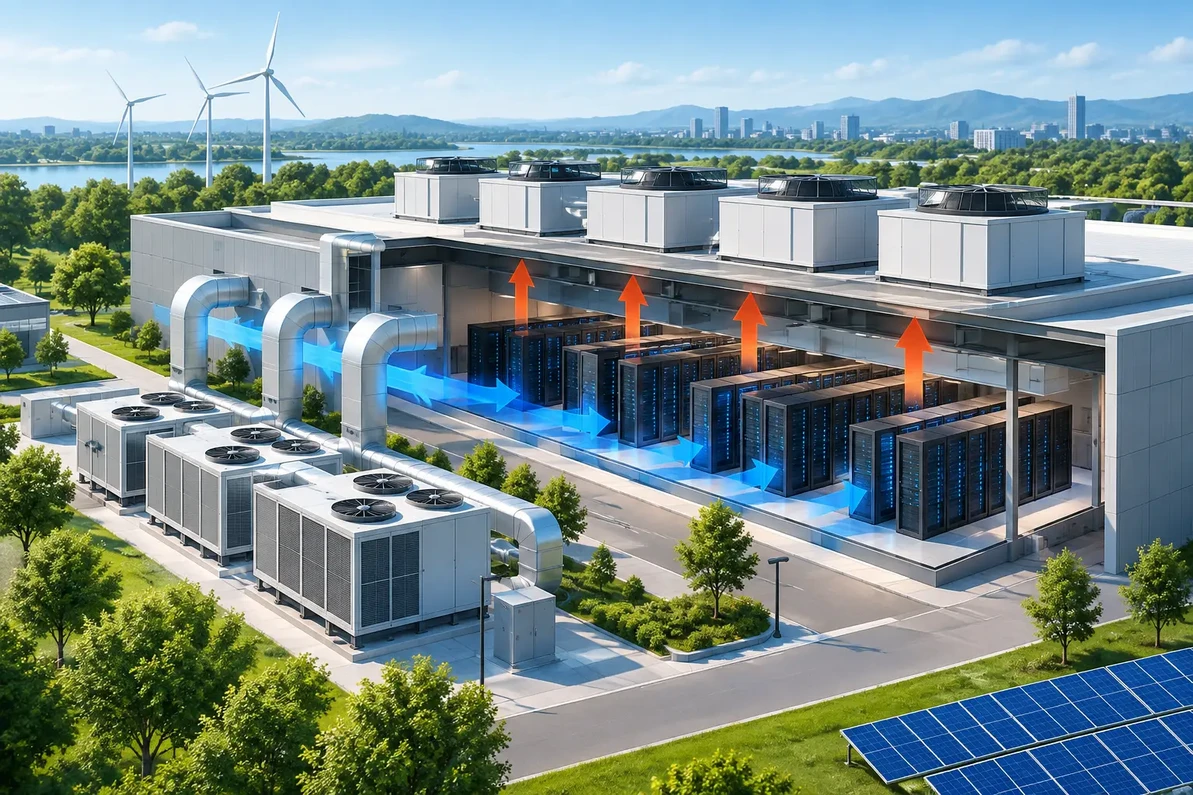
Data centers and crypto mining operations are among the strongest applications for intelligent cooling because electrical power becomes heat continuously. Every kilowatt consumed by IT hardware or mining equipment must ultimately be rejected from the space through air cooling, liquid cooling, immersion cooling, or a combination of methods.
For air-cooled mining facilities, the first engineering question is heat rejection. A site with a 1 MW electrical load produces approximately 3.412 million BTU per hour of heat. That heat load drives the required airflow, intake area, exhaust capacity, filtration approach, equipment layout, and backup strategy. Software can refine operation, but it cannot reduce the fundamental heat generated by the load.
AI cooling can continuously compare intake temperature, exhaust temperature, rack or ASIC inlet temperatures, outdoor conditions, and fan power. It can identify when an exhaust bank is not producing expected airflow, when hot exhaust is being pulled back into intakes, or when a particular row has become a thermal bottleneck.
In a containerized crypto mine, controls may vary high-temperature exhaust fan speed based on inlet temperature and miner load while maintaining safe operating limits. In a data center, the system may coordinate containment, CRAC or CRAH units, economizer operation, liquid cooling loops, and fan arrays. The best approach depends on local climate, water availability, electrical cost, redundancy requirements, and the acceptable operating envelope of the equipment.
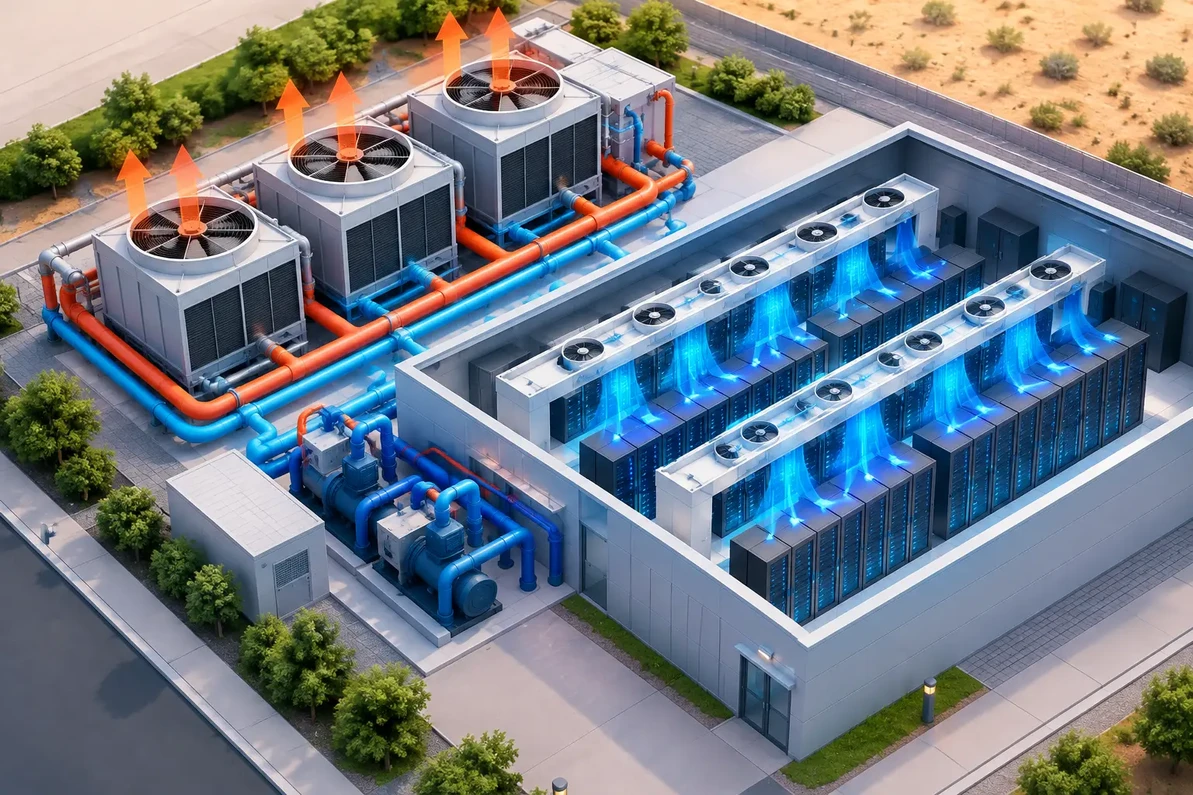
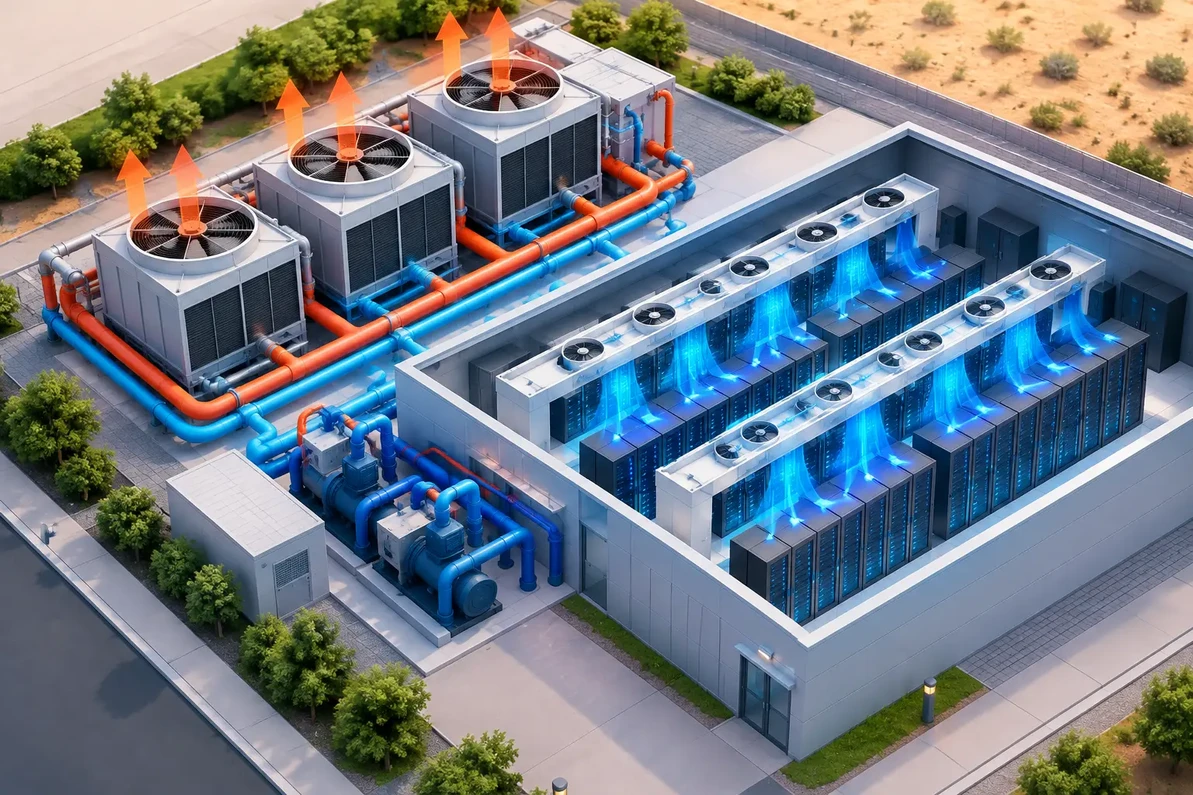
Immersion and hydro cooling can reduce dependence on high-volume room airflow, but they introduce different design requirements. Heat exchangers, pumps, fluid compatibility, filtration, maintenance access, leak management, and heat-rejection equipment all require careful selection. AI controls are useful here as well, particularly for monitoring fluid temperature, pump performance, heat exchanger approach temperature, and dry cooler operation.
AI Cooling for Warehouses, Manufacturing, and Cultivation
Warehouses and manufacturing facilities often have uneven heat loads. Loading doors open, production equipment cycles, welding or process areas create localized heat, and roof heat gain rises sharply in summer. An AI-assisted ventilation strategy can combine roof exhaust, wall exhaust, HVLS fans, make-up air, and zone sensors to avoid treating the entire building as one uniform space.
The system should not rely only on a thermostat mounted in an office or at a convenient wall location. Sensor placement affects every decision the controls make. Temperature sensors near the ceiling may reveal stratification, while sensors in the occupied zone show actual worker conditions. Differential pressure sensors can confirm whether make-up air is keeping pace with exhaust. Motor feedback can show whether a fan is operating, even when a belt issue or obstruction has reduced its delivered airflow.
In greenhouse, cannabis, and hemp cultivation environments, AI cooling must account for both temperature and plant response. Ventilation affects humidity, vapor pressure deficit, disease pressure, CO2 retention, and odor-control performance. A control sequence that aggressively exhausts heat may also exhaust enriched air or destabilize humidity if it is not coordinated with dehumidification and make-up air.
This is where a staged strategy is more effective than a single temperature setpoint. Circulation fans may run first to reduce microclimates. Roof vents or low-energy exhaust may follow. Evaporative cooling, supplemental mechanical cooling, or dehumidification can be brought on only when outdoor conditions and crop targets require it. The right sequence depends on the facility, crop stage, local climate, and installed equipment.
Start With Airflow Engineering, Then Automate
The most reliable AI cooling projects begin with a physical review of the facility. Before selecting controls, establish the real heat load, desired indoor conditions, available intake and exhaust paths, static pressure, equipment duty cycle, and electrical capacity. Review where heat enters, where it collects, and whether exhausted air can return to the building.
A productive evaluation typically examines four areas:
- Heat load in BTU per hour or kilowatts, including process equipment, lighting, miners, servers, solar gain, and people.
- Airflow requirements in CFM, including required air changes, temperature-rise calculations, and fan performance at actual static pressure.
- Air distribution, including intake placement, hot-spot locations, duct losses, containment, louvers, dampers, and make-up air paths.
- Controls architecture, including sensors, VFDs, EC motor compatibility, alarms, remote access, fail-safe operation, and manual override.
The manual override requirement deserves attention. Automated controls should improve response, not leave operators powerless during a network interruption, sensor fault, or commissioning issue. Critical sites need local control capability, alarm escalation, documented sequences of operation, and practical maintenance access.
The Trade-Offs Behind Smarter Cooling
AI cooling can reduce energy waste and improve thermal stability, but it adds sensors, programming, commissioning, and ongoing verification. A poorly calibrated sensor can drive the wrong decision with great confidence. Data quality, cybersecurity, network reliability, and technician training all matter.
There is also a point where advanced controls are unnecessary. A small, stable storage space with a simple exhaust requirement may benefit more from correctly sized ventilation and a dependable thermostat than from a complex analytics platform. The value increases as heat load, energy cost, operational risk, and environmental variability increase.
For larger facilities, the strongest result usually comes from pairing intelligent controls with properly selected fans, drives, make-up air, and heat-rejection equipment. Factory Fans Direct evaluates the full airflow path so controls are working with the ventilation design, not trying to overcome its limitations.
Factory Fans Direct - Crypto Mining & Data Center Cooling Experts. Contact Mike Miller, VP Engineering, for a FREE Project Evaluation at 888-849-1233 or Mike@FactoryFansDirect.com.
The next cooling upgrade should begin with measured conditions, not a generic equipment schedule. When the heat load, airflow path, and control logic agree, operators gain a system that protects equipment while using energy with far more discipline.
Factory Fans Direct - Commercial & Industrial Ventilation & Cooling Experts | Contact Mike Miller VP Engineering at Factory Fans Direct for a FREE Project Evaluation 888-849-1233 | Mike@FactoryFansDirect.com
Recent Posts
-

AI Mega Factories Use Edmonds ecoPOWER Hybrid Ventilation
AI Mega Factories use Edmonds ecoPOWER Hybrid Turbine Ventilation because heat rejection cannot be t …4th Oct 2026 -
AI Cooling for High-Heat Facilities
A server aisle running 12°F hotter than its neighboring aisle, a crypto container recirculating exha …4th Oct 2026 -
AI Ventilation: Better Control Starts With Data
A warehouse can look adequately ventilated on paper and still have a 15-degree temperature differenc …4th Oct 2026