Data Center Cooling That Matches the Heat Load
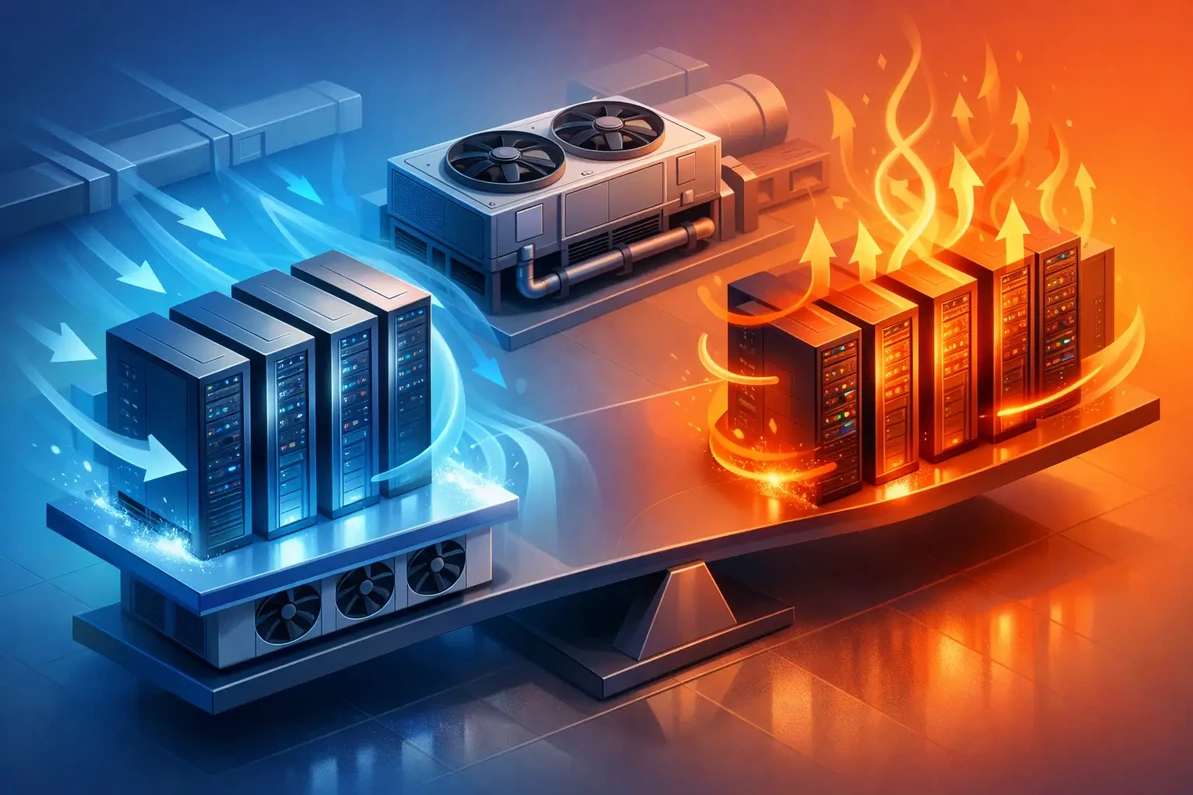
A data center can have plenty of installed cooling capacity and still run hot at the racks. The usual cause is not simply a lack of tonnage or CFM. It is a mismatch between the actual heat load, the air path, equipment layout, fan static-pressure capability, and the control strategy. For conventional IT rooms, high-density compute clusters, and crypto mining operations, data center cooling must move heat out of the equipment zone reliably, not merely circulate air around it.
The engineering question is straightforward: where is the heat generated, where does it accumulate, and what is the lowest-resistance path to remove it? Getting that answer right protects hardware uptime, reduces wasted fan and compressor energy, and gives facility teams a system that can scale as the load changes.
Start Data Center Cooling With the Actual Heat Load
Every watt consumed by servers, switches, power supplies, and mining hardware ultimately becomes heat. That means cooling design begins with electrical demand, measured or projected at full operation, rather than the room's square footage alone.
A small room with densely packed GPU servers may require far more cooling than a much larger office-like server room. The same applies to ASIC mining containers, where high equipment density and elevated inlet-air temperatures can push exhaust temperatures beyond what ordinary commercial ventilation equipment can handle.
For a preliminary air-cooling calculation, the sensible heat relationship is useful:
BTU/hr = 1.08 x CFM x temperature rise
If the equipment produces 100,000 BTU/hr and the design allows a 20-degree Fahrenheit rise from supply air to exhaust air, the required airflow is approximately 4,630 CFM. That is only a starting point. It does not account for restrictions from louvers, filters, sound attenuation, ductwork, guards, heat exchangers, or equipment racks. Those restrictions create static pressure, which is where many fan selections fail.
A fan rated at 10,000 CFM in free air may deliver substantially less airflow once it is installed behind intake louvers, filters, and a discharge plenum. Review the fan curve at the expected operating static pressure, not just the headline CFM on a catalog page.
Airflow Management Matters as Much as Air Volume
Cooling air must reach the equipment intake before it mixes with hot exhaust. When supply and return air short-circuit, the room can show acceptable average temperatures while individual racks experience damaging inlet conditions.
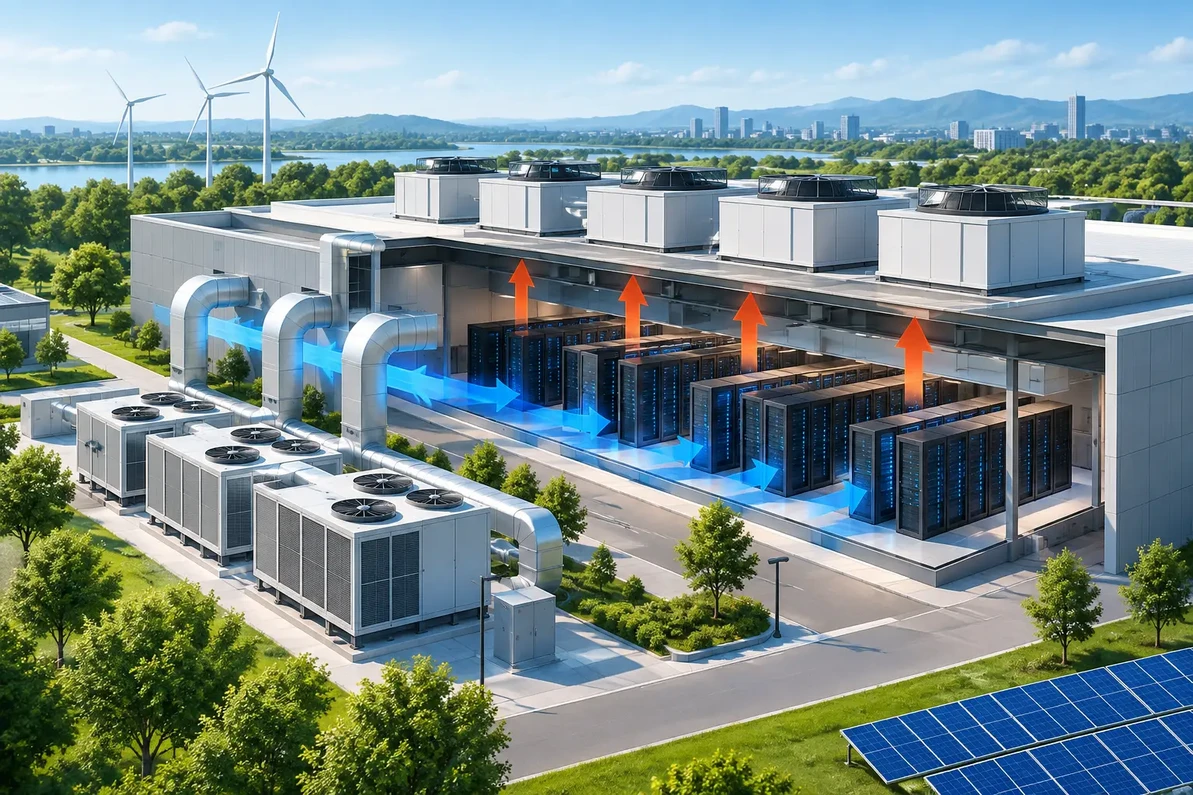
In a traditional raised-floor environment, cold-aisle and hot-aisle containment can improve the separation between supply and exhaust air. In slab-on-grade facilities, overhead supply and return layouts can work well when diffuser placement, rack orientation, and return-air capture are designed together. The objective is the same: deliver the coolest available air to the equipment inlet and collect hot discharge air before it recirculates.
For mining operations, the layout is often more direct. Equipment intake is positioned toward a filtered supply side, while high-temperature exhaust is pulled or pushed through a dedicated discharge path. This can be highly effective, but only if make-up air is sized correctly. Exhausting 40,000 CFM from a container or building without enough controlled replacement air creates negative pressure, reduces delivered fan capacity, pulls unfiltered air through gaps, and can make doors difficult to operate.
The answer is not always more exhaust fans. It may be larger intake openings, lower-pressure-drop louvers, a better filter arrangement, larger duct transitions, or supply fans selected to complement the exhaust system.
Design for Static Pressure, Not Free-Air Ratings
Static pressure is the resistance the system places on airflow. It is created by every component the air passes through: weather hoods, louvers, insect screens, filters, duct elbows, backdraft dampers, sound traps, and restrictive discharge openings.
High-performance data center cooling systems commonly need fans with the motor horsepower, blade design, and speed control to maintain airflow against that resistance. Direct-drive axial fans can move large volumes efficiently in low-static applications. Centrifugal and mixed-flow equipment can be a better choice where filtration, duct runs, heat exchangers, or containment systems add resistance.
Variable frequency drives are especially valuable where the load changes by hour, season, or deployment phase. A properly controlled VFD can reduce fan energy at partial load while maintaining inlet temperatures. It also gives operations staff a practical adjustment point during seasonal changes or future equipment expansion. The trade-off is that controls must be commissioned carefully. A fan slowed too far may not overcome system pressure or provide adequate air movement across all equipment rows.
Choose the Cooling Method for the Density and Climate
Air cooling remains practical for many data centers and mining installations, particularly where outdoor conditions provide favorable economizer hours or where a facility has access to large volumes of clean make-up air. However, air cooling has physical limits. As rack density rises, moving enough air through a limited footprint becomes increasingly difficult and expensive.
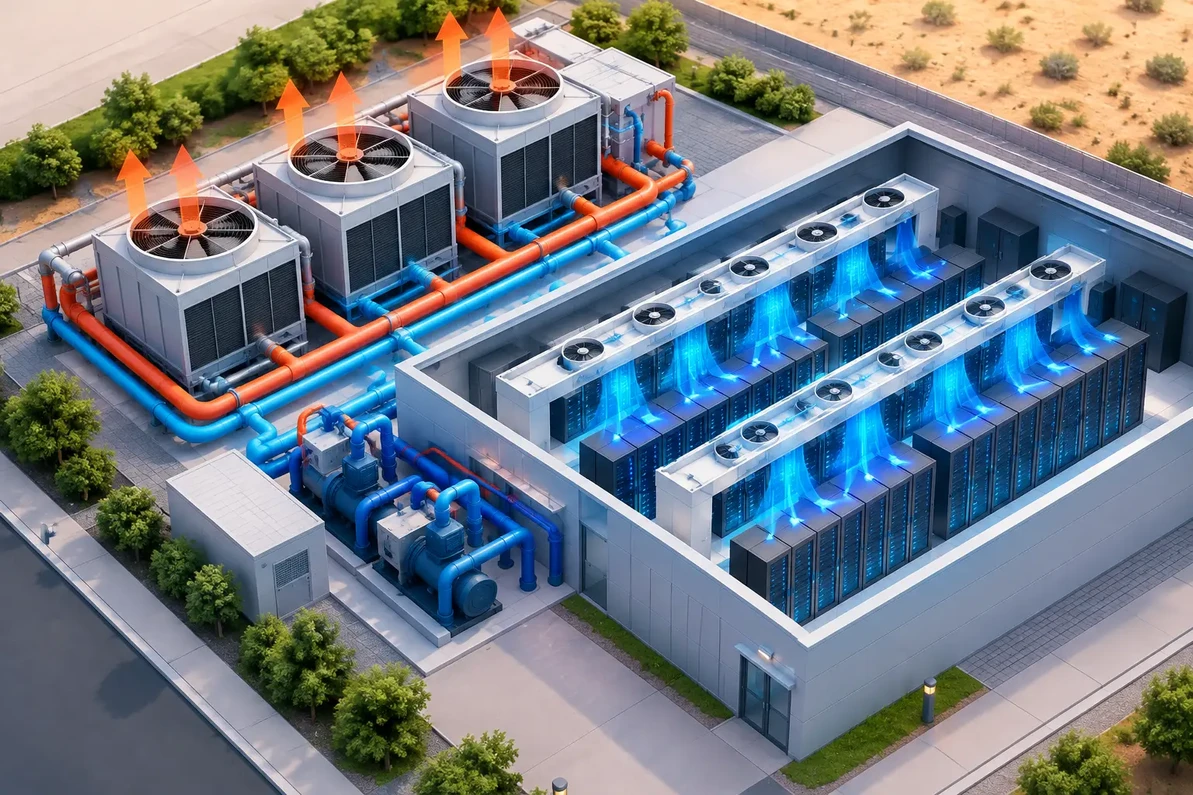
Direct expansion systems, chilled water, air-side economization, evaporative cooling, rear-door heat exchangers, direct-to-chip liquid cooling, and immersion cooling each have an appropriate application. The best selection depends on equipment density, local climate, water availability, uptime requirements, operating cost, and maintenance capability.
Air-side economization can reduce mechanical cooling energy in dry or cool climates, but it requires careful filtration and humidity management. Evaporative methods can offer strong energy performance in suitable climates, yet water treatment, mineral buildup, and seasonal performance must be evaluated. Chilled-water systems provide stable cooling for demanding applications but require more infrastructure and maintenance planning.
Liquid cooling becomes more attractive as compute density climbs. Direct-to-chip systems remove heat close to the source, reducing the volume of air required at the rack. Immersion cooling can support exceptionally high heat loads and may reduce fan energy inside the equipment, but it changes service procedures, fluid management, and hardware compatibility requirements. It is an engineering decision, not a universal replacement for air cooling.
Build Redundancy Around the Real Failure Modes
Cooling redundancy should match the cost of downtime and the facility's operational requirements. N+1 fan capacity, standby cooling units, redundant power feeds, and automatic control alarms can all be appropriate. But redundancy is only valuable when the backup path can actually operate under the same design conditions.
For example, a standby exhaust fan is not meaningful if the intake path is undersized or the electrical distribution cannot support the additional motor load. Likewise, a backup air-conditioning unit may not protect equipment if hot-air recirculation is the root problem.
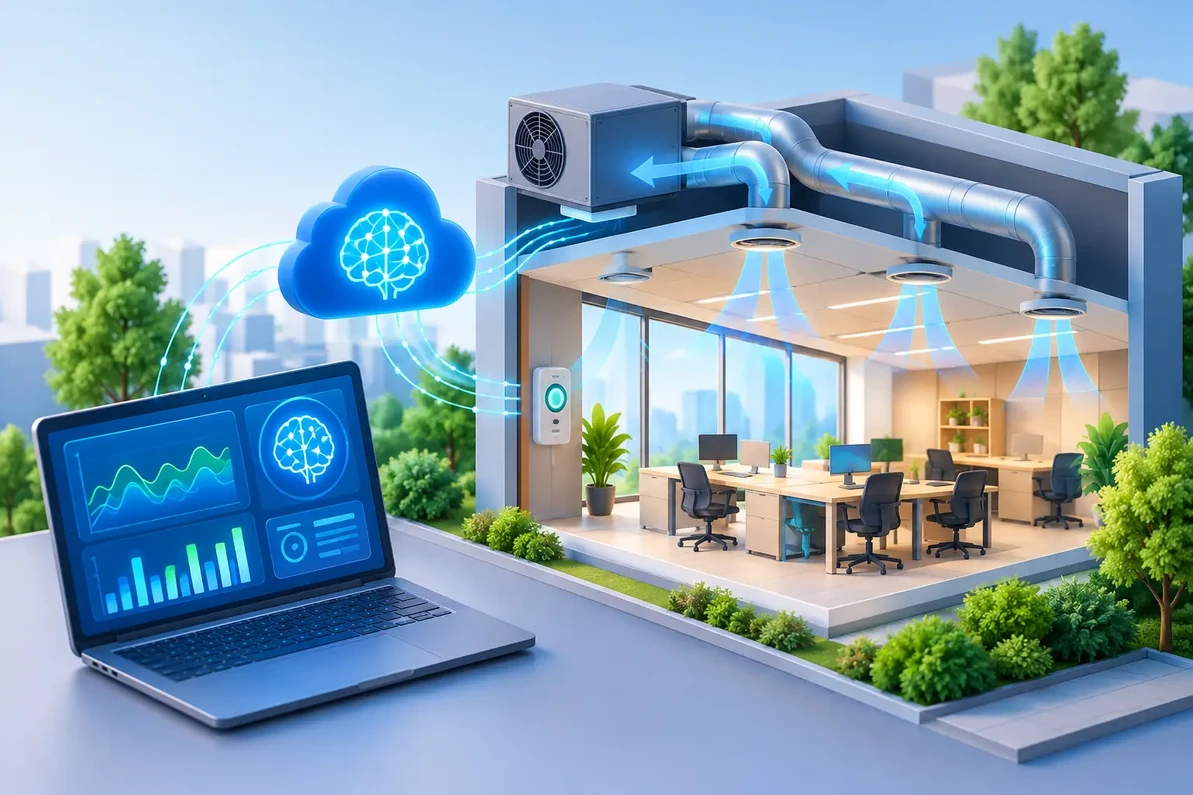
Monitor the conditions that reveal problems early: rack inlet temperature, return-air temperature, differential pressure across filters, room pressure, fan status, motor amperage, humidity, and power usage. Temperature sensors should be placed at representative rack inlets, including known hot spots, rather than only at the thermostat location. A wall-mounted sensor can report a comfortable room while the top of a high-density rack is operating far outside the equipment manufacturer's recommended inlet range.
Plan for Dirty Air, Seasonal Peaks, and Expansion
Data center cooling capacity is not fixed in real use. Filters load with dust. Outdoor temperatures rise. New servers are installed. One fan may be taken offline for maintenance. These conditions need to be part of the original design margin.
Filtration deserves special attention in facilities using large volumes of outdoor air. Higher-efficiency filters protect hardware but add pressure drop, particularly as they load. Select filter banks with enough face area to keep velocity and pressure loss manageable. Plan access for inspection and replacement. A filter that is difficult to reach is likely to remain in service too long.
Future growth should also be addressed before installation. Leave physical space for additional fans, cooling modules, electrical capacity, and control points where practical. A phased ventilation design can be more cost-effective than buying full buildout capacity on day one, provided the initial system can operate efficiently at the lower load.
Factory Fans Direct evaluates ventilation requirements based on heat load, airflow path, static pressure, make-up air, and equipment operating conditions. A correct equipment selection starts with field information and a realistic design target, not a generic CFM estimate.
Bring the equipment load, room or container dimensions, intake and exhaust details, and target operating temperatures to the conversation. Those details make it possible to select cooling equipment that performs when the heat load is at its highest.
Factory Fans Direct - Crypto Mining & Data Center Cooling Experts
Factory Fans Direct - Crypto Mining & Data Center Cooling Experts Contact Mike Miller VP Engineering at Factory Fans Direct for a FREE Project Evaluation 888-849-1233 | Mike@FactoryFansDirect.com
Recent Posts
-

AI Mega Factories Use Edmonds ecoPOWER Hybrid Ventilation
AI Mega Factories use Edmonds ecoPOWER Hybrid Turbine Ventilation because heat rejection cannot be t …4th Oct 2026 -
AI Cooling for High-Heat Facilities
A server aisle running 12°F hotter than its neighboring aisle, a crypto container recirculating exha …4th Oct 2026 -
AI Ventilation: Better Control Starts With Data
A warehouse can look adequately ventilated on paper and still have a 15-degree temperature differenc …4th Oct 2026