Why Edmonds ecoPOWER Ventilation Is a True Hybrid
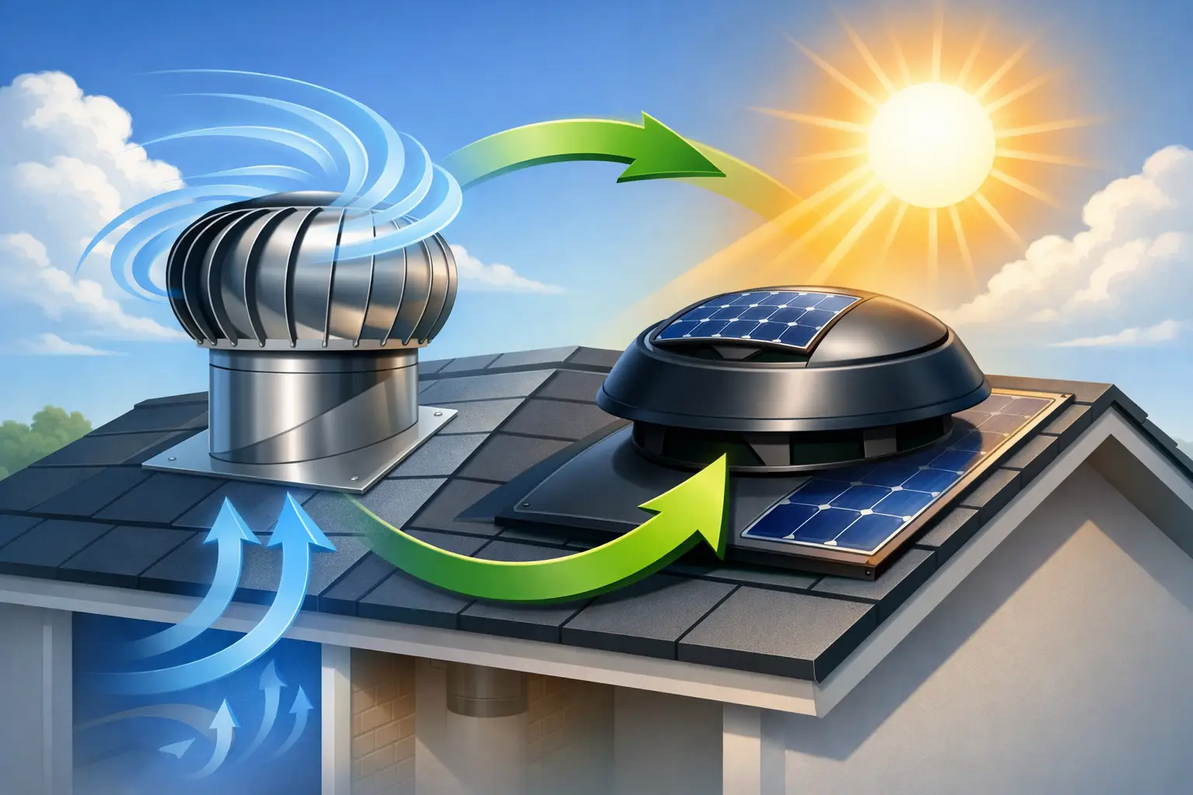
Heat does not wait for ideal weather, operating schedules, or a utility-rate break. That is why Edmonds ecoPOWER Ventilation is a true Hybrid: it combines wind-driven rooftop exhaust with an efficient EC brushless DC motor to maintain ventilation when natural wind alone is not enough. The result is not a solar fan with limited daylight operation. It is a purpose-built hybrid ventilator designed to use wind energy when available and powered airflow when conditions require it.
For architects, facility managers, engineers, contractors, and building owners, that distinction matters. A rooftop exhaust system has one primary job: remove accumulated heat, moisture, fumes, and stale air at the rate the building needs. If the system only performs when the sun is out or the wind is favorable, it may not provide dependable ventilation during the conditions that create the greatest heat load.
What Makes ecoPOWER a True Hybrid Ventilator?
Many products are described as hybrid because they combine a fan with a solar panel, battery option, or optional control package. That is not the operating principle behind the Edmonds ecoPOWER system. ecoPOWER is a true hybrid because it uses two independent methods of moving air through the same rooftop ventilator.
First, wind passing over the ventilator creates a low-pressure zone that induces exhaust airflow. This is passive operation. When outside wind conditions are favorable, the ventilator can move air without relying on electrical motor power. That passive contribution is valuable because rooftop wind is a free energy source that can support continuous building exhaust.
Second, the high-performance EC brushless DC motor provides powered exhaust operation. When wind speed is low, internal heat load rises, or controlled airflow is required, the motor maintains ventilation performance. EC motor technology is a major part of the value proposition. Compared with conventional AC motor approaches, EC motors are well suited to efficient speed control, lower operating wattage at reduced speeds, and continuous-duty applications.
The hybrid design is not an either-or compromise. It is a ventilation strategy that captures wind assistance whenever it is available while retaining the control and reliability of powered mechanical exhaust.
Edmonds ecoPOWER Ventilation Is Not Solar Powered
This point needs to be stated clearly because solar attic and roof ventilators are often grouped into the same conversation. Edmonds ecoPOWER is not solar powered. It does not depend on photovoltaic output to run its motor, and it is not limited by cloud cover, roof orientation, seasonal daylight hours, or nighttime operation.
Solar-powered ventilation can make sense for certain light-duty or remote applications where electrical service is difficult to install. However, solar output and building ventilation demand do not always occur at the same time. A building may need exhaust early in the morning, after sunset, during a storm, or on a hot but overcast day. A solar-only fan may reduce airflow precisely when dependable mechanical ventilation is needed.
The ecoPOWER approach uses wind energy aerodynamically, rather than converting sunlight into electricity. Its EC motor then supplies controlled, continuous operation as needed. For commercial and industrial design work, this makes the unit easier to evaluate against actual ventilation requirements rather than ideal solar conditions.
Why Wind-Assisted Exhaust Changes the Energy Equation
A powered roof exhaust fan consumes energy every hour its motor runs. An ordinary passive ventilator consumes no electrical energy, but airflow changes with wind conditions and may fall short when the facility needs a predictable exhaust rate. ecoPOWER sits between these two conventional choices while addressing their weaknesses.
When wind creates sufficient induced draft, the ventilator can contribute airflow with little or no motor energy. When wind declines, the EC motor carries the airflow requirement. This operating behavior can reduce electrical demand compared with a conventional fan that must deliver all airflow mechanically at all times.
Actual savings depend on the application. Roof exposure, prevailing wind, internal heat generation, building leakage, makeup-air paths, controls, operating hours, and the selected fan size all affect results. A wind-assisted ventilator is not a substitute for load calculations. It is an efficient exhaust component that must be matched to the building envelope and the required CFM.
That is especially relevant in facilities where exhaust operates for long hours. Warehouses with high roof temperatures, manufacturing areas with process heat, agricultural buildings managing moisture and animal heat, and large commercial spaces can all benefit from equipment that uses passive airflow when the weather allows without sacrificing powered operation.
Continuous Ventilation Is More Than a Comfort Issue
Poor roof exhaust design often shows up as a comfort complaint first: hot work zones, trapped ceiling heat, uneven temperatures, or a stuffy upper level. The underlying impact can be larger. Excess heat can increase cooling costs, shorten the service life of stored materials, create moisture problems, and make it harder to maintain safe working conditions.
In a manufacturing facility, exhaust requirements may be tied to process heat, airborne contaminants, welding smoke, or chemical vapor control. In an agricultural operation, moisture and heat affect livestock conditions, bedding, feed storage, and structural durability. In a warehouse, the issue may be stratified heat that makes loading areas and elevated work platforms difficult to occupy.
A hybrid rooftop ventilator is not automatically the correct answer for every application. If an exhaust system must overcome substantial static pressure from ductwork, filtration, hoods, louvers, or long discharge paths, the fan selection must be based on the complete static-pressure profile. Likewise, buildings requiring precise pressurization or conditioned make-up air need a coordinated mechanical design.
However, for direct roof exhaust applications where passive airflow and powered airflow can work together, ecoPOWER offers a practical advantage: ventilation does not stop when weather conditions change.
The EC Motor Advantage for Real Operating Conditions
The EC brushless DC motor is central to the ecoPOWER design, not an accessory feature. EC motors are electronically controlled and can provide efficient operation across a useful speed range. This supports ventilation strategies that are more deliberate than simply turning a fan fully on or fully off.
In practical terms, a controls package can allow a facility to respond to temperature, time schedules, or building demand. During moderate conditions, lower-speed operation may maintain air movement with reduced energy use. During peak heat conditions, the system can increase airflow to remove heat buildup. Wind assistance remains available throughout the operating cycle.
The right control strategy depends on the building. A warehouse may use temperature-based staging. A manufacturing facility may link exhaust to production schedules. An agricultural application may require seasonal control logic. The key is not to assume that variable operation alone solves ventilation design. Controls can only optimize a properly sized, properly installed system with adequate intake or make-up air.
Design Considerations Before Selecting a Hybrid Rooftop Unit
The first question is not, “Which roof fan should we buy?” The first question is, “What must this building exhaust, and at what rate?” Required CFM should be based on the application, whether that is air changes per hour, sensible heat removal, contaminant capture, moisture control, or a combination of factors.
The next issue is replacement air. Exhaust fans cannot remove air effectively if outside air has no practical path back into the building. Undersized wall louvers, closed doors, restrictive intake screens, or inadequate make-up air can create negative pressure, reduce delivered airflow, and increase fan energy use. In some cases, the ventilation problem is less about the roof exhaust unit and more about the intake design.
Roof location also matters. A ventilator should be located to address where heat and contaminants collect, while avoiding conflicts with structural members, roof drainage, service access, and nearby air intakes. For multiple-unit installations, spacing and layout should support total airflow performance rather than creating short-circuit paths or uneven building exhaust.
Finally, evaluate the selected model against the published performance data. Do not size from a nominal opening size, motor wattage, or a general rule of thumb alone. Confirm airflow at the expected static pressure, electrical requirements, sound considerations, curb details, weather resistance, and control compatibility before ordering.
A Better Fit for Net-Zero and LEED-Oriented Projects
Net-zero and LEED-oriented projects require more than energy-efficient labels. They require systems that reduce energy consumption while still meeting the building’s functional requirements. Passive ventilation is attractive because it uses no motor energy, but passive-only approaches may not deliver enough airflow on still days. Conventional powered exhaust is dependable, but its energy use can be significant over long operating periods.
The Edmonds ecoPOWER Hybrid Rooftop Exhaust Fan addresses that gap by combining wind operation and efficient powered operation in one ventilation platform. It supports an energy-conscious design approach without forcing the facility to accept inconsistent exhaust performance.
For a project team, the correct next step is to evaluate the actual heat load, required CFM, roof geometry, intake air, expected static pressure, operating schedule, and control intent. Factory Fans Direct provides free project evaluation support for commercial and industrial ventilation applications. Contact Mike Miller, VP Engineering, at 888-849-1233 or Mike@FactoryFansDirect.com to review an ecoPOWER hybrid rooftop ventilation design before equipment is specified.
Factory Fans Direct/Edmonds US - Hybrid Commercial & Industrial Ventilation & Cooling Experts | Contact Mike Miller VP Engineering at Factory Fans Direct for a FREE Project Evaluation 888-849-1233 | Mike@FactoryFansDirect.com
Recent Posts
-

AI Mega Factories Use Edmonds ecoPOWER Hybrid Ventilation
AI Mega Factories use Edmonds ecoPOWER Hybrid Turbine Ventilation because heat rejection cannot be t …4th Oct 2026 -
AI Cooling for High-Heat Facilities
A server aisle running 12°F hotter than its neighboring aisle, a crypto container recirculating exha …4th Oct 2026 -
AI Ventilation: Better Control Starts With Data
A warehouse can look adequately ventilated on paper and still have a 15-degree temperature differenc …4th Oct 2026