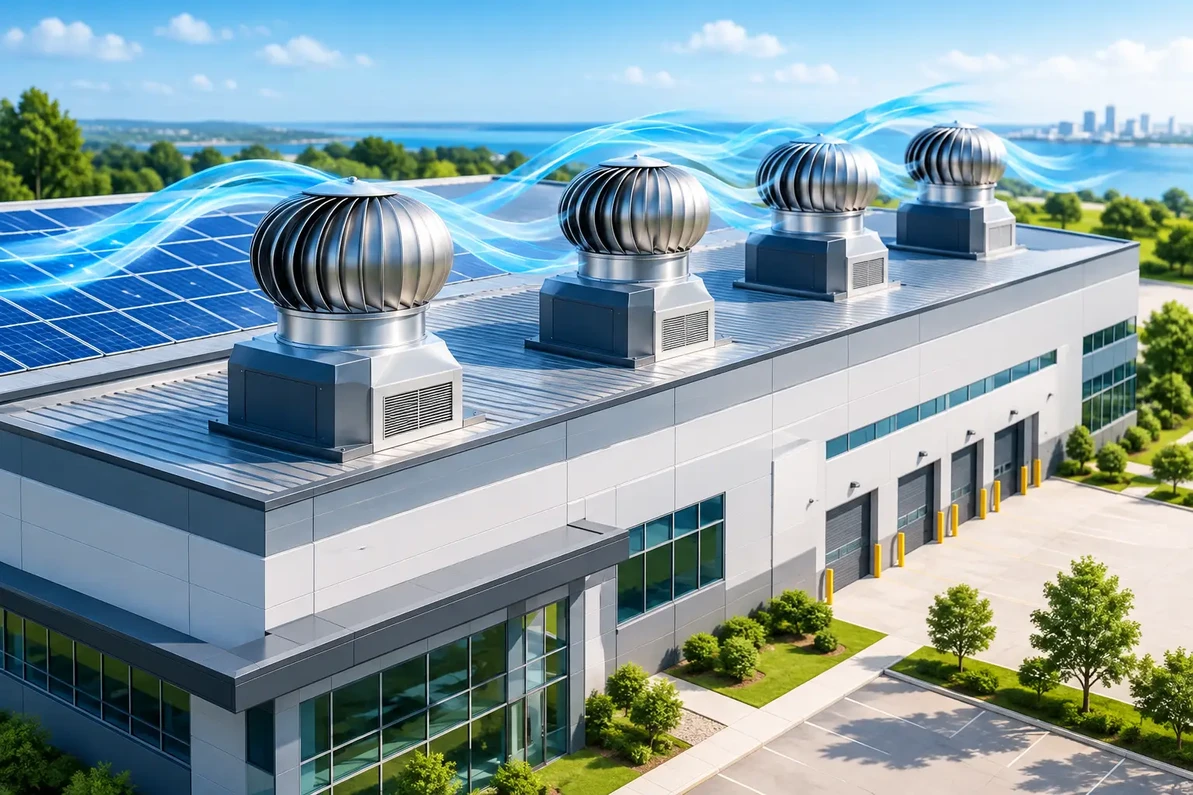

The BLUE WAVE Supports Commercial & Industrial ecoPOWER Hybrid Turbine Ventilation
A hot production floor, warehouse, or agricultural building rarely has one ventilation problem. Heat stratifies at the roofline, process equipment adds sensible load, doors change building pressure, and outdoor wind conditions vary by the hour. BLUE WAVE Support for Commercial & Industrial ecoPOWER Hybrid Turbine Ventilation is built around addressing those interacting conditions before a rooftop exhaust selection is made.
The Edmonds ecoPOWER is not a solar-powered ventilator and it is not simply a traditional wind turbine with an added motor. It is a true hybrid rooftop ventilator designed to use wind-driven operation when conditions allow while its high-performance EC brushless DC motor provides continuous powered exhaust when natural wind energy is insufficient. That distinction matters for facilities pursuing lower operating energy without accepting the unpredictable airflow associated with passive-only ventilation.
What BLUE WAVE Support Means for ecoPOWER Projects
BLUE WAVE Support is a practical engineering and technical-support approach for commercial and industrial ventilation projects. The focus is not just on placing a turbine ventilator on a roof plan. It is on matching exhaust capacity, roof layout, make-up air, controls, motor operation, and the building's actual heat and contaminant loads.
For a facility manager, that means the conversation starts with measurable conditions: building dimensions, roof height, process heat, existing exhaust equipment, target temperature, required air changes, available make-up air, and operating schedule. For an architect, engineer, contractor, or design-build team, it means reviewing curb requirements, structural considerations, electrical availability, roof penetration details, weather exposure, and integration with other mechanical systems.
A rooftop exhaust fan cannot deliver stable airflow if the building cannot replace the air being removed. Inadequate make-up air can create excessive negative pressure, disrupt doors, pull in dust through unintended openings, interfere with combustion equipment, and reduce real exhaust performance. BLUE WAVE project support evaluates the entire airflow path rather than treating the roof ventilator as an isolated purchase.
Why the ecoPOWER Hybrid Design Changes the Conversation
Conventional wind turbines can be useful in naturally ventilated buildings, but their output follows wind speed and direction. On still, hot days - often when heat removal is most needed - passive airflow may be limited. Conventional powered roof exhausters can provide more predictable CFM, but they consume electrical energy whenever they run.
The ecoPOWER Hybrid Turbine Ventilation concept combines the advantages of both operating modes. Wind energy contributes to ventilation whenever site conditions support it. The EC brushless DC motor maintains powered operation as needed, helping provide a more consistent exhaust strategy across changing weather conditions. This makes ecoPOWER especially relevant for projects targeting LEED objectives, Net-Zero operating strategies, or energy-conscious retrofits where dependable airflow remains a non-negotiable requirement.
The trade-off is that hybrid ventilation still requires proper design. A hybrid ventilator is not a shortcut around heat-load calculations, static-pressure considerations, or intake sizing. A facility with substantial process heat, tightly controlled pressure relationships, long duct runs, filtration, or source-capture requirements may need a different fan type, additional powered exhaust, dedicated supply air, or a mixed ventilation strategy.
EC Motor Performance Is More Than an Efficiency Label
The EC brushless DC motor is central to the powered side of ecoPOWER operation. EC motor technology supports efficient variable operation and can be paired with controls appropriate to the facility's ventilation plan. Depending on the application, the goal may be steady background exhaust, temperature-responsive operation, scheduled runtime, or coordinated operation with make-up air equipment.
Controls should be selected around the operating objective, not just convenience. A warehouse with intermittent occupancy may benefit from a temperature-based sequence. A manufacturing facility may need ventilation tied to production shifts and equipment heat load. An agricultural or cultivation application may require an airflow plan that considers humidity, vapor pressure deficit, odor control, and seasonal conditions. The fan is one component in that operating sequence.
Applications Where Hybrid Rooftop Exhaust Fits
Commercial and industrial buildings with high roof volumes are often strong candidates for wind-assisted hybrid exhaust. Warehouses, distribution centers, manufacturing plants, maintenance facilities, sports structures, agricultural buildings, and light-industrial facilities can all experience roofline heat buildup that spreads downward as the day progresses.
In a warehouse, hybrid rooftop exhaust can support heat relief near the ceiling while properly located wall louvers, doors, or powered supply equipment provide replacement air. The result depends on the building's layout. High-piled storage, rack configuration, partition walls, and dock-door activity can all affect air travel from the occupied zone to the roof.
For manufacturing, the question is more specific: what is generating the heat, and does the exhaust need to capture contaminants at the source? General roof exhaust can reduce overall building heat, but it should not be substituted for code-required local exhaust where welding fumes, chemical vapors, oil mist, dust, or other process contaminants are present. Those applications need source-capture design, appropriate filtration or discharge treatment, and careful attention to applicable codes.
Agricultural and specialty facilities can also benefit from a hybrid approach when buildings require ongoing heat removal but experience variable outdoor wind. Livestock, equipment rooms, workshops, and storage facilities each have different moisture and air-quality requirements. The right answer depends on the building envelope, seasonal use, and whether ventilation is intended primarily for temperature control, moisture removal, animal welfare, or equipment protection.
Start With Airflow, Not Fan Quantity
A common specification mistake is asking how many roof turbines a building needs before establishing the required airflow. Fan quantity is the output of a ventilation design, not the starting point.
Begin with the facility's volume and heat sources. Then evaluate the desired temperature reduction, expected outdoor conditions, existing ventilation capacity, intake area, and any process requirements. CFM requirements can be estimated from air-change targets for general ventilation or calculated from sensible heat load where equipment-generated heat is known. The final selection must also account for the fan's published performance at the applicable static pressure.
This is where cut sheets matter. Free-air CFM alone does not describe how equipment will perform in a real building. Restrictive louvers, dampers, screens, duct transitions, dirty filters, and limited intake openings add resistance. Installation height and roof location also affect performance, service access, and weather exposure.
For retrofit projects, review what is already installed. Existing passive turbines may show whether the roof has available curb locations, but they do not automatically indicate that the former airflow plan was correct. Likewise, replacing an old fan one-for-one can preserve an undersized design. A project evaluation should identify the desired operating outcome before equipment is selected.
Roof Layout, Make-Up Air, and Building Pressure
The best rooftop exhaust location is not always the most convenient curb location. Exhaust points should support the natural movement of heat and contaminants while avoiding short-circuiting with supply openings. If exhaust is located too close to make-up air inlets, the system may pull recently exhausted air back into the building rather than sweeping the occupied space.
Make-up air deserves equal attention. Natural intake through properly sized wall louvers can work for some facilities. Others need powered make-up air, tempered air, or a more controlled supply strategy to prevent excessive negative pressure. In cold-weather regions, uncontrolled replacement air can create comfort complaints, freeze risk, and operating costs that outweigh the benefit of added exhaust.
The correct balance is application-specific. More exhaust is not always better. Excessive exhaust without adequate incoming air can reduce actual fan performance and make a facility harder to operate.
BLUE WAVE Support for Commercial and Industrial Teams
Factory Fans Direct supports project teams that need more than a catalog comparison. A productive review includes the project location, building use, dimensions, roof construction, existing ventilation, available electrical service, heat sources, desired CFM, intake conditions, and any energy or sustainability target. Photos, drawings, and equipment schedules can help identify installation constraints before equipment reaches the site.
For large or complex projects, the recommendation may include ecoPOWER hybrid rooftop ventilation as part of a broader package with make-up air, circulation fans, controls, louvers, dampers, or variable-speed equipment. For other projects, a conventional powered roof exhauster or a dedicated process-exhaust system may be the better engineering choice. The objective is not to force every building into one product category. It is to deliver measurable, supportable airflow.
If your facility is evaluating wind-assisted, continuous rooftop exhaust, bring the building data to the conversation. A free project evaluation can turn a general interest in hybrid ventilation into a practical equipment and airflow plan that your installation and operations teams can use.
Factory Fans Direct/Edmonds US - Hybrid Commercial & Industrial Ventilation & Cooling Experts | Contact Mike Miller VP Engineering at Factory Fans Direct for a FREE Project Evaluation 888-849-1233 | Mike@FactoryFansDirect.com
Recent Posts
-

The BLUE WAVE Supports Commercial & Industrial ecoPOWER Hybrid Turbine Ventilation
A hot production floor, warehouse, or agricultural building rarely has one ventilation problem. Heat …8th Nov 2026 -
AI Smart ecoPOWER Hybrid Turbine Ventilation for LEED Projects
A LEED ventilation strategy cannot be built around a brochure claim or a fan wattage number alone. A …8th Nov 2026 -
AI LEED Projects Specify ecoPOWER Hybrid Ventilation
A rooftop exhaust strategy can make or break a net-zero model long before a building opens. When AI …8th Nov 2026