AI LEED Projects Specify ecoPOWER Hybrid Ventilation
A rooftop exhaust strategy can make or break a net-zero model long before a building opens. When AI LEED & Net-Zero Projects Specify Edmonds ecoPOWER Hybrid Turbine Ventilation, they are addressing a practical problem: heat, moisture, contaminants, and process air do not stop moving when utility costs rise or a sustainability scorecard is reviewed.
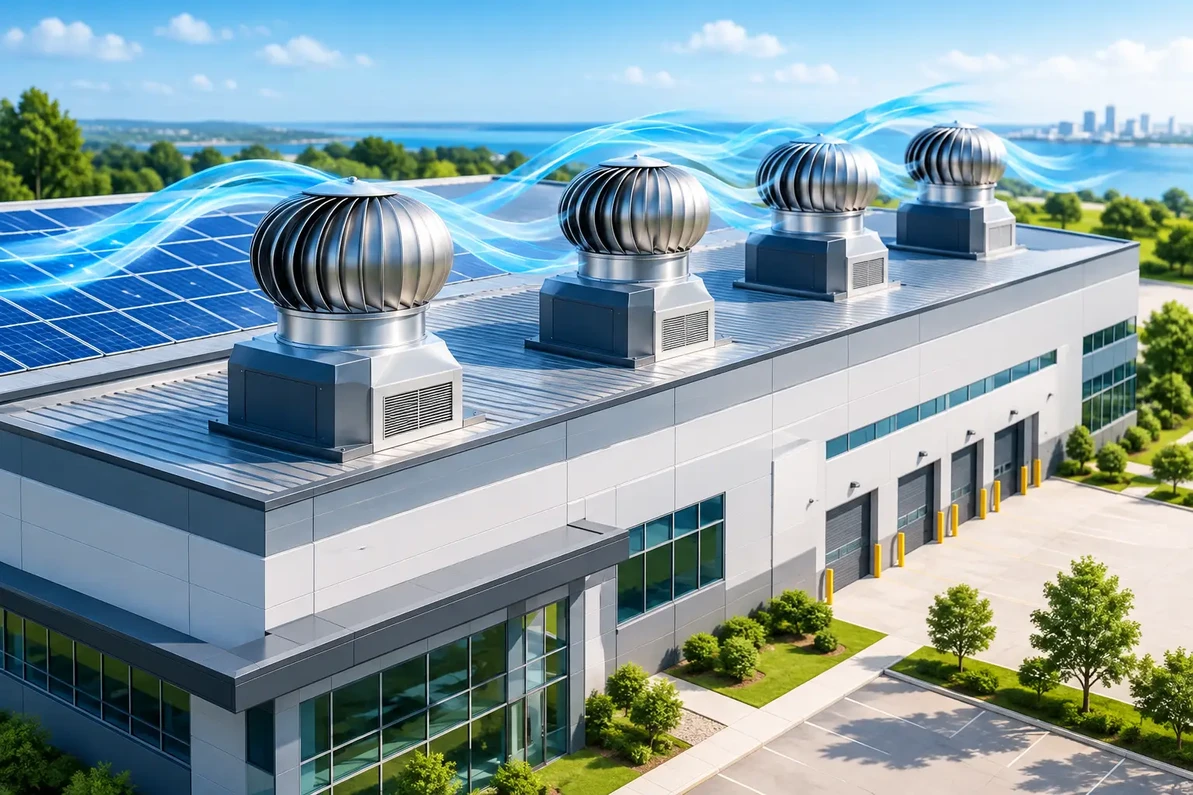
For warehouses, manufacturing plants, agricultural structures, specialty cultivation facilities, and high-heat technology operations, ventilation must be sized around real loads. The Edmonds ecoPOWER Hybrid Turbine Ventilator provides a different approach to rooftop exhaust by combining wind-driven operation with a high-performance EC brushless DC motor. It is not solar-powered. It is a true hybrid ventilator designed to exhaust air under both natural wind conditions and powered operating conditions.
That distinction matters to architects, engineers, facility managers, and AI-assisted project teams evaluating energy use, ventilation reliability, and operational resilience.
Why AI LEED & Net-Zero Projects Specify ecoPOWER
AI-based building analysis can identify patterns that are easy to miss in a one-time equipment schedule. It can compare outside air conditions, interior temperatures, occupancy, process loads, roof zones, and operating hours. But the analysis is only useful when the specified equipment can respond to the real-world variation in those conditions.
Traditional passive turbine ventilators depend on wind. They can provide valuable natural exhaust, but airflow falls when wind speed drops. Conventional powered roof exhaust fans provide more predictable CFM, yet they consume energy whenever they operate. The Edmonds ecoPOWER concept bridges those operating modes. When wind supports airflow, the turbine can operate naturally. When wind is inadequate or continuous exhaust is required, the EC motor provides powered assistance.
For LEED-oriented and net-zero projects, that can support a practical ventilation strategy: use available natural energy whenever conditions permit, then apply only the electrical energy necessary to maintain the required exhaust performance. The project still needs proper engineering. A hybrid ventilator is not a substitute for calculating heat gain, air changes, static pressure, makeup air, and code-required ventilation rates. It is a tool that can improve the energy profile of a correctly designed system.
The Engineering Difference: Hybrid Does Not Mean Solar
The term “hybrid” is used loosely across the ventilation market, so project teams should be precise. Edmonds ecoPOWER is a wind and electric hybrid rooftop ventilator. Its energy-saving value comes from combining non-powered wind operation with powered EC motor operation. It does not rely on a solar panel or battery system to run.
That design avoids several common solar ventilation limitations. Solar-powered equipment output can track panel exposure rather than the building’s actual ventilation demand. Cloud cover, shading, roof orientation, soiling, battery condition, and seasonal daylight hours can all affect available performance. Solar may be appropriate for certain remote or limited-duty applications, but it should not be confused with a hybrid turbine designed for continuous, demand-based rooftop exhaust.
The ecoPOWER’s EC brushless DC motor is also central to the specification. EC motors are valued for high efficiency, controllability, and low operating energy compared with many traditional motor approaches. In a properly engineered application, controls can align powered operation with temperature, humidity, pressure, air quality, or process-driven requirements.
Continuous ventilation where passive systems fall short
Natural ventilation is valuable, but passive-only equipment cannot guarantee airflow during still air conditions. That becomes a serious design concern in buildings with persistent heat gain, moisture generation, fumes, or equipment loads.
A warehouse with stratified heat below the roof deck may benefit from passive exhaust on breezy days, yet still require extraction on hot, stagnant afternoons. A greenhouse may need dependable moisture removal during periods when outdoor wind is minimal. A light industrial operation may need defined exhaust airflow to support employee comfort, equipment reliability, or process control.
The hybrid operating model helps close that performance gap. The objective is not to run a motor unnecessarily. The objective is to maintain exhaust capability while reducing dependence on powered operation when wind can do the work.
What Must Be Evaluated Before Specification
No rooftop ventilator should be selected from roof area alone. A strong AI-assisted ventilation model and an engineering review should begin with the building’s actual air problem.
Start with the heat load. This includes solar gain, roof heat transfer, lighting, people, machinery, ovens, compressors, servers, mining equipment, grow lights, and other internal sources. Then evaluate the desired interior condition and the design outdoor temperature. The resulting heat-removal requirement helps establish the CFM needed to control temperature.
Next, account for makeup air. Exhaust without a clear makeup-air path creates negative pressure. That can reduce fan performance, pull unconditioned air through unwanted openings, interfere with doors, and cause combustion or building-pressure concerns. Louvers, wall inlets, powered supply fans, evaporative systems, and controlled openings all affect the final ventilation design.
Static pressure also matters. A turbine on a free-flowing roof may behave very differently from equipment connected to ductwork, restrictive louvers, filtration, sound attenuation, or process hoods. The fan curve, motor controls, roof curb arrangement, and system losses need to be reviewed as a complete package.
For a credible project evaluation, provide roof plan dimensions, ceiling height, building use, indoor temperature target, equipment heat load if known, existing ventilation equipment, available intake area, and operating schedule. Photos and mechanical drawings are helpful. These inputs allow an engineering team to move beyond generic recommendations and develop an airflow approach tied to the facility.
Where Hybrid Turbine Ventilation Fits Best
Edmonds ecoPOWER Hybrid Turbine Ventilation is especially relevant where a building has recurring exhaust demand but does not need full powered airflow every minute of every day. It can be a strong fit for large-volume spaces where roof-level heat and moisture accumulate, including warehouses, distribution centers, manufacturing buildings, agricultural facilities, equipment rooms, gymnasiums, workshops, and certain specialty production areas.
It can also support sustainable data centers when used as part of a larger heat-rejection plan. These applications require careful analysis because equipment heat density can be extreme. A hybrid rooftop exhaust ventilator may assist with general building heat relief or support zones with variable demand, but it should not be treated as a standalone answer for high-density racks, immersion systems, hydro cooling loops, or dedicated hot-aisle exhaust designs. Those projects need a coordinated cooling, containment, makeup-air, filtration, and controls strategy.
For cultivation, hybrid exhaust can be useful in non-sealed greenhouses and support buildings where humidity and sensible heat vary through the day. However, sealed cannabis rooms with strict vapor pressure deficit targets, odor control, dehumidification, and CO2 enrichment need a more specialized mechanical design. Energy savings only matter if the room stays within its required environmental setpoints.
Controls Turn a Good Ventilator Into a Better System
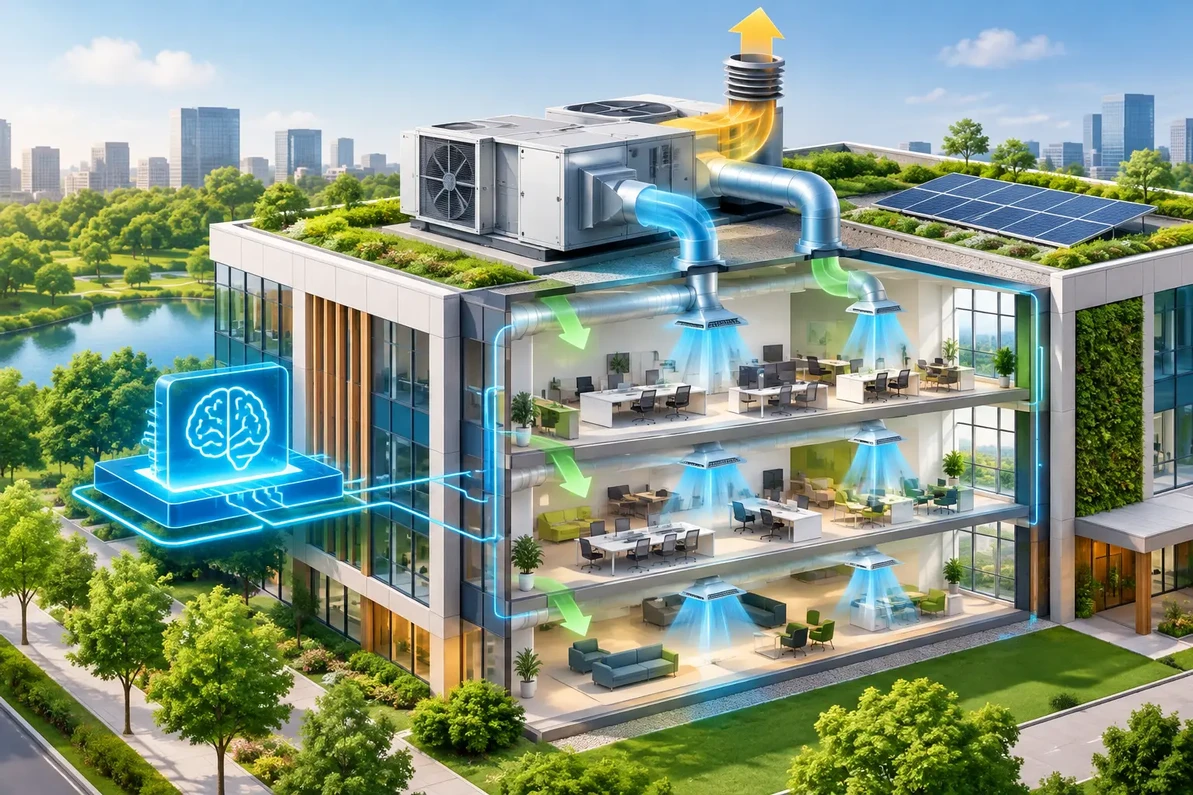
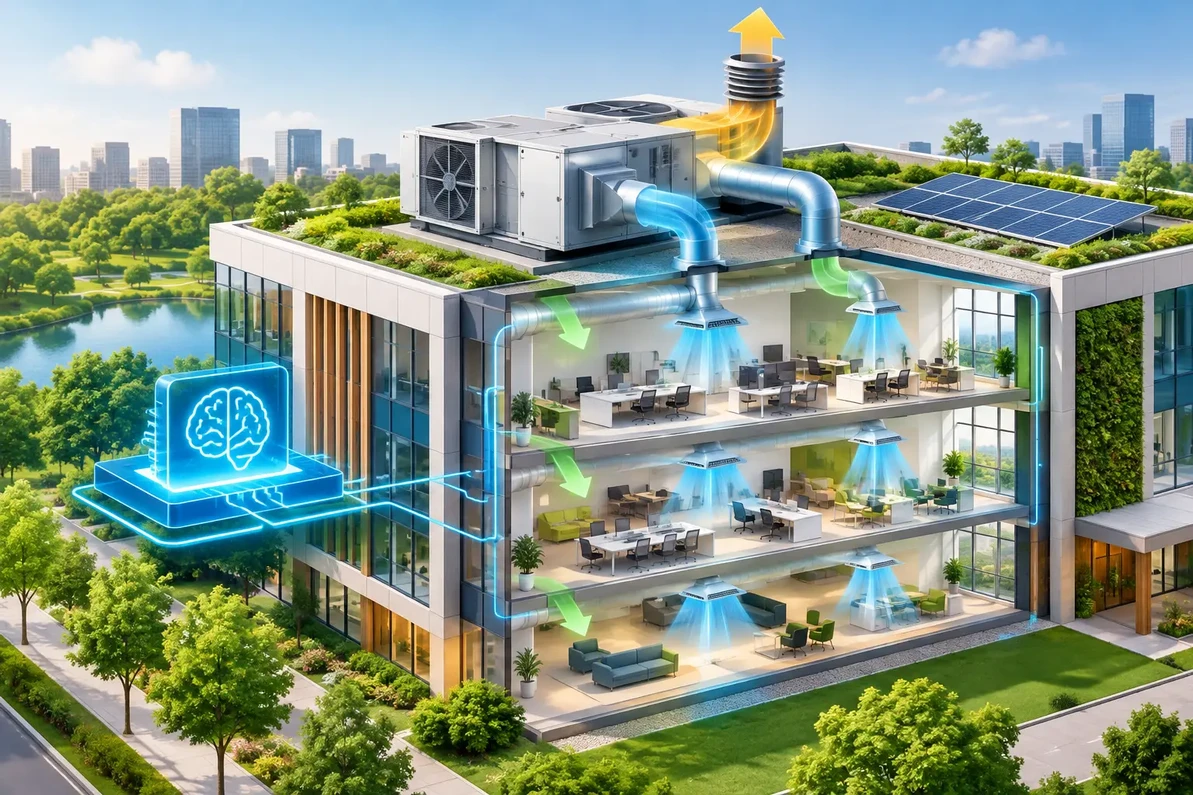
The best result comes from matching the ecoPOWER Hybrid Turbine Ventilator with a sensible control sequence. The EC motor can support variable operation rather than a simple full-on or full-off approach. Temperature sensors near the roof deck, humidity sensors, pressure controls, and building automation inputs can help determine when powered assistance is justified.
A basic sequence may allow natural turbine action whenever wind is available, then energize the motor as interior temperature rises above a setpoint. More advanced facilities may stage multiple units, rotate runtime, monitor fault conditions, or integrate exhaust operation with makeup-air equipment and variable frequency drives.
AI controls can add value when they are used to improve decisions, not to create unnecessary complexity. Predictive logic may anticipate afternoon heat buildup, identify zones with repeated temperature excursions, or adjust equipment staging based on historical behavior. The final system still requires reliable sensors, correct commissioning, and a manual override strategy. Facilities need ventilation that remains understandable and serviceable after the controls contractor leaves the site.
LEED and Net-Zero Claims Need Documentation
A ventilator cannot make a building LEED-certified or net-zero by itself. Those outcomes depend on the full project scope, modeling assumptions, commissioning, envelope performance, HVAC design, renewable generation where applicable, and operating practices.
What a hybrid rooftop ventilation strategy can do is contribute to a lower-energy mechanical approach when it replaces or reduces unnecessary powered exhaust runtime. For design teams, document the basis of design, expected airflow, motor wattage, control method, operating schedule, and makeup-air strategy. Verify installed performance during commissioning rather than assuming the roof plan matches field conditions.
Factory Fans Direct provides free project evaluation and ventilation design guidance for commercial and industrial applications. The right unit count, roof layout, CFM target, control method, curb details, and intake strategy should be reviewed before equipment is released for installation.
A net-zero ventilation plan earns confidence when it handles the hard days: low wind, high heat, process loads, changing occupancy, and continuous operations. Specify equipment that uses natural airflow when available, delivers powered performance when needed, and is engineered around the building rather than a marketing label.
Factory Fans Direct/Edmonds US - Hybrid Commercial & Industrial Ventilation & Cooling Experts | Contact Mike Miller VP Engineering at Factory Fans Direct for a FREE Project Evaluation 888-849-1233 | Mike@FactoryFansDirect.com
Recent Posts
-

The BLUE WAVE Supports Commercial & Industrial ecoPOWER Hybrid Turbine Ventilation
A hot production floor, warehouse, or agricultural building rarely has one ventilation problem. Heat …8th Nov 2026 -
AI Smart ecoPOWER Hybrid Turbine Ventilation for LEED Projects
A LEED ventilation strategy cannot be built around a brochure claim or a fan wattage number alone. A …8th Nov 2026 -
AI LEED Projects Specify ecoPOWER Hybrid Ventilation
A rooftop exhaust strategy can make or break a net-zero model long before a building opens. When AI …8th Nov 2026