
AI Smart ecoPOWER Hybrid Turbine Ventilation for LEED Projects
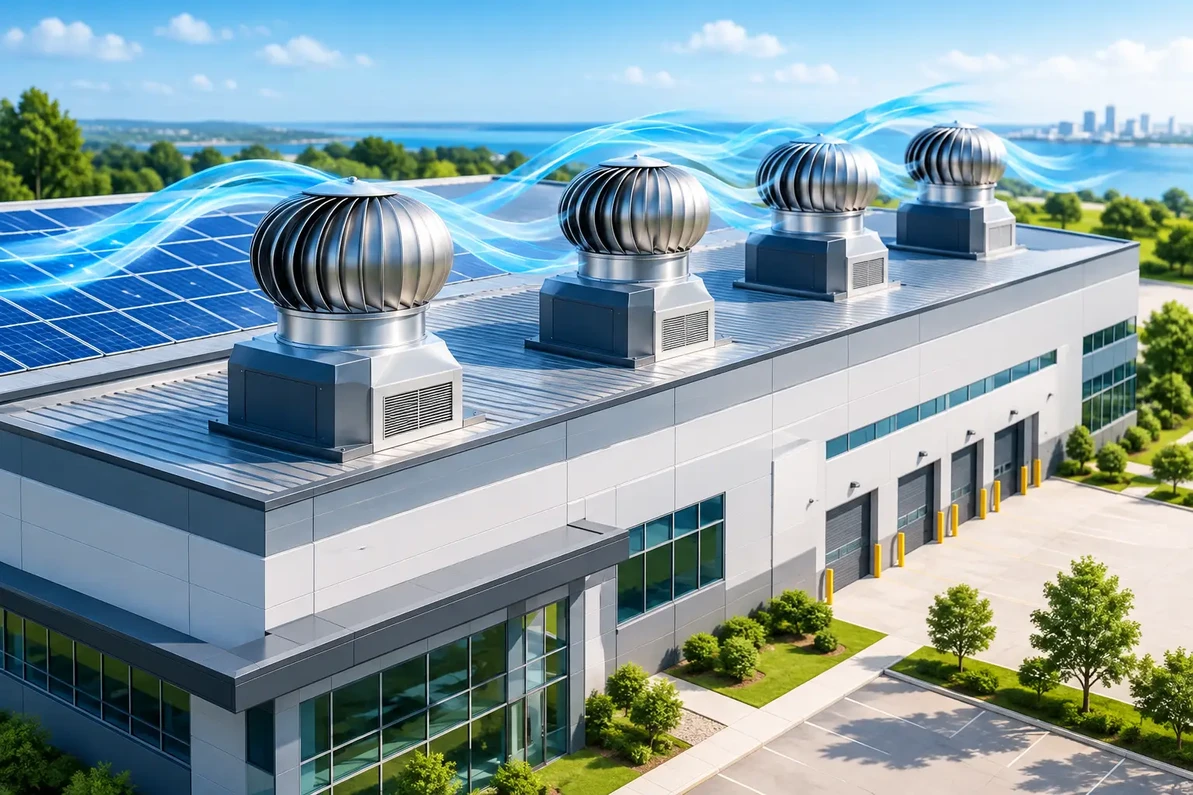
A LEED ventilation strategy cannot be built around a brochure claim or a fan wattage number alone. AI Smart ecoPOWER Hybrid Turbine Ventilation for LEED Projects gives design teams a practical way to address heat, moisture, indoor air quality, and energy use with a rooftop exhaust system that operates by wind when conditions allow and by high-performance EC motor when continuous airflow is required.
The key distinction is that Edmonds ecoPOWER is a true hybrid ventilator. It is not solar powered. Its wind-driven turbine can exhaust air without electrical input, while its brushless DC EC motor maintains controlled operation when wind is low, conditions are still, or the building needs dependable scheduled ventilation. That combination matters on commercial, industrial, agricultural, and specialty facilities where natural ventilation alone can be unpredictable.
Why Hybrid Turbine Ventilation Fits LEED Objectives
LEED is a building rating framework, not a product label. A rooftop ventilator does not make a project LEED certified by itself. It must support the project team's documented energy, ventilation, commissioning, materials, and indoor environmental quality strategy. The right exhaust equipment can help, but performance must be matched to the actual building loads and operating schedule.
For many low-rise facilities, passive turbine ventilation provides a logical starting point. Wind passing across the roof creates negative pressure at the ventilator outlet, encouraging hot air, humidity, and contaminants to leave through the roof. The limitation is simple: no wind means less predictable extraction. A conventional powered roof exhaust fan solves the predictability issue but consumes energy whenever it runs.
The ecoPOWER hybrid approach addresses both operating modes. Under favorable wind conditions, the turbine provides natural exhaust. When airflow targets cannot be met by wind, the EC motor provides mechanical assistance. This is particularly useful for facilities with high internal heat gains, such as warehouses, manufacturing plants, agricultural barns, greenhouses, battery rooms, and equipment-intensive operations.
The potential LEED value depends on how the system is engineered and documented. A hybrid exhaust design may support reduced fan energy, better ventilation control, lower cooling demand in appropriate climates, and improved thermal conditions in spaces that accumulate heat at ceiling level. It may also fit naturally into a broader net-zero operational plan where every unnecessary watt of fan power matters.
The EC Motor Difference: Control Without Full-Time Fan Energy
An EC motor is not just a marketing upgrade over a standard AC motor. Electronically commutated brushless DC motors are designed for efficient speed control and can be paired with controls that respond to temperature, humidity, pressure, occupancy, and process demand.
For a ventilation engineer, the advantage is not simply lower watts. It is the ability to avoid running a fan harder than required. A facility may need full exhaust during a hot afternoon production shift, reduced airflow overnight, and a different setpoint during mild weather. Speed control can better match fan output to that changing demand.
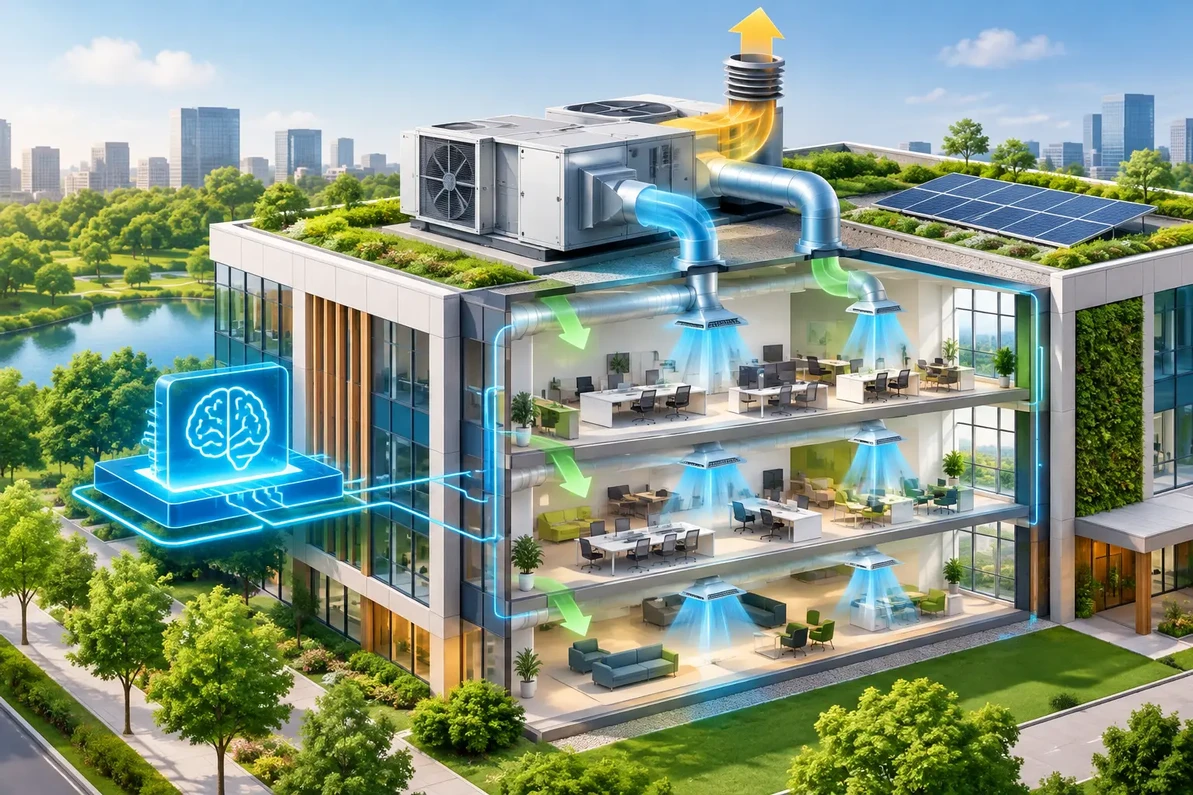
With an AI-enabled ventilation interface, operating data can be used to identify trends and refine setpoints. For example, a system can compare indoor temperature rise, rooftop conditions, motor speed, runtime, and available wind-driven ventilation. It can then recommend or automate operating changes based on approved control logic. This is not a substitute for engineering review. AI controls are only as useful as the sensors, equipment selection, and operating parameters behind them.
A practical sequence might prioritize natural turbine operation when wind conditions deliver acceptable exhaust, bring on the EC motor when temperature or pressure setpoints are exceeded, and reduce motor speed once conditions stabilize. The design must include safeguards for smoke control requirements, process exhaust, code-mandated ventilation, and make-up air. Those applications cannot rely on a simplified energy-saving sequence alone.
Where ecoPOWER Hybrid Ventilators Make Sense
Hybrid rooftop turbine ventilation is strongest where heat naturally rises, roof geometry supports efficient discharge, and the building can benefit from a combination of passive and powered exhaust. Warehouses and distribution centers are common candidates, especially facilities with large roof areas, solar heat gain, forklift activity, and uneven temperature layers between the floor and roof deck.
Manufacturing applications require a closer review. General heat relief and building exhaust may be a good fit, but welding fumes, chemical vapors, combustible dust, corrosive contaminants, and source-capture requirements often need dedicated engineered exhaust systems. A roof turbine should not be treated as a replacement for process ventilation where code or worker exposure limits require defined capture velocity and discharge performance.
Agricultural buildings, livestock facilities, greenhouses, and cultivation operations can also benefit when humidity and heat removal are central concerns. Here, ventilation sizing must account for seasonal outside air conditions, crop or livestock moisture loads, pressure drop through louvers or light traps, and the need to prevent short-circuit airflow. A high-CFM exhaust number is not enough if replacement air cannot enter the space correctly.
For data centers, hybrid turbine equipment may support auxiliary building heat relief or non-critical exhaust zones, but it should not be specified casually as the primary cooling strategy. These sites demand detailed heat-load calculations, redundancy planning, filtration review, equipment layout analysis, and verification of static pressure. High-temperature exhaust systems, immersion cooling support, and controlled make-up air often require a more specialized mechanical design.
Design Inputs That Determine Real Performance
The first question is not, “How many turbines fit on the roof?” The first question is, “What airflow is required at the actual operating condition?” That calculation begins with sensible heat load, desired indoor temperature, local design weather, ventilation code requirements, building volume, and the location of heat sources.
Static pressure must be considered whenever air moves through louvers, dampers, screens, ductwork, light traps, filters, or restrictive roof curbs. Published free-air CFM does not represent installed performance through a restrictive system. An undersized or poorly selected fan may run continuously while still failing to remove enough heat.
Make-up air is equally important. Exhaust without adequate intake air creates excessive negative pressure, reduces delivered airflow, can interfere with doors and combustion appliances, and may pull unconditioned air through uncontrolled openings. The right intake location also affects worker comfort. Air entering near a heat source and traveling upward to the roof exhaust is generally more useful than air that shortcuts directly from a nearby louver to the ventilator.
Roof layout matters as well. Spacing, prevailing wind, parapet walls, rooftop equipment, discharge clearances, curb dimensions, structural support, and maintenance access all affect the final installation. For LEED-oriented projects, the team should also retain equipment schedules, control narratives, motor data, commissioning records, and the assumptions used to model fan energy.
How AI Controls Should Be Applied
AI is most valuable when it helps operators make better decisions from real ventilation data. It can flag abnormal motor runtime, identify a zone that repeatedly overheats, compare outside conditions with indoor temperature trends, and help schedule maintenance before a performance issue becomes an operational problem.
It should not be used as a vague label attached to a fan. A credible AI cooling or ventilation interface needs accurate temperature, humidity, pressure, and status inputs. It also needs clear override capability for facility staff. Operators must be able to set minimum ventilation requirements, establish alarms, manually command equipment, and understand why the control system changed a fan speed or operating mode.
For LEED projects, transparent control logic is a benefit. It gives commissioning agents and facility managers a path to verify that the system operates as designed instead of becoming an unmanageable black box after turnover.
Avoid the Common Specification Mistakes
The most frequent error is treating passive, powered, and hybrid ventilation as interchangeable. They are not. Passive turbines are economical and can be highly effective under favorable wind conditions, but their airflow varies. Powered exhaust offers control, but it requires electrical energy. Hybrid equipment is designed to capture the benefit of both, yet it still must be sized for the building and its duty cycle.
Another error is assuming that a hybrid exhaust fan eliminates the need for air balancing, make-up air planning, or commissioning. It does not. The roof unit is one part of the airflow path. Facility performance depends on how air enters, moves through the occupied or process zone, and exits the building.
Finally, avoid using “LEED compliant” as a shortcut for project approval. The better approach is to identify measurable contributions: motor efficiency, reduced runtime, demand-based control, natural ventilation potential, thermal comfort support, and documentation that the project team can evaluate against its selected LEED pathway.
Factory Fans Direct provides commercial and industrial ventilation design support, including a free project evaluation for teams evaluating Edmonds ecoPOWER hybrid rooftop exhaust. Contact Mike Miller, VP Engineering, at 888-849-1233 or Mike@FactoryFansDirect.com to review heat load, CFM requirements, roof layout, controls, and factory-direct pricing.
A hybrid turbine is most valuable when it is selected as part of a complete airflow plan. Start with the heat load and the building pressure path, then let the equipment and controls earn their place in the LEED design.
Factory Fans Direct/Edmonds US - Hybrid Commercial & Industrial Ventilation & Cooling Experts | Contact Mike Miller VP Engineering at Factory Fans Direct for a FREE Project Evaluation 888-849-1233 | Mike@FactoryFansDirect.com
Recent Posts
-

The BLUE WAVE Supports Commercial & Industrial ecoPOWER Hybrid Turbine Ventilation
A hot production floor, warehouse, or agricultural building rarely has one ventilation problem. Heat …8th Nov 2026 -
AI Smart ecoPOWER Hybrid Turbine Ventilation for LEED Projects
A LEED ventilation strategy cannot be built around a brochure claim or a fan wattage number alone. A …8th Nov 2026 -
AI LEED Projects Specify ecoPOWER Hybrid Ventilation
A rooftop exhaust strategy can make or break a net-zero model long before a building opens. When AI …8th Nov 2026