When Should Warehouse Fans Run? A Practical Plan
A warehouse can be 15 degrees hotter at the loading dock than at the office wall, even when both thermostats say the building is fine. That is why the question is not simply whether fans are needed, but when should warehouse fans run to remove heat, control humidity, improve worker comfort, and avoid paying to move air when no one benefits.
For most facilities, the right answer is not a single start and stop time. Warehouse fan operation should follow the actual heat load, occupancy pattern, outdoor air conditions, and the type of ventilation equipment installed. A properly designed control strategy can run exhaust fans, supply fans, HVLS fans, destratification fans, and make-up air equipment at different times and speeds for a measurable operational benefit.
When should warehouse fans run during a normal shift?
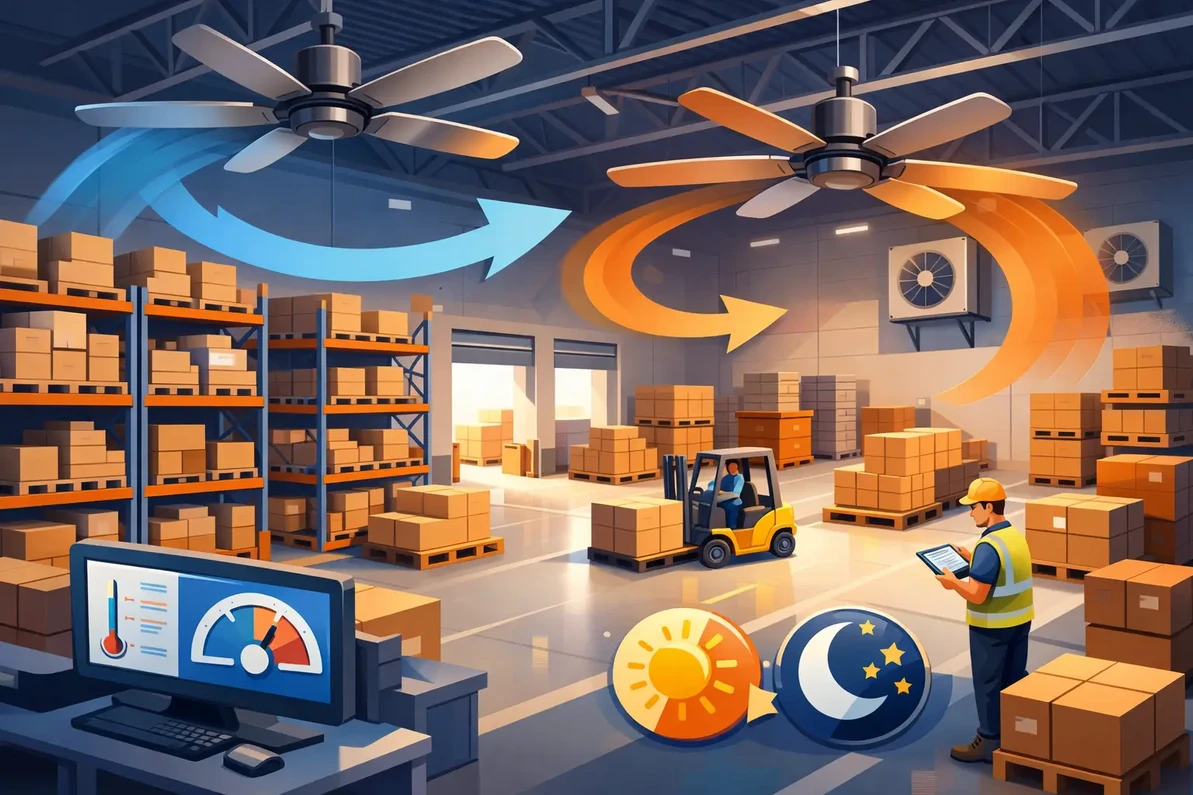
In an active warehouse, fans should generally start before heat and contaminants become a problem, not after employees begin reporting discomfort. A practical starting point is 30 to 60 minutes before the first shift, especially in buildings with high ceilings, metal roofs, solar exposure, forklifts, chargers, packaging lines, or process equipment. Early operation starts breaking up the warm air layer at the ceiling and establishes airflow before the building absorbs another day of heat.
During occupied hours, warehouse fans should run whenever they are supporting a defined ventilation objective. That objective may be air exchange, heat removal, spot cooling, destratification, or removal of dust, odors, fumes, and moisture. A fan schedule tied only to a clock is easy to program, but it often misses the real conditions on the floor.
For example, a distribution center that operates from 6 a.m. to 4 p.m. may need full airflow from late morning through late afternoon, when roof heat gain and loading-dock traffic peak. A manufacturing warehouse with welding, curing ovens, battery charging, or automated equipment may need process exhaust throughout production, regardless of outdoor temperature. The schedule must reflect the load.
After the shift, fans may continue operating for 30 to 90 minutes to purge accumulated heat, humidity, or process contaminants. This post-shift purge can reduce next-day startup temperatures. However, leaving every fan on all night is not automatically efficient. In a mild climate, night ventilation can be valuable. In hot, humid conditions, it can bring in moisture and add to the next day’s cooling burden.
Use temperature, humidity, and air quality to control run time
The best warehouse fan control plans combine a schedule with sensors and adjustable setpoints. A schedule establishes predictable operation. Sensors prevent the system from blindly running when conditions do not justify it.
Temperature-driven operation
Exhaust fans should commonly stage on as indoor temperature rises above the facility’s acceptable operating range. The correct setpoint depends on employee activity, clothing, process heat, and whether the building is air conditioned. A warehouse with active picking and forklift traffic may maintain acceptable comfort at a higher temperature than a sedentary packing or inspection area.
Do not place a temperature sensor directly in the exhaust airstream, near a roof deck, or against a sun-heated wall. Those locations can produce false high readings and cause unnecessary fan operation. Locate sensors where people work and where heat complaints occur, then compare those readings with ceiling-level temperatures. A 10- to 20-degree temperature difference between the occupied zone and the ceiling is a strong sign that destratification or HVLS circulation needs attention.
Humidity-driven operation
Humidity matters in warehouses storing paper products, wood, food ingredients, steel, electronics, textiles, or moisture-sensitive inventory. Exhausting warm, humid air can help only if replacement air is drier or if the facility has a dehumidification strategy. On a humid summer day, bringing in untreated outdoor air may increase indoor moisture rather than solve it.
Set fan controls around the facility’s allowable relative humidity or dew point, not a generic comfort setting. If condensation, corrosion, carton failure, or mold risk is present, measure conditions near stored materials and in known problem areas, not only at one wall-mounted thermostat.
Air-quality-driven operation
Fans should run whenever operations generate contaminants that need source capture or dilution. Forklift combustion emissions, welding smoke, solvents, dust, cleaning chemicals, battery-charging gases, and packaging odors are not comfort issues alone. They are ventilation design issues.
Where applicable, use carbon monoxide, nitrogen dioxide, volatile organic compound, particulate, or other appropriate sensors to trigger staged exhaust. A properly designed system may increase fan speed as contaminant concentration rises, rather than operating at full capacity all day. This approach saves energy, but only when sensor selection, placement, calibration, and alarm response are handled correctly.
Warehouse fan schedules by equipment type
Not every fan should run under the same rule. Treating all equipment as one system is a common cause of poor airflow performance and excessive utility cost.
HVLS and circulation fans
HVLS fans and other air-movement fans are often most useful during occupied hours. In cooling mode, they create air speed at the worker level, improving evaporative cooling without necessarily lowering air temperature. In heating season, they can run at low speed to push trapped ceiling heat back into the occupied zone.
Their operation should be coordinated with overhead doors, sprinkler clearance requirements, racking layouts, and any crane or material-handling activity. A circulation fan does not replace required exhaust or make-up air. It moves existing air. If the warehouse has a heat, fume, or moisture problem, it may need actual air exchange as well.
Exhaust fans
Roof-mounted and wall-mounted exhaust fans should operate when the building needs heat or contaminant removal and when adequate replacement air is available. Running a high-CFM exhaust system without make-up air creates negative pressure. The result can be hard-to-open doors, whistling gaps, reduced fan airflow, backdrafting concerns, and uncontrolled air entering through every crack in the building envelope.
The fan’s published CFM is only part of the calculation. Static pressure from louvers, dampers, filters, ductwork, guards, and intake paths can substantially reduce delivered airflow. Verify fan performance against the actual system static pressure, not free-air ratings alone.
Make-up air systems
Make-up air should run with exhaust, typically through interlocked controls. In colder climates, tempered make-up air prevents the exhaust system from pulling in freezing air through doors and wall openings. In conditioned facilities, the trade-off is more complicated: excess outdoor air can increase heating or cooling cost, but insufficient replacement air can make the exhaust system ineffective.
Variable frequency drives are especially useful where heat load changes across shifts. Instead of cycling large fans fully on and off, a VFD can modulate fan speed according to temperature, pressure, or air-quality demand. Because fan power drops dramatically as speed is reduced, even modest turndown can produce meaningful energy savings.
When fans should not run at full speed
Full-speed operation is not always the best answer. If outdoor air is hotter than indoor air and the only equipment is non-conditioned exhaust ventilation, aggressive exhaust may make a warehouse hotter. If outdoor humidity is extremely high, ventilation may worsen moisture control. If a building is unoccupied and no process load remains, circulation fans may offer little value beyond a controlled night purge strategy.
There are also operational limits. Do not use general ventilation fans as a substitute for engineered dust collection, fume capture, hazardous-location equipment, or code-required smoke control. In facilities with flammable vapors, combustible dust, high-temperature processes, or specialized manufacturing emissions, fan selection, motor type, electrical classification, and control logic require project-specific engineering review.
Build a control sequence that operators can actually use
A useful warehouse fan sequence should be clear enough for operations staff to understand and flexible enough for changing weather and production. Start with an occupancy schedule, then add temperature staging, humidity limits, pressure control, and air-quality alarms where relevant. Include manual override capability, but limit it with timers or reset logic so a fan is not left running for days after a special event.
Trend the data for several weeks. Compare indoor temperature, humidity, fan status, door activity, and utility demand against employee comfort complaints and production schedules. This reveals whether the system is short on airflow, poorly balanced, running at the wrong time, or simply controlled by the wrong sensor location.
The goal is not maximum fan runtime. It is the right airflow, at the right static pressure, delivered to the right zone when the facility needs it. Factory Fans Direct provides commercial and industrial ventilation guidance and free project evaluations for facilities that need fan capacity, make-up air, control strategy, and equipment selection reviewed before a costly installation or replacement.
Factory Fans Direct - Commercial & Industrial Ventilation & Cooling Experts | Contact Mike Miller VP Engineering at Factory Fans Direct for a FREE Project Evaluation 888-849-1233 | Mike@FactoryFansDirect.com
Recent Posts
-

AI Mega Factories Use Edmonds ecoPOWER Hybrid Ventilation
AI Mega Factories use Edmonds ecoPOWER Hybrid Turbine Ventilation because heat rejection cannot be t …4th Oct 2026 -
AI Cooling for High-Heat Facilities
A server aisle running 12°F hotter than its neighboring aisle, a crypto container recirculating exha …4th Oct 2026 -
AI Ventilation: Better Control Starts With Data
A warehouse can look adequately ventilated on paper and still have a 15-degree temperature differenc …4th Oct 2026