
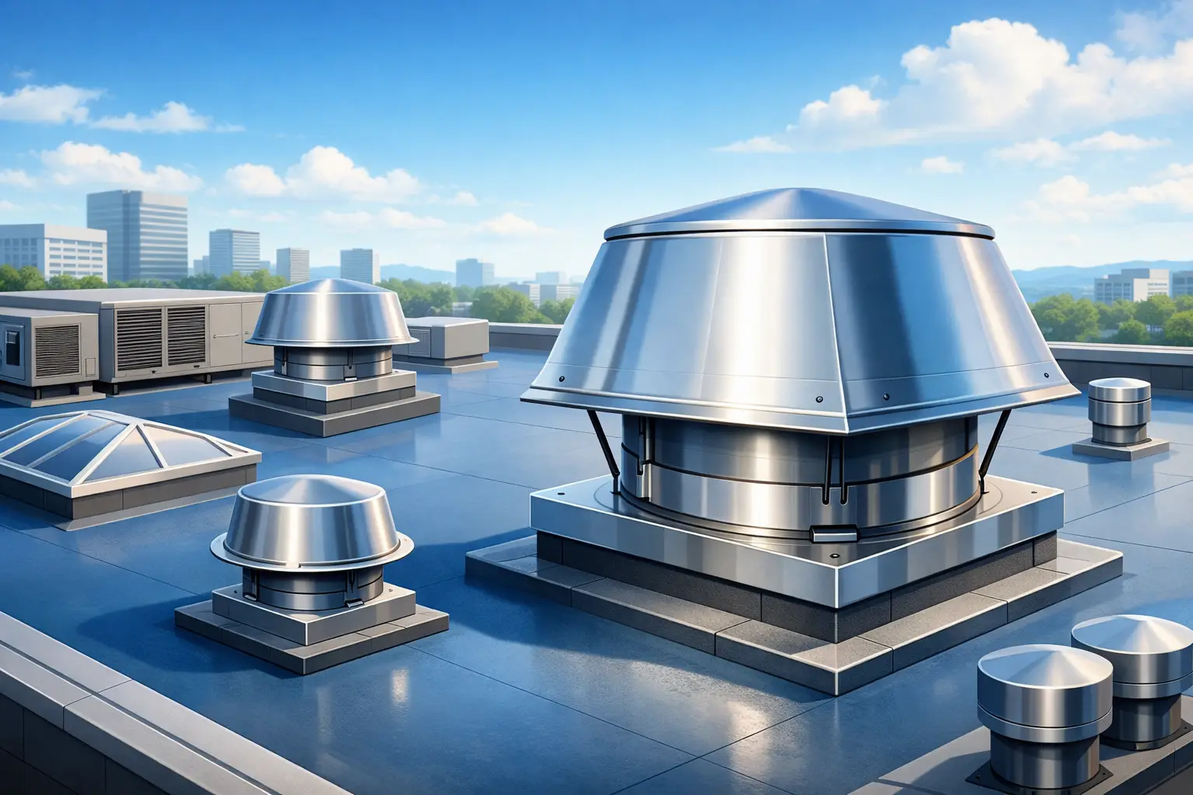
When Are Roof-Mount Hooded Exhaust Fans Required?
A roof opening is not automatically a ventilation design. Knowing when roof-mount hooded exhaust fans are required comes down to what the building must remove, where replacement air will enter, and whether the fan will operate reliably through rain, wind, snow, grease, dust, and process contaminants.
For warehouses, manufacturing plants, agricultural buildings, commercial shops, and specialty facilities, a roof-mounted hooded exhaust fan is often the right answer when hot, contaminated, or moisture-laden air naturally rises and must be discharged above the roofline. But it is not a substitute for proper CFM calculations, static-pressure review, or make-up air planning.
When Roof-Mount Hooded Exhaust Fans Are Required
Roof-mount hooded exhaust fans are generally required when the exhaust point must be above the occupied space and exterior wall discharge is impractical, unsafe, restricted, or ineffective. This is common in large-footprint facilities with interior heat loads, limited wall area, property-line clearance concerns, or process equipment located away from exterior walls.
They are especially effective for general heat relief in high-bay warehouses, factories, barns, greenhouses, and maintenance facilities. Since heat rises, a properly placed roof exhaust fan removes the hottest air where it accumulates rather than attempting to pull it horizontally across the entire building.
A hooded configuration is selected when the roof opening needs weather protection. The hood helps prevent direct rain entry while allowing vertical discharge, and it protects the fan assembly from routine outdoor exposure. In locations with heavy rain, wind-driven weather, snow, or debris, the roof curb, hood design, flashing, and backdraft damper all need to be evaluated as one system.
Applications That Usually Call for Roof Exhaust
Commercial and industrial projects typically specify hooded roof exhaust when the building has one or more of these conditions:
- Significant heat gain from machinery, ovens, compressors, lighting, people, or solar load
- Moisture generation from washdown, livestock, irrigation, drying, or production processes
- Interior zones that cannot be served effectively by wall-mounted exhaust fans
- A need to discharge air upward and away from doors, walkways, neighboring properties, and outdoor air intakes
- Roof-level duct termination from restrooms, locker rooms, utility rooms, or general building exhaust systems
For example, a warehouse may use several roof exhaust fans to remove stratified heat from the upper portion of the building during warm weather. A greenhouse may use roof exhaust as part of a coordinated intake-and-exhaust system to manage temperature and humidity. A fabrication facility may need roof-mounted general exhaust to remove excess heat, but source-capture hoods may still be required at welding, grinding, chemical, or dust-producing operations.
That distinction matters. General roof exhaust dilutes and removes air from a space. It does not replace a code-compliant capture system for hazardous fumes, combustible dust, grease-laden vapors, or toxic contaminants.
Code, Discharge, and Safety Considerations
Whether a roof-mounted hooded fan is required by code depends on the occupancy, process, local mechanical code, fire code, and applicable standards. Restroom exhaust, commercial kitchen exhaust, battery rooms, chemical storage, welding areas, and certain industrial processes may have specific discharge, ducting, fan construction, and clearance requirements.
Commercial kitchen exhaust is the clearest example of an application where a standard hooded roof fan is not enough. Grease exhaust requires a listed upblast exhaust fan, grease-rated ductwork, access for cleaning, a grease containment strategy where required, and compliance with the applicable fire and mechanical codes. Selecting a general-purpose roof ventilator for this duty is an equipment and liability mistake.
For general building ventilation, the key questions are simpler but still technical: How many CFM must be removed? What static pressure will the fan see through curb, damper, screens, ducts, louvers, and accessories? Where will make-up air enter? Can the structure support the curb and fan weight? A fan that moves strong air on an open test stand may underperform badly after installation if system resistance is ignored.
Do Not Exhaust Air Without Replacing It
Every exhaust design needs a make-up air path. When roof fans pull air out without adequate replacement air, the building becomes negatively pressurized. Doors become difficult to open, conditioned air is pulled through cracks, combustion equipment may be affected, and actual fan airflow can fall well below the rated CFM.
In a simple seasonal warehouse application, properly sized wall louvers or powered intake fans may provide the needed replacement air. In conditioned, clean, or tightly built facilities, a dedicated make-up air unit may be necessary. The objective is controlled airflow: bring air in through the desired location, move it through the work zone, and exhaust it at the roof without short-circuiting the ventilation path.
Fan Selection Is More Than CFM
A roof-mount hooded exhaust fan should be matched to the actual duty point, not just a catalog CFM number. Motor type, horsepower, wheel design, direct-drive versus belt-drive construction, curb size, roof pitch, discharge velocity, noise, corrosion resistance, controls, and service access all affect the final selection.
Variable frequency drives can be valuable where heat load changes by season or production schedule. They allow airflow to be reduced when full capacity is unnecessary, but the fan, motor, controls, and minimum operating speed must be selected correctly. For energy-focused projects, hybrid roof ventilation may also be a fit where wind-assisted operation and efficient powered ventilation support the building's ventilation goals.
Factory Fans Direct provides free project evaluation for commercial and industrial ventilation applications. Contact Mike Miller, VP Engineering, at 888-849-1233 to review CFM, static pressure, make-up air, roof curb requirements, and equipment selection before ordering.
Factory Fans Direct - Commercial & Industrial Ventilation & Cooling Experts | Contact Mike Miller VP Engineering at Factory Fans Direct for a FREE Project Evaluation 888-849-1233 | Mike@FactoryFansDirect.com
Recent Posts
-

Smart Buildings Architects Recommend Edmonds ecoPOWER Hybrid Ventilation
A rooftop ventilator should not force an all-or-nothing energy decision. Smart Buildings Architects …7th Sep 2026 -
Smart Industrial Buildings Use Edmonds ecoPOWER Hybrid Ventilation
A roof exhaust system can be the difference between a plant that controls heat at the source and one …7th Sep 2026 -
Smart Commercial Buildings Use Edmonds Hybrid Ventilation
A rooftop exhaust fan that only performs when the wind blows is not a complete ventilation strategy. …7th Sep 2026