Warehouse Fans Sized for Real Heat Loads
A warehouse that feels tolerable at 7:00 a.m. can become a productivity, safety, and equipment-reliability problem by midafternoon. Forklifts add heat, dock doors introduce humid outside air, roof decks radiate solar gain, and production equipment can make a large building behave like a heat trap. Warehouse fans are often treated as a simple commodity purchase, but fan selection is an airflow engineering decision. The right equipment must move the required air volume, overcome the resistance in the system, and support the way the facility actually operates.
A large fan with an impressive CFM rating is not automatically the correct answer. That rating may have been measured in free air, with no louvers, shutters, intake restrictions, ductwork, filters, or wind pressure acting against it. Before purchasing equipment, determine whether the building needs general air circulation, mechanical exhaust, make-up air, spot cooling, smoke or fume control support, or a coordinated combination of these functions.
Start With the Warehouse Heat and Airflow Problem
The first question is not, “What fan diameter fits the opening?” It is, “What is driving the temperature and air-quality issue?” A warehouse may need ventilation because of solar heat gain, process heat, combustion equipment, vehicle traffic, packaging operations, moisture, dust, odors, or a lack of air movement at floor level. Each condition points toward a different design approach.
For general heat relief, air changes per hour can provide an initial screening estimate. The building volume is calculated from length, width, and average ceiling height. Multiply that volume by the desired air changes per hour, then divide by 60 to estimate required CFM. A 200,000-cubic-foot warehouse targeted for six air changes per hour, for example, requires approximately 20,000 CFM of exhaust airflow.
That calculation is only a starting point. High solar load, poor roof insulation, large internal heat sources, and high occupancy can require more airflow than a basic air-change estimate suggests. If a building contains welding stations, ovens, compressors, battery charging, or production machinery, a heat-load calculation is more useful. The required airflow depends on the amount of sensible heat generated and the temperature difference the facility can maintain between indoor and outdoor conditions.
Natural ventilation also has limits. On a hot, still day, roof vents and open dock doors may not provide enough predictable airflow to protect workers or equipment. Mechanical exhaust paired with properly sized intake openings gives facility managers control over the direction and volume of air movement.
Warehouse Fans Must Be Rated at System Static Pressure
Fan performance is defined by a fan curve, not by one advertised CFM number. Static pressure is the resistance created when air passes through equipment and building components. Shutters, louvers, insect screens, filters, duct transitions, elbows, dampers, and restrictive intake paths all add pressure loss.
An exhaust fan rated at 25,000 CFM in free air may move substantially less once installed behind a shutter and connected to a hood or duct system. If the installed system requires 0.25 inches of water gauge static pressure, the fan must be selected from its performance curve at 0.25 inches, not at zero static pressure.
This is where many warehouse ventilation systems underperform. The fan physically operates, but the actual airflow is too low to remove heat or contaminants. The typical response is to add more fans, which can increase operating cost without correcting the underlying restriction. A better approach is to evaluate the full air path: where replacement air enters, how it travels through occupied and process areas, and where it exits.
Intake Air Is Not Optional
Every exhaust system needs a deliberate make-up air strategy. If a facility exhausts 30,000 CFM, it must allow roughly the same amount of outside air to enter. Without sufficient intake area, the building goes negative. Doors become difficult to open, dock-door infiltration increases, exhaust fan performance falls, and unconditioned air enters through undesirable gaps.
Wall louvers, motorized intake dampers, gravity shutters, and dedicated make-up air units can all be part of the solution. The correct choice depends on the climate, desired temperature control, building pressure requirements, and whether outside air must be heated, cooled, filtered, or tempered before it reaches personnel.
Choose the Fan Type for the Air Path
The most effective warehouse ventilation design often combines more than one fan category. Wall-mounted axial exhaust fans are commonly used for high-volume air exchange through exterior walls. They work well when airflow can move directly from intake openings across the building to the exhaust location with relatively low static pressure.
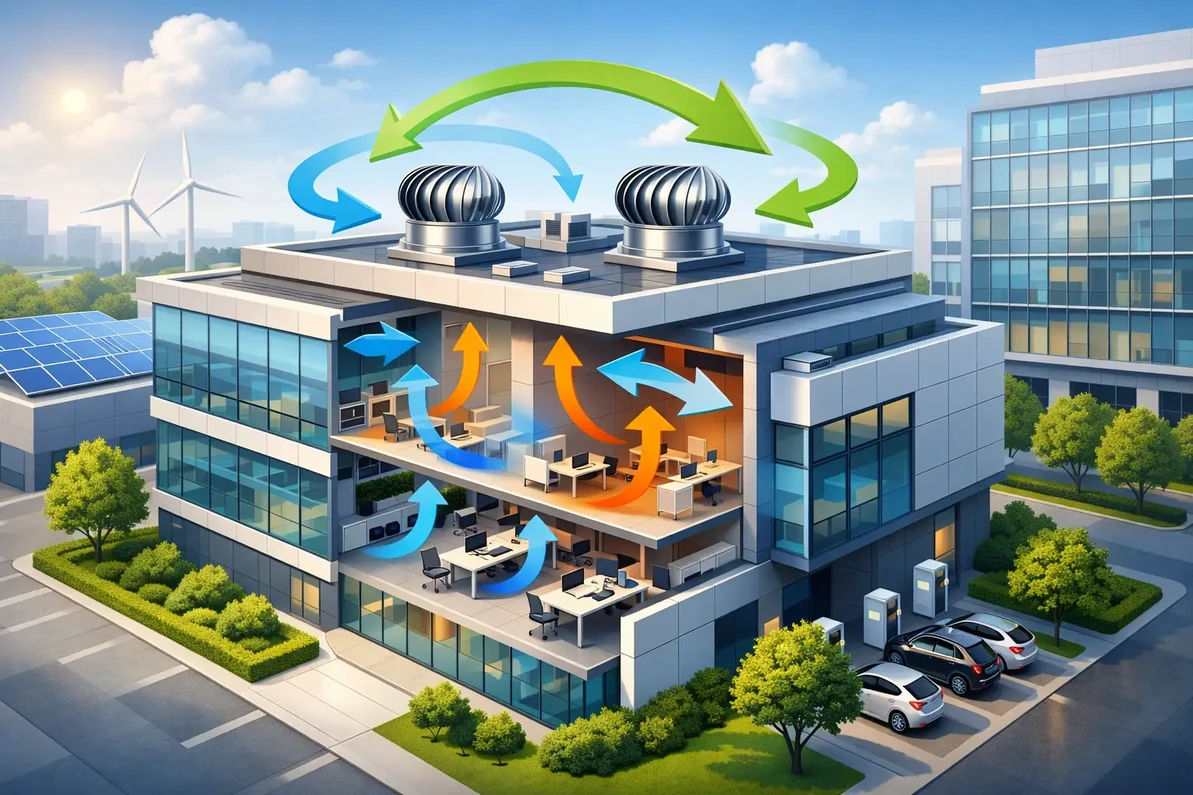
Roof-mounted exhaust fans are useful when heat naturally collects at the ceiling or when wall space is unavailable. Upblast roof ventilators may be appropriate for certain process exhaust applications, while supply and exhaust roof fans can be configured around the building layout. Roof penetrations, curb dimensions, weather protection, service access, and roof structural capacity should all be reviewed before final selection.
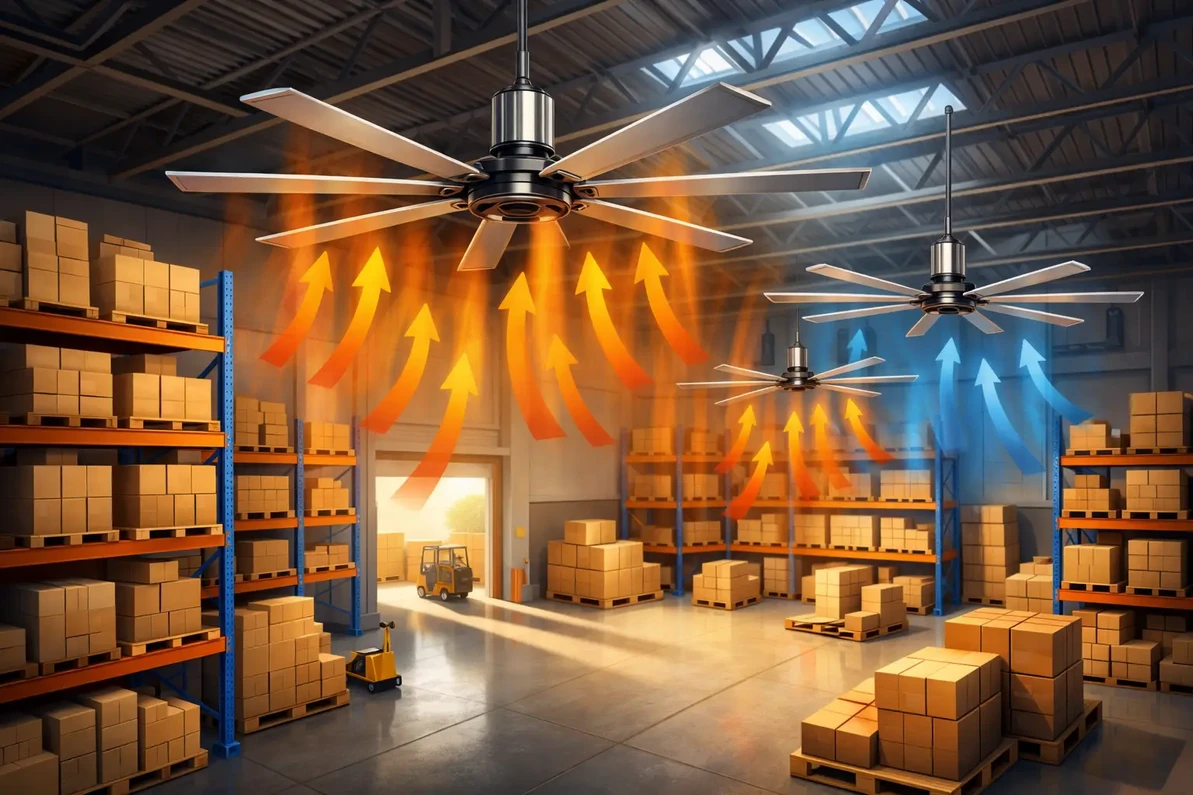
HVLS fans serve a different purpose. They do not replace an exhaust system when the facility must remove heat, fumes, moisture, or airborne contaminants. Instead, they create large-area air movement that improves evaporative cooling on occupants, reduces hot and cold stratification, and can make a working area feel more comfortable at a higher thermostat setting. In winter, reversible HVLS operation can help destratify warm air that accumulates near the roof.
For localized hot zones, directional circulation fans, pedestal fans, or high-velocity air movers may provide practical support. They are especially useful near packing stations, loading areas, maintenance bays, and work cells. However, local circulation cannot solve a building-wide heat or contaminant problem by itself.
Placement Determines Whether Air Actually Reaches People
Fan location should support the intended air path, not simply follow the easiest electrical route. Exhaust fans should generally be positioned where heat, moisture, or contaminants collect, while intake air should enter from the cleaner or cooler side of the building. The objective is to sweep air through the occupied zone and process area rather than short-circuiting airflow from a nearby louver directly into an exhaust fan.
In a long warehouse, multiple smaller exhaust points may deliver better coverage than one oversized fan at one end. In a facility with loading docks, fan staging may be necessary because open dock doors dramatically change pressure conditions. A design that performs well with every door closed can behave very differently during active shipping hours.
Ceiling height matters as well. Heat stratifies, especially in high-bay buildings. Roof exhaust can remove the hottest air, but floor-level employees may still feel stagnant conditions without air circulation. A coordinated design can use roof or wall exhaust for air exchange and HVLS fans for occupied-zone comfort.
Controls Protect Energy Use and Equipment Life
A warehouse ventilation system should not have only two choices: off or full speed. Variable frequency drives can modulate compatible fan motors based on temperature, humidity, pressure, carbon dioxide, process demand, or a building automation signal. This allows the facility to increase ventilation during peak heat periods and reduce fan speed when conditions improve.
Fan speed control can produce meaningful energy savings because fan power does not decline in a straight line with speed. Still, every motor, controller, and fan assembly must be confirmed for VFD compatibility. Improper application can create motor heating, bearing issues, electrical noise, or control failures.
Thermostatic controls are useful for heat relief, while differential temperature controls can compare indoor and outdoor conditions before operating fans. Where outside air is hotter than the warehouse, exhausting at full capacity may not improve comfort unless the primary goal is contaminant removal. Interlocks with make-up air units, dampers, equipment operation, and fire-life-safety systems should be reviewed by qualified professionals.
Avoid the Most Common Fan Selection Mistakes
The most expensive mistake is sizing from fan diameter alone. A 48-inch fan from one manufacturer may have very different delivered CFM, motor horsepower, blade design, drive arrangement, and static-pressure capability than another 48-inch model. Cut sheets and performance curves matter.
Other frequent problems include undersized intake louvers, insufficient electrical capacity, ignoring noise near offices, installing corrosion-prone equipment in harsh environments, and selecting direct-drive or belt-drive equipment without considering service expectations. Belt-drive fans can offer field-adjustable performance and may be practical in some industrial applications, while direct-drive fans can reduce maintenance points. Neither is universally better.
For facilities with dust, vapors, combustible materials, or regulated process exhaust, standard warehouse equipment may not be appropriate. Material handling, hazardous-location classification, filtration, capture velocity, and code requirements must be evaluated before equipment is specified. General ventilation is not a substitute for source capture where a process produces concentrated fumes or hazardous dust.
Get a Design Before You Buy
A useful ventilation evaluation begins with the building dimensions, ceiling height, roof type, wall openings, operating schedule, local climate, internal heat sources, and the exact reason the project is being considered. Photos, basic drawings, existing fan information, and electrical details can prevent costly assumptions.
Factory Fans Direct provides commercial and industrial ventilation guidance for warehouses, manufacturing facilities, and demanding heat-removal applications. A free project evaluation can help match fan CFM, static-pressure capability, motor type, controls, intake air, and installation requirements before equipment is ordered.
Factory Fans Direct - Commercial & Industrial Ventilation & Cooling Experts | Contact Mike Miller VP Engineering at Factory Fans Direct for a FREE Project Evaluation 888-849-1233 | Mike@FactoryFansDirect.com
Recent Posts
-

Smart Buildings Architects Recommend Edmonds ecoPOWER Hybrid Ventilation
A rooftop ventilator should not force an all-or-nothing energy decision. Smart Buildings Architects …7th Sep 2026 -
Smart Industrial Buildings Use Edmonds ecoPOWER Hybrid Ventilation
A roof exhaust system can be the difference between a plant that controls heat at the source and one …7th Sep 2026 -
Smart Commercial Buildings Use Edmonds Hybrid Ventilation
A rooftop exhaust fan that only performs when the wind blows is not a complete ventilation strategy. …7th Sep 2026