
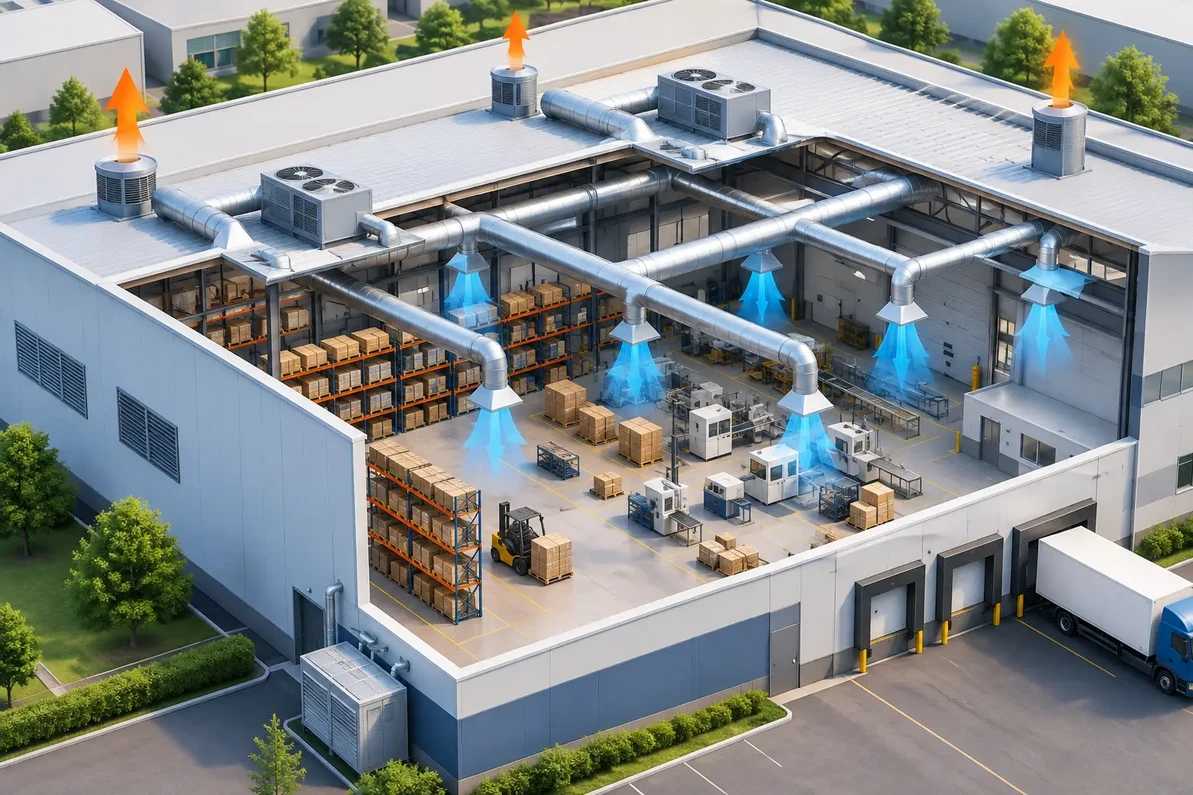
Ventilation Retrofit for Warehouses and Plants
A ventilation retrofit is rarely just a fan replacement. In a warehouse, manufacturing plant, processing facility, or agricultural building, poor airflow usually reflects a system-level problem: heat load has changed, production has expanded, roof penetrations are undersized, make-up air is missing, or existing equipment no longer operates near its published CFM.
The cost of leaving those conditions unresolved shows up quickly. Employees work in hotter areas, process equipment runs harder, contaminants linger, loading doors become the only source of replacement air, and exhaust fans pull against static pressure they were never selected to overcome. A properly engineered retrofit starts with what the building is actually doing now, not with a catalog fan size or a rough square-footage rule.
When a Ventilation Retrofit Is the Right Move
Facilities often consider a retrofit after a comfort complaint, but temperature is only one signal. A building may need airflow improvements when new machinery adds sensible heat, welding or finishing operations increase contaminant loads, a warehouse changes from storage to active fulfillment, or production layouts block established air paths. High utility costs, excessive negative pressure, roof fan failures, and uneven temperatures from floor to ceiling also deserve investigation.
Retrofitting can be more practical than full HVAC replacement when the primary need is heat rejection, process exhaust, air exchange, or pressure control. It can also complement air conditioning by reducing the thermal burden before conditioned equipment has to handle it. The correct approach depends on climate, occupancy, process emissions, building leakage, roof construction, and whether air must be treated before discharge.
For example, adding more exhaust capacity may reduce heat in a fabrication area. But if the facility cannot provide enough intentional replacement air, the new fans can create stronger negative pressure, reduce delivered airflow, pull in dust through unplanned openings, and make exterior doors difficult to operate. That is not a fan problem. It is an air-balance problem.
Start With a Field Assessment, Not a Nameplate
An effective ventilation retrofit begins by documenting the conditions that define performance. Existing fan nameplates matter, but they do not tell the entire story. Belt condition, blade pitch, dirty shutters, clogged guards, motor speed, backdraft dampers, duct losses, and discharge restrictions can all reduce real CFM.
A field review should establish the building volume, ceiling height, heat-producing equipment, operating schedules, occupancy, process contaminants, and current intake and exhaust locations. It should also identify where the heat is collecting. In high-bay buildings, a roof-mounted exhaust fan may remove the hottest air efficiently, while circulation or HVLS fans help move air through occupied zones. In other applications, spot exhaust close to the process is the priority.
Static pressure deserves particular attention. Fans selected for free-air CFM can disappoint when they are connected to ductwork, louvers, filters, light traps, dampers, or long discharge paths. The fan curve, not the largest advertised airflow number, determines whether the unit can deliver the required CFM at the system's operating pressure.
Measure the Heat Load and Airflow Path
Heat load is not a guess. Motors, ovens, compressors, lighting, IT equipment, solar gain, people, and process equipment all contribute. A crypto mining room or data center expansion can add a concentrated and continuous heat load that overwhelms ventilation designed for occasional occupancy. A greenhouse may need a different strategy because solar gain, humidity, crop conditions, and light-deprivation equipment change throughout the day.
The air path is equally important. Supply air should enter where it can reach the occupied or process zone, travel through the space, collect heat or contaminants, and exit without short-circuiting directly from intake to exhaust. A large exhaust fan mounted too close to an open louver can move plenty of air while doing very little work in the areas that need cooling.
Match Equipment to the Actual Retrofit Objective
There is no single retrofit package for every facility. The equipment selection should follow the ventilation objective and operating conditions.
Roof-mounted exhaust systems are often appropriate for high-bay warehouses, manufacturing plants, gyms, and agricultural structures where hot air naturally rises. Wall exhaust fans can be highly effective when paired with properly sized supply louvers on the opposite wall. Where ducted capture is required, centrifugal or mixed-flow equipment may be needed to overcome higher static pressure. In corrosive, humid, or washdown environments, material selection and motor protection become central to service life.
Make-up air equipment becomes necessary when exhaust volume is substantial, outside air must be tempered, or the building envelope is relatively tight. During cold-weather operation, untreated replacement air can create comfort and freeze-risk concerns. A heated make-up air system may cost more initially, but it can protect production conditions and prevent a ventilation upgrade from becoming a wintertime operating problem.
Variable frequency drives and controls add another level of value when loads change throughout the day. Rather than operating every fan at full speed continuously, controls can stage equipment based on temperature, humidity, pressure, carbon dioxide, or process signals. This can reduce noise and electrical use while maintaining a defined operating target. The trade-off is that controls must be commissioned correctly. A sophisticated controller cannot compensate for undersized intakes, incorrectly selected fans, or poor sensor placement.
Consider Hybrid and Energy-Conscious Options
For roof ventilation projects with a focus on energy performance, hybrid rooftop ventilators can offer a useful option. Edmonds ecoPOWER hybrid ventilation combines wind-driven operation with a high-performance EC brushless DC motor for continuous mechanical operation when needed. It is not solar powered. The value is in using available wind conditions while maintaining dependable powered ventilation and controllability for LEED and Net-Zero-oriented projects.
That said, hybrid equipment is not automatically the answer for every facility. Buildings with high process heat, significant duct resistance, tightly controlled pressure requirements, or around-the-clock cooling loads may need conventional powered exhaust, make-up air, and automated control sequences. Selection should be based on the design duty, not a technology label.
Installation Details That Decide Retrofit Performance
The installation phase is where a good design can either perform or fail. Roof curbs must match the fan base and roof pitch. Structural loading, electrical capacity, disconnects, weatherproofing, and service access should be addressed before equipment arrives. In wall-mounted applications, openings need adequate framing and correct shutter or louver orientation.
Intake area is frequently underestimated. A small louver may create enough resistance to choke an exhaust system, add noise, and increase motor load. The same issue appears with restrictive bird screens, dirty filters, or undersized dampers. Supply openings should be sized for acceptable face velocity and placed to support the planned air path.
Commissioning should verify fan rotation, motor amperage, VFD programming, damper operation, control setpoints, and actual building pressure. For larger projects, airflow testing and balancing provide valuable confirmation that the system meets the intended duty. If the numbers do not match the design target, correct the cause before declaring the project complete.
Avoid the Common Retrofit Shortcuts
The most expensive ventilation retrofit is one that has to be redone. Replacing failed fans with the same model may be reasonable when the building and duty have not changed. It is a poor strategy when the original system was undersized, the process has expanded, or the fan failed because it was operating beyond its rated conditions.
Another common shortcut is treating circulation fans as exhaust. HVLS and directional fans can improve perceived comfort, destratify heat, and support employee productivity, but they do not remove contaminants or reduce building pressure on their own. They work best as part of a coordinated airflow plan.
Finally, do not base the entire project on CFM alone. CFM, static pressure, motor type, sound, duty cycle, material construction, controls, intake capacity, and future expansion all affect the right equipment choice. The best system is not necessarily the largest fan. It is the system that delivers the required airflow where and when the facility needs it.
Factory Fans Direct provides ventilation design engineering support and a free project evaluation for commercial and industrial applications. A useful project discussion begins with your building dimensions, roof or wall layout, current equipment, process heat sources, and the operational problem you need to solve.
A well-planned retrofit gives a facility more than cooler air. It gives operations a measurable, maintainable airflow strategy that can keep pace with changing production, equipment loads, and energy goals.
Factory Fans Direct - Commercial & Industrial Ventilation & Cooling Experts | Contact Mike Miller VP Engineering at Factory Fans Direct for a FREE Project Evaluation 888-849-1233 | Mike@FactoryFansDirect.com
Recent Posts
-

The BLUE WAVE Supports Commercial & Industrial ecoPOWER Hybrid Turbine Ventilation
A hot production floor, warehouse, or agricultural building rarely has one ventilation problem. Heat …8th Nov 2026 -
AI Smart ecoPOWER Hybrid Turbine Ventilation for LEED Projects
A LEED ventilation strategy cannot be built around a brochure claim or a fan wattage number alone. A …8th Nov 2026 -
AI LEED Projects Specify ecoPOWER Hybrid Ventilation
A rooftop exhaust strategy can make or break a net-zero model long before a building opens. When AI …8th Nov 2026