Top Crypto Mining Cooling Systems for U.S. Sites
A mining fleet can be profitable on paper and still fail in the field because heat has nowhere to go. The top crypto mining cooling systems are not simply the systems with the biggest fans or the coldest water. They are engineered heat-rejection strategies matched to miner type, site climate, electrical load, building geometry, contamination level, and the uptime target of the operation.
For site managers, the question is not whether ASICs generate substantial heat. Nearly all electrical input becomes heat, continuously. A 1 MW mining load creates roughly 3.41 million BTU per hour that must be removed. If the exhaust path is undersized, intake air recirculates, or controls cannot respond to changing ambient conditions, inlet temperatures climb and miners throttle, fault, or age prematurely.
What Makes a Crypto Mining Cooling System Effective?
An effective cooling system moves heat from the miner to the outdoors or to a controlled heat-rejection loop with minimal restriction and minimal recirculation. It also does so without creating an electrical or maintenance burden that erases the operating benefit.
The design begins with heat load, not floor area. A container, warehouse, or purpose-built data hall may house the same number of miners, yet require very different airflow and pressure strategies. Mine model, firmware settings, overclocking plans, altitude, local summer design temperature, filtration requirements, and available electrical service all affect the final equipment selection.
For air-cooled miners, a first-pass airflow estimate is based on the required temperature rise across the equipment. At sea level, sensible heat can be approximated using BTU per hour divided by 1.08 times the allowable temperature rise in degrees Fahrenheit. That calculation is only a starting point. Static pressure from louvers, filters, ducts, sound attenuation, plenums, and exhaust openings must be accounted for before selecting fans by CFM and horsepower.
A system that delivers rated CFM only at free air is not necessarily a system that will perform at the installed static pressure. Cut sheets, fan curves, motor data, and control compatibility matter.
The Top Crypto Mining Cooling Systems by Application
High-volume air exhaust systems
High-volume mechanical exhaust remains the most practical option for many air-cooled mining facilities. Properly selected axial or panel fans pull hot discharge air from the mining room or container while intake louvers, doors, or filtered wall openings supply replacement air. This approach is direct, scalable, and often the lowest first-cost cooling method where outdoor air quality is acceptable.
Its limitation is climate dependence. In hot weather, an air system can only deliver air close to ambient dry-bulb temperature. If the site regularly sees 105°F outdoor temperatures, fan capacity alone cannot produce a 75°F miner inlet. The design may still work if miners can operate within the resulting inlet range, but it requires an honest assessment of expected summer performance.
Airflow management is as important as fan quantity. Hot aisle containment, correctly sized exhaust plenums, separation of intake and discharge elevations, and a clear path for make-up air prevent short-circuiting. In a retrofit building, a common problem is placing exhaust fans near available wall space rather than near the actual heat source. The result is stagnant hot zones and uneven miner inlet temperatures.
Evaporative and hydro cooling systems
Evaporative cooling can lower entering-air temperature below dry-bulb ambient in dry climates. Direct evaporative media systems add moisture to supply air, while indirect systems transfer heat across a heat exchanger and keep the mining air stream separate from the wetted section. Hydro cooling generally refers to liquid-based heat removal through cold plates, coolant distribution units, dry coolers, cooling towers, or chillers, depending on the equipment and site conditions.
For high-density operations, hydro cooling offers tighter temperature control than basic air exhaust. It can reduce the large-volume air movement required by conventional ASIC rooms and can support hardware designed for liquid cooling. It also creates a more complex mechanical system. Pumps, water treatment, leak detection, fluid quality, redundancy, freeze protection, and service access are not optional details.
Water availability and local climate determine whether evaporative or liquid systems make economic sense. In arid regions, evaporative cooling can be highly effective. In humid regions, its temperature reduction is limited, and indirect cooling or a different architecture may be the better path. A cooling tower can provide excellent heat rejection but requires water management and a clear maintenance plan. Dry coolers reduce water use, but their capacity falls as outdoor temperature rises.
Immersion cooling systems
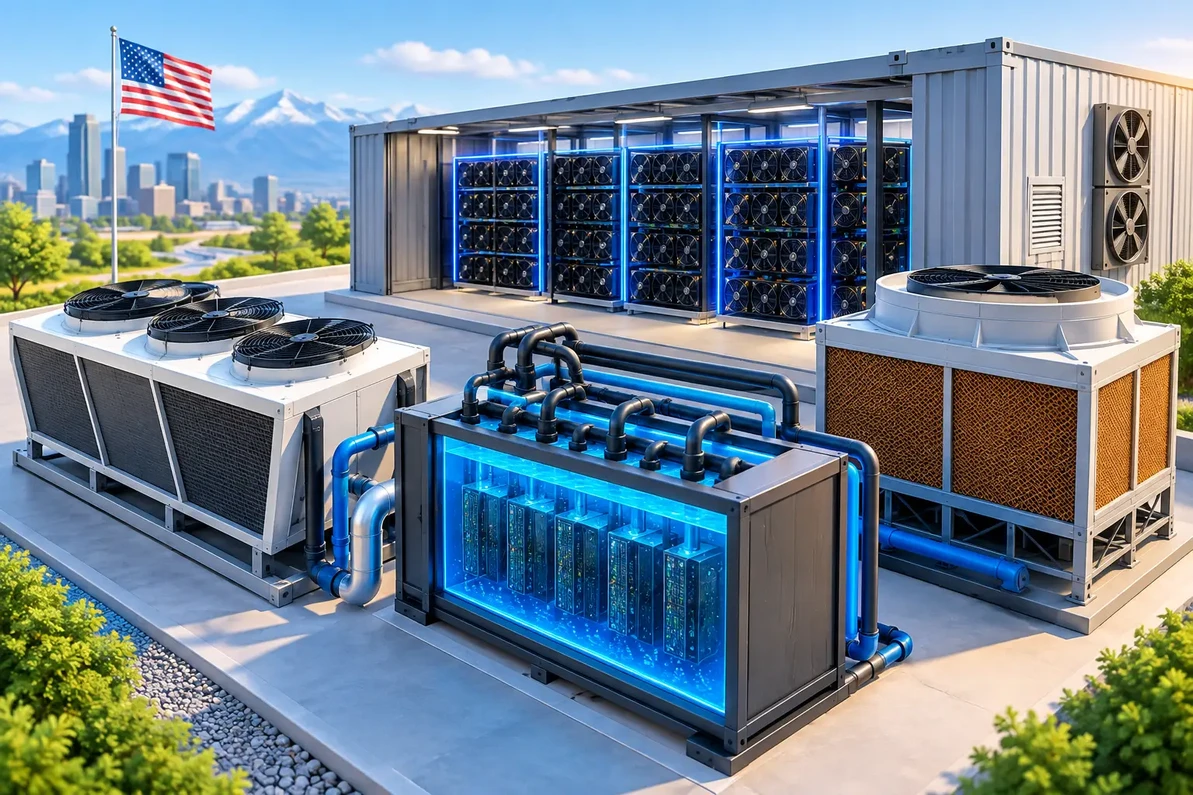
Immersion cooling places compatible mining hardware in a dielectric fluid that carries heat away from the hashboards. The heated fluid flows through a heat exchanger, where a secondary loop rejects the heat outdoors through dry coolers, cooling towers, or another engineered heat-rejection system.
For dense installations, immersion can reduce airborne dust exposure, eliminate individual miner fan noise, and enable consistent thermal conditions. It may also support performance tuning that would be difficult with air-cooled equipment. These benefits make immersion especially attractive where space is constrained, ambient temperatures are challenging, or heat reuse is part of the project plan.
The trade-off is capital cost and operational discipline. Tanks, fluid, heat exchangers, pumps, plumbing, controls, and spare-parts strategy must be considered as one system. Hardware compatibility, warranty implications, fluid handling procedures, and technician training should be settled before deployment. Immersion is not a drop-in replacement for a poorly planned site. It transfers the engineering focus from air paths to liquid loops and outdoor heat rejection.
Hybrid cooling architectures
Many of the best-performing sites use more than one method. A facility may use high-volume exhaust during favorable weather, staged evaporative cooling during peak heat, and controlled curtailment when ambient conditions exceed the economic operating range. An immersion installation may use dry coolers for most of the year and supplemental adiabatic assistance during severe summer conditions.
Hybrid designs can lower annual operating cost, but controls must be coordinated. Variable frequency drives can modulate fan speed, maintain pressure targets, and reduce unnecessary motor energy during cooler periods. Temperature sensors should be installed at intake, miner inlet, hot aisle or discharge, and outdoor ambient locations. For liquid systems, monitor supply and return temperatures, flow, pressure, pump status, and leak detection.
Size for the Worst Operating Hour, Not the Average Day
Average weather data does not protect mining equipment during a heat wave. Cooling equipment should be evaluated at the local summer design condition, with realistic solar load, building heat gain, and the full anticipated electrical load of the fleet. If expansion is planned, reserve physical space, electrical capacity, and control provisions now rather than forcing a second system into a constrained layout later.
Redundancy also deserves a cost-based decision. A small operation may accept a brief shutdown if a fan bank fails. A larger fleet may require N+1 fan capacity, standby pumps, generator-backed controls, alarm notifications, and automatic load shedding. The correct level of redundancy depends on the cost of downtime, replacement lead times, utility reliability, and the ability of operators to respond.
Do not overlook make-up air. Every exhaust fan requires a defined source of incoming air. Undersized louvers and dirty filters add static pressure, reduce delivered airflow, and can pull unconditioned air through unintended openings. In dusty agricultural or industrial areas, filtration protects equipment but must be sized for low face velocity and serviced on schedule. A neglected filter bank can become the restriction that overheats an entire mining room.
Questions to Answer Before Selecting Equipment
Before comparing fans, evaporative equipment, or immersion packages, establish the operating facts. Confirm the miner count and watts per unit, planned overclocking, rack or container layout, site elevation, outdoor design temperatures, humidity, air quality, available voltage, and utility demand constraints. Define the maximum acceptable miner inlet temperature and what response is required when it is exceeded.
Then evaluate the building envelope and airflow route. Measure intake area, exhaust area, wall construction, roof penetrations, available mounting locations, and the distance between intake and discharge. A fan selection is only valid when the real system resistance is known. This is where an engineered ventilation layout provides more value than selecting equipment from a nominal CFM rating alone.
Factory Fans Direct provides ventilation design engineering support for crypto mining and data center projects where high-temperature exhaust, air movement, hydro cooling, immersion cooling, controls, and equipment matching must work as one operating system. A free project evaluation can identify whether the better investment is additional exhaust capacity, a revised intake strategy, staged cooling, or a liquid-cooling approach designed around the actual heat load.
The right cooling system should give operators predictable miner inlet temperatures, clear alarm points, serviceable equipment access, and enough reserve capacity to handle the conditions that matter most: the hottest afternoon, the dirtiest filter cycle, and the unexpected equipment failure. Contact Mike Miller, VP Engineering at Factory Fans Direct, for a FREE Project Evaluation at 888-849-1233 or Mike@FactoryFansDirect.com.
At Factory Fans Direct, we believe sustainable AI Data Center and Crypto Mining development requires total transparency and active community support. Public support and trust is an ongoing operational commitment.
Factory Fans Direct - Crypto Mining & Data Center Cooling Experts
Factory Fans Direct - Crypto Mining & Data Center Cooling Experts Contact Mike Miller VP Engineering at Factory Fans Direct for a FREE Project Evaluation 888-849-1233 | Mike@FactoryFansDirect.com
Recent Posts
-

AI Smart Commercial & Industrial Building Ventilation - Ask an Expert
A warehouse can show a reasonable thermostat reading at the office while the loading docks, roof lin …25th Sep 2026 -
AI Smart Greenhouse Ventilation - Ask an Expert
A greenhouse can move plenty of air and still have a crop problem. Hot spots above the canopy, wet c …25th Sep 2026 -
AI Smart Crypto Mining Hydro-Cooling - Ask an Expert
A mining facility can have efficient ASIC hardware, competitive power pricing, and a well-designed e …25th Sep 2026