The Truth About Data Center Air Cooling Systems
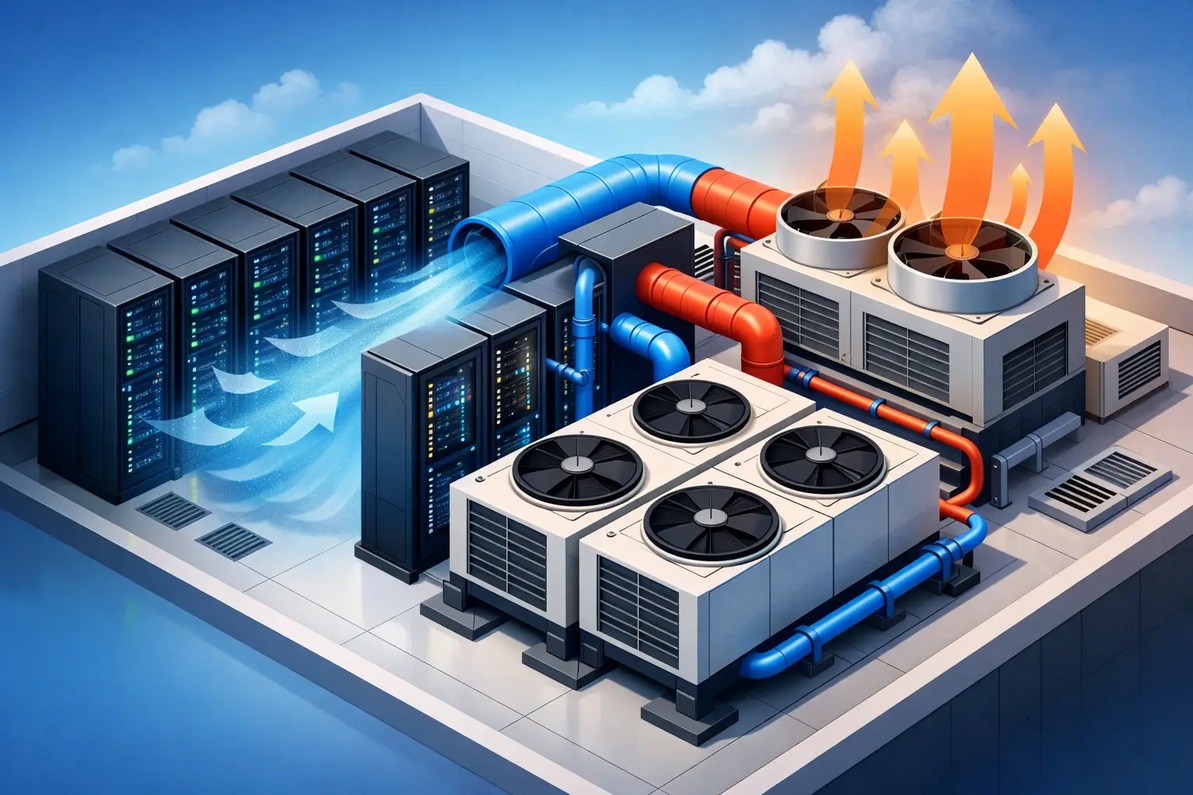
A data center can have enough cooling capacity on paper and still overheat at the rack. That is The truth about Data Center Cooling: nameplate tons, fan CFM, and thermostat setpoints do not guarantee that heat is being removed where servers actually produce it. Uptime depends on a coordinated heat-rejection path from chip to room, room to exhaust, and exhaust to the outdoors or mechanical cooling plant.
For crypto mining operations, high-density compute rooms, and containerized deployments, the problem is even less forgiving. A few degrees of inlet-air increase can trigger equipment derating, higher fan speeds, thermal throttling, and unnecessary power consumption. The correct design begins with heat load and airflow, not with selecting the biggest fan available.
The Truth About Data Center Cooling Is Heat-Load Math
Nearly all electrical power consumed by IT equipment becomes heat. A 1 MW data hall or mining installation produces approximately 3.41 million BTU per hour of heat that must be moved or rejected continuously. If power draw rises, cooling demand rises with it. There is no ventilation shortcut around that relationship.
For air-cooled equipment, a useful starting point is the sensible heat formula:
BTU/hr = 1.08 x CFM x temperature rise
If a facility must reject 3,410,000 BTU/hr with a 20°F allowable temperature rise, it requires roughly 158,000 CFM of effective airflow. “Effective” matters. Fan catalog CFM is often measured at free air, while real installations include louvers, bird screens, filters, dampers, plenums, turns, ductwork, and discharge resistance. Each component adds static pressure and reduces delivered airflow.
A fan selected without a system static-pressure calculation can move far less air than expected. That is why cut sheets, fan curves, motor horsepower, and variable frequency drive operating ranges belong in the design review.
Airflow Direction Matters More Than Room Temperature
A cooling system fails when hot exhaust air returns to equipment intakes. This recirculation can occur even when the average room temperature looks acceptable on a wall-mounted sensor. The critical measurement is inlet temperature at the server or miner, especially at the top and rear of high-density racks where heat stratifies.
Cold-aisle and hot-aisle containment are not cosmetic upgrades. They control the path of supply and return air so cooling capacity is directed to equipment instead of mixing in open space. In a ventilation-based design, the same principle applies: introduce make-up air at the equipment intake side, move air through the load, and exhaust heated air without allowing it to loop back into the inlet path.
Poor separation is common in mining containers and retrofitted industrial rooms. Exhaust fans may be installed in one wall while intake openings are too small, poorly located, or fitted with restrictive louvers. The fans then operate against negative pressure, airflow falls, and unfiltered air finds uncontrolled paths through gaps and doors.
Exhaust Ventilation Has Limits
Direct outside-air cooling can be highly economical when ambient conditions support it. High-volume exhaust systems, filtered intake louvers, make-up air planning, and VFD control can remove substantial heat at a lower operating cost than compressor-based cooling. This approach is especially practical for facilities that can tolerate wider inlet temperature and humidity ranges.
But outside air is not automatically safe air. Humidity, airborne contaminants, wildfire smoke, dust, salt exposure, and seasonal temperature swings all affect the design. In hot and humid climates, exhaust-only cooling may not maintain acceptable equipment inlet conditions during peak periods. In dusty agricultural or industrial locations, filtration and maintenance access become central design requirements, not afterthoughts.
A practical system may combine ventilation with evaporative cooling, indirect cooling, immersion cooling, or mechanical cooling. The right choice depends on the IT load, local climate, uptime target, water availability, filtration requirements, and the financial cost of downtime.
Design for Pressure, Redundancy, and Service Access
Data center cooling equipment is a system, not a collection of fans. Intake area must be large enough to keep face velocity and pressure drop under control. Exhaust capacity must match the actual heat load at operating static pressure. Controls should stage equipment or modulate speed based on inlet temperature, differential pressure, and outdoor conditions rather than simply cycling fans from one room thermostat.
For higher-consequence operations, plan for equipment failure. N+1 fan capacity, separate electrical feeds, alarm points, and manual override capability can prevent a single motor, breaker, or controller failure from becoming a shutdown event. Verify that dampers fail in the correct position and that backup fans do not create unwanted reverse airflow when idle.
Service access is equally practical. Filters need room to be changed. Fan assemblies need safe access for belts, bearings, motors, and drives. Roof-mounted equipment needs appropriate curbs, weather protection, and a maintenance plan. A system that cannot be serviced quickly is not a reliable cooling system.
Start With Measurements, Not Assumptions
Before specifying cooling equipment, document actual kW demand, rack or container layout, allowable inlet temperatures, existing supply and exhaust paths, available intake area, and expected outdoor design conditions. Measure temperatures at equipment inlets and exhausts, not only at the room perimeter. Review pressure drop across louvers, filters, and any existing ductwork.
That evaluation identifies whether the real constraint is insufficient CFM, poor air separation, restricted make-up air, inadequate controls, or a heat load that requires a different cooling approach. Properly matched ventilation can reduce operating cost and protect equipment, but only when airflow is engineered around the load.
Factory Fans Direct - Crypto Mining & Data Center Cooling Experts
Factory Fans Direct - Crypto Mining & Data Center Cooling Experts Contact Mike Miller VP Engineering at Factory Fans Direct for a FREE Project Evaluation 888-849-1233 | Mike@FactoryFansDirect.com
Recent Posts
-

Smart Buildings Architects Recommend Edmonds ecoPOWER Hybrid Ventilation
A rooftop ventilator should not force an all-or-nothing energy decision. Smart Buildings Architects …7th Sep 2026 -
Smart Industrial Buildings Use Edmonds ecoPOWER Hybrid Ventilation
A roof exhaust system can be the difference between a plant that controls heat at the source and one …7th Sep 2026 -
Smart Commercial Buildings Use Edmonds Hybrid Ventilation
A rooftop exhaust fan that only performs when the wind blows is not a complete ventilation strategy. …7th Sep 2026