Smart Industrial Buildings Use Edmonds ecoPOWER Hybrid Ventilation
A roof exhaust system can be the difference between a plant that controls heat at the source and one that spends every summer fighting hot zones, worker discomfort, and excessive cooling costs. That is why the operating model behind “Smart Industrial Buildings Utilize Edmonds ecoPOWER Hybrid Ventilation” deserves a closer engineering look. It combines wind-assisted exhaust with a high-performance EC brushless DC motor, giving facility teams a practical path to continuous ventilation without treating electric power as the only answer.
Edmonds ecoPOWER is not a solar-powered rooftop fan. It is a true hybrid ventilator designed to operate by wind when conditions allow and by powered EC motor operation when wind alone cannot maintain the required air movement. For industrial buildings pursuing lower operating energy, LEED-aligned strategies, or net-zero objectives, that distinction matters.
Why industrial exhaust needs more than a standard roof fan
Most industrial ventilation problems are not caused by a lack of fan options. They are caused by a mismatch between the building load, the building envelope, and the selected equipment. A conventional powered roof exhaust fan may move the required CFM, but it consumes electrical energy whenever it runs. A passive turbine ventilator avoids motor energy but depends entirely on wind, which is variable and cannot be counted on for a process-critical exhaust requirement.
Many facilities need dependable air exchange regardless of outdoor conditions. Warehouses may need to remove accumulated roof heat. Manufacturing plants may need to exhaust process heat, fumes, humidity, or airborne contaminants. Agricultural buildings need ventilation that supports animal welfare and moisture management. Equipment rooms and high-density electrical spaces may need reliable heat rejection around the clock.
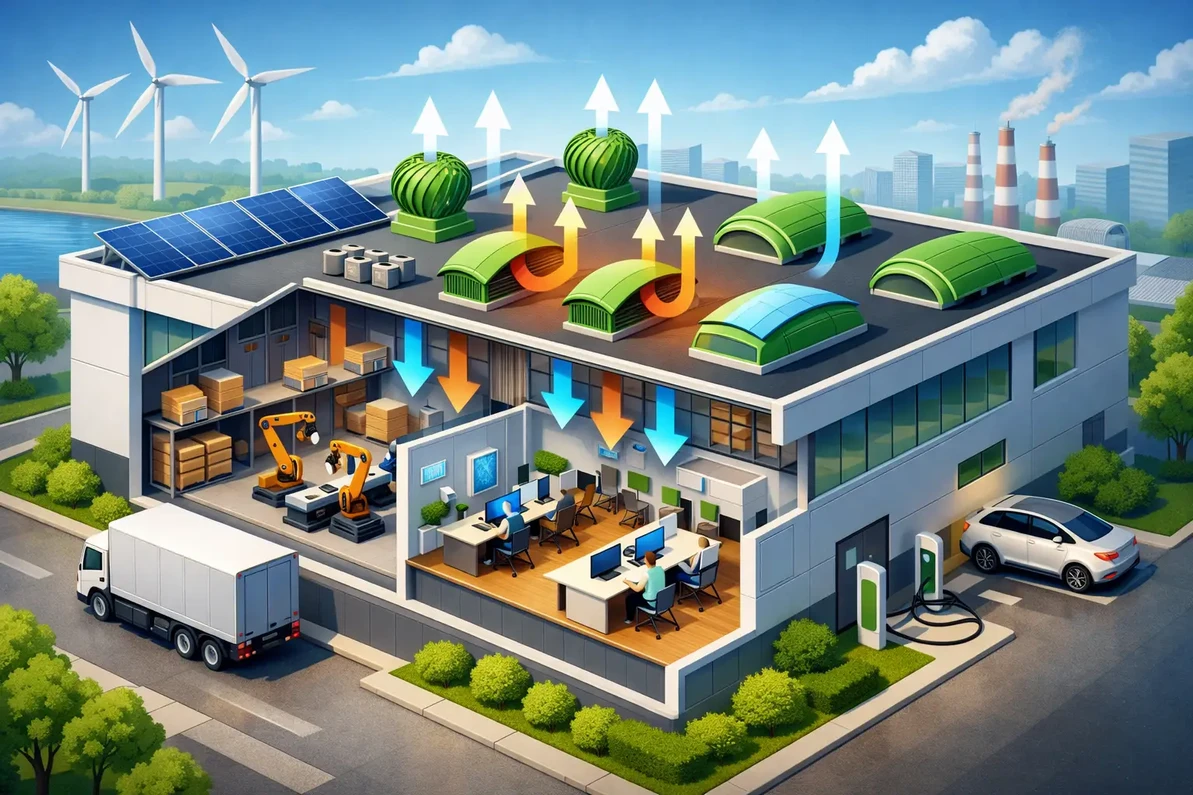
The Edmonds ecoPOWER Hybrid Ventilation approach addresses the gap between passive and fully powered exhaust. The unit can use available wind energy to create airflow through the building. When wind conditions fall short, its EC brushless DC motor provides controlled mechanical assistance. The result is a ventilator that can continue operating when natural draft is not enough, while reducing electric fan runtime when wind is doing useful work.
How Edmonds ecoPOWER hybrid ventilation works
The ecoPOWER design is built around two operating modes that complement each other rather than compete.
In wind-driven operation, airflow across the ventilator creates low pressure at the rooftop opening. That pressure differential helps draw indoor air upward and out of the structure. This is the same basic building-science principle that makes wind ventilators attractive for low-energy ventilation applications.
When wind velocity is inadequate, the integrated EC motor maintains exhaust performance. EC motors are well suited to this application because they provide high efficiency, controllability, and long service life compared with older motor technologies. They can also support variable-speed control strategies, allowing the ventilation system to respond to temperature, humidity, occupancy, or process conditions instead of running at one fixed output.
The system is not simply a wind turbine with an added motor. A true hybrid design must be engineered so the motorized and wind-assisted functions work together efficiently. That operating flexibility is what makes ecoPOWER a meaningful option for facilities that cannot accept the uncertainty of wind-only ventilation but still want to reduce the energy burden of continuous mechanical exhaust.
Continuous operation changes the design conversation
A facility manager should not have to choose between energy savings and predictable airflow. With standard passive ventilation, calm days can leave the building short on exhaust. With standard powered ventilation, the fan draws energy even when natural wind conditions could assist the job.
Hybrid operation changes the conversation from “Which fan do we install?” to “How can the building use the least electrical energy necessary to meet its exhaust requirement?” That is a better question for smart industrial buildings, especially those using building automation, temperature sensors, VFD controls, and energy monitoring to manage operating costs.
Where ecoPOWER makes the most sense
Edmonds ecoPOWER Hybrid Ventilation is most valuable where the facility has a recurring need for rooftop exhaust and a credible opportunity to use natural wind. Warehouses, distribution centers, manufacturing plants, sports facilities, maintenance buildings, agricultural structures, and certain specialty production environments are strong candidates.
It can be particularly effective in large-volume buildings where heat stratifies near the roof deck. Hot air naturally rises, but it still needs an intentional path out of the building. Properly located rooftop exhaust can relieve this heat layer, reduce stress on interior cooling equipment, and improve conditions in occupied work zones below.
For manufacturing applications, the answer depends on what is being exhausted. General heat relief is different from welding fume, chemical vapor, combustible dust, or corrosive process exhaust. Source capture, duct velocity, filtration, spark mitigation, explosion protection, and code requirements may govern the ventilation design. A hybrid rooftop ventilator can be part of the overall strategy, but it should not be treated as a substitute for a process-specific exhaust system where one is required.
The same caution applies to make-up air. Every exhaust fan removes air from the building. If the replacement air path is undersized or uncontrolled, the building can develop excessive negative pressure. Doors become difficult to open, conditioned air is pulled through unintended leaks, and actual fan CFM can fall below expectations. The exhaust system, intake louvers, make-up air units, and building pressure strategy need to be evaluated together.
Engineering factors that determine real performance
Nameplate airflow alone does not tell the full story. Smart ventilation design starts with the actual heat load and air-change objective, then checks the resistance the fan will encounter in the installed condition.
Key factors include roof opening size, curb dimensions, ductwork where applicable, discharge location, prevailing winds, indoor contaminant load, required CFM, and available make-up air. Static pressure is especially important in ducted or restricted applications. A fan that delivers strong free-air CFM may produce far less airflow once it is connected to a system with elbows, dampers, screens, louvers, or long duct runs.
Controls also deserve early attention. A simple thermostat may be suitable for general heat relief, while a more demanding facility may use staged controls, temperature sensors at multiple elevations, humidity controls, occupancy scheduling, or connection to a building management system. Variable-speed capability can prevent unnecessary runtime and reduce noise during low-load periods.
Roof layout matters as well. Exhaust ventilators should be located to remove the hottest, most contaminated air without short-circuiting incoming make-up air. Placing exhaust too close to intake openings can pull discharged air back into the building. In facilities with multiple bays or separate process areas, zoning may deliver better results than a single large exhaust point.
Energy savings are real, but they must be modeled honestly
The strongest case for hybrid ventilation is not a blanket promise that it eliminates electrical use. Wind is not constant, and every building has different exposure, operating hours, heat loads, and airflow requirements. A sheltered site with low prevailing wind may rely on motor assistance more often than an exposed site in a consistently windy region.
Still, reducing motor runtime during favorable wind conditions can create meaningful energy savings over a long operating schedule. The value increases where exhaust must operate many hours per day, where electrical rates are high, or where the project includes broader sustainability and energy-reporting targets.
Facility teams should look at annual operating hours, estimated motor wattage, local utility costs, control setpoints, and the site’s wind profile. They should also account for secondary benefits. Removing accumulated roof heat can reduce the load on cooling systems, improve employee comfort, and protect temperature-sensitive equipment. Those indirect gains can be significant, but they should be evaluated based on the specific building rather than assumed.
A practical selection process for facility teams
Before specifying an ecoPOWER unit, define what the system must accomplish. Is the objective heat relief, air changes, humidity control, code-required general exhaust, or support for a larger mechanical cooling strategy? The answer drives the CFM target and control method.
Next, identify the building’s intake air path. Roof exhaust without adequate make-up air is one of the most common causes of poor ventilation performance. Then review the roof construction, curb requirements, structural loading, weather exposure, electrical availability, and control integration requirements.
Finally, compare the projected performance against alternatives. In some projects, a hybrid ventilator will be the right fit. In others, a high-efficiency powered exhaust fan, large-diameter HVLS fans, dedicated make-up air, evaporative cooling, or a combination of systems may deliver a better outcome. The correct equipment is the equipment that meets the required duty point with the lowest practical lifecycle cost.
Factory Fans Direct/Edmonds US provides ventilation design engineering support for commercial and industrial projects where CFM, heat load, static pressure, motor selection, and make-up air must be matched correctly. A free project evaluation can help determine whether Edmonds ecoPOWER Hybrid Ventilation belongs in the design before equipment is purchased and installed.
Factory Fans Direct/Edmonds US - Hybrid Commercial & Industrial Ventilation & Cooling Experts | Contact Mike Miller VP Engineering at Factory Fans Direct for a FREE Project Evaluation 888-849-1233 | Mike@FactoryFansDirect.com
Recent Posts
-

AI Mega Factories Use Edmonds ecoPOWER Hybrid Ventilation
AI Mega Factories use Edmonds ecoPOWER Hybrid Turbine Ventilation because heat rejection cannot be t …4th Oct 2026 -
AI Cooling for High-Heat Facilities
A server aisle running 12°F hotter than its neighboring aisle, a crypto container recirculating exha …4th Oct 2026 -
AI Ventilation: Better Control Starts With Data
A warehouse can look adequately ventilated on paper and still have a 15-degree temperature differenc …4th Oct 2026