Smart Commercial Buildings Use Edmonds Hybrid Ventilation
A rooftop exhaust fan that only performs when the wind blows is not a complete ventilation strategy. A powered fan that runs at full speed regardless of outdoor conditions can waste energy. Smart commercial and industrial buildings use Edmonds Hybrid Ventilation because it addresses both realities: dependable powered exhaust when airflow is needed and wind-driven operation when conditions allow it.
Edmonds ecoPOWER is not a solar fan. It is a true hybrid rooftop ventilator built around a high-performance EC brushless DC motor and a wind-operated aerodynamic design. The result is a practical approach to roof exhaust for warehouses, manufacturing plants, agricultural facilities, sports complexes, and other buildings where heat, stale air, and roof-level pressure need to be controlled without treating electrical consumption as an afterthought.
What Makes Edmonds Hybrid Ventilation Different?
Most roof ventilators fall into one of two categories. Passive ventilators depend entirely on stack effect and wind pressure. Powered exhaust fans use electrical energy to move air whenever the motor is operating. Each has a place, but each also has limitations.
A passive unit may provide useful relief on a windy day, then deliver insufficient airflow during hot, still weather when the building needs ventilation most. A conventional powered roof fan provides predictable CFM, but its operating cost rises when it runs longer than necessary or is poorly matched to the building's intake-air path.
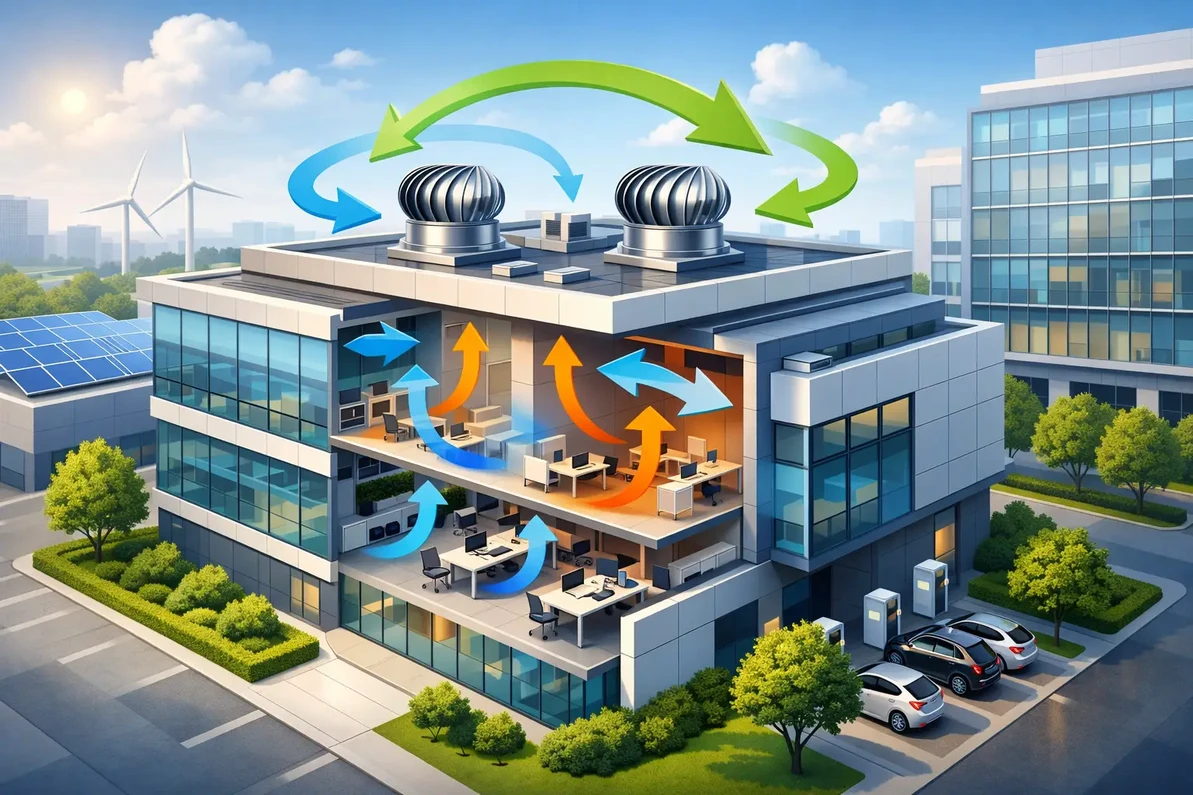
Edmonds ecoPOWER Hybrid Ventilation combines powered and non-powered operation. The EC brushless DC motor provides continuous mechanical exhaust capability. When wind conditions are favorable, the ventilator's design can use wind energy to move air, reducing the need for motor-driven operation. This is the distinction behind a true hybrid system: the equipment is designed to operate with power and without power, rather than simply adding a solar panel to a conventional fan.
For facility teams, that distinction matters because ventilation demand rarely follows one simple schedule. Internal heat loads, occupancy, production cycles, outdoor temperatures, wind direction, and building pressure all change throughout the day.
Why Smart Commercial and Industrial Buildings Use Edmonds Hybrid Ventilation
Heat rises, but it does not automatically leave a building at the rate required to protect people, product, or equipment. Large roof volumes can trap heat above the occupied zone, especially when roof insulation, process equipment, lighting, forklifts, compressors, or solar gain add to the load. If exhausted air is not replaced through properly sized intake openings, the building can become negatively pressurized and exhaust performance will fall.
The hybrid approach is particularly effective where a facility has predictable heat accumulation but variable outdoor wind. During still conditions, the EC motor provides controlled exhaust. During favorable wind conditions, natural airflow contributes to the ventilation process. This can reduce electrical demand while maintaining a more reliable ventilation profile than passive roof vents alone.
The operational benefit is not simply lower wattage. A properly engineered system can improve working conditions near production areas, reduce roof-level heat buildup, support moisture management, and help maintain more stable air movement across a large floor plate. In some applications, it can also reduce the burden on mechanical cooling equipment, although roof exhaust is not a substitute for air conditioning where conditioned supply air and humidity control are required.
Powered Airflow When You Need It, Wind Assistance When You Can Use It
The EC motor is central to the ecoPOWER concept. EC motors are valued for efficient operation and controllability compared with many traditional motor platforms. They allow the ventilator to provide powered airflow when natural driving forces are insufficient.
In calm or hot weather, powered operation prevents the common passive-ventilation problem: a roof full of hot air with little meaningful exhaust. In windy conditions, the ventilator can take advantage of wind energy. The system is not dependent on sunlight, battery condition, or solar-panel output, which is why it should not be specified or represented as a solar-powered roof fan.
This operating flexibility supports net-zero and energy-conscious building strategies, but it does not eliminate the need for a ventilation design. A hybrid rooftop ventilator is one component in an airflow system. Its performance depends on available intake area, fan placement, roof geometry, interior obstructions, building leakage, process heat load, and the airflow path from intake to exhaust.
Start With Airflow Engineering, Not a Fan Count
A common specification mistake is selecting rooftop exhaust units based on roof area alone. Square footage matters, but it does not define the heat load, required air changes, pressure losses, or intake-air capacity. Two 100,000-square-foot warehouses can need dramatically different ventilation designs if one is a low-occupancy storage building and the other contains welding, packaging lines, heat-producing machinery, or a high-volume loading operation.
Before selecting Edmonds Hybrid Ventilation, the design team should establish the target airflow in CFM and identify why that airflow is needed. Is the goal general heat relief, process heat removal, moisture control, building pressurization, odor dilution, or code-required exhaust? The answer determines fan quantity, placement, controls, and whether the project also needs make-up air.
The next issue is intake. Exhaust fans cannot deliver their published performance if replacement air cannot enter the building. Restricted louvers, undersized wall openings, closed doors, clogged screens, and inadequate relief paths raise static pressure and reduce delivered CFM. They can also create uncomfortable drafts at random openings as the building searches for air.
Roof location matters as well. Units should be distributed to pull heat from the areas where it accumulates, while avoiding short-circuiting between intake and exhaust. Structural curb details, roof penetration requirements, flashing, electrical disconnects, service access, noise expectations, and local wind exposure should be addressed before the installation crew arrives.
Where Hybrid Rooftop Exhaust Is a Strong Fit
Hybrid ventilation is a strong candidate for high-bay warehouses, light manufacturing, maintenance facilities, agricultural buildings, distribution centers, gymnasiums, and large commercial spaces with significant roof-level heat. It is also worth evaluating for facilities pursuing LEED-aligned or net-zero operating objectives where equipment energy and ventilation strategy are being reviewed together.
It is not the right answer for every exhaust requirement. Source-capture applications such as welding fume extraction, chemical vapor exhaust, paint operations, commercial kitchens, and hazardous dust collection require dedicated systems engineered for the contaminant, duct static pressure, filtration or treatment method, discharge location, and applicable code. General rooftop exhaust should not be used as a substitute for properly designed source capture.
Likewise, a building that requires tight temperature and humidity control may need mechanical cooling, dehumidification, or a balanced make-up air system in addition to roof exhaust. Hybrid ventilation can reduce heat buildup and improve air exchange, but it cannot overcome a ventilation plan that ignores process conditions or indoor environmental requirements.
Controls Turn a Good Ventilator Into a Smarter System
The equipment should be matched with a control strategy that reflects the facility's operating schedule. Temperature-based control is often appropriate for general heat relief, allowing powered exhaust to operate when roof-level or occupied-zone temperatures exceed the chosen setpoint. Timed schedules can support predictable shifts, while manual override gives operations personnel control during unusual production events.
For larger facilities, zoning is usually better than running every roof ventilator the same way. A shipping area, a production line, and a storage zone may carry very different heat loads. Dividing the system into zones can reduce unnecessary runtime and provide more usable airflow where the building needs it most.
Facility managers should also verify actual performance after commissioning. Measure amperage, confirm motor rotation and control response, inspect intake paths, and compare indoor temperatures before and after installation. If the project includes a defined CFM target, verify that the building can supply adequate replacement air under operating conditions.
Specify the System Around the Building
Edmonds ecoPOWER hybrid rooftop ventilators can support energy-conscious ventilation, but only when fan selection is tied to the building's real operating conditions. A cut sheet provides equipment data. It does not replace a heat-load review, intake-air calculation, roof layout, or discussion of how the facility will control and maintain the system.
Factory Fans Direct/Edmonds US provides commercial and industrial ventilation design support for projects where CFM, static pressure, motor type, roof mounting, make-up air, and application-specific performance need to be evaluated before equipment is purchased. The most useful first step is to gather building dimensions, roof height, process heat sources, existing intake openings, operating hours, and any available mechanical plans. That information turns a fan quote into an engineered ventilation decision.
Factory Fans Direct/Edmonds US - Hybrid Commercial & Industrial Ventilation & Cooling Experts | Contact Mike Miller VP Engineering at Factory Fans Direct for a FREE Project Evaluation 888-849-1233 | Mike@FactoryFansDirect.com
Recent Posts
-

AI Mega Factories Use Edmonds ecoPOWER Hybrid Ventilation
AI Mega Factories use Edmonds ecoPOWER Hybrid Turbine Ventilation because heat rejection cannot be t …4th Oct 2026 -
AI Cooling for High-Heat Facilities
A server aisle running 12°F hotter than its neighboring aisle, a crypto container recirculating exha …4th Oct 2026 -
AI Ventilation: Better Control Starts With Data
A warehouse can look adequately ventilated on paper and still have a 15-degree temperature differenc …4th Oct 2026