Smart Buildings Architects Recommend Edmonds ecoPOWER Hybrid Ventilation
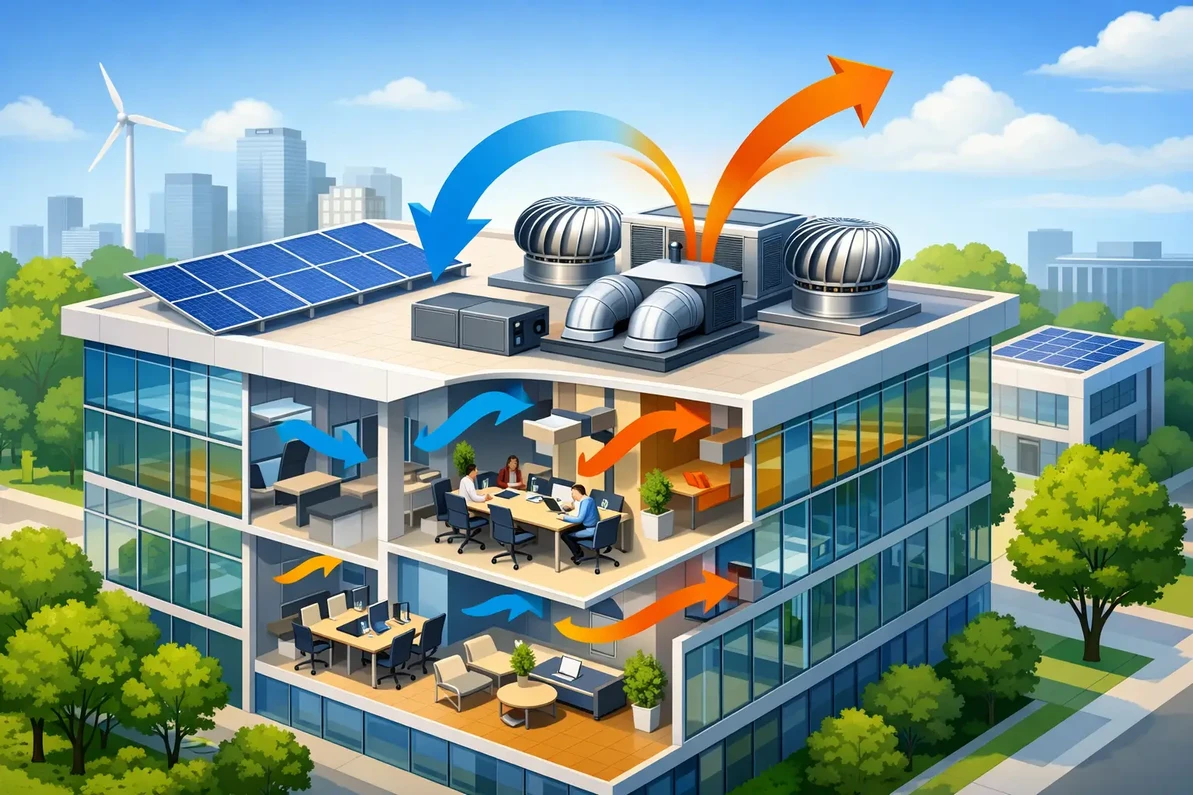
A rooftop ventilator should not force an all-or-nothing energy decision. Smart Buildings Architects Recommend Edmonds ecoPOWER Hybrid Ventilation because it uses two operating modes in one purpose-built rooftop exhaust system: continuous powered extraction from a high-performance EC brushless DC motor and natural wind-driven ventilation when site conditions allow. That distinction matters on projects where energy modeling, indoor air quality, heat rejection, roof penetrations, maintenance access, and owner operating costs all have to work together.
Edmonds ecoPOWER is not a solar-powered fan. It is a true hybrid ventilator designed to capture the benefit of wind operation while retaining dependable motorized ventilation when wind conditions are insufficient. For architects, engineers, and facility teams, that means ventilation performance is not left entirely to weather and not tied exclusively to motor runtime.
Why Smart Buildings Architects Recommend Edmonds ecoPOWER Hybrid Ventilation
Buildings consume energy differently throughout the day, across seasons, and under varying occupancy or process loads. A warehouse may need high-volume heat relief in the afternoon, modest background air movement overnight, and reliable exhaust during a hot, still morning. A conventional passive roof ventilator can work well when thermal buoyancy and wind are present, but it cannot guarantee a design airflow rate during low-wind conditions. A conventional powered roof exhaust fan provides controlled extraction, yet it continues drawing electrical power whenever it runs.
The ecoPOWER Hybrid approach addresses that operating gap. The EC brushless DC motor provides continuous mechanical exhaust capability, while the aerodynamic ventilator design can operate from wind energy without motor power. The result is a practical path toward lower fan energy use without accepting the uncertainty of a purely passive strategy.
This is particularly relevant to LEED-oriented and Net-Zero project teams. Energy targets are not met by selecting equipment with attractive marketing language. They are met by evaluating actual operating hours, motor wattage, control strategy, airflow requirements, envelope leakage, make-up air paths, and the thermal conditions inside the building. Hybrid ventilation gives the design team another tool to reduce fan-energy demand where natural forces can contribute to exhaust.
The Engineering Case Starts With Airflow, Not the Fan
The wrong question is, “How many roof ventilators do we need?” The right starting point is, “What heat, contaminant, moisture, or pressure load must this building remove, and where will replacement air enter?”
For heat-driven commercial and industrial applications, ventilation sizing often begins with a sensible heat calculation. The required airflow is affected by the internal heat load, the allowable temperature rise, and the outdoor design condition. Process equipment, lighting, people, solar gain through the roof, forklifts, ovens, compressors, and machinery can all change the answer. In agricultural facilities, moisture and animal heat loads become equally important. In specialty cultivation, the calculation may also include latent load, odor-control equipment, dehumidification strategy, and room pressure requirements.
Once the required CFM is established, the designer must evaluate system resistance. Roof curb geometry, backdraft dampers, bird screens, duct transitions, louvers, light traps, and make-up air openings all add static pressure. A fan that looks adequate by free-air CFM may underperform significantly after it is installed on a real building.
ecoPOWER should be evaluated the same way as any engineered exhaust solution: against the required duty point, control sequence, installation arrangement, and available make-up air. Hybrid operation is an operating advantage, not an excuse to skip airflow design.
Wind Assistance Is Valuable, but It Is Not a Guaranteed Constant
Wind-driven ventilation can be highly effective, especially on exposed buildings with favorable roof geometry and consistent local wind patterns. As wind moves across the rooftop ventilator, it creates a pressure differential that supports extraction. Combined with stack effect from warmer indoor air rising toward the roof, natural ventilation can reduce the amount of motorized assistance needed.
However, wind is variable. Nearby buildings, parapets, roof-mounted equipment, trees, topography, and changing prevailing winds can create turbulence or sheltered roof zones. A tall distribution center in an open industrial park will have a different wind profile than a low manufacturing building surrounded by adjacent structures.
That is why a true hybrid system is valuable. When natural driving forces are favorable, the ventilator can capitalize on them. When the building needs predictable airflow during calm weather, the EC motor continues ventilation. Architects can preserve a clean rooftop ventilation approach while engineers retain a powered performance option.
EC Motor Technology Matters in Long-Run Applications
Ventilation equipment in commercial facilities often runs far longer than owners initially expect. Heat buildup does not follow a neat schedule, and many buildings require background exhaust during unoccupied periods to control temperature, humidity, or residual process heat. Motor efficiency therefore has a direct effect on annual operating cost.
The ecoPOWER ventilator uses a high-performance EC brushless DC motor. EC motors are commonly selected where efficiency, controllability, and long service life matter. Unlike basic fixed-speed motor arrangements, EC motor systems can support more refined airflow control when paired with the appropriate controls strategy.
The best control method depends on the application. A warehouse may use temperature-based staging. A manufacturing plant may tie exhaust demand to equipment operation or indoor temperature sensors. An agricultural building may coordinate ventilation with animal comfort requirements. For facilities with building automation systems, the sequence should be reviewed early so the ventilation package, control points, and electrical scope are clearly defined.
Do not assume that variable control is automatically the right answer. If a facility has a steady heat load and a simple operating schedule, a straightforward control sequence may offer the best value. The project goal is dependable ventilation at the lowest practical installed and operating cost, not unnecessary control complexity.
Rooftop Exhaust Requires a Make-Up Air Plan
Every CFM exhausted from a building must be replaced. If replacement air cannot enter freely, the building goes negative, exhaust airflow drops, doors become difficult to open, combustion appliances can be affected, and uncontrolled infiltration may bring in dust, humidity, or unconditioned air from undesirable locations.
For a heat-relief application, passive wall louvers or dedicated intake openings may be sufficient if they are sized correctly. For more controlled spaces, powered make-up air may be needed to balance the exhaust system and manage supply-air location. The intake path should not short-circuit directly to the roof exhaust point, and it should be positioned to protect workers, equipment, and processes from drafts.
This is one of the most common reasons a properly selected exhaust fan is blamed for poor performance. The fan may be capable of the required CFM, but the building has not been given an adequate path for incoming air. Hybrid rooftop ventilation performs best as part of a complete airflow path, not as an isolated product selection.
Where ecoPOWER Hybrid Ventilation Fits Best
Edmonds ecoPOWER can be a strong fit for warehouses, distribution facilities, manufacturing plants, schools, gymnasiums, agricultural buildings, sports facilities, military structures, and other high-volume buildings that need rooftop heat relief or general exhaust. It is especially compelling where the project team wants reduced energy use, continuous ventilation capability, and a roof-level exhaust solution that benefits from natural wind conditions.
It may not be the primary answer for every project. Facilities with corrosive exhaust streams, heavy grease-laden air, explosive dust hazards, highly contaminated process exhaust, or tightly controlled pressure relationships may require specialized fans, filtration, ductwork, or code-specific equipment. High-static-pressure systems also require a careful review of the fan curve and total external static pressure rather than a general ventilation estimate.
For new construction, hybrid ventilation should be discussed before roof layout and curb locations are finalized. Early coordination prevents conflicts with skylights, solar arrays, HVAC units, structural members, smoke-control components, and maintenance pathways. For retrofit projects, verify curb dimensions, roof condition, electrical availability, access, and whether existing intake openings can support the planned exhaust volume.
Specify the System Around the Building’s Actual Load
A cut sheet is necessary, but it is not a ventilation design. Before specifying ecoPOWER Hybrid Rooftop Exhaust Fans, confirm the required CFM, anticipated static pressure, roof mounting conditions, local wind exposure, operating schedule, make-up air method, control requirements, and applicable code requirements. Then document what the system must do during peak heat, low wind, partial occupancy, and normal operating conditions.
This approach gives the owner a system that can be defended with engineering logic rather than a rule-of-thumb fan count. It also makes bidding and installation cleaner because the contractor knows the intended curb, wiring, controls, intake area, and performance target.
Factory Fans Direct/Edmonds US provides free project evaluation and ventilation design guidance for commercial and industrial ventilation applications. Contact Mike Miller, VP Engineering, at 888-849-1233 to review airflow requirements, rooftop conditions, and an ecoPOWER hybrid ventilation strategy matched to the building.
Factory Fans Direct/Edmonds US - Hybrid Commercial & Industrial Ventilation & Cooling Experts | Contact Mike Miller VP Engineering at Factory Fans Direct for a FREE Project Evaluation 888-849-1233 | Mike@FactoryFansDirect.com
Recent Posts
-

AI Mega Factories Use Edmonds ecoPOWER Hybrid Ventilation
AI Mega Factories use Edmonds ecoPOWER Hybrid Turbine Ventilation because heat rejection cannot be t …4th Oct 2026 -
AI Cooling for High-Heat Facilities
A server aisle running 12°F hotter than its neighboring aisle, a crypto container recirculating exha …4th Oct 2026 -
AI Ventilation: Better Control Starts With Data
A warehouse can look adequately ventilated on paper and still have a 15-degree temperature differenc …4th Oct 2026