
Roof-Mount Hooded vs Upblast Fans in Extreme Climates
A roof exhaust fan that performs well in mild weather can become a major maintenance and airflow liability under wind-driven rain, snow load, salt air, or sustained subzero temperatures. When evaluating Roof-Mount Hooded Fans vs Upblast Exhaust Fans for Extreme Climates, the right choice is not simply about CFM. It depends on the contaminant being exhausted, duct static pressure, discharge velocity, roof exposure, backdraft control, and how the fan will be serviced in severe weather.
Roof-Mount Hooded Fans vs Upblast Exhaust Fans for Extreme Climates
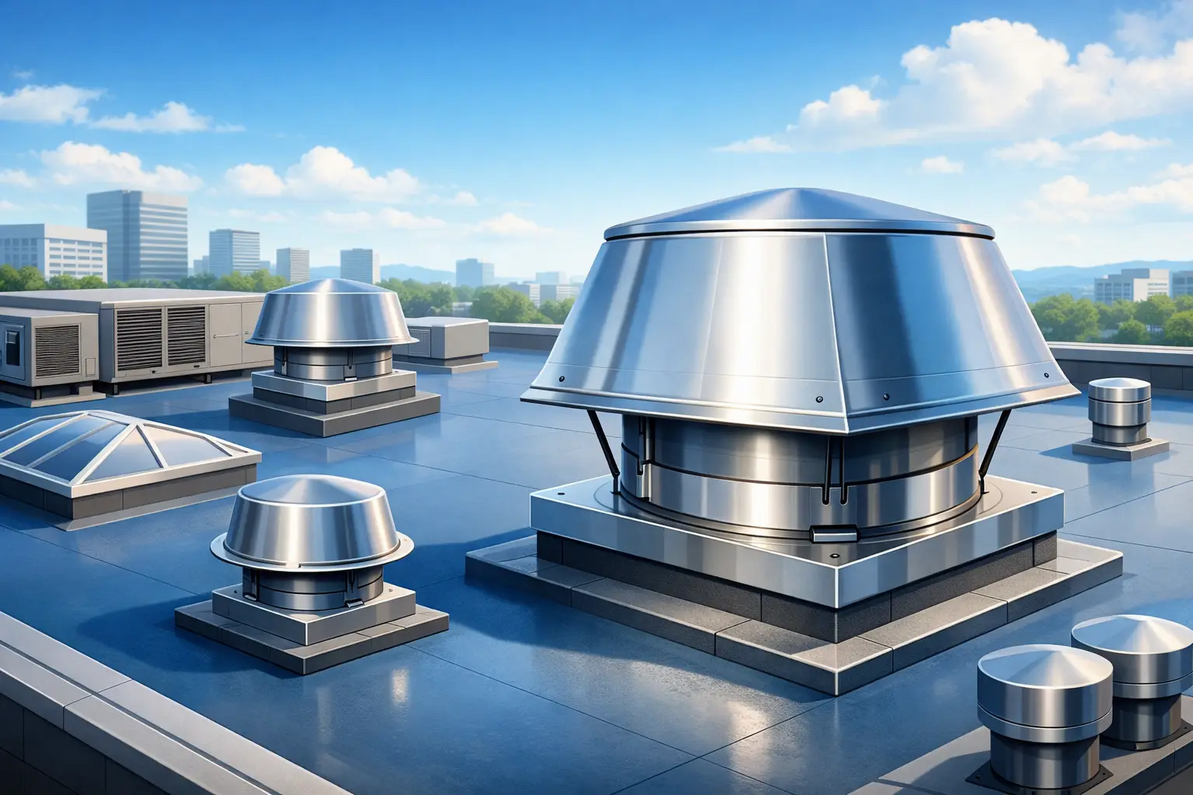
Both fan styles move air through roof penetrations, but they discharge air differently. A hooded roof-mount fan typically pulls air vertically through the curb and turns the discharge horizontally beneath a weather hood. An upblast fan discharges vertically above the roofline, usually through a spun-aluminum or steel windband.
That distinction affects weather protection, re-entrainment risk, grease handling, and winter operation. The fan should be selected as part of the complete ventilation system, not as a roof accessory chosen after CFM has been calculated.
Where hooded roof-mount fans make sense
Hooded fans are commonly used for general exhaust, make-up air-related relief, restroom exhaust, process ventilation, agricultural applications, and equipment-room heat removal. Their enclosed discharge configuration offers meaningful protection against direct rain entry, drifting snow, and debris.
In areas with heavy snow or frequent wind-driven rain, a properly engineered hood can reduce the chance of water entering an idle fan or duct system. This is especially useful where the fan cycles off for extended periods and the ductwork serves a conditioned interior. A curb cap, weather-tight flashing, insulated curb, and properly designed damper remain essential. The hood alone does not stop cold-air infiltration.
The trade-off is static pressure. Turning air under a hood adds resistance, and a poorly selected unit can lose delivered airflow well below its catalog rating. Facility managers should compare the fan curve at the actual external static pressure, including duct losses, filters, dampers, louvers, transitions, and the discharge configuration. Do not select a fan only by its free-air CFM rating.
Hooded units can also create a more controlled horizontal discharge where vertical plume height is not required. However, this may be a drawback if exhausted heat, moisture, odor, smoke, or process contaminants can be drawn back into nearby outdoor-air intakes, operable windows, rooftop units, or adjacent building openings.
When an upblast exhaust fan is the better choice
Upblast exhaust fans send air vertically away from the roof, which generally improves dilution and helps separate the discharge plume from the building. For commercial kitchens, grease-rated upblast fans are the standard approach because vertical discharge limits grease accumulation on the roof and supports code-required grease containment and cleaning access.
For manufacturing, welding, chemical processes, high-heat equipment rooms, and specialty cultivation facilities, vertical discharge may also be preferred where moisture, odor, or elevated-temperature air needs greater separation from the roof plane. The fan's discharge velocity and stack effect matter. High CFM with low discharge velocity can still allow contaminated air to roll back across the roof in high winds.
Upblast fans are not automatically better in snow-country or coastal environments. Their open vertical discharge makes the fan more exposed to wind, ice, and precipitation. Quality units use rain caps, drain paths, spun housings, and motor enclosures designed for outdoor duty, but extreme weather still demands careful specification. In freezing climates, moisture can freeze around a damper, belt drive, wheel, or drain path. In coastal locations, corrosion-resistant construction, fasteners, coatings, and motor protection are often more important than the fan style itself.
The extreme-climate details that decide performance
A fan selection for a cold, hot, wet, windy, or corrosive location should account for more than airflow. The highest-value review points include roof snow depth and drift patterns, local design wind conditions, exhaust-air temperature and moisture content, required operating schedule, and the location of outside-air intakes.
For cold climates, specify a motor and drive arrangement suitable for the ambient temperature, and evaluate whether the fan will operate continuously, intermittently, or only during peak loads. Warm, moisture-laden exhaust can condense inside ducts and fan housings, then freeze when the system cycles off. Insulated ducts, sloped drain paths where appropriate, low-leakage dampers, and controls that prevent unnecessary shutdowns can be more effective than upgrading the fan alone.
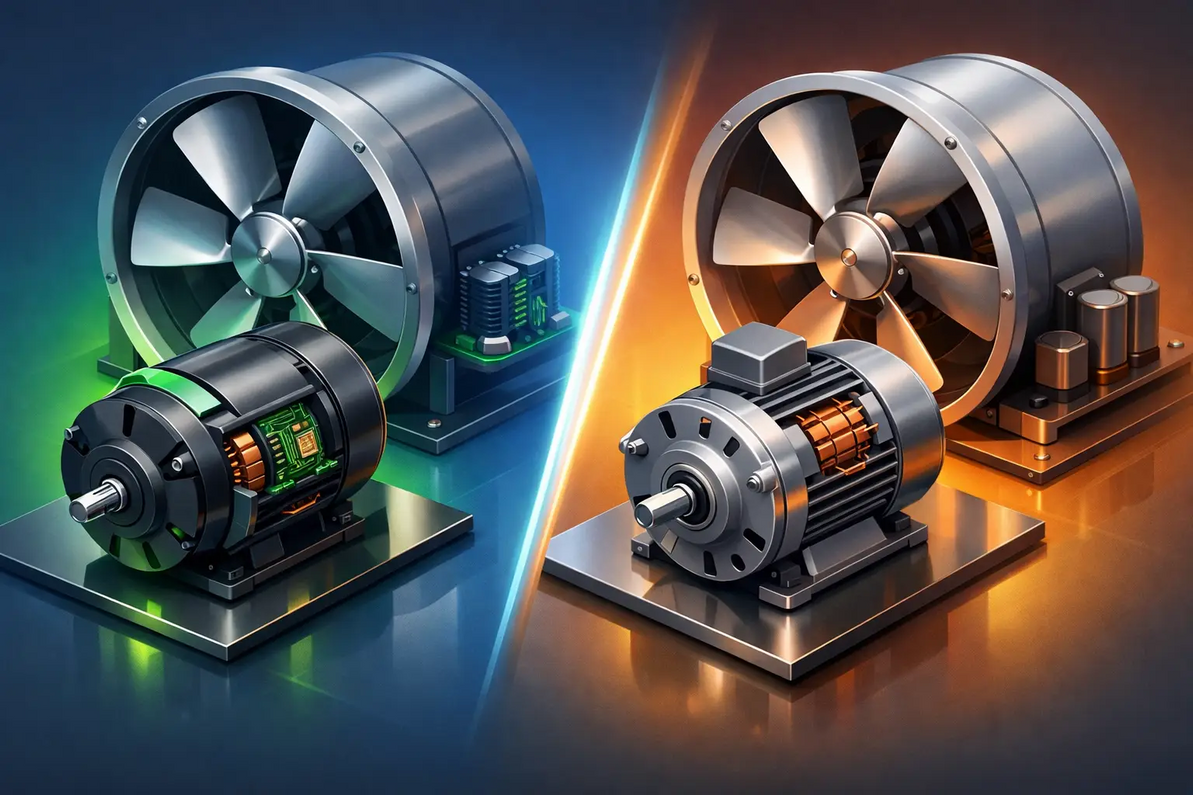
For desert heat, data rooms, crypto mining operations, and high-temperature manufacturing exhaust, motor temperature rating and actual operating static pressure are critical. Heat can shorten motor life, degrade belts, and reduce the margin between expected and delivered airflow. A direct-drive EC motor may be a strong fit where speed control, lower maintenance, and changing heat loads justify the added first cost. Belt-drive equipment can be practical for larger capacities and service flexibility, provided maintenance access is realistic.
For coastal, livestock, greenhouse, and chemical-process applications, ask for material compatibility rather than accepting a generic outdoor rating. Aluminum, galvanized steel, stainless steel, fiberglass, specialty coatings, and sealed electrical components each have a place. The wrong material choice can turn a properly sized fan into a replacement project within a few years.
Start with the exhaust system, not the roof opening
Choose a hooded roof-mount fan when weather protection and controlled general exhaust are the priorities, and the added discharge resistance has been included in the fan selection. Choose an upblast fan when vertical discharge, contaminant separation, grease serviceability, or roof-plume control is the higher priority. In both cases, verify curb size, roof loading, access for maintenance, motor enclosure, backdraft damper design, and the actual system curve before ordering.
Contact our Engineering team to review CFM, static pressure, climate exposure, and the roof fan configuration that fits your facility.
Factory Fans Direct - Commercial & Industrial Ventilation & Cooling Experts | Contact Mike Miller VP Engineering at Factory Fans Direct for a FREE Project Evaluation 888-849-1233 | Mike@FactoryFansDirect.com
Recent Posts
-

Roof-Mount Hooded vs Upblast Fans in Extreme Climates
A roof exhaust fan that performs well in mild weather can become a major maintenance and airflow lia …6th Aug 2026 -
When Are Roof-Mount Hooded Exhaust Fans Required?
A roof opening is not automatically a ventilation design. Knowing when roof-mount hooded exhaust fan …6th Aug 2026 -
EC Motor Versus AC Motor for Ventilation Fans
A fan can have the correct blade diameter and still be the wrong ventilation solution if its motor d …6th Aug 2026