Ratepayer Protection and BYOP for Hyperscalers
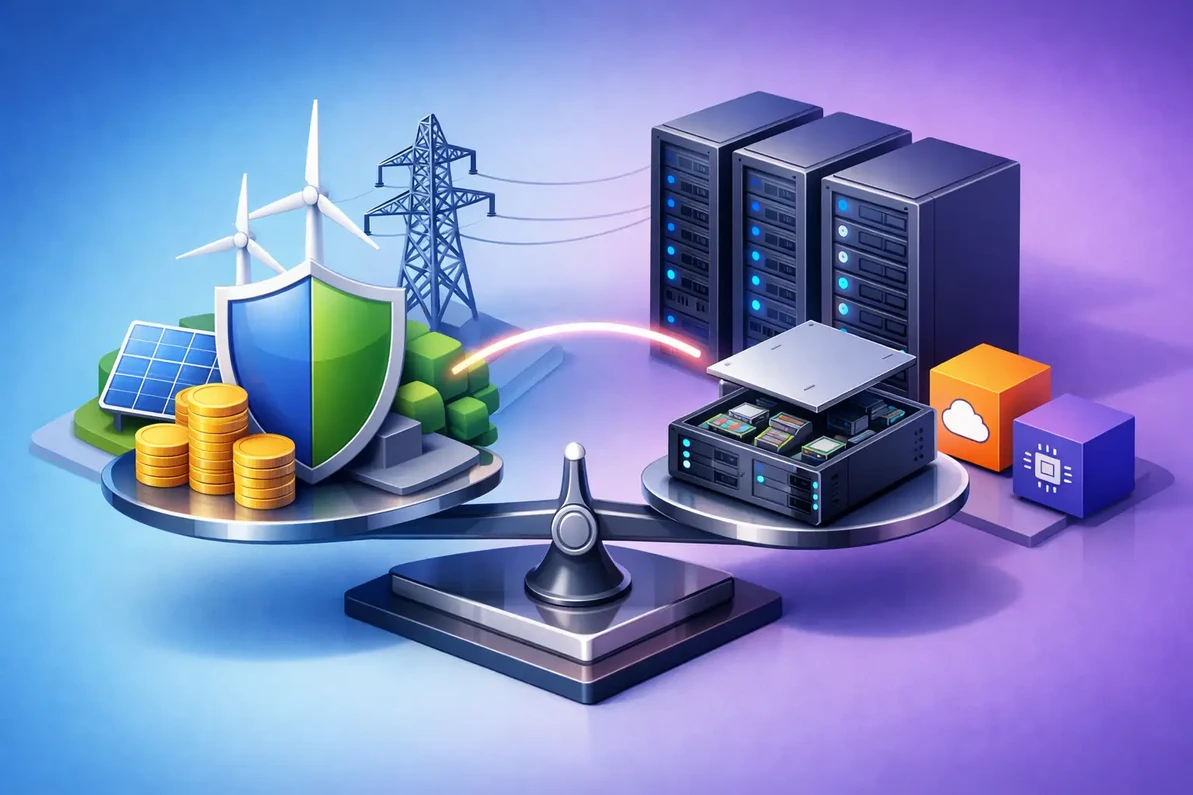
A hyperscale data center can add hundreds of megawatts of new demand to a local grid. When that demand arrives faster than transmission, generation, and substations can be built, the central question becomes simple: who pays? Ratepayer Protection Measures & Bring Your Own Power for Hyperscalers Explained starts with that question, but the operational consequences extend all the way to facility cooling, equipment uptime, and site selection.
For data center operators, power is no longer just a utility line item. It is a capacity constraint, a permitting issue, and a critical part of the mechanical design basis.
What ratepayer protection measures are designed to do
Ratepayer protection measures are utility, regulatory, or contractual requirements intended to keep the cost of serving very large new loads from being shifted to existing residential, commercial, and industrial customers. A hyperscaler may need new substations, feeder upgrades, transmission capacity, generation resources, or firm capacity commitments. Those assets cost money whether or not the facility ultimately reaches its projected load.
Utilities and public utility commissions may require large-load customers to provide deposits, minimum-demand commitments, upfront infrastructure contributions, longer contract terms, or exit fees. The details vary by state and utility territory, but the principle is consistent: the customer creating the exceptional demand should carry an appropriate share of the risk.
This is not automatically anti-data-center policy. Utilities want high-quality load growth, and communities want construction, tax base, and jobs. The concern is stranded infrastructure. If a large campus scales back, changes locations, or delays energization after major grid upgrades are completed, remaining ratepayers should not be left covering the shortfall.
Bring Your Own Power for hyperscalers
Bring Your Own Power, often shortened to BYOP, shifts part of the solution from the utility to the large-load customer. Under a BYOP approach, the hyperscaler is expected to procure, develop, finance, or contract for generation and sometimes transmission or interconnection capacity associated with its load growth.
BYOP does not necessarily mean a data center operates as an isolated island. In many cases, the facility remains grid-connected and relies on utility service for reliability, balancing, and delivery. The difference is that the customer has a defined responsibility to bring credible power resources to the table rather than assuming the grid can absorb a massive new load on the requested schedule.
Possible supply arrangements include dedicated renewable generation with storage, contracted firm generation, behind-the-meter generation, microgrids, power purchase agreements, and demand-response commitments. Each option has different implications for fuel availability, emissions requirements, interconnection studies, and operating cost.
A signed power purchase agreement alone may not satisfy every BYOP policy. Regulators and utilities may look at deliverability, capacity value during peak conditions, commercial operation dates, and whether the resource can actually support the specific constrained area. Nameplate megawatts are not the same as dependable megawatts.
Cooling design is part of the power strategy
When utility capacity is constrained or power is being phased in, mechanical loads receive much more scrutiny. Data hall IT load is usually the headline number, but cooling, pumping, air movement, water treatment, controls, and backup systems can represent a meaningful share of total facility demand.
That makes ventilation engineering a financial issue, not just a comfort issue. High-temperature exhaust strategies, containment, economization, immersion cooling, hydro cooling, and variable-speed fan control can reduce unnecessary auxiliary load when designed around the actual heat rejection method and local climate.
For air-cooled crypto mining and data center applications, fan selection must account for more than free-air CFM. Static pressure from louvers, filters, light traps, duct transitions, acoustic treatment, and long exhaust paths can materially reduce delivered airflow. An exhaust fan that looks adequate on a catalog page may fail to move the required air once it is installed in a real enclosure.
The practical design target is heat removal at the required operating condition. That requires matching heat load, allowable temperature rise, elevation, outdoor design temperature, pressure losses, fan curves, motor type, controls, and redundancy requirements. Variable frequency drives can help manage changing load, but they do not correct an undersized fan, inadequate intake area, or poor airflow path.
What operators should verify before committing to a site
Hyperscale development teams should treat the utility agreement, generation strategy, and cooling basis of design as connected workstreams. A site may appear attractive because it offers low energy rates, yet still carry major exposure if energization is uncertain, network upgrades are unfunded, or BYOP resources cannot be delivered on schedule.
Before finalizing the design, confirm the committed energization timeline, phased-load schedule, curtailment provisions, minimum-load obligations, infrastructure contribution requirements, and consequences of project delay. Review whether backup generation can be used for peak shaving or demand response, and verify all local air-quality, noise, fuel-storage, and permitting constraints.
Also model cooling power at realistic peak conditions, not only at ideal outdoor temperatures. A system that depends on high-volume exhaust, evaporative assistance, or fan redundancy must be evaluated during extreme heat, filter loading, component failure, and utility curtailment scenarios.
Factory Fans Direct provides FREE Project Evaluations for crypto mining and data center cooling applications, including Immersion, Hydro-Cooling, High-temperature exhaust fans and airflow paths, static-pressure considerations, fan selection, and control recommendations. Contact Mike Miller, VP Engineering, at 888-849-1233 before equipment is specified around an uncertain power plan.
Factory Fans Direct - Crypto Mining & Data Center Cooling Experts Contact Mike Miller VP Engineering at Factory Fans Direct for a FREE Project Evaluation 888-849-1233 | Mike@FactoryFansDirect.com
Recent Posts
-

Smart Buildings Architects Recommend Edmonds ecoPOWER Hybrid Ventilation
A rooftop ventilator should not force an all-or-nothing energy decision. Smart Buildings Architects …7th Sep 2026 -
Smart Industrial Buildings Use Edmonds ecoPOWER Hybrid Ventilation
A roof exhaust system can be the difference between a plant that controls heat at the source and one …7th Sep 2026 -
Smart Commercial Buildings Use Edmonds Hybrid Ventilation
A rooftop exhaust fan that only performs when the wind blows is not a complete ventilation strategy. …7th Sep 2026