Poultry Ventilation & Light Deprivation Experts
A poultry house can have enough installed fan CFM on paper and still struggle with wet litter, uneven bird comfort, ammonia odor, and poor tunnel air speed. The request, "Poultry Farming Ventilation & Light Deprivation - Talk with an Expert," is usually not just about buying exhaust fans. It is about making the entire house operate as one controlled air system.
For broiler, breeder, pullet, and layer operations, ventilation must remove heat, moisture, dust, ammonia, and carbon dioxide without creating cold drafts or sacrificing the lighting program. Light deprivation adds another engineering layer: every intake opening must block outside light while passing enough air at an acceptable static pressure. A fan, inlet, light trap, controller, and building envelope that are not matched will work against each other.
Why Poultry Ventilation Is a System, Not a Fan Count
Fan selection starts with CFM, but CFM alone does not tell you whether the system will perform. A poultry ventilation design has to account for house dimensions, bird count and age, stocking density, regional weather, insulation, inlet design, evaporative cooling equipment, desired air speed, and the actual resistance created by shutters, screens, pads, louvers, and light traps.
Static pressure is where many projects go wrong. A fan may be rated at a high airflow number in free air, yet a poultry house never operates in free air. When air must travel through a light trap, restrictive inlet, evaporative pad, dirty screen, or undersized opening, system resistance rises. The fan’s delivered CFM drops, sometimes substantially.
That is why cut-sheet performance data matters. Compare fan output at the static pressure the building is expected to see, not only the headline CFM rating. Also review motor horsepower, efficiency, belt or direct-drive configuration, shutter design, corrosion resistance, and service access. Agricultural environments are hard on equipment, especially where moisture, dust, and ammonia are present daily.
A proper design also considers where air enters the house and where it exits. Exhaust fans cannot create productive air movement if replacement air is pulled through random cracks, poorly sealed doors, or light leaks. Controlled inlets create a predictable air path. That is necessary for minimum ventilation and essential for uniform tunnel ventilation.
Poultry Farming Ventilation and Light Deprivation Must Work Together
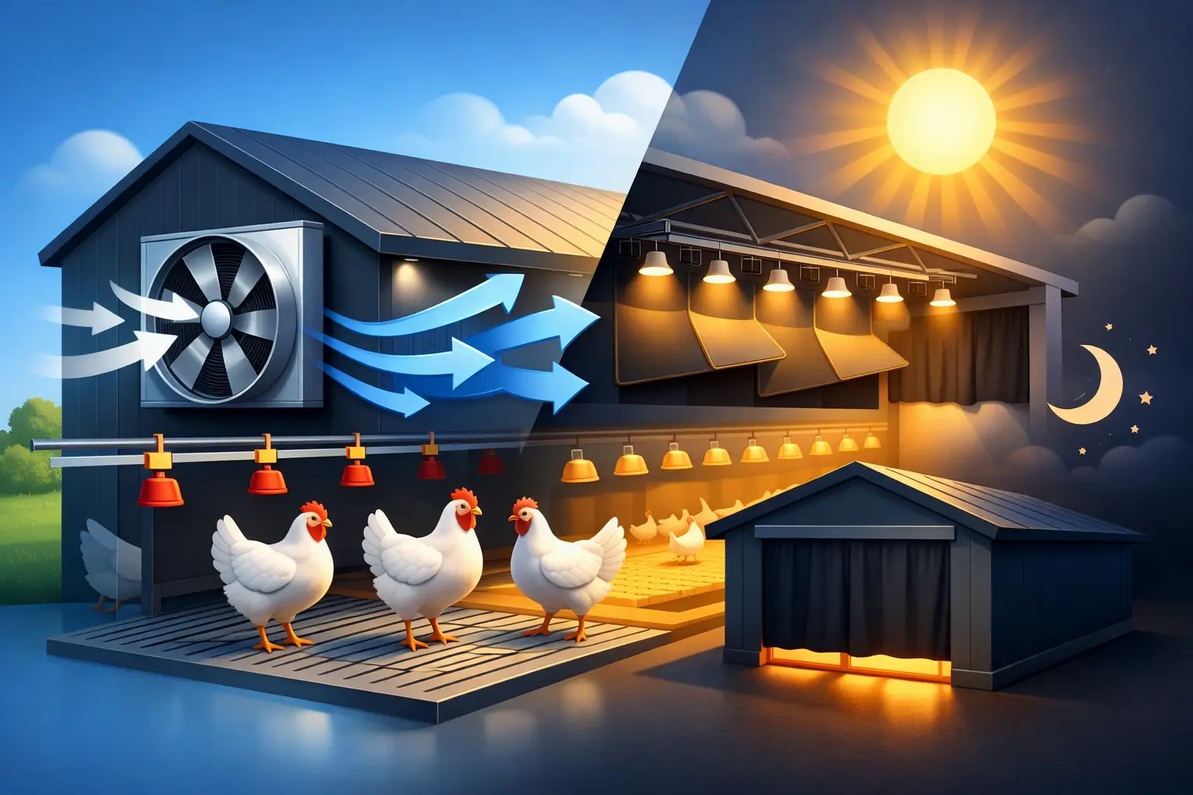
Light-deprivation poultry houses are designed to control the photoperiod, commonly to support bird management programs and production goals. The challenge is simple: light traps block light by forcing incoming or outgoing air through a baffled path. The engineering challenge is less simple because that baffled path creates pressure loss.
A light trap that is too small, too restrictive, or installed without enough open free area can choke the ventilation system. Fans run harder, airflow falls, power use increases, and temperatures become harder to control. During hot-weather tunnel operation, reduced airflow can mean lower air speed at bird level precisely when the flock needs it most.
The answer is not automatically to install larger motors or add more fans. In some cases, the better correction is more light-trap face area, a lower-resistance light-trap design, larger intake openings, or a revised fan staging sequence. Equipment must be evaluated as a package.
Light traps also require practical attention. Internal baffles collect dust and feathers. Screens can load up. Any buildup increases resistance and reduces the delivered airflow over time. A design that works on day one but has no cleaning access is not a durable production solution.
For houses using tunnel ventilation, locate and size light-trap assemblies so they do not create severe imbalance between air inlets. Uneven inlet resistance can cause air to favor one side of the house, leaving dead zones and reducing uniform cooling. Smoke testing, ribbon testing, and static-pressure readings during commissioning can reveal issues that a visual inspection misses.
Match Ventilation Mode to Bird Needs and Weather Conditions
A modern poultry house normally operates in stages. The ventilation system must be able to transition between those stages without losing control of temperature, humidity, air quality, or lighting.
Minimum ventilation is typically used during cooler conditions and early bird age. The goal is measured air exchange, not maximum air speed. Timers or controller logic cycle fans to remove moisture and contaminants while properly designed ceiling or sidewall inlets direct incoming air along the ceiling. That mixing action helps temper outside air before it reaches the birds.
Transitional ventilation is used as bird heat load rises. More fans operate, and inlet control becomes even more important. If inlets do not open correctly at the intended static pressure, air can drop directly onto birds and create drafts. If the building is too loose, the pressure may never develop enough to throw air across the ceiling.
Tunnel ventilation is the high-capacity mode for warm weather. Air moves lengthwise through the house, usually entering through tunnel inlets or cooling pads and exhausting through fan banks at the opposite end. Here, the design target is not simply air exchanges. It is consistent air speed across the occupied zone. Light traps on tunnel inlets, exhaust fans, or both must be included in the static-pressure calculation.
Evaporative cooling can reduce incoming air temperature, but it also adds resistance and moisture. Pad thickness, pad area, water flow, maintenance condition, and inlet velocity all affect performance. A system that combines pads, light traps, and high-speed tunnel fans needs a careful pressure-budget review instead of a generic fan recommendation.
Design Inputs an Expert Will Need Before Recommending Equipment
The fastest way to get a useful poultry ventilation recommendation is to provide operating details, not just building square footage. An engineering review should begin with the house length, width, ceiling height, sidewall construction, insulation level, and orientation. Bird type, maximum bird count, production stage, and target stocking density are equally important.
Existing equipment information matters as well. Include the number and model of installed fans, fan diameter, motor horsepower, inlet type, cooling-pad dimensions, controller brand, and any known static-pressure readings. Photos of fan walls, inlet walls, light traps, electrical service, and the inside ceiling can identify installation constraints quickly.
Local summer design conditions and winter conditions should both be part of the conversation. A poultry house in Georgia, Arkansas, California, or Minnesota may use similar components, but the required capacity, control strategy, and cold-weather inlet approach will not be identical.
For a new build, the best time to address light deprivation is before walls, fan openings, and inlet openings are finalized. Retrofitting can work, but retrofits often reveal limits in available wall area, structural framing, electrical capacity, or existing control logic.
Common Problems That Signal a Ventilation Design Issue
A few symptoms consistently point to a system-level problem rather than a single failed component. Condensation on ceilings or sidewalls during cool weather suggests inadequate moisture removal, poor insulation, incorrect inlet management, or a combination of all three. Wet litter can follow quickly and affect bird health, ammonia levels, and labor requirements.
In hot weather, birds crowding near inlets, away from walls, or near the center of the house can indicate weak tunnel air speed or uneven air distribution. If fan shutters fail to open fully, belts slip, screens are dirty, or light traps are overly restrictive, actual airflow may be far below the design expectation.
Light leaks deserve attention too. A small gap around a fan, door, curtain, or inlet can disrupt a controlled lighting program. At the same time, sealing every opening without providing engineered intake area can make the house too restrictive. Poultry ventilation is not a choice between tight and loose construction. It is about a tight, controllable envelope with correctly sized intentional air paths.
Commission the System Before Peak Season
Do not wait until the first heat event to find out whether the fan wall is underperforming. Test each fan, verify rotation direction, inspect shutters and belts, confirm controller staging, and check that all light-trap panels are secured and accessible for cleaning. Measure static pressure with the intended inlets and light traps in place, not with doors open during a quick walkthrough.
A useful pre-season review checks five operating points:
- Minimum-ventilation fan cycles and inlet response
- Transitional fan staging and temperature setpoints
- Tunnel fan operation and air speed at bird level
- Cooling-pad water distribution and pad condition
- Light leakage, trap cleanliness, and available free area
Factory Fans Direct provides free project evaluations for poultry houses and agricultural ventilation applications where fan performance, static pressure, light traps, and controls must be matched. Bring the building dimensions, existing equipment details, and production goals to the conversation. A short technical review before equipment is ordered can prevent an expensive airflow problem after the flock is in the house.
Factory Fans Direct - Commercial & Industrial Ventilation & Cooling Experts | Contact Mike Miller VP Engineering at Factory Fans Direct for a FREE Project Evaluation 888-849-1233 | Mike@FactoryFansDirect.com
Recent Posts
-

Smart Buildings Architects Recommend Edmonds ecoPOWER Hybrid Ventilation
A rooftop ventilator should not force an all-or-nothing energy decision. Smart Buildings Architects …7th Sep 2026 -
Smart Industrial Buildings Use Edmonds ecoPOWER Hybrid Ventilation
A roof exhaust system can be the difference between a plant that controls heat at the source and one …7th Sep 2026 -
Smart Commercial Buildings Use Edmonds Hybrid Ventilation
A rooftop exhaust fan that only performs when the wind blows is not a complete ventilation strategy. …7th Sep 2026