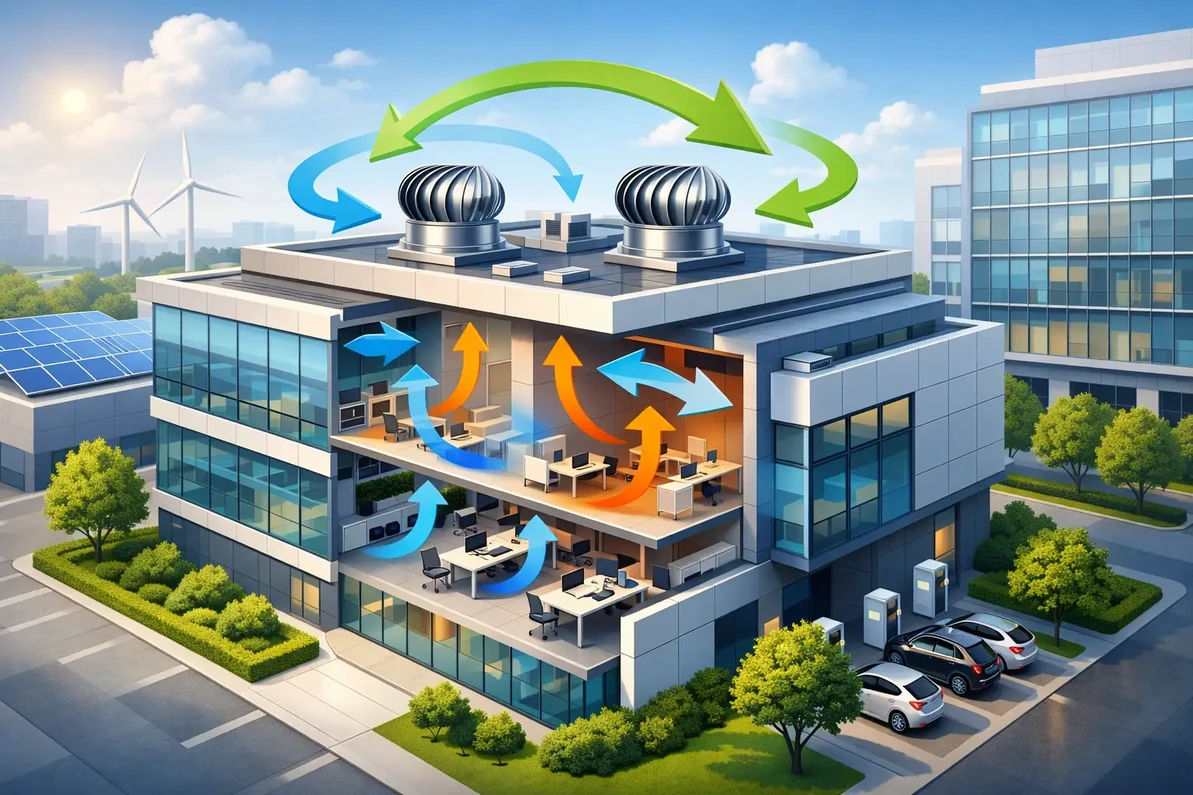

Net-Zero Ventilation Requirements for Buildings
A building can produce as much renewable energy as it consumes on paper and still miss its net-zero target because ventilation was treated as an afterthought. Exhaust fans, make-up air units, outside-air systems, pressure relief, and controls can become a major electrical and thermal load, especially in warehouses, manufacturing plants, cultivation facilities, and high-occupancy commercial spaces. Net-Zero Ventilation Requirements for Buildings are not a single prescriptive fan specification. They are a coordinated design process that protects indoor air quality while reducing fan energy, heating and cooling penalties, leakage, and unnecessary operating hours.
For project owners and design teams, the objective is straightforward: deliver the required airflow at the lowest practical total system energy, then account for that energy in the building’s net-zero energy model. The details are where projects succeed or fail.
What Net-Zero Ventilation Requirements Actually Mean
A net-zero energy building typically offsets its annual energy consumption with on-site or qualifying renewable energy generation. Ventilation is part of that annual energy budget. The design must therefore meet applicable ventilation, health, safety, and building-code requirements while keeping electrical fan power and conditioned-air losses under control.
The governing requirements vary by jurisdiction, occupancy, climate zone, and project certification target. In the United States, design teams commonly work from local building and mechanical codes, ASHRAE Standard 62.1 for commercial indoor air quality, ASHRAE 62.2 for residential ventilation, and ASHRAE 90.1 or an adopted energy code for energy performance. LEED, Passive House, and local building-performance programs may add further testing, documentation, commissioning, and energy-use requirements.
The critical point is that net-zero does not mean reducing ventilation below required levels. It means avoiding wasted airflow and wasted static pressure while recovering energy where the application supports it.
Start With the Airflow Requirement, Not the Fan Catalog
Correct fan selection begins with a load and airflow calculation. A fan cannot be sized responsibly from square footage alone when the building has process heat, equipment loads, contaminants, moisture, or pressure-control needs.
For a warehouse, the calculation may include people, forklifts, combustion sources, roof heat gain, loading-door activity, and stratified heat at the ceiling. For a manufacturing facility, the process may dictate local capture exhaust, welding fume removal, solvent vapor control, or make-up air requirements. A greenhouse or cultivation operation must account for plant transpiration, lighting heat, humidity targets, odor control, filtration, and seasonal outdoor-air conditions.
The required CFM should be tied to the actual purpose of each air stream: code-required outdoor air, source capture, general heat removal, equipment cooling, building pressurization, or emergency exhaust. Combining these functions into one oversized system often creates excessive fan energy and difficult controls.
A useful engineering question is not simply, “How many CFM do we need?” It is, “Which CFM must run continuously, which CFM can modulate, and which CFM is only needed under specific operating conditions?” That distinction drives the net-zero result.
Fan Energy Depends on Static Pressure as Much as CFM
A high-efficiency motor cannot overcome a poorly designed air path. Fan power rises with airflow and pressure, and unnecessary static pressure can quickly erase the benefit of premium equipment.
Static pressure losses come from undersized ductwork, restrictive louvers, dirty filters, backdraft dampers, tight bends, silencers, coils, light traps, and poorly selected roof curbs. In exhaust systems, an intake opening that is too small can starve the fan, reduce delivered airflow, increase noise, and create unwanted negative building pressure. In supply systems, a restrictive discharge path can move the operating point away from the fan’s best efficiency range.
Net-zero ventilation design should specify the fan at its actual operating point, not at free air. Review the fan curve, brake horsepower, motor efficiency, drive losses, sound data, and performance at the expected static pressure. A fan rated at 20,000 CFM in free air may deliver substantially less once guards, dampers, louvers, duct, and filters are installed.
Direct-drive EC motors and properly applied variable frequency drives can reduce energy use, but they are not automatic solutions. The fan, motor, controller, and duty cycle must be matched. Oversizing a fan and throttling it with a damper wastes energy. Oversizing it and slowing it excessively can also create poor throw, weak capture velocity, or unstable pressure control.
Use Controls to Match Ventilation to the Real Load
Continuous full-speed operation is rarely compatible with a cost-effective net-zero strategy unless a process or safety requirement demands it. Demand-controlled ventilation reduces airflow when occupancy, carbon dioxide, humidity, temperature, particulate concentration, or process activity falls below the design condition.
For general commercial occupancy, carbon dioxide-based control can reduce unnecessary outdoor air during low occupancy periods. For industrial facilities, temperature sensors, building-pressure sensors, equipment interlocks, and production schedules often provide more useful control signals. In cultivation spaces, humidity and vapor pressure deficit strategies must be coordinated carefully with dehumidification and odor-control systems. A ventilation fan that removes moisture may also bring in hot, humid, or cold outdoor air, increasing downstream conditioning energy.
Variable-speed control is especially effective when the airflow requirement changes substantially during the day. Fan affinity laws explain why: reducing speed can produce a disproportionate reduction in fan power. But control sequences must include minimum safe airflow, alarm points, damper position logic, and a plan for sensor calibration. A failed sensor or stuck damper can turn an energy-saving sequence into an indoor-air-quality problem.
Recover Heat When the Climate and Exhaust Stream Allow It
Energy recovery ventilation can be one of the largest net-zero ventilation levers in buildings that require substantial outdoor air. Heat recovery ventilators and energy recovery ventilators transfer sensible heat, and in some equipment latent energy, between exhaust and incoming outdoor air. This reduces the heating and cooling burden associated with ventilation.
However, energy recovery is not suitable for every exhaust stream. Grease-laden kitchen exhaust, corrosive chemical exhaust, high-dust manufacturing exhaust, pathogen-sensitive applications, and some cultivation or odor-control systems may require separation or specialized equipment to prevent cross-contamination. The added pressure drop through recovery equipment must also be included in the fan energy calculation.
In cold climates, frost control and defrost operation matter. In humid climates, latent load management may be more valuable than sensible heat recovery alone. The right answer depends on climate, exhaust cleanliness, run hours, utility rates, and the building’s heating and cooling system.
Building Envelope and Make-Up Air Are Ventilation Issues
A tight building envelope lowers uncontrolled infiltration, which makes ventilation rates more predictable and easier to model. It also means exhaust systems need intentional make-up air. Pulling large exhaust volumes from an airtight facility without a planned replacement-air path can cause door-opening problems, backdraft combustion appliances, disrupt process equipment, and reduce exhaust fan performance.
Make-up air should be introduced where it supports the air pattern, not merely where there is wall space. For heat-removal applications, low-level intake and high-level exhaust may use buoyancy to assist airflow. For contaminant control, air should move from cleaner spaces toward dirtier spaces and then to exhaust. For a conditioned facility, tempering make-up air may be necessary to protect comfort, humidity control, or process stability.
Natural, solar-assisted, and hybrid rooftop ventilation can reduce electrical fan demand in appropriate climate and building conditions. These systems can be particularly useful for large-volume facilities with high roof heat gain, but they still require engineering review of weather exposure, wind effects, required airflow, and backup performance during low-wind or low-temperature conditions.
Verify Performance Through Commissioning and Monitoring
A net-zero model is only as good as the installed system. Commissioning should confirm fan rotation, measured CFM, static pressure, motor amperage, control response, damper operation, pressure relationships, and alarm functions. Balancing is not a cosmetic final step. It verifies that the air actually moves where the design intended.
Ongoing monitoring is equally valuable for facilities with long operating hours. Trend fan speed, kW, building pressure, temperatures, humidity, filter differential pressure, and critical indoor-air-quality readings. A gradual increase in fan kW can indicate loaded filters, blocked louvers, belt problems, or a control sequence that has drifted from its original design.
Common Design Mistakes That Increase Net-Zero Energy Use
The most expensive problems usually begin before equipment is ordered. Common failures include selecting fans by nominal CFM only, ignoring system static pressure, exhausting air without adequate make-up air, using constant-speed operation for variable loads, and assuming that a higher-horsepower fan will solve an air-distribution problem.
Another frequent mistake is treating process ventilation and comfort ventilation as interchangeable. A facility may need localized source capture at a machine, moderate general exhaust for heat, and a separate code-required outside-air system for occupants. Breaking those functions apart can reduce total airflow, improve contaminant control, and make each fan easier to control efficiently.
For projects pursuing LEED or net-zero targets, keep cut sheets, fan curves, motor data, sequence-of-operation documents, commissioning reports, and measured performance records organized from the beginning. This documentation supports energy modeling, verification, maintenance, and future equipment replacement.
Factory Fans Direct provides commercial and industrial ventilation design support for projects where CFM, static pressure, make-up air, controls, and energy use must work together. Contact Mike Miller, VP Engineering, for a FREE Project Evaluation at 888-849-1233. The right ventilation plan does more than move air - it protects the building’s energy target, equipment, occupants, and operating budget.
Factory Fans Direct/Edmonds US - Hybrid Commercial & Industrial Ventilation & Cooling Experts | Contact Mike Miller VP Engineering at Factory Fans Direct for a FREE Project Evaluation 888-849-1233 | Mike@FactoryFansDirect.com
Recent Posts
-

Smart Buildings Architects Recommend Edmonds ecoPOWER Hybrid Ventilation
A rooftop ventilator should not force an all-or-nothing energy decision. Smart Buildings Architects …7th Sep 2026 -
Smart Industrial Buildings Use Edmonds ecoPOWER Hybrid Ventilation
A roof exhaust system can be the difference between a plant that controls heat at the source and one …7th Sep 2026 -
Smart Commercial Buildings Use Edmonds Hybrid Ventilation
A rooftop exhaust fan that only performs when the wind blows is not a complete ventilation strategy. …7th Sep 2026