Light Deprivation in Poultry Farming
A blackout barn that cannot move enough air becomes a heat, humidity, and bird-welfare problem quickly. Light Deprivation in Poultry Farming can support controlled photoperiod programs, but it changes the ventilation design conditions inside the house. Blocking daylight is only one part of the job. The system must also maintain required air exchange, manage static pressure, control litter moisture, and prevent hot spots without allowing light leaks.
For poultry producers, contractors, and agricultural facility designers, the real question is not whether the barn can be darkened. It is whether darkness can be maintained while the ventilation system continues to perform at the CFM and pressure levels the flock requires.
Why poultry operations use light deprivation
Poultry lighting programs influence bird behavior, growth patterns, reproductive development, and egg production. In broiler breeder, pullet, layer, and specialty poultry operations, operators may use controlled light schedules to manage the flock according to veterinary, genetics, production, and welfare requirements.
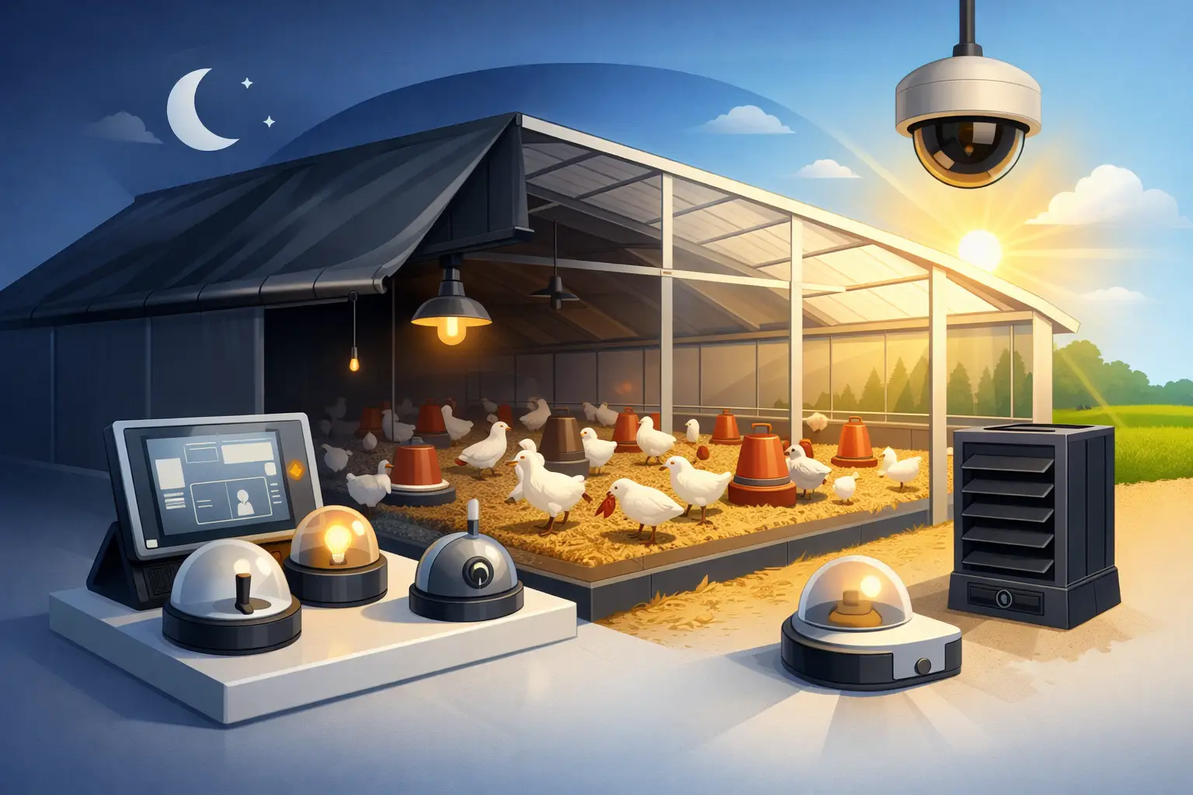
A light-deprivation building uses blackout construction and light traps to prevent daylight from disrupting the programmed photoperiod. This can include sealed sidewall openings, darkened inlet assemblies, curtain systems, light-tight doors, and exhaust fan light traps. The objective is to create predictable lighting conditions, not simply make the house dim.
The need for light control varies by production type. Broiler operations may use lighting schedules to balance performance and bird activity. Pullets and breeder flocks often require more precise light management because photostimulation can affect sexual maturity and production timing. Layer operations may use controlled programs to maintain a consistent production environment. The correct schedule should come from the flock's veterinarian, integrator, genetics supplier, or qualified poultry consultant - not from a generic lighting chart.
The ventilation challenge with light deprivation in poultry farming
Every opening that moves air can also become a light leak. This is why blackout ventilation cannot be designed by looking only at nominal fan CFM. Light traps, louvers, screens, shutters, cooling pads, dirty components, and building pressure all affect real airflow.
A light trap creates resistance. That resistance adds static pressure to the ventilation system. If an exhaust fan is selected only by its free-air rating, its delivered CFM may fall well below the requirement after the fan pulls through a light trap, inlet system, evaporative media, guards, and building restrictions.
This is a common design failure in blackout poultry houses: adequate fan quantity on paper, inadequate airflow under operating conditions. The results can include elevated house temperature, uneven air distribution, high ammonia levels, wet litter, reduced feed intake, poor uniformity, and increased mortality risk during hot weather.
The fan selection process must account for the full system pressure. In practice, this means reviewing the fan performance curve at the anticipated static pressure, not relying on a catalog's highest advertised CFM number. A high-efficiency fan that delivers the right airflow at the actual pressure condition can outperform a larger-looking unit that loses capacity as resistance rises.
Light traps are airflow components, not accessories
Light traps are often treated as an add-on after the fans are selected. They should be treated as a core part of the air-movement system. Their blade geometry, depth, internal finish, free area, and maintenance condition affect both light blocking and pressure drop.
The best light trap is not necessarily the darkest or deepest product in isolation. It must block direct light while providing sufficient free area for the required airflow. Undersized light traps can force fan motors to work against excessive pressure, increase electrical consumption, and reduce delivered ventilation volume when the flock needs it most.
For tunnel-ventilated poultry houses, exhaust fan light traps should be sized around the total design airflow, fan staging plan, and target pressure. For minimum ventilation, inlet light traps and sidewall inlet arrangements need equal attention. The system must distribute fresh air across the ceiling or through the intended air path rather than dumping cold air directly onto birds.
Start with the bird, then calculate the equipment
Ventilation design begins with flock requirements and building conditions. A reliable evaluation considers bird type, age, stocking density, house dimensions, insulation level, climate, target airspeed, cooling approach, and the local summer design temperature. It also needs to consider whether the operation uses natural, power, tunnel, cross, or hybrid ventilation.
Minimum ventilation is especially critical during cooler weather. The goal is to remove moisture, carbon dioxide, ammonia, and combustion byproducts while avoiding chilling. In a blackout house, the inlet system must introduce air with enough velocity and direction to mix before it reaches bird level. Poor inlet control can create cold drafts in one area while another area stays humid and stale.
During hot weather, the priority shifts to heat removal and airspeed. Tunnel ventilation can create a wind-chill effect at bird level, but only if the fan bank, inlet end, building seal, and internal obstructions are properly coordinated. A large fan package does not automatically produce uniform airspeed from one end of the house to the other.
Cooling-pad systems add another layer of resistance and maintenance demand. If evaporative cooling is part of the design, the fan package must be evaluated with pad pressure drop included. The water system, pad area, sump, recirculation rate, and controls must also be matched to the climate. In humid regions, evaporative cooling may provide less temperature reduction than it does in dry climates, so airflow capacity and bird-level airspeed carry even more weight.
Air sealing must be balanced with managed intake
A light-deprivation poultry barn needs a controlled envelope. Unplanned leaks compromise darkness and make airflow unpredictable. Air enters where resistance is lowest, not necessarily where the designer intended. A door gap, loose curtain, damaged wall panel, or unsealed fan housing can short-circuit the inlet system and create uneven conditions.
However, an overly sealed house without adequate planned intake area can also create excessive negative pressure. That can reduce fan output, strain shutters, make doors difficult to operate, and prevent fresh air from reaching the right areas. The goal is not maximum sealing. The goal is controlled leakage and correctly sized, light-controlled air inlets.
Pressure monitoring provides useful operational feedback. A stable static-pressure reading during each fan stage helps confirm that inlets are opening correctly and the house is not developing major leakage or restriction problems. Readings should be interpreted in the context of the specific house design. A number that works in one building may be wrong in another because inlet geometry, ceiling configuration, and ventilation mode differ.
Controls should stage airflow, lighting, and alarms together
Poultry-house controllers should coordinate lighting schedules with ventilation stages, inlet actuators, heaters, cooling equipment, and emergency alarms. Separating these functions into disconnected controls increases the chance of conflicting operation. For example, a lighting program may require full blackout while an improperly configured exhaust stage causes visible light leakage through fan openings.
Variable frequency drives can be useful where the system needs finer fan modulation, reduced starting current, or more stable pressure control. They are not a substitute for correct fan sizing. A VFD can improve how a correctly engineered system operates, but it cannot overcome an undersized light trap, inadequate inlet area, or excessive building restriction.
Backup power and alarm planning are essential. Birds in a light-tight, mechanically ventilated building depend on fans, controls, and electrical service. A generator should be sized and tested for the actual starting and running loads of fans, pumps, controllers, lighting, heaters, and other critical equipment. Alarm systems should notify responsible personnel quickly when high temperature, power loss, fan failure, or controller faults occur.
Maintenance protects both darkness and ventilation capacity
Blackout systems need regular inspection because dust, feathers, moisture, and wear can affect performance. Fan blades, shutters, belts, bearings, motors, louvers, screens, and light-trap passages should be inspected on a planned schedule. A dirty light trap may continue to block light but restrict much more airflow than it did when clean.
Walk the building during daylight with interior lights off to identify light leaks around doors, fans, inlet housings, utility penetrations, and curtain edges. Then inspect the same components while the ventilation system is running. Some gaps only become visible when pressure changes pull curtains, seals, or shutters out of position.
Maintenance also includes verifying controller sensors. A temperature sensor exposed to direct airflow, dust buildup, or heat from nearby equipment can make the control system stage fans at the wrong time. Calibrated sensors and documented setpoints are basic operating discipline, especially in houses where lighting and ventilation must work as one system.
Specify the system around real operating pressure
A successful blackout poultry project is an engineering exercise, not a fan-count exercise. The design should document target CFM by ventilation stage, estimated static pressure, light-trap free area, inlet capacity, fan performance at pressure, electrical requirements, controls, emergency ventilation, and maintenance access.
Factory Fans Direct can help evaluate light-trap restrictions, airflow paths, and equipment matching before a poultry ventilation purchase is made. Bring the house dimensions, bird type, ventilation layout, existing fan data, and any planned blackout components to the evaluation. The most useful design decisions are made before the fan openings are cut and before a hot, dark barn exposes a preventable airflow problem.
Factory Fans Direct - Commercial & Industrial Ventilation & Cooling Experts | Contact Mike Miller VP Engineering at Factory Fans Direct for a FREE Project Evaluation 888-849-1233 | Mike@FactoryFansDirect.com
Recent Posts
-

Smart Buildings Architects Recommend Edmonds ecoPOWER Hybrid Ventilation
A rooftop ventilator should not force an all-or-nothing energy decision. Smart Buildings Architects …7th Sep 2026 -
Smart Industrial Buildings Use Edmonds ecoPOWER Hybrid Ventilation
A roof exhaust system can be the difference between a plant that controls heat at the source and one …7th Sep 2026 -
Smart Commercial Buildings Use Edmonds Hybrid Ventilation
A rooftop exhaust fan that only performs when the wind blows is not a complete ventilation strategy. …7th Sep 2026