LEED Ventilation Design Trends for High-Performance Buildings
A ventilation schedule that only lists fan CFM and motor horsepower is no longer enough for a LEED project. Current LEED ventilation design trends place equal weight on outdoor-air delivery, energy recovery, controllability, verification, and the actual operating conditions of the building. For engineers, architects, contractors, and facility teams, that means equipment selection must begin with the load profile, occupancy, pressure relationships, and climate zone - not with a catalog fan size.
The objective is not simply to move more air. Oversized exhaust, poorly controlled make-up air, or an ERV selected without considering contamination risk can create comfort complaints, energy penalties, and commissioning failures. High-performance ventilation is a coordinated system: supply, exhaust, filtration, controls, dampers, sensors, and the building envelope all have to work together.
LEED Ventilation Design Trends Moving Beyond Basic Air Changes
The strongest trend is a move away from prescriptive thinking. Air changes per hour remain useful for many applications, especially warehouses, agricultural facilities, kitchens, and process spaces. But LEED-oriented design teams are increasingly evaluating ventilation by measured outcomes: acceptable indoor air quality, lower fan and conditioning energy, stable pressure, and documented performance after turnover.
This shift is especially relevant in mixed-use buildings and industrial facilities with variable occupancy. A warehouse may have a modest baseline ventilation load during storage hours, then experience sharp peaks from forklift traffic, dock activity, packaging operations, or high worker density. A fixed-speed exhaust system designed only for the peak condition can waste substantial energy for most of the year. Variable-speed fan control and staged make-up air allow the system to follow the real load.
The practical engineering question is not, “What is the largest fan we can install?” It is, “What airflow is required at each operating condition, and what static pressure will the system see?” Fan curves, duct losses, intake louvers, filters, backdraft dampers, and discharge conditions all affect delivered CFM. A fan rated at 20,000 CFM in free air may perform very differently once installed in a ducted or restricted system.
Dedicated Outdoor Air Systems Are Becoming More Common
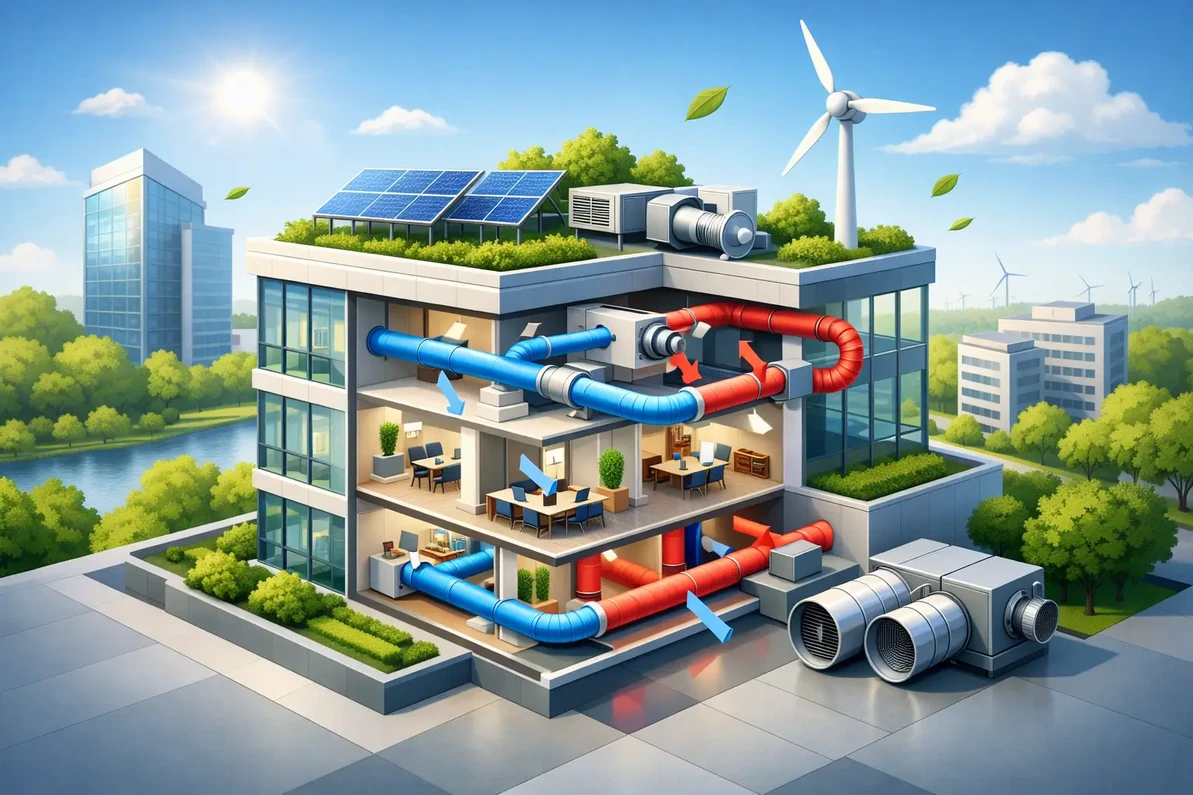
Dedicated outdoor air systems, often called DOAS, are a major part of modern LEED ventilation strategies. Rather than asking terminal equipment or recirculating HVAC units to manage all space conditioning and ventilation functions, a DOAS delivers conditioned outdoor air directly to occupied zones. Sensible heating and cooling can then be handled separately through other equipment.
This approach can improve humidity control, provide more predictable outdoor-air delivery, and simplify verification. It is particularly valuable where latent loads matter: offices with dense occupancy, schools, health-related spaces, multifamily properties, cannabis cultivation support areas, and buildings in humid US climates.
However, DOAS is not automatically the best answer for every building. It adds equipment, controls, ductwork, and coordination requirements. In a large industrial building with frequent open loading doors, heavy process exhaust, or minimal cooling demand, a simpler properly balanced exhaust and make-up air strategy may be more practical. The correct solution depends on the air balance and the process, not on a label.
Energy Recovery Is Now a Design Decision, Not an Add-On
Energy recovery ventilators and heat recovery ventilators are increasingly specified to reduce the heating and cooling burden associated with outdoor air. In many facilities, exhausting conditioned air while bringing in unconditioned replacement air is one of the largest hidden operating costs.
An ERV can transfer sensible heat and, depending on the technology, moisture between exhaust and incoming air streams. This can reduce peak HVAC loads and annual energy use. It is often a strong fit for offices, schools, commercial buildings, and conditioned production areas with relatively clean exhaust streams.
The trade-off is contamination control. Exhaust air from chemical processes, commercial kitchens, certain agricultural operations, battery rooms, and cultivation facilities may require careful evaluation before energy recovery is used. Pressure differentials, purge sections, wheel carryover, exhaust-stream contaminants, and maintenance access all matter. A design that saves energy but compromises air quality is not a high-performance design.
Demand-Controlled Ventilation Is Getting More Precise
CO2-based demand-controlled ventilation has been used for years, but the controls conversation has expanded. LEED projects increasingly use multiple sensor inputs to reflect how a building actually operates. CO2 sensors can indicate occupancy trends in people-dense spaces, while temperature, relative humidity, VOC, particulate, pressure, and equipment-status signals can help refine system response.
For facility managers, this means controls should be selected with a service plan in mind. A sensor that drifts out of calibration or is installed in a poor location can cause under-ventilation or unnecessary fan runtime. Sensors should be accessible, calibrated on schedule, and tied to a control sequence that operators can understand.
Variable frequency drives are central to this trend. A VFD can reduce fan speed as demand falls, and fan power drops dramatically when speed is reduced. But a VFD does not correct an improperly sized fan or a poorly designed duct system. The system still needs adequate static-pressure capability at design airflow, stable control logic, and motor compatibility across the intended operating range.
Electrification Raises the Stakes for Fan Energy
As buildings move toward electrification and lower operational carbon, ventilation fan energy receives more scrutiny. Exhaust and supply fans may run thousands of hours per year. Even a modest reduction in watts can have significant annual impact when multiplied across a facility.
Current design decisions often focus on electronically commutated motors, premium-efficiency motors, direct-drive arrangements where appropriate, low-pressure-drop duct layouts, and carefully selected louvers and filtration. The best choice is application-specific. Belt-drive fans can offer flexibility and serviceability in certain commercial and industrial installations, while direct-drive equipment may reduce maintenance points in other applications.
Static pressure deserves special attention. Long duct runs, undersized ducts, restrictive louvers, dirty filters, sound attenuators, and backdraft dampers can turn an efficient fan into an energy-intensive system. Before specifying equipment, establish the full external static pressure at clean and loaded conditions. This is where cut sheets, fan curves, and real application engineering make the difference.
Indoor Air Quality Is Expanding Beyond Outdoor-Air Volume
Higher-efficiency filtration, particulate monitoring, humidity management, and source control are becoming more common in LEED ventilation discussions. Building owners have learned that “more outside air” is not the only answer to indoor air quality concerns. In some climates or seasons, bringing in more untreated outdoor air can increase humidity loads, introduce particulates, and raise energy consumption.
A better approach is to identify the contaminant and control it at the appropriate level. Source capture may be required for welding fumes, process heat, chemical vapors, and localized moisture. General dilution ventilation may be suitable for broader occupancy-related loads. Filtration may address outdoor particulates, but filters also add pressure drop and require planned maintenance.
Pressure zoning is equally important. Restrooms, janitor closets, kitchens, chemical storage areas, and process rooms often need negative pressure relative to adjacent occupied spaces. Clean rooms, certain healthcare spaces, and sensitive production areas may need positive pressure. These relationships cannot be maintained if exhaust and make-up air systems are selected independently.
Commissioning and Measurement Are Part of the Equipment Strategy
A LEED ventilation system must be verifiable in the field. Design intent can be lost through substituted equipment, missing dampers, improperly installed sensors, unbalanced ductwork, or controls that are never fully programmed. Testing, adjusting, and balancing should not be treated as a final paperwork exercise.
A practical commissioning process verifies four areas:
- Actual supply, return, exhaust, and outdoor-air quantities at operating conditions
- Required pressure relationships between spaces and zones
- Fan response to VFD commands, sensor inputs, alarms, and occupied schedules
- Access for filter changes, belt service, damper adjustment, sensor calibration, and future maintenance
Trend logging is particularly useful after occupancy. A building may pass a functional test on one day but reveal overnight pressurization problems, humidity swings, or control hunting after several weeks of normal operation. Facility teams should have clear airflow setpoints and a simple way to identify when performance has shifted.
How to Select Ventilation Equipment for LEED-Oriented Projects
Start with the engineering data. Define the required CFM by zone and operating mode, estimate external static pressure, identify temperature and moisture conditions, and establish the required pressure relationships. Then review the duty cycle, power availability, control requirements, mounting location, noise limits, and maintenance access.
For roof-mounted exhaust, intake configuration and make-up air location are critical. Short-circuiting occurs when exhausted air is pulled back into nearby intakes. For large warehouses and manufacturing plants, high-volume airflow may require multiple fans, staged control, or destratification support rather than one oversized exhaust unit. For conditioned spaces, energy recovery and filtration pressure drop must be included in the fan selection from the beginning.
Factory Fans Direct provides ventilation design engineering support for commercial and industrial applications where airflow, heat load, static pressure, and equipment matching cannot be left to guesswork. A free project evaluation can help confirm whether the proposed fan, make-up air, VFD, and control strategy will perform as intended before equipment is ordered.
The most useful next step is to put the actual building conditions on paper: floor plan, ceiling height, process heat, occupancy, duct layout, electrical service, and desired operating schedule. Those details turn a LEED ventilation goal into a system that can be installed, balanced, and operated with confidence.
Factory Fans Direct/Edmonds US - Hybrid Commercial & Industrial Ventilation & Cooling Experts | Contact Mike Miller VP Engineering at Factory Fans Direct for a FREE Project Evaluation 888-849-1233 | Mike@FactoryFansDirect.com
Recent Posts
-

AI Mega Factories Use Edmonds ecoPOWER Hybrid Ventilation
AI Mega Factories use Edmonds ecoPOWER Hybrid Turbine Ventilation because heat rejection cannot be t …4th Oct 2026 -
AI Cooling for High-Heat Facilities
A server aisle running 12°F hotter than its neighboring aisle, a crypto container recirculating exha …4th Oct 2026 -
AI Ventilation: Better Control Starts With Data
A warehouse can look adequately ventilated on paper and still have a 15-degree temperature differenc …4th Oct 2026