Immersion Cooling vs Air Cooling for Mining
A mining container that runs well in January can become a production problem in July. The issue is not simply that miners run hot. It is whether the facility can remove every kilowatt of heat reliably when outdoor temperatures, dust loading, utility rates, and fleet density all change at once. In the immersion cooling vs air cooling decision, the right answer comes from the total heat-rejection design, not from the cooling method alone.
For crypto mining and high-density data center equipment, every watt consumed becomes heat that must go somewhere. A 1 MW mining load produces approximately 3.412 million BTU per hour of heat. Whether that heat moves through air or dielectric fluid, the final system must reject it outdoors, recover it for a useful process, or transfer it to another cooling loop. That is the engineering starting point.
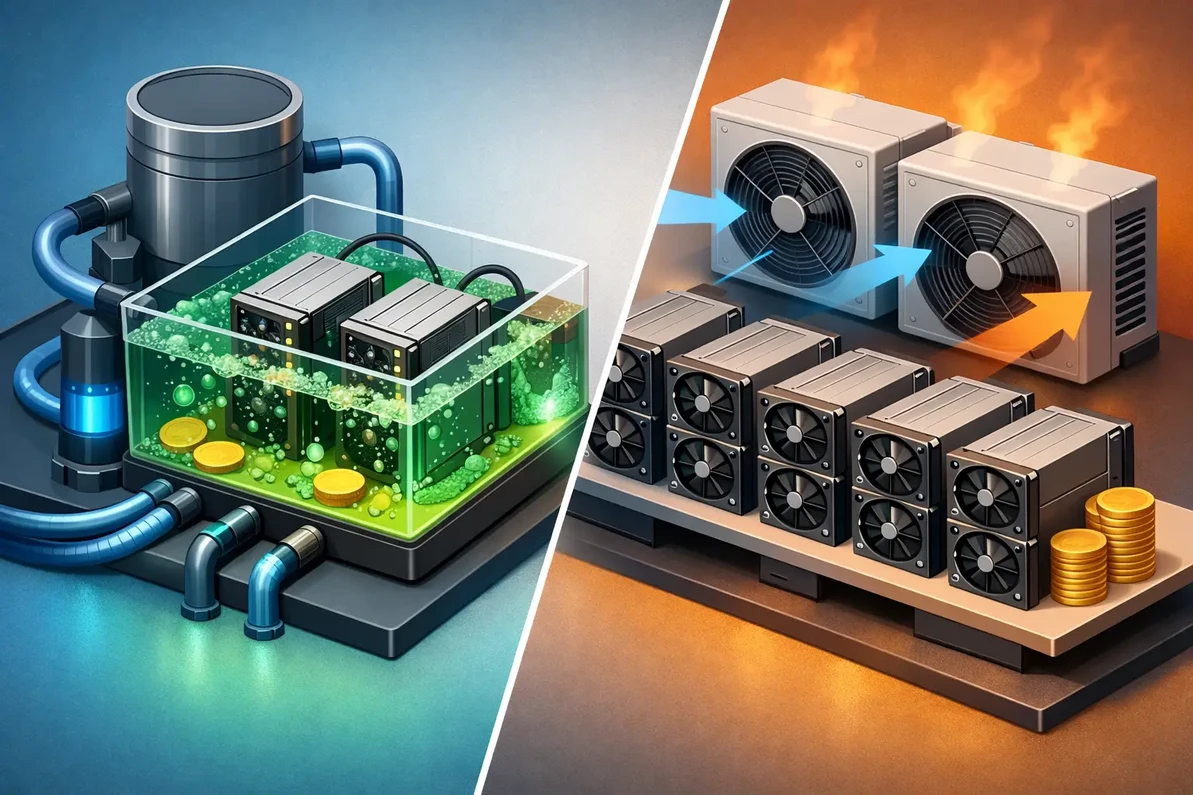
Immersion Cooling vs Air Cooling: The Core Difference
Air cooling uses the miner's onboard fans to move room or container air across heat sinks. Exhaust fans, louvers, ducts, evaporative cooling equipment, make-up air openings, and containment then manage the resulting heat stream. It is a familiar approach because most ASIC miners arrive configured for it, components remain accessible, and a properly designed ventilation system can support substantial loads without a chilled-water plant.
Immersion cooling places compatible equipment in a nonconductive dielectric fluid. The fluid absorbs heat directly from chips and heat-generating components, then circulates through a heat exchanger. A secondary loop - commonly water and glycol, dry coolers, cooling towers, or other heat-rejection equipment - carries that heat away. The ASIC's high-speed onboard fans are generally removed or disabled, reducing fan energy, noise, and airborne contamination.
The practical distinction is heat density. Air cooling needs a large volume of conditioned or managed air to transport heat. Immersion transfers substantially more heat in a smaller equipment footprint, but it replaces much of the fan-and-louver design work with fluid management, pumping, heat-exchanger sizing, and outdoor heat-rejection engineering.
When Air Cooling Is the Better Operating Choice
Air cooling remains the most economical and serviceable solution for many mining operations, especially when the site has favorable ambient conditions, adequate building volume, and room for large intake and exhaust paths. It is also often the logical choice for an existing farm using standard air-cooled miners where the owner wants to expand capacity without replacing the infrastructure model.
The key is to design for the actual sensible heat load rather than selecting exhaust fans by floor area. As a quick engineering check, airflow can be estimated with this relationship:
CFM = BTU/hr ÷ (1.08 × allowable temperature rise)
At a 20°F allowable rise, a 1 MW load requires roughly 158,000 CFM before allowances for static pressure, recirculation, elevation, dirty louvers, filters, and system losses. That number illustrates why undersized exhaust systems fail. A few high-CFM fans may sound sufficient on paper, but their delivered airflow drops when restrictive shutters, weather hoods, ductwork, silencers, or inadequate intake openings raise static pressure.
Air systems also require disciplined separation of intake and exhaust. Hot exhaust pulled back into miner intakes raises inlet temperatures, forces onboard fans to work harder, and can lead to throttling or shutdowns. In a container or modular mine, the airflow path should be direct: low-resistance intake, controlled movement through miners, and a clear exhaust route with enough fan capacity to maintain the intended pressure and temperature rise.
Air cooling has real operating benefits. Technicians can swap miners quickly. There is no fluid handling during standard repairs, no tank to open, and no compatibility question for equipment not approved for immersion. For sites with lower rack density, seasonal operation, or a need to deploy quickly, these advantages can outweigh the higher fan power and larger footprint.
The trade-off is environmental exposure. Dust, pollen, moisture, corrosive air, and high ambient temperatures all affect performance and maintenance. Filters can protect equipment, but they add static pressure and demand a cleaning schedule. Evaporative assist can reduce inlet temperature in dry climates, yet it adds water treatment, controls, and humidity considerations. Air cooling is straightforward only when the complete ventilation path is properly engineered.
Where Immersion Cooling Earns Its Cost
Immersion cooling is strongest where heat density, acoustic limits, contamination, or clocking requirements make air cooling difficult. It allows a much tighter equipment layout because the thermal transport medium is more effective than air. It can also reduce the electrical draw associated with thousands of small miner fans and eliminate a common point of mechanical failure.
For high-temperature mining environments, immersion can stabilize chip temperatures when outdoor air is too warm to support practical air-cooled operation. It can also permit more aggressive operating profiles on compatible hardware, although any overclocking decision should be evaluated against warranty terms, power infrastructure, transformer capacity, and the added heat load imposed on the heat-rejection system.
Noise reduction is another major consideration. A large air-cooled mining operation can create substantial fan noise at the miner and facility level. Immersion systems still use pumps, dry coolers, and often large axial fans outdoors, but the acoustic profile is usually easier to manage than thousands of high-RPM server fans concentrated in a container.
Immersion is not maintenance-free. Dielectric fluid selection, tank design, pump redundancy, filtration, leak containment, hose and fitting quality, fluid sampling, and heat-exchanger cleaning all matter. A poorly maintained secondary loop can lose heat-rejection capacity just as surely as a blocked air intake can. Technicians also need a defined process for handling, draining, inspecting, and returning miners to service.
The Heat-Rejection System Determines Uptime
The most common mistake in comparing these approaches is treating immersion as if the heat disappears once it enters the fluid. It does not. A 500 kW immersion deployment still needs to reject roughly 1.7 million BTU per hour. If the outdoor dry cooler is undersized for the design ambient, the fluid temperature rises, miner temperatures rise, and production suffers.
For air cooling, outdoor conditions directly affect the miner inlet temperature. For immersion, they affect the dry cooler or cooling tower's ability to remove heat from the fluid loop. Both systems must be designed around the site's summer design temperature, not its annual average.
A reliable system also needs failure planning. In air-cooled facilities, consider fan staging, VFD control, backup power strategy, motor access, automatic louvers, and alarm thresholds for intake and exhaust temperature. In immersion installations, consider N+1 pumps where justified, flow and temperature sensors, leak detection, isolation valves, expansion volume, and controls that safely reduce load if the heat exchanger cannot maintain setpoint.
Water availability changes the decision as well. Dry coolers avoid ongoing process-water consumption but may require more surface area and fan power during peak heat. Cooling towers can reject heat efficiently, particularly in hot climates, but introduce water chemistry, scale, biological control, and maintenance requirements. There is no universal winner without reviewing climate, utility pricing, water costs, and operating targets.
Capital Cost, Energy Cost, and Expansion Planning
Air cooling generally has the lower initial cost when a facility can use outside air, correctly sized exhaust fans, adequate intake area, and simple containment. The infrastructure is familiar to electrical contractors and maintenance teams, and the mine can typically accept standard equipment with fewer modifications.
Immersion has a higher initial investment because it requires tanks, dielectric fluid, pumps, manifolds, heat exchangers, controls, and a properly sized external rejection loop. The economics improve as power density increases, locations become hotter or dirtier, noise restrictions tighten, or the operator places a high value on reduced miner-fan energy and equipment protection.
Do not compare only the price of fans against the price of an immersion tank. Compare installed cost per kW, parasitic energy, service labor, expected uptime, equipment life, sound requirements, building or container footprint, and the cost of future expansion. A facility designed for 250 kW may have a very different best answer than a 5 MW deployment planned in phases.
Selecting the Right Cooling Strategy
Start with verified electrical load, not the nameplate estimate on one miner. Identify the present and planned kW load, outdoor design temperatures, available footprint, noise limits, site dust conditions, utility rate structure, water availability, and desired expansion path. Then calculate the required heat rejection with realistic safety margin and component derating.
Air cooling is often the practical choice for standard-density deployments in favorable climates, particularly where rapid service access and lower upfront cost are priorities. Immersion cooling is often the stronger long-term choice for dense installations, harsh environments, high-temperature operations, noise-sensitive sites, and fleets where thermal consistency has a measurable value.
Factory Fans Direct provides Crypto Mining & Data Center Cooling expertise, including ventilation design guidance for high-temperature and SP mining applications, air movement equipment, and immersion or hydro cooling planning. Before buying another fan, tank, or dry cooler, put the full heat load and site conditions on one design sheet - that is where the correct cooling strategy becomes clear.
Factory Fans Direct - Crypto Mining & Data Center Cooling Experts Contact Mike Miller VP Engineering at Factory Fans Direct for a FREE Project Evaluation 888-849-1233 | Mike@FactoryFansDirect.com
Recent Posts
-

Smart Buildings Architects Recommend Edmonds ecoPOWER Hybrid Ventilation
A rooftop ventilator should not force an all-or-nothing energy decision. Smart Buildings Architects …7th Sep 2026 -
Smart Industrial Buildings Use Edmonds ecoPOWER Hybrid Ventilation
A roof exhaust system can be the difference between a plant that controls heat at the source and one …7th Sep 2026 -
Smart Commercial Buildings Use Edmonds Hybrid Ventilation
A rooftop exhaust fan that only performs when the wind blows is not a complete ventilation strategy. …7th Sep 2026