
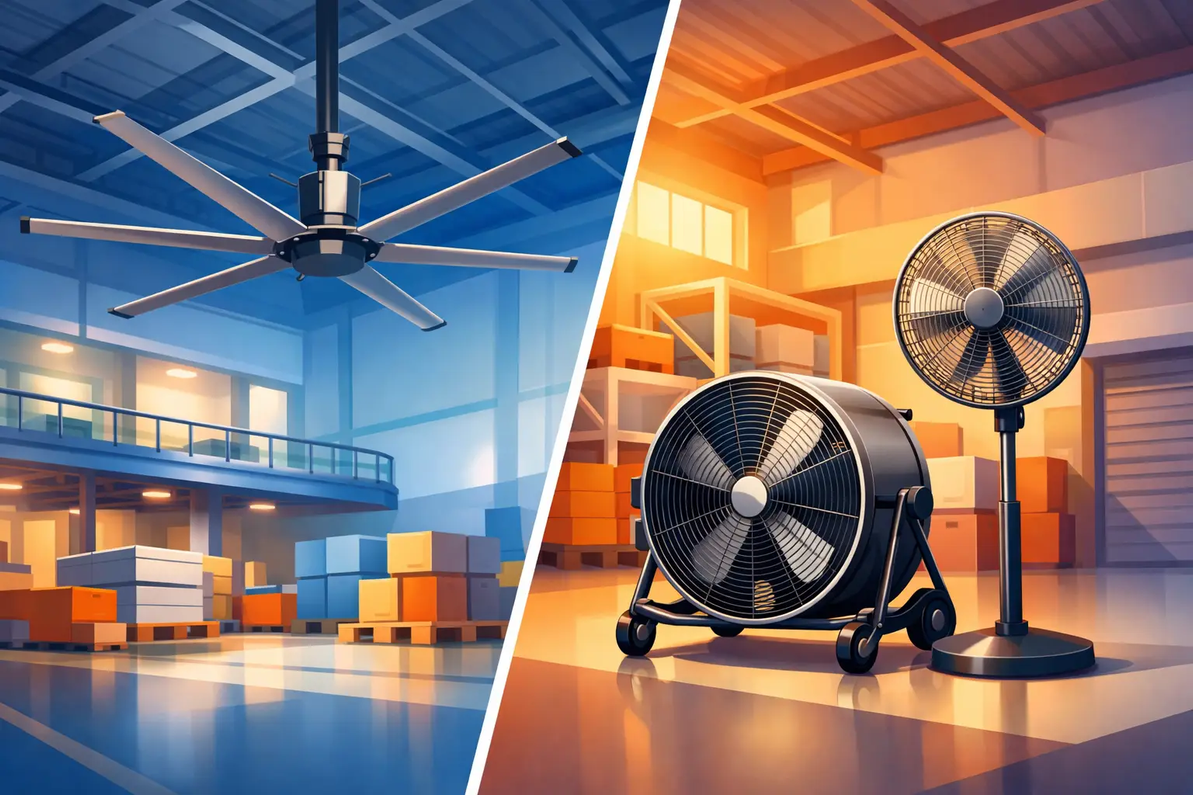
HVLS Fan vs Floor Fans - What Fits Your Facility?
A hot aisle between pallet racks, a humid livestock barn, or a grow room with uneven canopy temperatures rarely has a simple fan problem. It has an air-movement design problem. When comparing an HVLS fan vs floor fans, the right answer depends on ceiling height, floor plan, heat sources, obstructions, worker locations, and whether the goal is comfort, destratification, drying, or process cooling.
Floor fans can deliver concentrated air exactly where it is needed. HVLS fans move a large volume of air at low velocity across a broad area. Both can be effective equipment, but they are not interchangeable. Selecting based only on fan diameter, horsepower, or upfront price often leaves a facility with hot zones, excessive fan noise, and higher operating costs.
HVLS Fan vs Floor Fans: The Core Difference
HVLS means high-volume, low-speed. These large-diameter ceiling fans typically operate at relatively low RPM and create a wide, downward-moving air column that spreads horizontally once it reaches the floor. The objective is not a narrow blast of air. It is consistent air circulation across a large occupied zone.
Floor fans, including pedestal fans, drum fans, mobile fans, and high-velocity barrel fans, use smaller blades and higher air velocity to project air in a defined direction. They are useful when a crew works at one station, when heat is concentrated around a machine, or when temporary airflow is needed during a seasonal peak.
This distinction matters because CFM alone does not describe how useful a fan will be. A high-CFM floor fan may feel powerful standing directly in front of it, yet have little effect 30 feet away or around a rack system. An HVLS fan may create less perceived velocity at one point, but improve air movement across thousands of square feet.
Where HVLS Fans Deliver Better Results
HVLS fans are generally the stronger choice for large, open interiors with adequate ceiling clearance. Warehouses, distribution centers, manufacturing floors, gymnasiums, aircraft hangars, riding arenas, dairy barns, and large cultivation spaces are common applications.
Large Coverage With Fewer Fan Locations
A properly sized HVLS fan can cover a substantial floor area, reducing the need to place multiple portable units around the building. That matters in facilities where floor space is valuable and mobile equipment creates trip hazards, forklift conflicts, or maintenance burdens.
The wide airflow pattern also helps reduce stagnant zones. In summer, air movement increases evaporative cooling at the skin, allowing employees to feel cooler even though the room temperature has not changed. In livestock facilities, gentle, broad air movement can support animal comfort without directing a harsh stream at a specific pen.
Destratification in High-Ceiling Buildings
Heat rises. In a warehouse or production building with a 24- to 40-foot ceiling, heated air can accumulate overhead while occupants remain uncomfortable below. During colder months, an HVLS fan operating in reverse or at an appropriate low-speed setting can mix warm ceiling air back into the occupied zone.
This is one reason an HVLS installation can support heating efficiency. The actual savings depend on insulation, door activity, heating equipment, thermostat placement, and operating schedules. Still, correcting temperature stratification is often more productive than simply increasing the heater setpoint.
Lower Velocity, Better Whole-Room Comfort
High velocity is not always desirable. Employees handling lightweight packaging, powders, paperwork, or delicate product may not tolerate a direct blast from a drum fan. HVAC air distribution can also be disrupted when portable fans are aimed without a plan.
HVLS fans are designed for large-scale circulation rather than point cooling. They can provide a more even comfort improvement across work areas, especially where people move throughout the shift instead of staying at one workstation.
When Floor Fans Are the Practical Choice
Floor fans earn their place because not every facility has the height, layout, budget, or operating need for an overhead system. They are a practical tool when flexibility and immediate spot cooling matter most.
A floor fan is often appropriate for a loading dock, welding bay, maintenance area, packing line, temporary event space, or an individual work cell with high radiant heat. It can be rolled into position, aimed at the heat source or worker zone, and removed when the job changes.
They are also useful as supplemental equipment. A facility may use HVLS fans for general circulation while using floor fans at ovens, compressors, injection molding machines, or other locations with concentrated process heat. This combination can be more effective than trying to make one fan type solve every airflow issue.
The Limits of Portable Air Movement
The same mobility that makes floor fans useful can make them difficult to manage. Units may be unplugged, moved away from the intended location, blocked by inventory, or pointed in a direction that does not support the overall airflow plan. Cords can create housekeeping and safety concerns, while floor-mounted equipment competes with traffic lanes.
Noise should also be evaluated. High-velocity fans can be loud, particularly in facilities already dealing with machinery noise. Before selecting equipment, consider measured or published sound levels, not just motor horsepower and airflow claims.
Installation and Building Constraints
Ceiling height is a deciding factor for HVLS fans. The fan must have appropriate clearance from the floor, roof structure, lights, sprinklers, doors, cranes, and other equipment. Mounting structure, electrical supply, downrod length, control location, and seismic requirements where applicable must all be reviewed.
In warehouses with overhead cranes, closely spaced racks, low-hanging process equipment, or multiple ceiling elevations, an HVLS layout requires more engineering than simply centering fans in open bays. One poorly placed large fan can leave circulation gaps or interfere with operations.
Floor fans avoid overhead installation work, but they still require thoughtful placement. A fan aimed at an open roll-up door may pull in humid outside air or waste conditioned air. A fan blowing directly at a dusty process can create airborne particulate problems. In cultivation and greenhouse applications, excessive direct airflow can stress plants, alter humidity patterns, or promote uneven drying.
Energy Use: Compare the Job, Not Just the Watts
An HVLS fan may use more watts than a single floor fan, especially at higher speeds, but that comparison is incomplete. The question is how many floor fans would be needed to provide similar coverage and how consistently they would operate.
Modern HVLS fans commonly use efficient direct-drive motors and variable-speed controls. The ability to slow the fan down during mild conditions can reduce energy use while maintaining air circulation. A large fan may also help facilities raise cooling setpoints in certain applications because better air movement improves perceived comfort.
Floor fans can be economical for a small targeted task. Running a 30-inch or 36-inch pedestal fan at one workstation may be far less expensive than installing a ceiling system for a short-term need. But multiplying that approach across a 100,000-square-foot warehouse can lead to dozens of units, more electrical outlets, more maintenance, and inconsistent results.
How to Size the Right Fan Strategy
Start with the problem you need to solve. If the issue is broad employee comfort, ceiling heat stratification, or low air movement across a large open floor, evaluate HVLS fan coverage and mounting geometry. If the issue is a single hot station or a changing temporary workspace, floor fans may be the better fit.
Then review ceiling height, available mounting structure, square footage, obstructions, heat load, building envelope, existing HVAC or exhaust capacity, and the location of people and equipment. For agricultural, greenhouse, cannabis, and hemp operations, also account for crop stage, humidity targets, airflow at the canopy, and the need to avoid dead zones without creating excessive wind stress.
Do not treat recirculation as a replacement for ventilation. Neither an HVLS fan nor a floor fan removes heat, moisture, fumes, dust, or contaminants from a building. Where process heat, welding fume, combustion byproducts, high humidity, or odor are present, exhaust and make-up air requirements must be addressed first. Circulation fans can then improve how that conditioned or ventilated air reaches the occupied space.
A Better Way to Make the Decision
The best HVLS fan vs floor fans decision is often a layered approach: large overhead circulation for the building, targeted floor-level airflow for isolated hot spots, and properly sized exhaust or make-up air where heat and contaminants must leave the facility.
Factory Fans Direct provides free project evaluations for commercial and industrial ventilation and cooling applications. Before buying by diameter alone, document the building dimensions, ceiling height, obstructions, equipment heat load, and the specific comfort or ventilation issue employees are experiencing. That information makes it possible to match airflow equipment to the work being done instead of asking a fan to solve the wrong problem.
For a large facility, the most economical fan is usually the one that delivers usable airflow where people and processes need it, without adding clutter, noise, or unnecessary operating cost.
Factory Fans Direct - Commercial & Industrial Ventilation & Cooling Experts | Contact Mike Miller VP Engineering at Factory Fans Direct for a FREE Project Evaluation 888-849-1233 | Mike@FactoryFansDirect.com
Recent Posts
-

Smart Buildings Architects Recommend Edmonds ecoPOWER Hybrid Ventilation
A rooftop ventilator should not force an all-or-nothing energy decision. Smart Buildings Architects …7th Sep 2026 -
Smart Industrial Buildings Use Edmonds ecoPOWER Hybrid Ventilation
A roof exhaust system can be the difference between a plant that controls heat at the source and one …7th Sep 2026 -
Smart Commercial Buildings Use Edmonds Hybrid Ventilation
A rooftop exhaust fan that only performs when the wind blows is not a complete ventilation strategy. …7th Sep 2026