How to Select a Hydro-Cooled Mining Container & Dry Cooler
A mining container can look complete on a quotation and still fail the only test that matters: maintaining stable chip temperatures through the hottest hours of the year. The decision to Select the Best Hyrdro-Cooled Crypto Mining Container & Dry-Cooler is not primarily about container dimensions or miner count. It is a heat-rejection and reliability design problem that must be matched to your ASIC fleet, climate, electrical capacity, water loop, and operating target.
Hydro-cooled and direct-to-chip liquid-cooled mining systems move much more heat than air-cooled deployments in a far smaller footprint. That is the advantage. The trade-off is that poor piping, undersized dry coolers, weak water treatment, or inadequate control logic can put a high-value mining operation at risk. Equipment selection needs engineering review before the purchase order is issued.
Start With the Real Heat Load, Not the Nameplate
Nearly all electrical energy delivered to an ASIC miner becomes heat. A hydro-cooled miner drawing 5.5 kW adds approximately 5.5 kW of thermal load to the liquid loop. A 100-unit installation at that power level produces roughly 550 kW of heat that must be rejected continuously, before accounting for pumps, controls, distribution losses, and reserve capacity.
Do not size the dry cooler from the container's advertised miner capacity alone. Confirm the actual operating wattage per miner, planned overclocking range, inlet water temperature requirement, and expected ambient design condition. A deployment operated at a higher frequency or performance mode can materially exceed the base-case heat load.
The core calculation is straightforward: heat load determines required coolant flow and dry-cooler capacity. The design becomes more complicated when the site experiences 100°F-plus summer conditions, has wide day-to-night swings, or requires low supply-water temperatures to protect miner performance. A dry cooler rejects heat to ambient air, so its capacity drops as outdoor temperature rises and the temperature difference between the fluid and outdoor air narrows.
A system that performs well at 75°F ambient may lose its safety margin during a sustained 100°F heat event. That is why design ambient should be based on site weather data and operational risk tolerance, not a mild annual average.
Match the Container to the Cooling Architecture
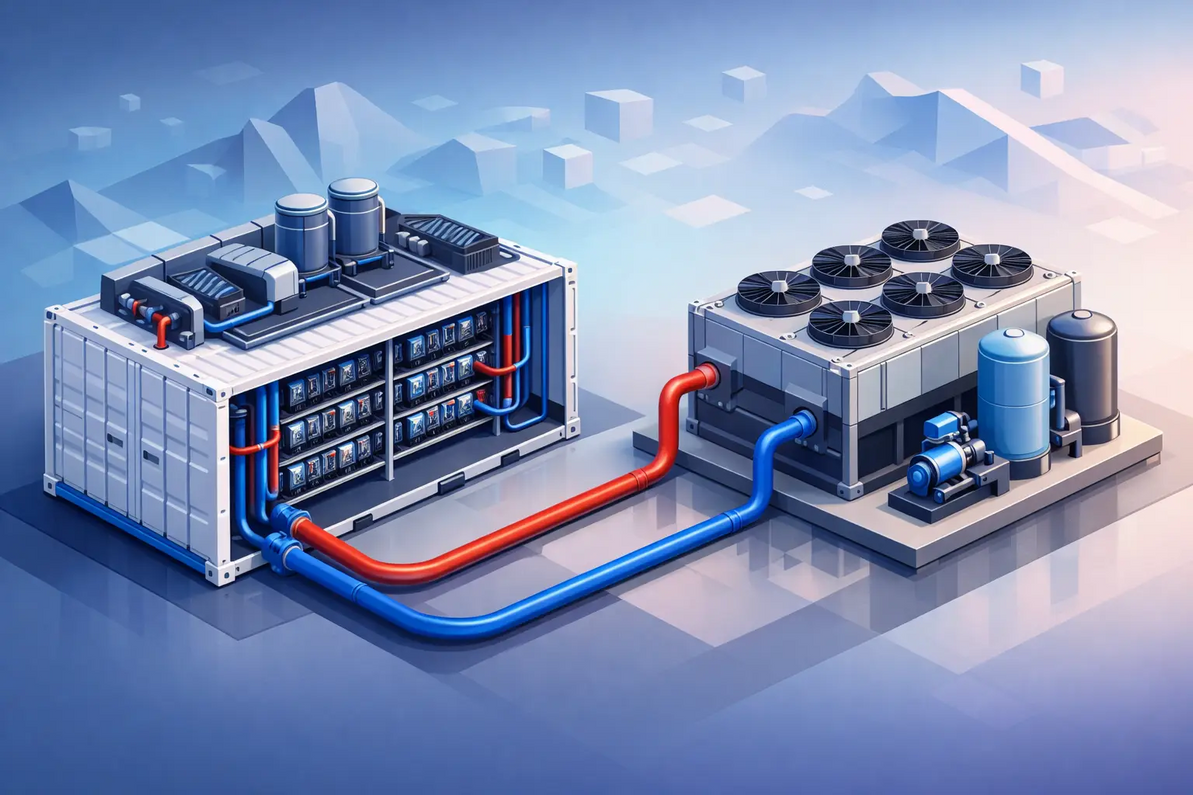
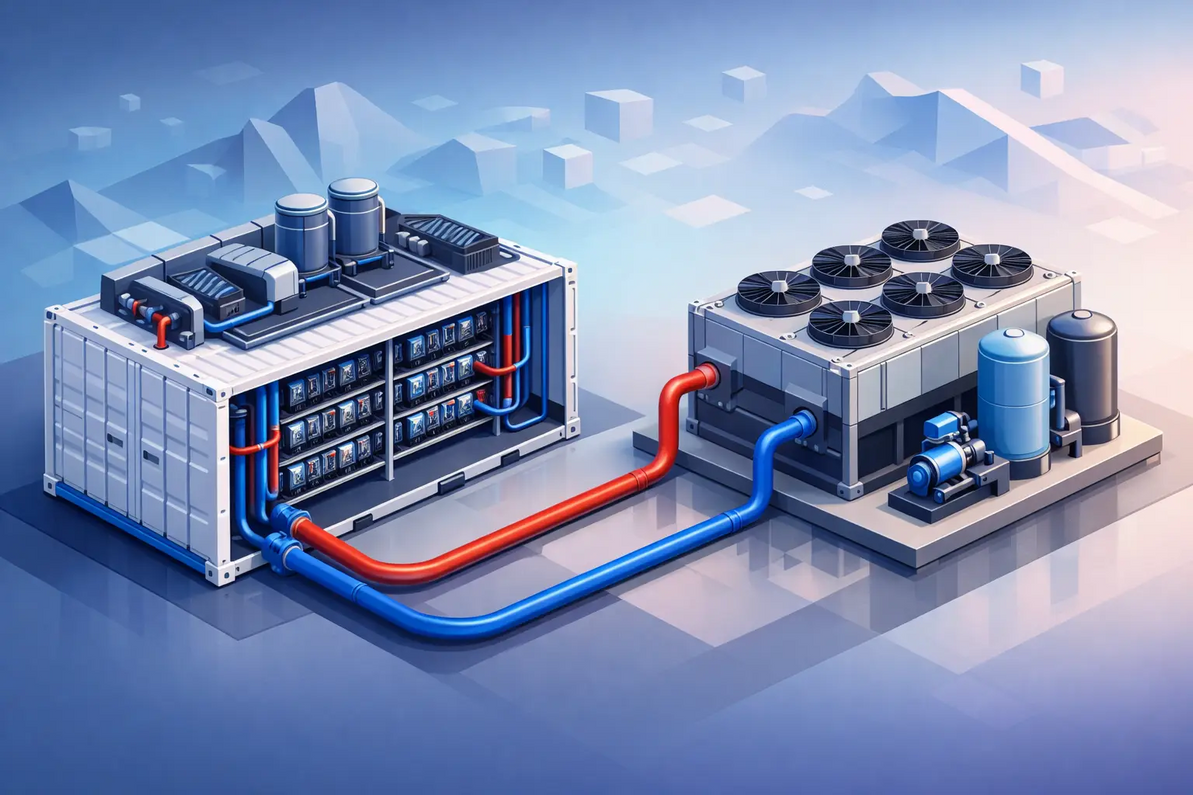
Not every liquid-cooled mining container uses the same hydraulic layout. Some designs use direct distribution manifolds serving rows of hydro ASICs. Others use a primary-secondary loop, plate heat exchangers, buffer tanks, or separate container and outdoor cooling circuits. Each approach can work, but the piping and controls must support the selected miners.
Ask for the container's hydraulic design data before comparing pricing. At minimum, review required supply and return temperatures, total flow rate, allowable pressure drop, pipe connection size, pump head, filtration requirements, and fluid specification. A container can have excellent electrical distribution and rack density while still placing excessive pressure drop on the pumps or creating uneven flow to individual miners.
Manifold balancing matters. If one bank of miners receives warmer water or lower flow than another, the result can be inconsistent hash rate, thermal alarms, derating, or premature equipment wear. The best container designs provide accessible isolation valves, flow verification, purge points, drain connections, leak detection, and service clearance around pumps and manifolds.
For field deployment, consider how the container will be commissioned and serviced. A compact design may save space, but it should not require shutting down an entire row to replace a hose, valve, or miner. Maintenance access is part of uptime engineering.
Select the Dry Cooler for Peak Conditions
A dry cooler is not simply an oversized radiator with fans. Its coil surface, fan package, controls, fluid circuit, and installation location determine how much heat it can reject under real conditions.
The first question is whether the dry cooler can achieve the required leaving-water temperature at your design outdoor dry-bulb temperature and full mining load. This is often expressed through approach temperature. A smaller approach, meaning coolant temperature closer to ambient, requires more coil surface, airflow, fan power, or all three. It can also increase equipment cost and physical footprint.
There is no universally correct approach temperature. Mining projects in cooler climates can operate efficiently with a more moderate dry-cooler selection. High-temperature regions may require larger coils, additional fan capacity, staged equipment, or a revised miner operating strategy during extreme heat. The correct answer depends on the ASIC manufacturer's temperature limits and how much performance reduction the operation can accept when ambient conditions peak.
Fan control is equally important. Variable-speed EC fan motors or properly controlled VFD fan systems can reduce energy use and noise when outdoor conditions are favorable. They also allow more stable control than simple on-off staging. Review the control sequence, not just the fan horsepower. The dry cooler should respond to supply-water or return-water temperature in a way that prevents hunting, short cycling, and sudden thermal swings.
Physical placement deserves the same attention. Dry coolers need clear intake and discharge paths. Recirculation occurs when hot discharge air is drawn back through the coil, reducing capacity exactly when the system needs it most. Avoid tight equipment yards, low walls, exhaust discharge conflicts, and locations where multiple dry coolers face each other without adequate separation. Snow, dust, cottonwood, and agricultural debris can also reduce coil performance and must be included in the maintenance plan.
Water Quality, Freeze Protection, and Materials Compatibility
Liquid cooling does not eliminate maintenance. It changes the maintenance from air filters and exhaust pathways to water chemistry, filtration, pressure control, and leak prevention.
Confirm the approved fluid and material compatibility for every component in the circuit, including ASIC cold plates, hoses, fittings, manifolds, pump seals, heat exchangers, and dry-cooler coils. Water that is too hard, corrosive, or biologically active can scale passages and restrict flow. In closed-loop systems, proper treatment, dirt separation, air elimination, and periodic testing are standard operating requirements, not optional extras.
Freeze protection requires a site-specific decision. In cold climates, glycol may be necessary to protect outdoor piping and dry-cooler coils. However, glycol changes fluid viscosity, heat-transfer performance, pump requirements, and dry-cooler capacity. A system designed for water cannot automatically deliver the same thermal performance with a glycol mixture. The concentration must be selected for the lowest expected temperature, then incorporated into the pump and coil selection.
For installations that cannot tolerate glycol or need maximum heat-transfer efficiency, an isolated heat-exchanger arrangement may be appropriate. This can keep a treated indoor or container loop separate from a glycol-protected outdoor loop. It adds components and pressure drop, but it can simplify fluid management and protect sensitive equipment.
Build Redundancy Around the Failure Points
Mining profitability depends on available hash rate. A single-point failure in circulation or heat rejection can take an entire container offline, so redundancy should focus on components with the highest operational consequence.
Evaluate whether the design needs N+1 dry-cooler fan capacity, standby pumps, dual pumps with automatic lead-lag operation, redundant controls, emergency power for controls and circulation, and isolation valves that allow a section to be serviced without draining the full loop. The right level of redundancy depends on the cost of downtime, site staffing, replacement-part availability, and the number of containers supported by the same cooling plant.
A single container at a remote site may justify spare pumps, fan motors, sensors, control boards, and critical hose assemblies stored on location. A larger campus may gain more value from modular cooling equipment that can be isolated while other modules remain operational. In either case, insist on alarms for high supply temperature, low flow, pump failure, leak detection, high differential pressure, and abnormal fan status.
Electrical coordination is another common oversight. Pump and fan loads must be included in transformer, switchgear, generator, and distribution planning. A dry cooler may use less electrical power than a refrigeration-based chiller, but its fan demand can still be significant at high ambient conditions. The controls should also define what happens after a power outage. A controlled restart sequence can prevent simultaneous miner loading before coolant flow and dry-cooler operation are proven.
Do Not Ignore Ventilation Around the Container
Hydro-cooled ASICs remove most chip heat through the liquid circuit, but the container still contains electrical gear, network equipment, pump motors, power supplies, and personnel heat. These components need appropriate ventilation or conditioned air based on their thermal load and enclosure ratings.
This is where mining operators often mix two separate design tasks. The dry cooler handles process heat from the hydro ASIC loop. Container ventilation handles residual sensible heat, electrical-room heat, and any local equipment that is not liquid cooled. Fan selection should be based on actual heat gain, required temperature rise, static pressure, louvers, filters, and discharge path. Oversimplified CFM estimates can leave switchgear rooms and control compartments operating above their acceptable temperature range.
Factory Fans Direct provides free project evaluation for crypto mining and data center cooling projects where dry-cooler selection, auxiliary ventilation, make-up air, heat load, and equipment matching must work together. Bring the miner model, unit quantity, electrical load, location, target operating conditions, and available site plan. Those details turn a product quote into a cooling system designed for the way the mine will actually operate.
Factory Fans Direct - Crypto Mining & Data Center Cooling Experts
Factory Fans Direct - Crypto Mining & Data Center Cooling Experts Contact Mike Miller VP Engineering at Factory Fans Direct for a FREE Project Evaluation 888-849-1233 | Mike@FactoryFansDirect.com
Recent Posts
-

Factory Fans Direct: Data Center and Crypto Cooling Experts
A mining container can go from acceptable inlet temperatures to repeated thermal throttling in a sin …8th Aug 2026 -
How to Select a Hydro-Cooled Mining Container & Dry Cooler
A mining container can look complete on a quotation and still fail the only test that matters: maint …8th Aug 2026 -
How to Design a Profitable Air-Cooled Crypto Mining Container
A mining container can have efficient ASICs, low-cost power, and a strong site agreement, then still …8th Aug 2026