How to Design a Profitable Air-Cooled Crypto Mining Container
A mining container can have efficient ASICs, low-cost power, and a strong site agreement, then still lose money because the ventilation design is wrong. Every watt consumed by an air-cooled miner becomes heat that must be removed. If that heat recirculates, intake temperatures climb, chip temperatures rise, fans run harder, hash boards throttle, and uptime suffers. Knowing How to Design a Profitable Air-Cooled Crypto Mining Container starts with treating airflow as a production system, not an accessory.
The target is not simply moving a large volume of air. It is delivering enough clean, cool intake air through the miners while exhausting heat with the lowest practical static pressure and parasitic power draw. The container, racks, louvers, filters, exhaust fans, controls, and electrical system must work as one engineered package.
Start With Heat Load, Not a Fan Catalog
The first design input is the actual operating electrical load. For practical ventilation design, nearly all miner power becomes sensible heat in the container. A 1 MW operating load produces approximately 3.412 million BTU per hour of heat. Add switchgear losses, lighting, network equipment, and any supplemental loads that operate inside the enclosure.
Airflow can be estimated with a standard sensible-heat formula:
CFM = BTU/hr ÷ (1.08 × allowable temperature rise)
For example, if a 1 MW container has a 3,412,000 BTU/hr heat load and the design allows a 20°F temperature rise from outdoor intake to hot-aisle exhaust, the required airflow is roughly 158,000 CFM. At a 15°F rise, the requirement increases to about 211,000 CFM.
That difference is why a promised fan CFM number is not enough. A tighter temperature rise protects miner intake temperatures but requires more airflow, larger intake area, more fan horsepower, and higher capital cost. A larger allowable rise may reduce fan cost and energy use, but it can become unworkable during hot weather. The correct balance depends on the ASIC model, site climate, operating strategy, and the owner’s uptime tolerance.
Design the Air Path Before Selecting Equipment
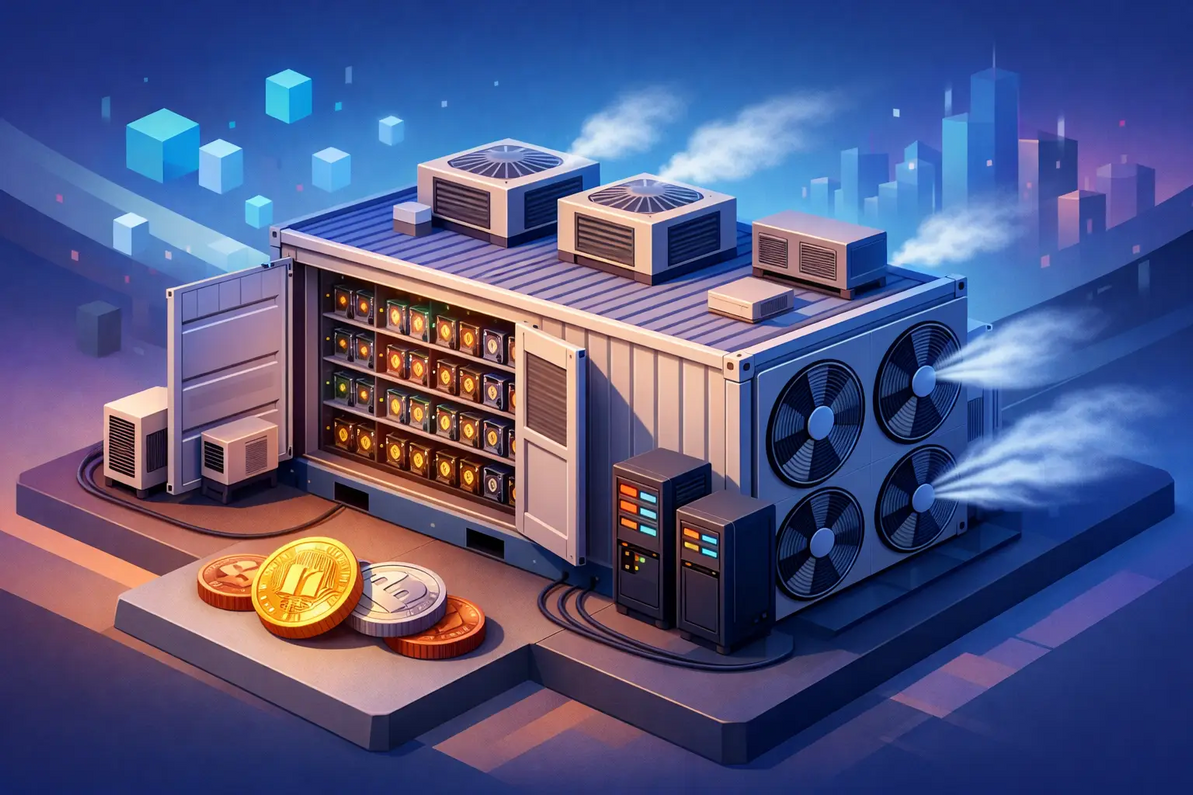
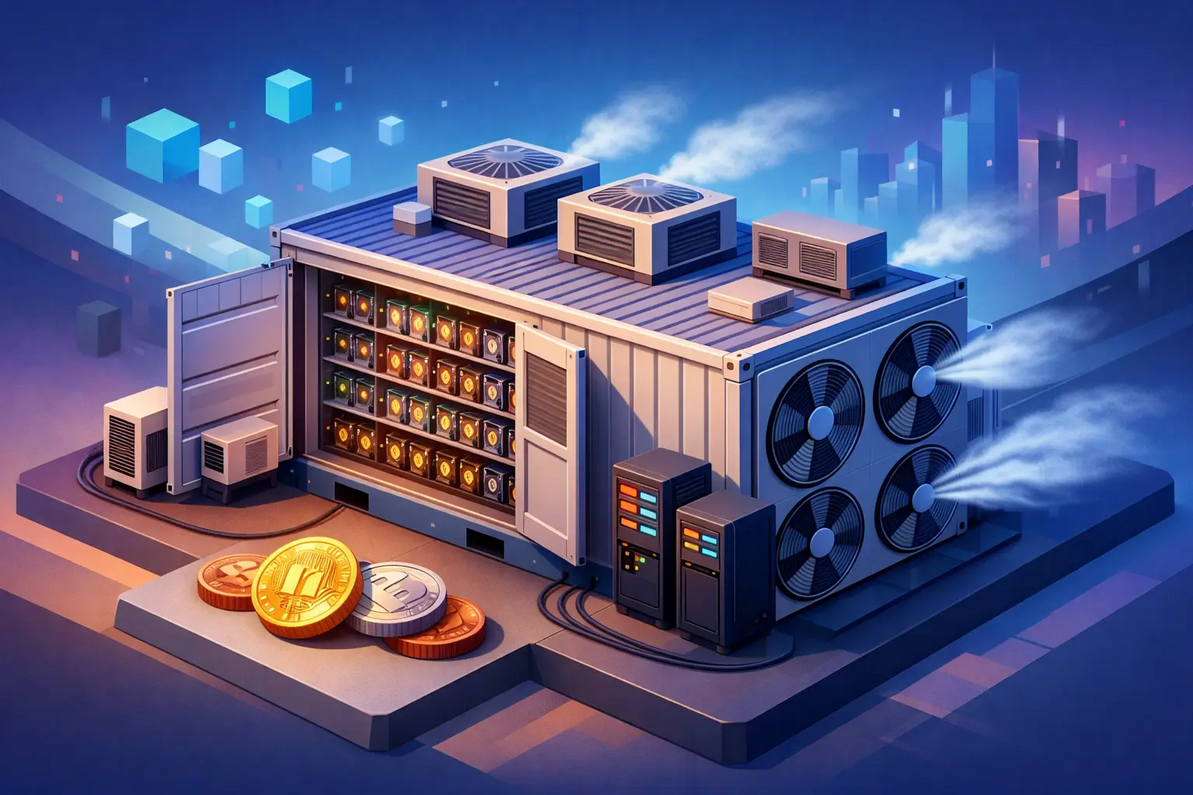
Most profitable air-cooled container designs use a clear one-way air path: filtered ambient air enters at the cold side, passes through the miners, then leaves through the hot side. The design fails when hot discharge air finds an easy route back to the intake.
Place intake louvers and filtration on the side or end feeding the miner fan inlets. Use rack orientation, containment panels, blanking panels, and sealed cable openings to force air through the equipment rather than around it. Exhaust should discharge away from the intake plane, with enough separation to prevent wind-driven recirculation.
A common mistake is to install high-CFM exhaust fans on one end of a container while leaving large uncontrolled gaps throughout the structure. Air takes the path of least resistance. Instead of passing through the ASICs, it bypasses racks through doors, floor openings, unsealed panels, and unused rack spaces. The fan may be moving air, but the miners may not be receiving it.
Airflow uniformity matters as much as total airflow. Miners closest to the exhaust often see different pressure conditions than units at the intake end. Use a rack layout that limits long, unrestricted hot-air plenum paths. In larger containers, dividing the container into airflow zones can improve temperature consistency and make maintenance more manageable.
Size Intake Louvers and Filters for Low Static Pressure
Fans only deliver their published airflow at a stated static pressure. Once louvers, bird screens, filters, racks, miner resistance, dampers, and exhaust accessories are added, the operating point changes. If the system pressure is underestimated, actual CFM can fall far below the design requirement.
Intake free area is especially important. Do not size louvers by their rough opening alone. Use the manufacturer’s net free area and pressure-drop data. A louver with a deep blade profile, weather protection, insect screen, and filtration can impose meaningful resistance at mining-container airflow velocities.
For a high-dust site, filtration is necessary, but filter selection requires discipline. Fine filters protect heatsinks and miner fans, yet they create pressure drop and load quickly. Coarser prefilters may be the better operational choice where regular service is available. Differential-pressure monitoring should be included so the operations team replaces filters based on condition, not guesswork.
Avoid excessive face velocity across filters and louvers. High velocity increases pressure drop, noise, water entrainment risk, and uneven airflow. A larger intake wall costs space and materials, but it can lower fan energy consumption every hour the container operates.
Select Exhaust Fans From the System Curve
Exhaust fan selection should be based on required CFM at total static pressure, not free-air performance. Obtain fan curves and select a duty point that includes dirty-filter allowance, louver losses, internal restrictions, and a reasonable margin for field conditions.
For container mining applications, industrial axial exhaust fans are often effective because they can move very high CFM at relatively low static pressure. However, not every axial fan is suitable. Standard agricultural or warehouse fans may not provide the required performance, motor protection, bearing life, corrosion resistance, or controllability for continuous high-temperature mining duty.
Specify fans with appropriate motor service factors, guards, weather protection, and a documented operating curve. High-temperature crypto mining exhaust fan packages may be required where discharge temperatures and continuous duty exceed the limits of standard equipment. Fan redundancy also deserves attention. A design with multiple fan banks can maintain partial cooling capacity during a fan failure and allows staged operation during mild weather.
Variable frequency drives can reduce parasitic power when ambient conditions are favorable. They also allow fan staging and pressure control. But VFDs are not a substitute for correct sizing. A fan system that is undersized at full speed cannot be repaired with controls.
Use Controls That Protect Hash Rate and Equipment
The most profitable container does not run every fan at maximum speed all year. It responds to actual conditions while protecting miner inlet temperature and pressure balance.
At minimum, monitor outdoor dry-bulb temperature, container intake temperature, hot-side temperature, differential pressure across filters, fan status, and fan speed. Establish alarms for high intake temperature, high exhaust temperature, loss of fan proof, and excessive filter pressure drop. If the miners provide telemetry, correlate ventilation data with hash rate, rejection rate, and board temperatures.
A practical sequence can stage fan banks as intake or hot-aisle temperatures rise, then increase VFD speed to maintain a setpoint. In very hot conditions, controls should prioritize protecting equipment rather than minimizing fan energy. The cost of additional fan kW is generally far lower than the cost of throttled or offline mining capacity.
Plan for Weather, Dust, and Seasonal Reality
Air cooling is highly climate-dependent. A container that performs well at 65°F ambient may struggle at 100°F, particularly when solar gain, nearby containers, and recirculated exhaust are present. Use local design weather data, not annual average temperatures, when establishing the maximum operating case.
Direct sun exposure can materially increase skin temperature and internal heat gain. Container orientation, shade structures, reflective coatings, and spacing between rows should be addressed during site layout. When containers are packed tightly, one unit’s hot exhaust can become the next unit’s intake air. That arrangement can erase the expected cooling capacity.
Dust, smoke, pollen, salt air, and agricultural debris affect both filtration and equipment longevity. Some sites justify more aggressive filtration and frequent maintenance; others may require larger filter banks, washable prefiltration, or a different cooling strategy. Air-cooled mining remains attractive because it is comparatively simple, but simple does not mean maintenance-free.
Protect Profitability With Electrical and Maintenance Allowances
Fan power is part of the mining PUE calculation. Oversized or poorly selected fans consume margin continuously. Under-sized fans create a larger problem: heat-driven derating, miner failures, and emergency shutdowns. Evaluate the fan system in terms of delivered CFM per watt at the actual static pressure, not just purchase price.
Make service access part of the design. Filters must be replaceable without blocking the intake path. Fan assemblies need safe access, isolation, guards, and clear replacement procedures. Keep critical spare parts on site, including belts where applicable, contactors, VFD components, sensors, and at least one fan motor or complete replacement fan for high-value installations.
Before commissioning, perform a field verification. Measure intake and discharge temperatures, fan amperage, static pressure, airflow where practical, and temperature variation across racks. If the hottest miners are consistently warmer than the rest, investigate bypass leakage, rack obstruction, fan imbalance, or recirculation before adding more equipment.
A profitable air-cooled mining container is built around verified heat load, measured static pressure, disciplined air separation, and controls that respond to real conditions. Factory Fans Direct can provide a free project evaluation for mining operators who need exhaust fan selection, intake sizing, and ventilation design support matched to their container load and climate.
Factory Fans Direct - Crypto Mining & Data Center Cooling Experts
Factory Fans Direct - Crypto Mining & Data Center Cooling Experts Contact Mike Miller VP Engineering at Factory Fans Direct for a FREE Project Evaluation 888-849-1233 | Mike@FactoryFansDirect.com
Recent Posts
-

Factory Fans Direct: Data Center and Crypto Cooling Experts
A mining container can go from acceptable inlet temperatures to repeated thermal throttling in a sin …8th Aug 2026 -
How to Select a Hydro-Cooled Mining Container & Dry Cooler
A mining container can look complete on a quotation and still fail the only test that matters: maint …8th Aug 2026 -
How to Design a Profitable Air-Cooled Crypto Mining Container
A mining container can have efficient ASICs, low-cost power, and a strong site agreement, then still …8th Aug 2026