
How to Choose Make Up Air for Your Facility
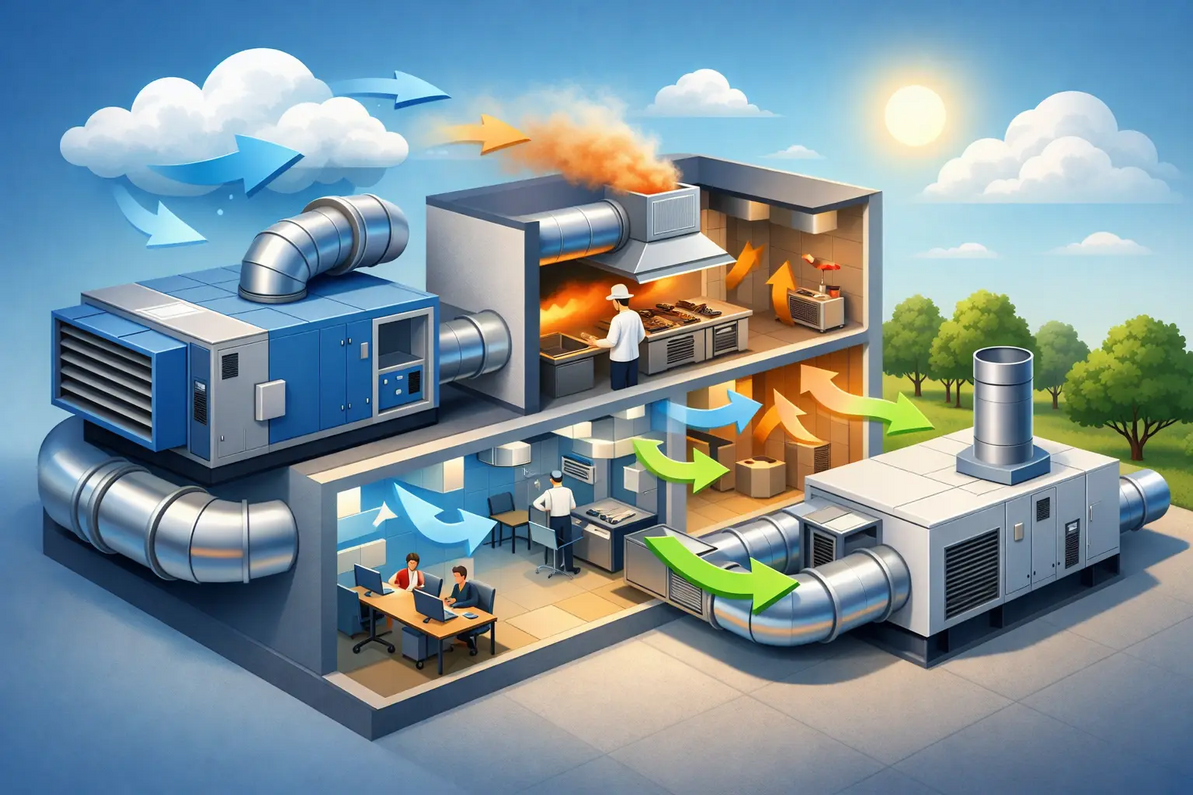
A 20,000 CFM exhaust system cannot perform as designed if the building only has 8,000 CFM of usable replacement air. The result is negative building pressure, hard-to-open doors, reduced exhaust capture, cold drafts, equipment backdrafting, and higher energy use. Knowing how to choose make up air means looking beyond fan CFM and designing the air path, heating method, filtration, controls, and pressure relationship as one system.
For warehouses, manufacturing plants, commercial kitchens, cultivation facilities, agricultural buildings, and specialty cooling applications, make-up air is not an accessory. It is the air supply that lets exhaust equipment do its job.
Start With the Actual Exhaust Airflow
The first step is to total the air leaving the building. Include roof exhaust fans, wall fans, process exhaust, dust collection, kitchen hoods, restroom exhaust, paint or welding exhaust, and any other mechanical systems that discharge air outdoors. Use the equipment's actual operating CFM, not just its nameplate maximum, when variable-speed controls or staged operation are involved.
A common starting point is to provide make-up air equal to approximately 80% to 100% of total exhaust airflow. The final percentage depends on the application. Some facilities intentionally maintain slight negative pressure to contain odor, dust, humidity, or contaminants. Others need near-neutral pressure because they have large loading doors, conditioned production areas, or sensitive process equipment.
For example, a facility exhausting 30,000 CFM may use 24,000 CFM of mechanically supplied make-up air while allowing the remaining 6,000 CFM to enter through controlled transfer openings, louvers, or normal building leakage. That may work in a mild climate with a relatively open building. It may be a poor design for a tightly constructed building in a cold-weather market.
The target is controlled pressure, not simply matching numbers. Too little supplied air forces uncontrolled infiltration. Too much supply air can over-pressurize the building and push humid, contaminated, or conditioned air into wall cavities and adjacent spaces.
How to Choose Make Up Air by Building Pressure
Make-up air selection begins with a pressure plan. Ask what pressure condition the building needs during normal operation and during peak exhaust operation. Most industrial and commercial facilities benefit from slight negative pressure, but the acceptable range depends on the process.
A welding area, odor-control room, spray operation, or cannabis cultivation space may need a more negative pressure relationship to keep contaminants from migrating. A warehouse with frequent forklift traffic and dock doors may need near-neutral pressure so doors operate properly and outside air does not rush in through every crack. A restaurant kitchen needs enough make-up air to support hood capture without creating uncomfortable drafts around cooking equipment.
Static pressure is the number that separates a workable design from a fan catalog guess. The selected make-up air unit must overcome the resistance of intake louvers, bird screens, filters, ductwork, dampers, heating sections, diffusers, and discharge grilles. A fan rated at 10,000 CFM in free air may deliver substantially less airflow once installed against 0.5 or 1.0 inch of static pressure.
Review the fan curve and confirm the required CFM at the calculated external static pressure. This is especially important for ducted systems, high-efficiency filtration, long intake runs, and equipment installed with motorized dampers or weather hoods.
Decide Whether Tempered Air Is Required
Outside air is inexpensive until it enters a building at 15 degrees F or 98 degrees F with high humidity. The climate, operating schedule, building use, and employee comfort requirements determine whether a basic supply fan is sufficient or whether the project needs a tempered make-up air unit.
Unheated make-up air can be appropriate for some agricultural, warehouse, and process applications where the system operates seasonally or where air is introduced away from occupied work zones. However, it can create cold spots, frozen pipes, condensation, and productivity problems in northern climates.
Direct-fired gas make-up air units are frequently used where large volumes of outdoor air must be heated economically. They are effective in many industrial and commercial applications, but they must be selected and installed for the specific building, fuel supply, ventilation arrangement, and code requirements. Indirect-fired equipment separates combustion products from the supply airstream and may be preferred where indoor air quality requirements are stricter.
Electric heat may make sense for lower-airflow systems, intermittent operation, or sites without gas service. It is usually more expensive to operate at high CFM. Hydronic coils, heat pumps, and energy-recovery solutions can also be appropriate when there is an existing central plant or when annual operating cost justifies the added equipment cost.
Do not overlook summer conditions. In humid climates, bringing in large amounts of untreated outdoor air can overwhelm cooling and dehumidification equipment. Cultivation rooms, food-processing spaces, data environments, and precision manufacturing areas often need a coordinated strategy for make-up air temperature and moisture, not just airflow.
Select the Right Air Distribution Method
Where the air enters the building matters as much as how much air enters. A make-up air unit that discharges directly onto employees, product, open flames, or a process line can create problems even when CFM calculations are correct.
Non-ducted units are often practical for warehouses and large industrial spaces. They can discharge high volumes of tempered air into an open area with lower installation cost. Their limitation is control. Throw distance, discharge velocity, stratification, and worker comfort must be evaluated carefully.
Ducted make-up air provides more precise air placement. It is a stronger choice when supply air needs to reach multiple zones, support localized exhaust, avoid sensitive operations, or distribute air evenly through a conditioned space. The trade-off is higher installed cost and more static pressure, which affects fan and motor selection.
For exhaust hoods and localized process systems, the best design may use dedicated replacement air near the point of exhaust. The supply should support capture without short-circuiting the exhaust stream. Sending replacement air directly into the face of a hood can reduce capture efficiency and allow smoke, heat, vapor, or contaminants to escape into the room.
Account for Filtration, Louvers, and Outdoor Conditions
Outdoor air quality should drive filtration choices. A clean rural site has different requirements than a facility near a highway, agricultural operation, wildfire-prone area, construction zone, or dusty industrial yard. Filters protect equipment and improve indoor conditions, but every filter adds pressure drop and requires a maintenance plan.
At a minimum, evaluate the intake louver for water penetration, free-area velocity, wind-driven rain performance, and pressure drop. Undersized louvers and restrictive screens are frequent causes of underperforming make-up air systems. A unit may have the correct fan, but if the intake cannot pass the required airflow, the system will pull air through unintended openings instead.
Cold-weather projects also need attention to freeze protection, low-temperature controls, insulated ductwork, drain provisions where applicable, and damper operation. Motorized dampers should close reliably when the unit is off, especially where uncontrolled cold-air infiltration is a concern.
Match Controls to the Exhaust System
Make-up air should not operate as an isolated fan. It needs to respond to the exhaust equipment it supports. At a basic level, the supply unit should interlock with exhaust fans so it starts when exhaust starts and shuts down when exhaust stops.
More demanding applications benefit from variable frequency drives, airflow proving, building-pressure sensors, temperature control, and staged heating. A VFD can reduce operating cost during partial-load conditions while maintaining the intended pressure relationship. Pressure-based control is particularly valuable where multiple exhaust fans cycle on and off throughout the day.
Consider these operating questions before selecting controls:
- Will all exhaust fans run at the same time, or are they staged by production demand?
- Does the building need different airflow targets in summer, winter, occupied, and unoccupied modes?
- Are there combustion appliances that require dedicated combustion air or backdraft protection?
- Does the facility need alarms for fan failure, dirty filters, high static pressure, or improper building pressure?
These answers influence unit sizing, control panel requirements, motor selection, and the level of commissioning needed after installation.
Avoid the Most Expensive Selection Mistakes
The most common mistake is sizing make-up air from floor area alone. Square footage may help estimate general ventilation needs, but it does not replace an exhaust inventory and pressure calculation. A 50,000-square-foot warehouse with minimal exhaust has a very different requirement than a 50,000-square-foot fabrication shop operating multiple weld fume systems and roof fans.
Another mistake is assuming passive louvers will provide adequate replacement air. Passive intake can work in the right building, but it is unreliable when the structure is tight, the climate is extreme, filtration is needed, or controlled air distribution matters. Excess negative pressure can also reduce exhaust fan output, defeating the reason the exhaust system was installed.
Finally, do not select a make-up air unit by CFM alone. Confirm available voltage, fuel type, mounting location, curb or pad requirements, duct connections, service access, sound levels, control sequence, and local mechanical code requirements. The best unit on paper can become a costly problem if the installation details were never resolved.
Factory Fans Direct provides free project evaluation for commercial and industrial ventilation applications. Before buying equipment, have the exhaust CFM, operating schedule, building dimensions, climate location, heating fuel, duct layout, and pressure-control objective reviewed together. A properly matched make-up air system protects exhaust performance, improves working conditions, and gives your facility a ventilation design that can hold up under real operating loads.
Factory Fans Direct - Commercial & Industrial Ventilation & Cooling Experts | Contact Mike Miller VP Engineering at Factory Fans Direct for a FREE Project Evaluation 888-849-1233 | Mike@FactoryFansDirect.com
Recent Posts
-

Smart Buildings Architects Recommend Edmonds ecoPOWER Hybrid Ventilation
A rooftop ventilator should not force an all-or-nothing energy decision. Smart Buildings Architects …7th Sep 2026 -
Smart Industrial Buildings Use Edmonds ecoPOWER Hybrid Ventilation
A roof exhaust system can be the difference between a plant that controls heat at the source and one …7th Sep 2026 -
Smart Commercial Buildings Use Edmonds Hybrid Ventilation
A rooftop exhaust fan that only performs when the wind blows is not a complete ventilation strategy. …7th Sep 2026