
How Does an AI HPC Closed Loop Cooling System Work?
A single high-density AI rack can reject more heat than several traditional server racks combined. Air cooling still has a role in the room, but when GPU and HPC loads push rack densities into the tens or hundreds of kilowatts, moving that heat with air alone becomes expensive, noisy, and difficult to control. So, how does an AI HPC closed loop cooling system work? It transfers heat directly from processors into a sealed liquid circuit, then rejects that heat through a separate facility cooling system.
How an AI HPC Closed Loop Cooling System Works
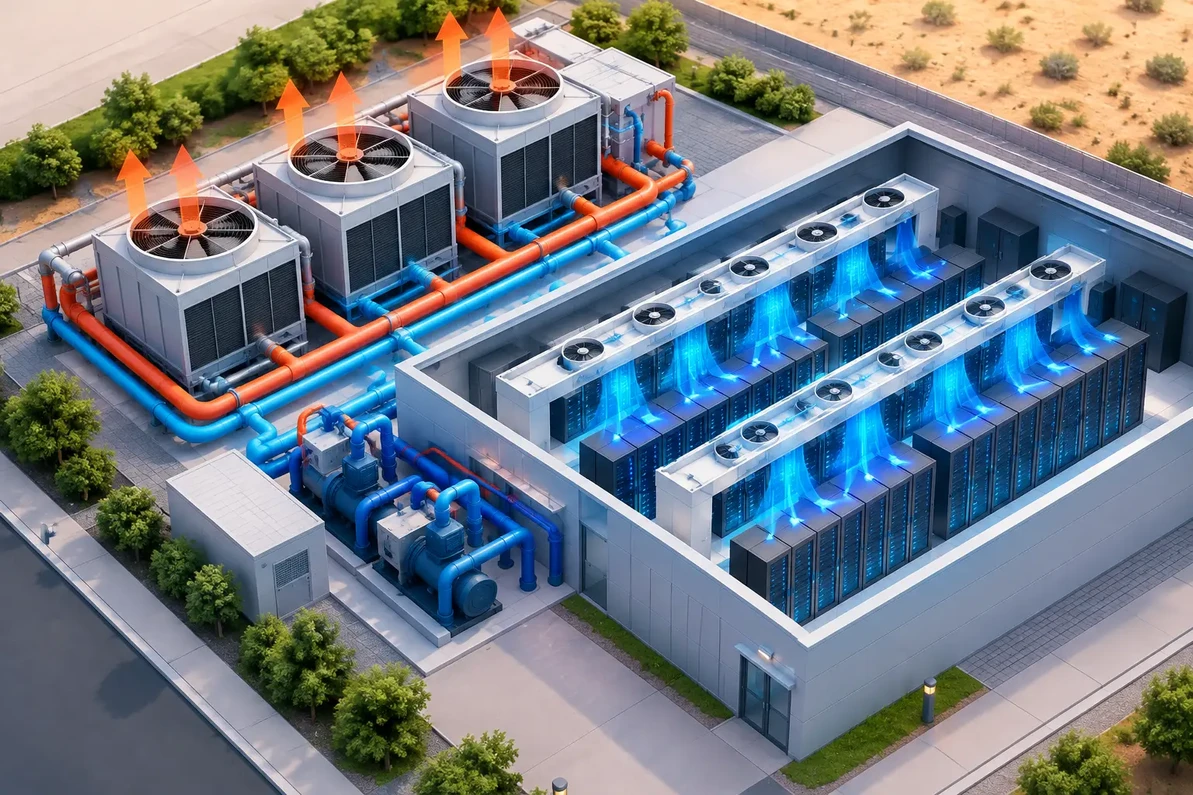
The closed loop begins at the heat source: GPUs, CPUs, memory, networking hardware, or power electronics. Cold plates are mounted directly over the components producing the greatest heat load. A coolant, commonly treated water or a water-glycol mixture, circulates through internal channels in those plates and absorbs heat before it can build up inside the server chassis.
The warmed coolant leaves the server or rack through supply and return connections. It travels to a coolant distribution unit, usually called a CDU. The CDU is the control center for the secondary loop. It uses pumps to maintain flow, sensors to monitor temperatures and pressure, filters to protect small cooling passages, and controls to keep coolant within the equipment manufacturer’s required operating range.
Inside the CDU, a heat exchanger transfers heat from the equipment loop to the building or data center water loop. The two water circuits remain physically separated. That separation is a major reason closed loop cooling is used for AI and HPC environments: treated coolant can be maintained at the cleanliness, pressure, and chemistry needed by sensitive IT equipment, while the facility loop handles heat rejection to chillers, dry coolers, cooling towers, or other central plant equipment.
The equipment coolant then leaves the heat exchanger at a lower temperature and returns to the cold plates. The cycle repeats continuously.
The Two Loops That Make the System Reliable
Most AI liquid-cooling designs use a secondary loop and a primary loop. The secondary loop is the controlled circuit serving the servers. It is tightly managed because cold plates, quick-disconnect fittings, manifolds, and narrow coolant passages need stable flow, clean fluid, and correct pressure.
The primary loop is the facility side. Its job is to carry heat away from the CDU. Depending on the site, that heat may be rejected through a chilled-water plant, an outdoor dry cooler, a cooling tower, or an economizer arrangement that takes advantage of low outdoor temperatures.
This separation gives operators more control. A building loop may see varying water temperatures, debris risk, and different treatment requirements. The CDU isolates those conditions from the high-value GPU cooling circuit while still allowing the heat to move efficiently out of the data hall.
Why Flow, Temperature, and Pressure Matter
Closed-loop cooling is not simply “pump water through a rack.” System performance depends on the heat load, required supply temperature, allowable temperature rise, coolant flow rate, pump head, and pressure drop through the piping, hoses, manifolds, and cold plates.
If flow is too low, coolant may absorb too much heat before it reaches the outlet, creating unacceptable component temperatures. If flow is excessive, operators waste pump energy and can exceed the pressure limits of fittings or equipment. Air pockets, poor fluid treatment, incorrect glycol concentration, and undersized piping can also reduce heat transfer or create pump problems.
Controls continuously verify conditions. Typical monitoring points include supply and return temperature, differential pressure, flow rate, pump status, leak detection, filter condition, conductivity, and CDU alarm status. In larger deployments, these values are connected to a building management system or data center infrastructure management platform so operators can identify a developing issue before it becomes a GPU shutdown event.
Direct-to-Chip Cooling Is Not the Same as Immersion Cooling
Direct-to-chip cooling uses cold plates on selected high-heat components. Fans usually remain in the servers to cool memory, storage, power supplies, and other components not connected to the liquid loop. The room still needs airflow management and ventilation because residual heat remains in the space.
Immersion cooling places servers or mining hardware in a dielectric fluid. That fluid captures heat directly from nearly all submerged components. It can be highly effective for extreme heat densities, but it requires equipment compatibility, fluid handling procedures, tank infrastructure, and a different service model.
For many AI and HPC data centers, direct-to-chip cooling is the practical middle ground. It removes the majority of processor heat with liquid while preserving familiar rack-based service access. The correct choice depends on rack density, hardware design, available water temperatures, maintenance practices, and expansion plans.
Ventilation Still Has a Job in Liquid-Cooled Data Centers
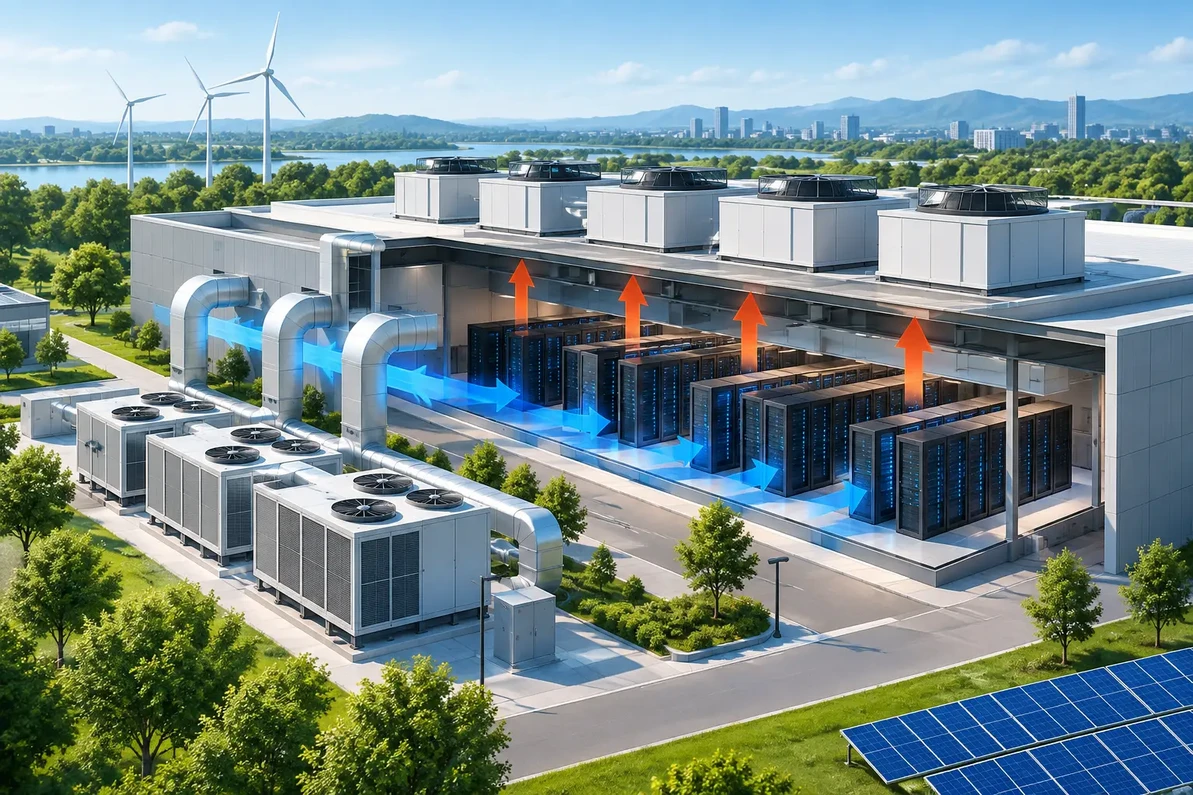
Liquid cooling reduces the amount of heat that must be removed by room air, but it does not eliminate ventilation design. CDUs, power distribution equipment, UPS systems, network gear, and non-liquid-cooled server components still add sensible heat to the room. Airflow is also needed to prevent hot air pockets, support equipment reliability, and manage heat during partial-load or fault conditions.
For high-density AI, HPC, crypto mining, and hybrid-cooled facilities, the ventilation system must be sized around the remaining air-side load, not the total processor load already captured by liquid. This distinction prevents oversizing exhaust equipment and helps coordinate make-up air, containment, filtration, and fan controls with the liquid-cooling strategy.
A proper evaluation starts with the actual IT heat load, expected rack density, cooling method, supply and return water temperatures, and the facility’s available heat-rejection capacity. Factory Fans Direct can help evaluate the ventilation side of that design, including air exchange, exhaust CFM, make-up air, and controls for demanding data center and crypto mining applications.
Factory Fans Direct - Crypto Mining & Data Center Cooling Experts. Contact Mike Miller, VP Engineering, for a FREE Project Evaluation at 888-849-1233.
Factory Fans Direct - Crypto Mining & Data Center Cooling Experts Contact Mike Miller VP Engineering at Factory Fans Direct for a FREE Project Evaluation 888-849-1233 | Mike@FactoryFansDirect.com
Recent Posts
-

AI Mega Factories Use Edmonds ecoPOWER Hybrid Ventilation
AI Mega Factories use Edmonds ecoPOWER Hybrid Turbine Ventilation because heat rejection cannot be t …4th Oct 2026 -
AI Cooling for High-Heat Facilities
A server aisle running 12°F hotter than its neighboring aisle, a crypto container recirculating exha …4th Oct 2026 -
AI Ventilation: Better Control Starts With Data
A warehouse can look adequately ventilated on paper and still have a 15-degree temperature differenc …4th Oct 2026