Crypto Mining Options: Air-Cooled, Hydro-Cooling & Immersion
A mining facility does not fail because an ASIC is difficult to purchase. It fails when heat removal, airflow paths, electrical capacity, and operating controls are treated as separate decisions. Crypto Mining Options: Air-Cooled, Hydro-Cooling & Immersion all solve the same basic problem - moving large, continuous heat loads away from high-value computing equipment - but they require very different facility designs.
For planning purposes, nearly all electrical power consumed by mining equipment becomes heat. A 3 MW mining load is therefore a heat-rejection problem on the scale of roughly 10.2 million BTU per hour. The right cooling method depends on mining density, climate, utility economics, water availability, maintenance capability, downtime tolerance, and whether the site needs to scale in phases.
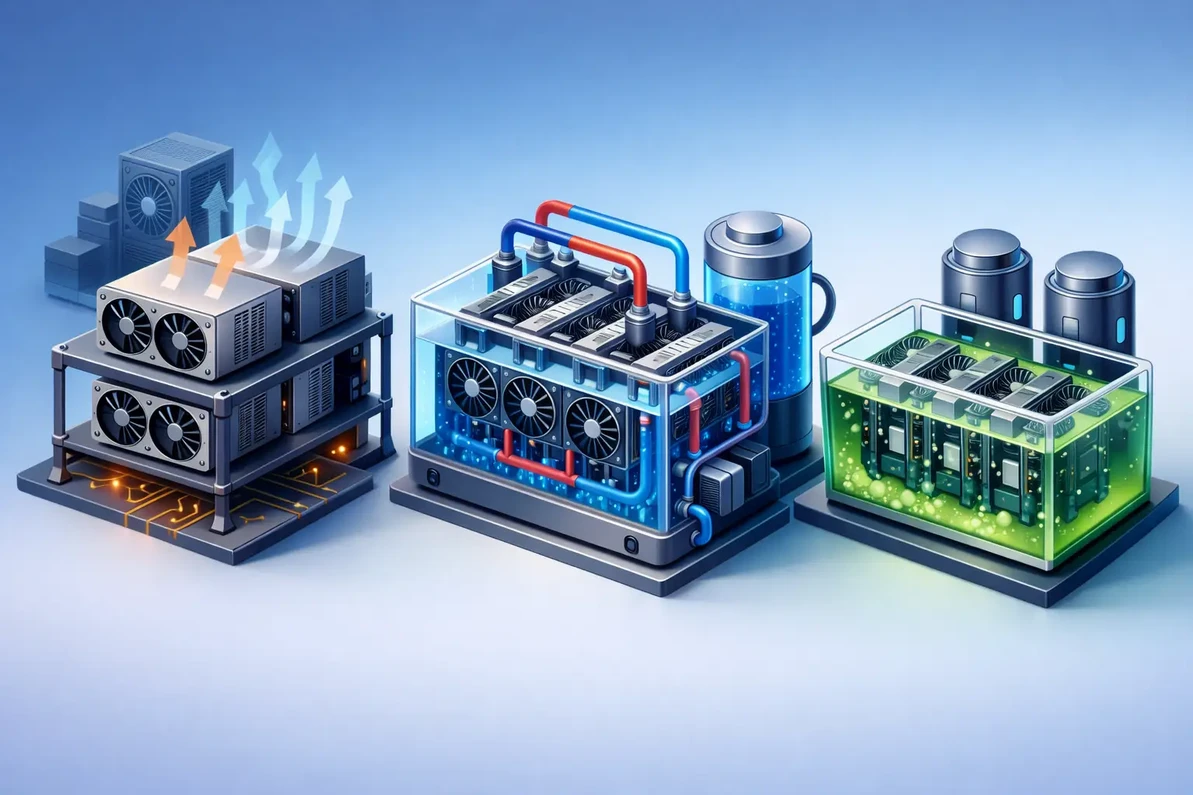
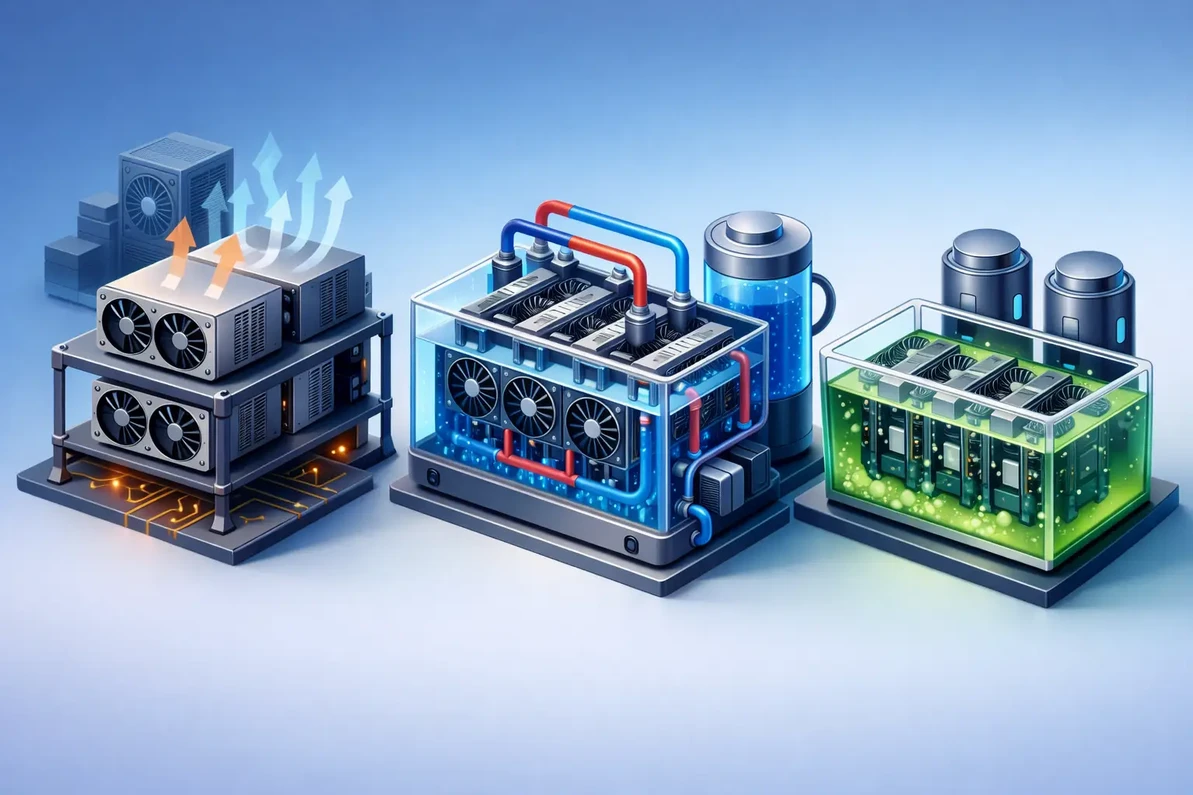
Air-Cooled Crypto Mining Options
Air cooling remains the most common approach because it is familiar, comparatively direct to deploy, and well suited to containerized or warehouse-based mining operations. ASIC fans pull air through the machine, carrying heat into a controlled hot aisle, exhaust plenum, or outdoor discharge area. The building or container ventilation system then has to remove that heat without allowing it to recirculate back to the equipment intake.
The design error seen most often is selecting exhaust fans based only on free-air CFM. Mining rooms, duct transitions, louvers, filters, backdraft dampers, acoustic treatments, and discharge plenums all add static pressure. A fan that appears adequate on a catalog page can lose substantial airflow once installed against real system resistance. Fan performance must be selected from the correct curve at the expected static pressure, not at zero static pressure.
Air-cooled facilities need disciplined air management. Cool supply air and hot exhaust air must remain separated. If discharge air finds its way back to the intake side, inlet temperatures climb, ASIC fans accelerate, power use rises, hash rates may become unstable, and equipment life can be reduced. In a high-temperature climate, direct exhaust ventilation may still be viable, but the available temperature difference between outdoor air and the desired ASIC inlet temperature becomes the limiting factor.
Air cooling is usually the best fit when the site has moderate rack density, plentiful outside air, a limited construction budget, and equipment that needs fast deployment. It is also easier for technicians to service because miners remain accessible and dry. However, air systems require large fan volumes, large openings, careful pressure balancing, and enough physical footprint for intake and exhaust separation.
Dust, moisture, smoke, agricultural contaminants, and corrosive airborne compounds require additional consideration. Filtration protects equipment but increases static pressure and creates a maintenance requirement. In some environments, filtered make-up air, positive pressure zones, and properly sized exhaust are a better choice than simply opening wall louvers and installing high-CFM fans.
Hydro-Cooling for Higher-Density Mining
Hydro-cooling, often called direct liquid cooling, moves heat through a water or water-glycol loop rather than relying on each miner's onboard air fans. Hydro-cooled ASICs use cold plates or internal liquid paths to transfer heat into circulating coolant. That coolant is then routed to dry coolers, cooling towers, fluid coolers, chillers, or another heat-rejection system.
This method can support much higher power density than conventional air cooling. It also reduces the amount of airborne contamination moving through the mining hardware and can lower the noise level inside the equipment area. For facilities constrained by floor area, hydro-cooling can make a large difference because the heat is moved through piping rather than massive volumes of air.
The trade-off is that hydro-cooling is not merely an equipment purchase. It is a mechanical system. The design must account for supply and return temperatures, flow rate, pump head, pipe sizing, fluid quality, water treatment, redundancy, leak detection, expansion capacity, and controls. If a pump, valve, or heat-rejection component fails, the heat load remains. The system needs a defined response plan, including equipment shutdown logic and alarm monitoring.
Outdoor conditions matter just as much as they do with air cooling. A dry cooler can reject heat efficiently when the outdoor dry-bulb temperature is favorable. Cooling towers can offer lower fluid temperatures but introduce water consumption, treatment, freeze protection, and maintenance. Chiller-based systems provide more control but can add significant electrical demand and capital cost. There is no universal winner; the economics depend on the local climate, water cost, electrical rate, and target operating temperature.
Hydro-cooling is often the strongest option for purpose-built high-density sites, facilities with limited air-side space, or operations seeking more controlled equipment inlet conditions. It is less forgiving of poor installation practices than air cooling. Proper commissioning, pressure testing, fluid balancing, and documented maintenance procedures are mandatory.
Immersion Cooling Changes the Facility Layout
Immersion cooling places compatible ASICs in dielectric fluid. The fluid absorbs heat directly from the equipment, and a circulation loop moves that heat to a heat exchanger, dry cooler, cooling tower, or other external rejection system. Because the fluid is non-conductive, the miners can operate without traditional high-speed equipment fans.
The practical benefit is thermal stability at very high density. Immersion systems can reduce fan-related power consumption, minimize exposure to dust and humidity, lower acoustic levels, and support controlled overclocking strategies where the miner, power distribution, and cooling system have been engineered for the added load. A well-designed immersion installation can place a substantial amount of compute capacity in a relatively compact footprint.
It also changes the day-to-day maintenance model. Technicians need safe procedures for lifting equipment, draining and handling fluid, replacing components, and keeping tanks clean. Cable routing, busbars, connectors, and networking hardware must be selected for compatibility with the tank design and operational environment. Not every ASIC model, power supply, gasket, cable jacket, or manufacturer warranty is suitable for every dielectric fluid.
Heat rejection remains the real facility issue. Immersion tanks do not eliminate heat; they concentrate heat collection and transfer it to a secondary loop. The external dry cooler, fluid cooler, tower, or chiller still has to reject the full thermal load. A 1 MW immersion deployment still produces approximately 3.4 million BTU per hour of heat that must go somewhere, continuously.
Immersion generally has the highest upfront system cost and demands the most specialized operational knowledge. It can be an excellent fit for high-density deployments, noise-sensitive locations, dirty environments, and mining operations that want more repeatable thermal control. It may be excessive for a small operation that can achieve acceptable results with properly engineered air cooling.
Comparing Air, Hydro, and Immersion Cooling
The first decision should not be which technology sounds most advanced. It should be how much heat the site must reject, at what density, under the worst expected outdoor condition. From there, evaluate the constraints that determine whether the system is practical.
Air cooling favors lower initial cost, fast expansion, straightforward service access, and locations with favorable ambient temperatures. Its weak points are large airflow requirements, recirculation risk, noise, filtration burden, and performance losses during hot weather.
Hydro-cooling provides tighter thermal control and higher density while keeping miners accessible outside of fluid tanks. It requires pumps, piping, heat exchangers, water or glycol management, and reliable mechanical controls. It is an engineered plant, not a simple ventilation upgrade.
Immersion delivers the highest density potential and strong environmental isolation, but it requires tank infrastructure, dielectric fluid management, compatible hardware, specialized service procedures, and a carefully designed secondary heat-rejection loop. The cooling equipment outside the tank remains mission-critical.
For all three methods, electrical and ventilation engineering must work together. Electrical gear rooms, transformers, switchgear, UPS equipment, and power distribution units add heat that may require separate ventilation. Exhaust discharge cannot be positioned where it is drawn into electrical inlets, office areas, or neighboring equipment. Make-up air pathways, fan controls, motor horsepower, variable frequency drives, louvers, and weather protection should be evaluated as one system.
Design Inputs That Should Be Known Before Equipment Selection
A credible mining cooling evaluation starts with actual operating data, not a generic fan size. The engineering team should know the planned miner model and count, watts per unit, anticipated expansion phases, room or container dimensions, available electrical capacity, local design temperatures, elevation, indoor contamination level, and preferred heat-rejection method.
For air-cooled sites, the required exhaust CFM, intake free area, fan static pressure, and hot-air discharge path are central calculations. For hydro and immersion systems, the required coolant flow, supply and return temperatures, pump head, heat-exchanger approach temperature, and outdoor heat-rejection capacity must be established. Redundancy decisions should be made early. N+1 fan, pump, or cooler capacity costs more upfront but can prevent an equipment-wide thermal event when one component is offline.
Controls should not be an afterthought. Temperature sensors at equipment inlets and exhaust points, differential-pressure monitoring, fan staging, VFD control, pump alarms, leak detection, and emergency shutdown sequences give operators time to act before miners throttle or trip. The objective is not simply to keep the room from feeling hot. It is to maintain repeatable inlet conditions and protect uptime at the lowest practical operating cost.
Factory Fans Direct provides crypto mining and data center cooling evaluations that consider heat load, CFM, static pressure, equipment placement, and the ventilation or heat-rejection path before equipment is specified. The best system is the one matched to the site’s real heat load, operating environment, and expansion plan - before the miners are energized.
Factory Fans Direct - Crypto Mining & Data Center Cooling Experts
Factory Fans Direct - Crypto Mining & Data Center Cooling Experts Contact Mike Miller VP Engineering at Factory Fans Direct for a FREE Project Evaluation 888-849-1233 | Mike@FactoryFansDirect.com
Recent Posts
-

Factory Fans Direct Supports Transparent AI Data Center Development & Community Engagement
A large AI data center can introduce a major new electrical and thermal load long before the first s …13th Aug 2026 -
AI Data Center Developers Must be Transparent and Benefit Communities
A proposed AI data center can bring major capital investment to a community, but the project also co …13th Aug 2026 -
Crypto Mining Options: Air-Cooled, Hydro-Cooling & Immersion
A mining facility does not fail because an ASIC is difficult to purchase. It fails when heat removal …13th Aug 2026