Gym & Rec Center Cooling With Edmonds Hybrid Ventilation
A full gym at 6:00 p.m. can turn a well-designed building into a heat and moisture problem in less than an hour. Occupant density spikes, doors cycle constantly, showers add humidity, and courts, fitness floors, pools, and locker rooms all create different ventilation demands. For facility teams evaluating Gym & Rec Center Energy Saving Cooling | Edmonds Hybrid Ventilation, the goal is not simply moving more air. It is removing heat where it accumulates, controlling stale air and moisture, and avoiding unnecessary electrical fan energy when weather conditions can do part of the work.
Why gyms create difficult cooling loads
Recreation centers are rarely one uniform space. A fieldhouse may have a high roof, large cubic volume, and intermittent crowds. A weight room can carry high internal gains from people and equipment in a comparatively compact footprint. Group fitness rooms need fresh air during back-to-back classes, while locker rooms and restrooms require dependable exhaust even when the primary activity areas are quiet.
That mix makes a single, constant-speed exhaust approach inefficient. Oversizing fans to solve the worst afternoon heat event can waste power during early mornings, low-occupancy periods, and cooler seasons. Undersizing them leaves staff with hot zones, odors, condensation, and complaints from members who may not know the cause but notice the comfort problem immediately.
Mechanical cooling remains necessary in many facilities, particularly where humidity control, pool environments, or year-round temperature targets apply. Ventilation is not a replacement for properly sized HVAC equipment. It is a coordinated part of the building air strategy. When exhaust, make-up air, air distribution, and cooling equipment are matched, the facility can reduce heat buildup before the air-conditioning system has to fight it.
How Edmonds hybrid ventilation saves fan energy
Edmonds ecoPOWER Hybrid Rooftop Ventilators combine wind-driven ventilation with a high-performance EC brushless DC motor. This is a true hybrid operating concept: when wind conditions support airflow, the ventilator uses that natural energy source; when wind is insufficient, the EC motor provides controlled continuous operation.
The distinction matters. Edmonds ecoPOWER is not solar powered. Its energy-saving value comes from combining non-powered wind operation and low-energy powered assistance in the same rooftop ventilation platform. That allows a gym or recreation center to maintain exhaust performance across changing weather conditions without relying on a conventional motor to run at full output all day.
For an owner focused on operating cost, the relevant question is not whether a fan has a low nameplate wattage alone. It is how much useful airflow the system delivers across its actual annual operating hours. Hybrid ventilation can be especially valuable in facilities with broad roof exposure, regular shoulder-season use, and areas that need ongoing exhaust but do not always need full mechanical cooling.
Gym & rec center energy-saving cooling starts with air balance
Exhaust airflow must be replaced. If a facility pulls air from locker rooms, restrooms, equipment storage, training rooms, or a hot upper roof zone without planned make-up air, the building can become negatively pressurized. Doors become difficult to open, outside air leaks through undesirable paths, conditioned air can be pulled from adjacent rooms, and combustion or equipment operation may be affected.
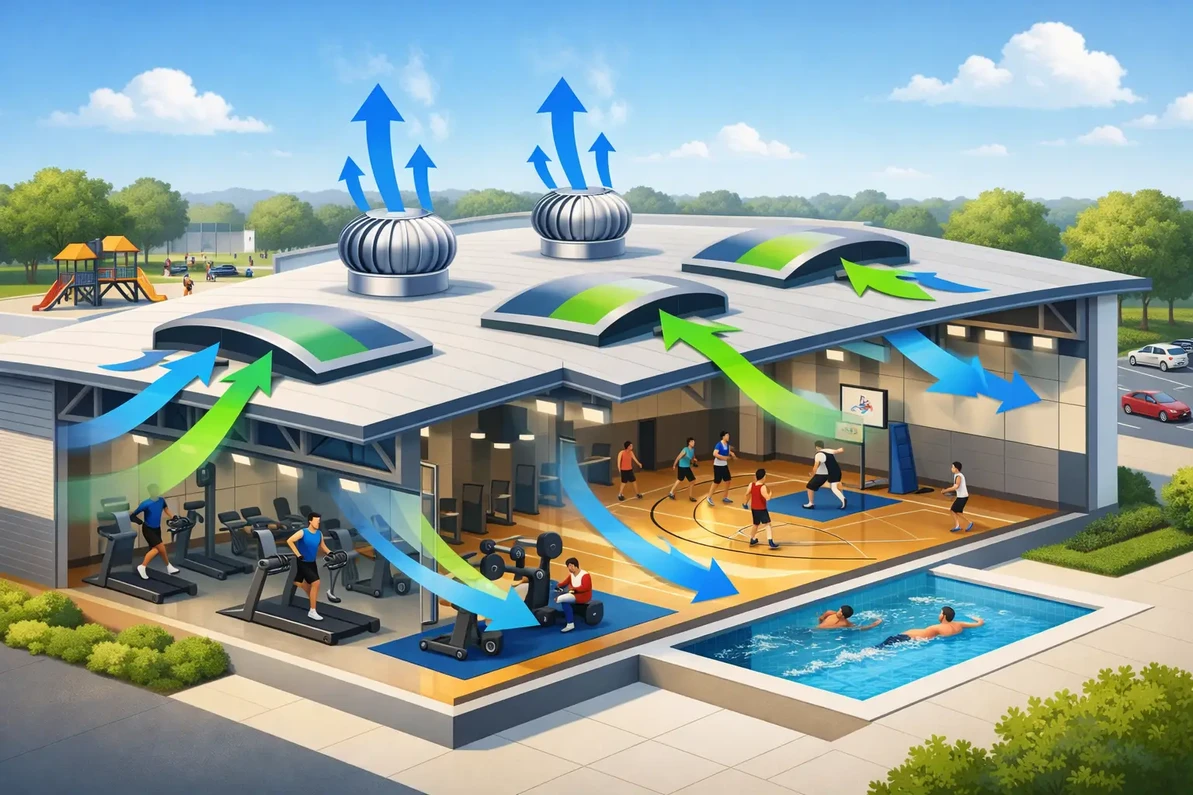
A workable design identifies where replacement air enters, how it is tempered when required, and where that air travels before it reaches the exhaust point. In a fieldhouse, for example, make-up air delivered low in the occupied zone can move through the space and carry rising heat toward rooftop exhaust. In a locker room, the path must pull odors and moisture away from adjacent corridors and public areas.
This is why CFM should never be selected in isolation. Engineering review should account for room volume, heat gain, occupancy schedules, ceiling height, duct losses, intake restrictions, roof curb arrangement, local wind exposure, and the available make-up air path. A fan that performs well in free air may deliver materially less airflow once installed against real system static pressure.
Where hybrid rooftop exhaust fits best
Hybrid ventilators are often a strong fit for high-bay gymnasiums, fieldhouses, indoor courts, recreation buildings, multipurpose halls, concession-adjacent areas, and general fitness spaces with roof access. They can remove stratified heat that collects at the roof line, particularly where large overhead volumes make the occupied floor feel stuffy even before thermostat readings appear extreme.
They also fit projects pursuing lower operational energy use, LEED-aligned design goals, or net-zero planning. The equipment itself does not eliminate the need for load calculations or code-required outside air. It can, however, reduce reliance on continuously powered exhaust by taking advantage of natural wind conditions while maintaining motor-assisted operation when needed.
Pool buildings are a separate case. Natatoriums have demanding moisture-control, corrosion-resistance, building-envelope, and dehumidification requirements. A general rooftop exhaust strategy should not be assumed suitable without a complete natatorium ventilation design. Likewise, spaces with tightly controlled humidity, such as specialty training or medical areas, may need more precise mechanical air handling than hybrid exhaust alone provides.
Do not confuse air movement with ventilation
HVLS fans, directional fans, and destratification fans are valuable in many gyms because they improve air mixing and occupant comfort. They can reduce the temperature difference between the roof deck and the court or fitness floor, making a large room feel more usable. But they do not remove heat, moisture, carbon dioxide, or odors from the building.
Rooftop exhaust removes air from the space. Circulation fans mix air within the space. Mechanical cooling lowers sensible temperature and, depending on the system, manages latent moisture. Good facility performance usually comes from using these functions together rather than expecting one product category to solve every problem.
For example, a high-bay fieldhouse may use air circulation to reduce stratification, controlled make-up air to establish a clean airflow path, and hybrid rooftop ventilators to discharge accumulated heat. During peak summer conditions, packaged HVAC or dedicated cooling equipment may still carry the main cooling load. During milder weather, the ventilation system can reduce the runtime burden placed on that cooling equipment.
Controls determine whether savings become real
A hybrid ventilator is most effective when its operation follows the building's use. Running any powered ventilation system at maximum speed during empty periods is usually hard to justify. EC motor technology supports efficient control, but the control sequence must be planned around the facility schedule and indoor conditions.
A practical sequence may use time scheduling for predictable activity periods, temperature sensing at high and low elevations to identify stratification, and occupancy or carbon dioxide inputs where outside-air needs vary substantially. Variable speed control can help maintain the required exhaust rate without the energy penalty of constant full-speed operation.
Controls also need sensible lockouts. On very hot, humid days, bringing in large amounts of untreated outside air can increase HVAC load rather than reduce it. In cold climates, uncontrolled exhaust can increase heating demand and create drafts. The best operating strategy changes by season, climate zone, space use, and the capability of the make-up air system.
Design details that affect field performance
Roof location matters. A ventilator placed near prevailing wind exposure, away from short-circuiting intake paths and contaminated exhaust sources, has a better opportunity to perform as intended. Multiple units may be preferable to one large unit when zones have different heat loads or when a broad roof requires more even extraction.
Specify the curb, flashing, electrical connection, disconnect, access provisions, and controls before installation begins. The project should also verify roof structure, curb dimensions, service clearance, and how the ventilator will interface with any existing building automation system. These basics prevent expensive field changes and keep maintenance practical after turnover.
Commissioning is equally important. Confirm actual rotation and motor operation, verify control setpoints, check building pressure with doors closed and open, and observe airflow during occupied use. A system that looks correct on a plan can still be compromised by blocked louvers, closed dampers, missing make-up air, or control settings that never match the building schedule.
Evaluate the facility before selecting equipment
The fastest way to get a reliable equipment recommendation is to start with usable project data: floor plan, roof plan, room dimensions, ceiling heights, occupancy patterns, current HVAC equipment, existing exhaust and intake locations, and known comfort complaints. Photos of the roof and interior are useful, as are utility concerns and any available mechanical schedules.
Factory Fans Direct provides ventilation design engineering support and a free project evaluation for commercial facilities. The review can help determine whether Edmonds ecoPOWER hybrid rooftop ventilation, powered exhaust, make-up air, HVLS circulation, variable frequency controls, or a combined approach is appropriate for the specific gym or recreation center.
The right answer is rarely the highest CFM fan on the quote. It is the system that produces the required airflow at actual static pressure, maintains a deliberate air path, works with the building's cooling equipment, and avoids wasting electrical energy when wind-assisted ventilation can carry part of the load.
Factory Fans Direct/Edmonds US - Hybrid Commercial & Industrial Ventilation & Cooling Experts | Contact Mike Miller VP Engineering at Factory Fans Direct for a FREE Project Evaluation 888-849-1233 | Mike@FactoryFansDirect.com
Recent Posts
-

AI Mega Factories Use Edmonds ecoPOWER Hybrid Ventilation
AI Mega Factories use Edmonds ecoPOWER Hybrid Turbine Ventilation because heat rejection cannot be t …4th Oct 2026 -
AI Cooling for High-Heat Facilities
A server aisle running 12°F hotter than its neighboring aisle, a crypto container recirculating exha …4th Oct 2026 -
AI Ventilation: Better Control Starts With Data
A warehouse can look adequately ventilated on paper and still have a 15-degree temperature differenc …4th Oct 2026