Greenhouse Exhaust System Guide for Better Airflow
A greenhouse can gain heat faster than most operators expect. On a clear day, solar load, lighting, equipment, plant transpiration, and restricted air intake can push temperatures beyond a crop’s acceptable range in minutes. This greenhouse exhaust system guide explains how to design a system around actual airflow, heat load, structure layout, and controls rather than selecting fans by greenhouse square footage alone.
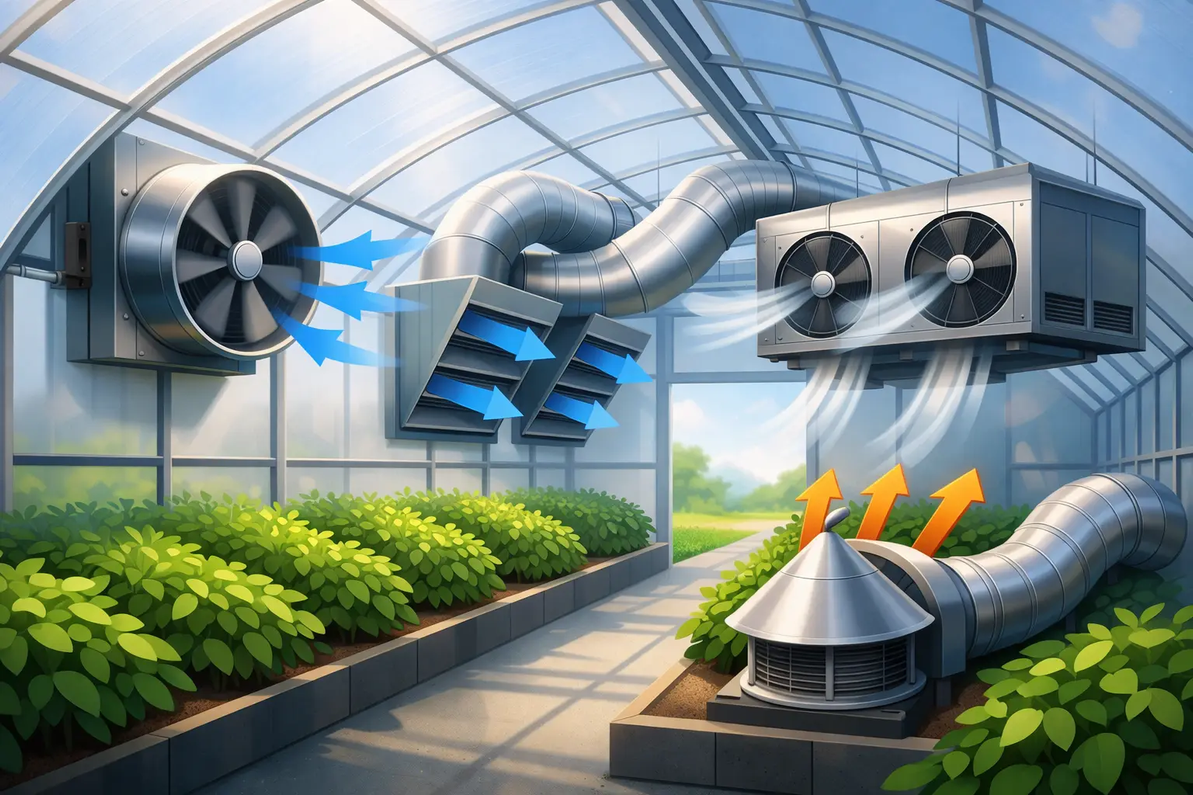
An exhaust fan is not just a piece of equipment mounted in an end wall. It is one part of a ventilation system that must pull enough air, provide a clear replacement-air path, overcome shutters and screens, and operate in stages that match changing outdoor conditions. When one part is undersized, the fans may run continuously while the growing zone still develops hot spots, humidity pockets, and uneven plant growth.
Start With the Greenhouse Heat and Airflow Requirement
The first sizing question is not, “What fan fits the opening?” It is, “How many CFM are required to hold the desired indoor temperature under peak conditions?” CFM means cubic feet per minute, and it is the performance number that determines whether an exhaust system can move enough air.
A common agricultural starting point for warm-weather ventilation is to target approximately one air exchange per minute. For a 30-foot by 100-foot greenhouse with an average interior height of 12 feet, the interior volume is 36,000 cubic feet. That suggests a baseline of roughly 36,000 CFM.
That is only a starting point. A greenhouse in Arizona, Texas, Florida, or another high-solar-load market may require more capacity than a similar structure in a moderate climate. Polycarbonate glazing, shade curtains, roof configuration, crop density, supplemental lighting, and whether the house uses evaporative cooling all affect the final design.
For projects with known heat loads, use the sensible heat relationship:
CFM = BTU per hour ÷ (1.08 × allowable temperature rise)
For example, if the estimated sensible heat load is 108,000 BTU per hour and the design allows a 10°F indoor-to-outdoor temperature rise, the required airflow is 10,000 CFM. Greenhouse solar gain is variable, however, so the heat-load calculation should be checked against air-exchange requirements and local operating conditions.
For cannabis, hemp, flower, and specialty cultivation, do not size solely for summer heat. You also need to account for dehumidification strategy, odor-control equipment, CO2 operating modes, lighting schedules, and room pressure requirements. Exhaust ventilation may be the right answer during hot periods, but it can work against temperature, humidity, and CO2 control when conditions are not favorable.
Greenhouse Exhaust System Guide: Match Fans to Static Pressure
Published fan CFM is only meaningful when you know the static pressure at which it was measured. A fan rated at 24,000 CFM in free air may deliver substantially less when it pulls through shutters, insect screens, light traps, evaporative cooling pads, louvers, ductwork, and dirty filters.
Static pressure is the resistance the fan must overcome to move air through the system. It is measured in inches of water gauge. In a basic naturally ventilated greenhouse with properly sized shutters, static pressure can be relatively low. Add wet-wall pads, dense insect exclusion mesh, carbon filtration, or light-deprivation components, and resistance can rise quickly.
Always review the fan performance curve and identify its delivered CFM at the expected static pressure. This is particularly important when comparing belt-drive agricultural fans, direct-drive wall fans, high-pressure tube axial fans, and centrifugal equipment. The correct fan style depends on resistance, required airflow, available wall space, noise limits, maintenance preferences, and the control strategy.
A lower-cost fan that misses its design CFM under operating pressure is not a savings. It can cause chronic heat stress, force equipment to run longer, and make operators add secondary fans that should not have been necessary.
Intake Area Is Not Optional
Every cubic foot exhausted must be replaced by incoming air. Undersized intake is one of the most frequent causes of poor greenhouse ventilation performance. When the intake opening is too small, the exhaust fan operates against higher static pressure, shutters may not open fully, and air enters at excessive velocity.
As a practical rule, provide substantially more net intake area than the fan discharge area. Many designs target 1.5 to 2 times the fan opening area, with adjustments for screens, pads, and louvers. The word “net” matters. A 10-square-foot louver does not provide 10 square feet of free air area once blades, frames, screens, and media are considered.
Place intake openings to create a consistent airflow path across the crop. In a fan-and-pad greenhouse, exhaust fans are generally installed at one end and cooling pads at the opposite end. In naturally ventilated systems, roll-up sidewalls, ridge vents, and end-wall shutters must work together without creating short-circuit airflow near the fans.
Select the Right Exhaust Fan Configuration
Most commercial greenhouse systems use multiple fans rather than one large fan. Multiple units provide staging, redundancy, and better low-load operation. If one fan requires service, the entire greenhouse does not lose ventilation capacity.
For a larger house, a typical staged arrangement might use smaller first-stage fans for mild conditions, additional fans as temperature rises, and a final high-capacity stage for peak heat. This approach reduces unnecessary electrical consumption compared with operating all fans whenever ventilation is needed.
Fan selection should also consider motor and drive type. Belt-drive fans can be serviceable and well suited to demanding agricultural applications, but belts require inspection and tension adjustment. Direct-drive fans reduce some maintenance points and can be efficient, although motor replacement and speed-control compatibility should be reviewed. For corrosive, high-humidity, or chemical environments, specify materials and motors suited to the exposure.
If the greenhouse uses evaporative cooling, select fans based on their delivered CFM through the pad system, not free-air ratings. Fan capacity, pad thickness, pad face velocity, water distribution, and exhaust placement must be coordinated. Excessive pad face velocity can increase water carryover and reduce cooling effectiveness, while insufficient airflow leaves heat trapped in the structure.
Controls Should Protect the Crop, Not Just Turn Fans On
A thermostat is the minimum control device, not a complete ventilation strategy. Good greenhouse controls stage fans based on temperature and may coordinate with shutters, ridge vents, circulation fans, pad pumps, heaters, shade systems, and alarms.
A simple staged sequence can operate the first exhaust bank at a lower setpoint, bring on additional capacity as temperature climbs, and activate pad cooling only when outdoor conditions make it effective. This prevents a common failure mode: running evaporative pads too early, raising humidity, and consuming water without producing enough temperature reduction.
Variable frequency drives can provide finer speed control for compatible motors and may reduce energy use during partial-load operation. They are not automatically the best choice for every fan. The motor must be rated for inverter duty when required, the controller must be properly programmed, and the system must maintain enough airflow to keep shutters operating correctly.
For cannabis and controlled-environment cultivation, integrate exhaust control with environmental sensors and operating modes. A room may need full exhaust during heat events, reduced exhaust during CO2 enrichment, or a dedicated dehumidification approach during dark cycles. The right answer depends on the crop protocol and the facility’s HVAC and odor-control design.
Installation Details That Determine Real Performance
Install fans square, plumb, and securely flashed into the wall opening. Poor framing, air gaps around housings, loose shutters, and inadequate weather sealing reduce performance and introduce water-entry risks. Confirm that shutters open freely and close fully when fans stop, especially in cold-weather locations where backdraft can increase heating demand.
Electrical design deserves the same attention as airflow design. Verify voltage, phase, full-load amps, disconnect requirements, branch circuit sizing, overload protection, controller ratings, and local code compliance. Large fan banks can create significant starting loads, so sequencing and electrical capacity should be evaluated before equipment is ordered.
Do not confuse exhaust fans with horizontal airflow fans. Exhaust equipment exchanges greenhouse air with outdoor air. Horizontal airflow fans circulate air within the greenhouse to reduce stratification, leaf wetness, and stagnant zones. A well-designed greenhouse usually needs both functions.
Maintain the System Before Peak Season
A fan that is dirty, loose, or partially blocked will not deliver rated airflow. Establish a preseason inspection before the first sustained warm-weather period, then repeat checks during the season.
Inspect fan blades and guards for dust or debris, check belts and pulleys where applicable, lubricate components according to the manufacturer’s schedule, verify shutter operation, and clean intake screens and evaporative pads. Also test thermostat stages, alarms, manual overrides, and backup power procedures. A failed controller at noon in July is not the time to discover that the emergency ventilation sequence was never tested.
If your system cannot hold crop temperature, the problem may not be fan horsepower. It may be insufficient intake area, excessive static pressure, poor fan placement, failed shutters, a control issue, or a heat load that exceeded the original design basis. Measure actual temperature, airflow direction, motor amperage, and operating pressure before replacing equipment.
Factory Fans Direct - Greenhouse, Cannabis & Hemp Ventilation & Cooling Experts | Contact Mike Miller VP Engineering at Factory Fans Direct for a FREE Project Evaluation 888-849-1233 | Mike@FactoryFansDirect.com
Recent Posts
-

Smart Buildings Architects Recommend Edmonds ecoPOWER Hybrid Ventilation
A rooftop ventilator should not force an all-or-nothing energy decision. Smart Buildings Architects …7th Sep 2026 -
Smart Industrial Buildings Use Edmonds ecoPOWER Hybrid Ventilation
A roof exhaust system can be the difference between a plant that controls heat at the source and one …7th Sep 2026 -
Smart Commercial Buildings Use Edmonds Hybrid Ventilation
A rooftop exhaust fan that only performs when the wind blows is not a complete ventilation strategy. …7th Sep 2026