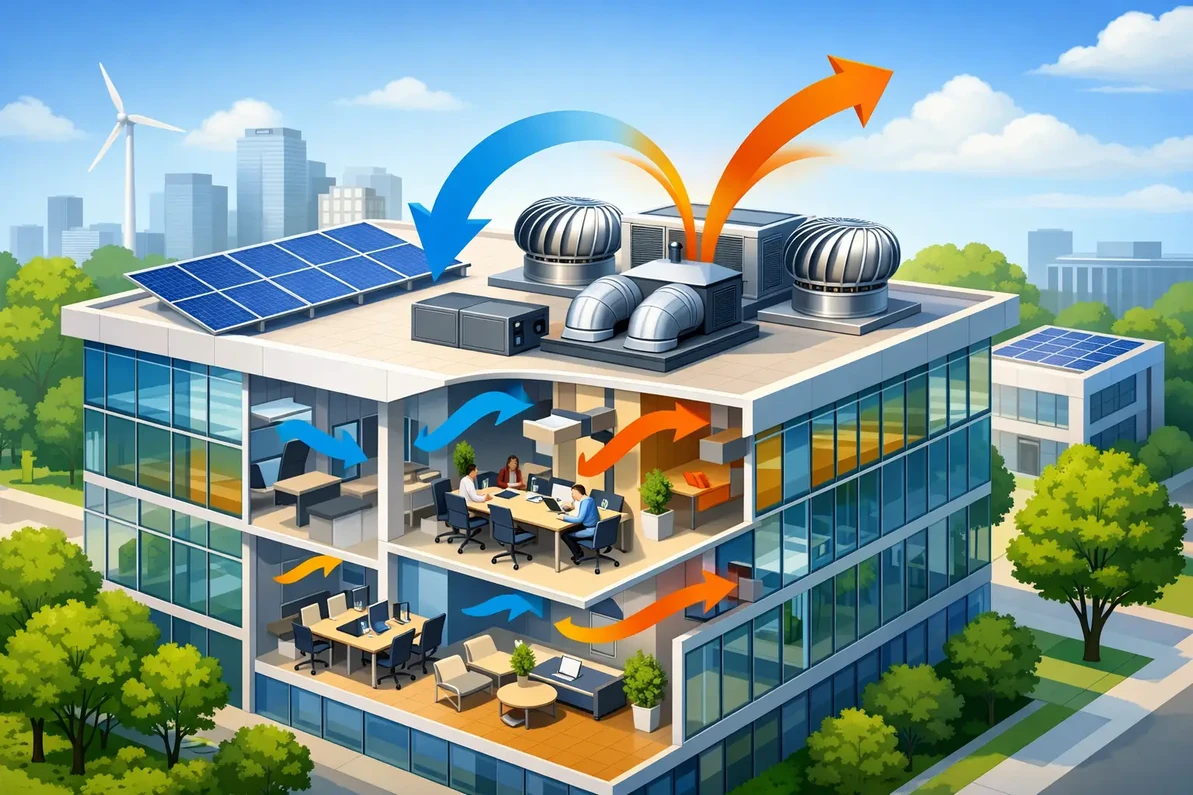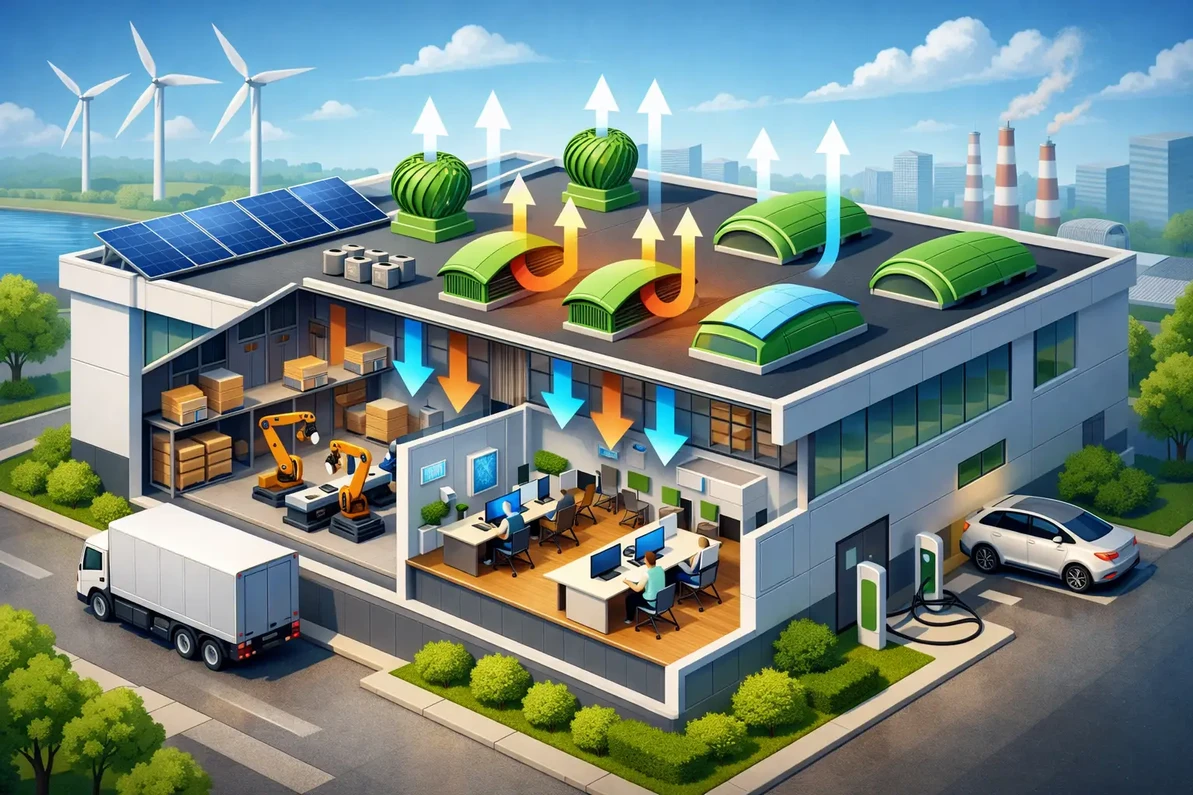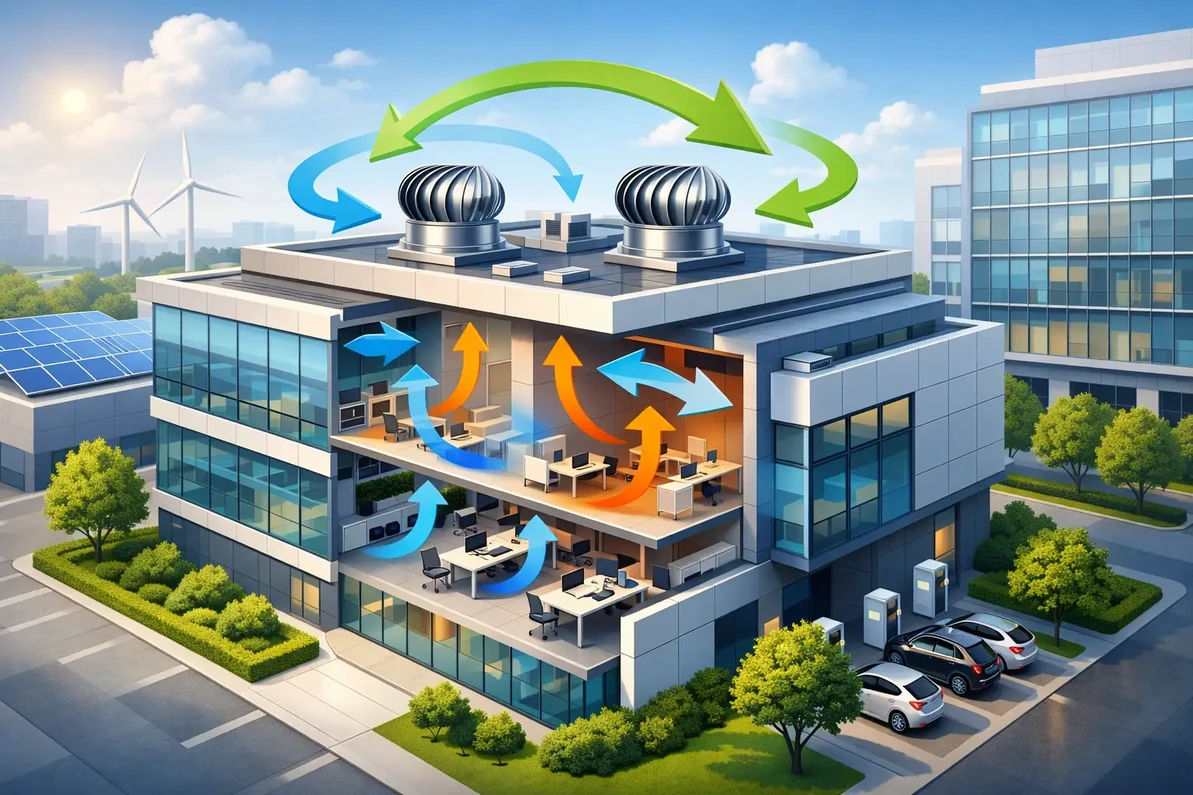

Green Building Design - Edmonds ecoPOWER Hybrid Ventilation
A green building can lose a large share of its energy advantage through one overlooked decision: using powered exhaust when natural forces could be doing part of the work. The search for Green Buildings Design Specify Edmonds ecoPOWER Hybrid Ventilation is really a search for a better way to remove heat and stale air without making rooftop exhaust another constant electrical load.
Edmonds ecoPOWER Hybrid Rooftop Exhaust Fans are designed with energy saving fractional HP motors for continous operation. For architects, engineers, contractors, and facility managers, the value is not simply a fan on the roof. It is a ventilation strategy that must be matched to the building heat load, occupancy pattern, roof geometry, make-up air path, and control requirements.
Why hybrid rooftop exhaust fits green building design
Conventional exhaust design often begins with a required airflow figure, selects enough fans to meet it, and then estimates annual electrical consumption. That approach can work, but it does not always account for when a building experiences its highest heat gain. Warehouses, schools, agricultural buildings, light manufacturing spaces, gymnasiums, workshops, and storage facilities commonly see peak roof and internal heat loads during daylight hours - precisely when solar-assisted operation has the greatest potential value.
The Edmonds ecoPOWER concept combines wind-assisted operation with the dependability of hybrid power. When wind is available, the fan can offset grid demand. When wind input is reduced or absent, the hybrid system can continue operating from its alternate power source, subject to the selected model and control configuration. That distinction matters. A solar-only fan may be appropriate for some intermittent applications, but critical ventilation cannot stop just because a cloud passes or the work shift extends past sunset.
For green-building projects, the specification case is strongest where daytime heat removal, reduced operating cost, and lower grid demand overlap. It may also support project teams pursuing energy-conscious design objectives, including LEED and Net-Zero-aligned strategies. Those outcomes still need to be demonstrated through the project’s own energy model, ventilation calculations, and documentation. No rooftop fan should be treated as a substitute for whole-building design analysis.
Start with air balance, not a product selection
A fan’s stated CFM is only useful when it is evaluated against the resistance and air replacement conditions it will actually see. Rooftop exhaust performance changes with static pressure, intake opening area, louvers, filters, duct transitions, backdraft dampers, building pressure, and wind effects. A fan selected from free-air CFM alone can underperform once it is installed.
Begin with the required exhaust rate. This may be driven by code-required air changes, contaminant capture, process equipment, moisture control, occupancy, or sensible heat removal. In heat-driven spaces, the calculation should consider the actual temperature differential between indoor and outdoor air. Moving a large amount of air is not automatically the same as removing a large amount of heat.
Then verify make-up air. Every cubic foot exhausted from a building must be replaced. If intake air is restricted, the building goes negative, exhaust fan airflow falls, doors become difficult to open, and conditioned air may be pulled in from unintended locations. Natural make-up air through properly sized wall louvers may be suitable for some facilities. Other buildings require powered make-up air, tempered air, filtration, or distribution ductwork to protect comfort and process conditions.
This is where hybrid ventilation needs the same engineering discipline as any commercial exhaust system. Solar assistance reduces energy demand; it does not eliminate the need for correct air balance.
How to specify Edmonds ecoPOWER Hybrid Ventilation
A useful specification starts by defining the operating duty, not just the fan quantity. Ask whether the unit will provide general heat relief, continuous background ventilation, smoke or fume-related process exhaust, moisture removal, or a combination of these functions. General ventilation and life-safety exhaust are not interchangeable applications, and code requirements must be reviewed before assigning a hybrid rooftop fan to any critical duty.
Next, establish the design airflow at the expected static pressure. Request the applicable cut sheet and performance data for the selected ecoPOWER model, then compare required CFM against the installed system resistance. Include the effects of roof curbs, ducts, discharge caps, dampers, bird screens, and any field-added accessories. If several fans operate together, consider staging. Multiple smaller units can provide better turndown and redundancy than one large fan, although they may add roof penetrations, wiring complexity, and maintenance points.
Solar exposure deserves equal attention. PV-supported ventilation is most effective on roof areas with reliable direct sun. Nearby structures, parapets, mechanical equipment, trees, future construction, and even the fan layout itself can cast shade that reduces available solar output. Coordinate orientation and placement early with the roofing, structural, electrical, and architectural teams. Moving a fan after curb locations have been finalized is expensive and often compromises the original ventilation plan.
The electrical scope must also be clear. Hybrid equipment can require electrical coordination for backup power, isolation, controls, monitoring, and safe service access. Do not assume that “solar” means no electrical planning. The project team should confirm available voltage, disconnect requirements, control wiring, roof access provisions, and responsibility for commissioning.
Controls determine whether savings become real
A hybrid fan that runs at full speed whenever power is available may provide ventilation, but it may not provide the best energy result. Controls should reflect the reason the fan is operating.
For heat relief, a thermostat or temperature-based controller can start and stage exhaust as indoor temperatures rise. In spaces with variable occupancy or intermittent processes, scheduling can prevent needless operation during unoccupied periods. Where indoor air quality is the concern, CO2, humidity, or process sensors may be more appropriate. The right control sequence depends on the building. A warehouse with afternoon heat buildup needs a different strategy than a greenhouse, livestock facility, or manufacturing room with a steady process load.
Variable-speed capability can be valuable when the building rarely needs design airflow all day. Reducing speed during lighter-load periods can lower sound levels and fan energy while maintaining a more stable indoor environment. However, variable-speed control should be evaluated with the fan motor, solar configuration, and control package as a complete system. Mixing components without confirming compatibility can create nuisance faults or leave performance on the table.
Specify a practical override and service mode as well. Facility staff need a clear way to run, stop, test, and troubleshoot equipment without bypassing every control safeguard. For larger sites, alarm contacts or building automation integration can provide useful confirmation that exhaust is operating when called upon.
Roof, weather, and maintenance details matter
Rooftop ventilation lives in a demanding environment. The curb must be compatible with the roof assembly and properly flashed. The structure must support equipment weight, wind loading, and service access. Discharge location must avoid recirculating warm or contaminated exhaust into outdoor air intakes, operable windows, or adjacent equipment.
Maintenance planning is especially important for a system expected to produce long-term energy savings. The fan, solar components, guards, screens, dampers, electrical connections, and roof penetrations should be accessible for inspection. Dust accumulation, damaged screens, failed dampers, and neglected belts or bearings can reduce airflow long before a fan stops completely. A simple seasonal inspection plan protects both ventilation performance and the energy case behind the project.
Noise is another site-specific issue. Rooftop units are usually less intrusive than interior equipment, yet discharge sound can still affect nearby offices, residences, or outdoor amenity areas. Review sound data when the project has sensitive adjacencies, and avoid placing units directly above quiet rooms where structure-borne vibration could become a complaint.
What Makes ecoPOWER a True Hybrid Ventilator?
Many products are described as hybrid because they combine a fan with a solar panel, battery option, or optional control package. That is not the operating principle behind the Edmonds ecoPOWER system. ecoPOWER is a true hybrid because it uses two independent methods of moving air through the same rooftop ventilator.
First, wind passing over the ventilator creates a low-pressure zone that induces exhaust airflow. This is passive operation. When outside wind conditions are favorable, the ventilator can move air without relying on electrical motor power. That passive contribution is valuable because rooftop wind is a free energy source that can support continuous building exhaust.
Second, the high-performance EC brushless DC motor provides powered exhaust operation. When wind speed is low, internal heat load rises, or controlled airflow is required, the motor maintains ventilation performance. EC motor technology is a major part of the value proposition. Compared with conventional AC motor approaches, EC motors are well suited to efficient speed control, lower operating wattage at reduced speeds, and continuous-duty applications.
The hybrid design is not an either-or compromise. It is a ventilation strategy that captures wind assistance whenever it is available while retaining the control and reliability of powered mechanical exhaust.
Edmonds ecoPOWER Ventilation Is Not Solar Powered
This point needs to be stated clearly because solar attic and roof ventilators are often grouped into the same conversation. Edmonds ecoPOWER is not solar powered. It does not depend on photovoltaic output to run its motor, and it is not limited by cloud cover, roof orientation, seasonal daylight hours, or nighttime operation.
Solar-powered ventilation can make sense for certain light-duty or remote applications where electrical service is difficult to install. However, solar output and building ventilation demand do not always occur at the same time. A building may need exhaust early in the morning, after sunset, during a storm, or on a hot but overcast day. A solar-only fan may reduce airflow precisely when dependable mechanical ventilation is needed.
The ecoPOWER approach uses wind energy aerodynamically, rather than converting sunlight into electricity. Its EC motor then supplies controlled, continuous operation as needed. For commercial and industrial design work, this makes the unit easier to evaluate against actual ventilation requirements rather than ideal solar conditions.
Why Wind-Assisted Exhaust Changes the Energy Equation
A powered roof exhaust fan consumes energy every hour its motor runs. An ordinary passive ventilator consumes no electrical energy, but airflow changes with wind conditions and may fall short when the facility needs a predictable exhaust rate. ecoPOWER sits between these two conventional choices while addressing their weaknesses.
When wind creates sufficient induced draft, the ventilator can contribute airflow with little or no motor energy. When wind declines, the EC motor carries the airflow requirement. This operating behavior can reduce electrical demand compared with a conventional fan that must deliver all airflow mechanically at all times.
Actual savings depend on the application. Roof exposure, prevailing wind, internal heat generation, building leakage, makeup-air paths, controls, operating hours, and the selected fan size all affect results. A wind-assisted ventilator is not a substitute for load calculations. It is an efficient exhaust component that must be matched to the building envelope and the required CFM.
That is especially relevant in facilities where exhaust operates for long hours. Warehouses with high roof temperatures, manufacturing areas with process heat, agricultural buildings managing moisture and animal heat, and large commercial spaces can all benefit from equipment that uses passive airflow when the weather allows without sacrificing powered operation.
The best green-building ventilation design does not begin with a sustainability label. It begins with required CFM, static pressure, heat load, make-up air, controls, and operating hours - then selects equipment that performs efficiently under those real conditions.
Factory Fans Direct/Edmonds US provides free project evaluations for commercial and industrial ventilation applications. Contact Mike Miller, VP Engineering, at 888-849-1233 to review airflow requirements, rooftop exhaust options, and Edmonds ecoPOWER hybrid fan selection before equipment is specified.
Factory Fans Direct/Edmonds US - Hybrid Commercial & Industrial Ventilation & Cooling Experts | Contact Mike Miller VP Engineering at Factory Fans Direct for a FREE Project Evaluation 888-849-1233 | Mike@FactoryFansDirect.com
Recent Posts
-

Smart Buildings Architects Recommend Edmonds ecoPOWER Hybrid Ventilation
A rooftop ventilator should not force an all-or-nothing energy decision. Smart Buildings Architects …7th Sep 2026 -
Smart Industrial Buildings Use Edmonds ecoPOWER Hybrid Ventilation
A roof exhaust system can be the difference between a plant that controls heat at the source and one …7th Sep 2026 -
Smart Commercial Buildings Use Edmonds Hybrid Ventilation
A rooftop exhaust fan that only performs when the wind blows is not a complete ventilation strategy. …7th Sep 2026