Free Expert Warehouse Ventilation & Cooling Advice
A warehouse that is 10 to 15 degrees hotter than the outdoor air is not automatically under-fanned. It may be fighting roof heat gain, forklifts, process equipment, poor air paths, or an exhaust system with no adequate make-up air. Free Expert Warehouse Ventilation & Cooling Advice starts with identifying the heat source and airflow restriction before selecting CFM, horsepower, or fan style.
The right system can improve employee comfort, protect inventory, reduce heat stress around workstations, and support more consistent operations. The wrong system can move a lot of air on paper while delivering little measurable relief at floor level.
Start With the Warehouse Heat Load
Warehouse ventilation design is not a square-footage-only exercise. Building volume matters, but heat gain determines how much air must move and where it needs to go. A facility with a high roof, direct sun exposure, dark roofing, loading docks, charging stations, compressors, ovens, or packaged equipment will behave very differently than a storage-only building of the same size.
A useful sensible-heat estimate is:
CFM = BTU/hr ÷ (1.08 × desired temperature difference)
For example, if a process releases 108,000 BTU per hour and the available outdoor air is 10 degrees cooler than the target indoor temperature, the starting airflow estimate is 10,000 CFM. This is only a starting point. Solar gain, building leakage, production changes, and the fan's actual performance at static pressure all affect final equipment selection.
When outdoor air is already hot and humid, exhaust ventilation cannot create air colder than the incoming air. It can still remove trapped roof heat, fumes, moisture, and equipment-generated heat. In those conditions, high-volume air movement, evaporative cooling where climate conditions allow, or mechanical cooling for critical zones may be the better answer.
Free Expert Warehouse Ventilation & Cooling Advice: Air In Must Match Air Out
Exhaust fans only perform when replacement air can enter the building. This is the most common failure point in warehouse cooling projects. A roof or wall exhaust fan may be rated for 20,000 CFM, but if the building has limited louvers, closed doors, restrictive screens, or undersized make-up air equipment, the system pulls into negative pressure and actual airflow drops.
Negative pressure can make dock doors difficult to operate, pull dust into the facility, interfere with combustion equipment, and cause fans to operate far from their published rating. The goal is controlled air travel: lower, cooler replacement air enters near the occupied or process zone; warmer air rises and exits through roof-mounted exhaust or properly located wall fans.
For facilities that must remain enclosed for security, pest control, filtration, or weather protection, powered make-up air may be required. Louvers, dampers, light traps, filters, and ductwork all add static pressure. Fan selection must use the manufacturer fan curve at the expected system static pressure, not the free-air CFM shown in a catalog headline.
Match the Equipment to the Airflow Job
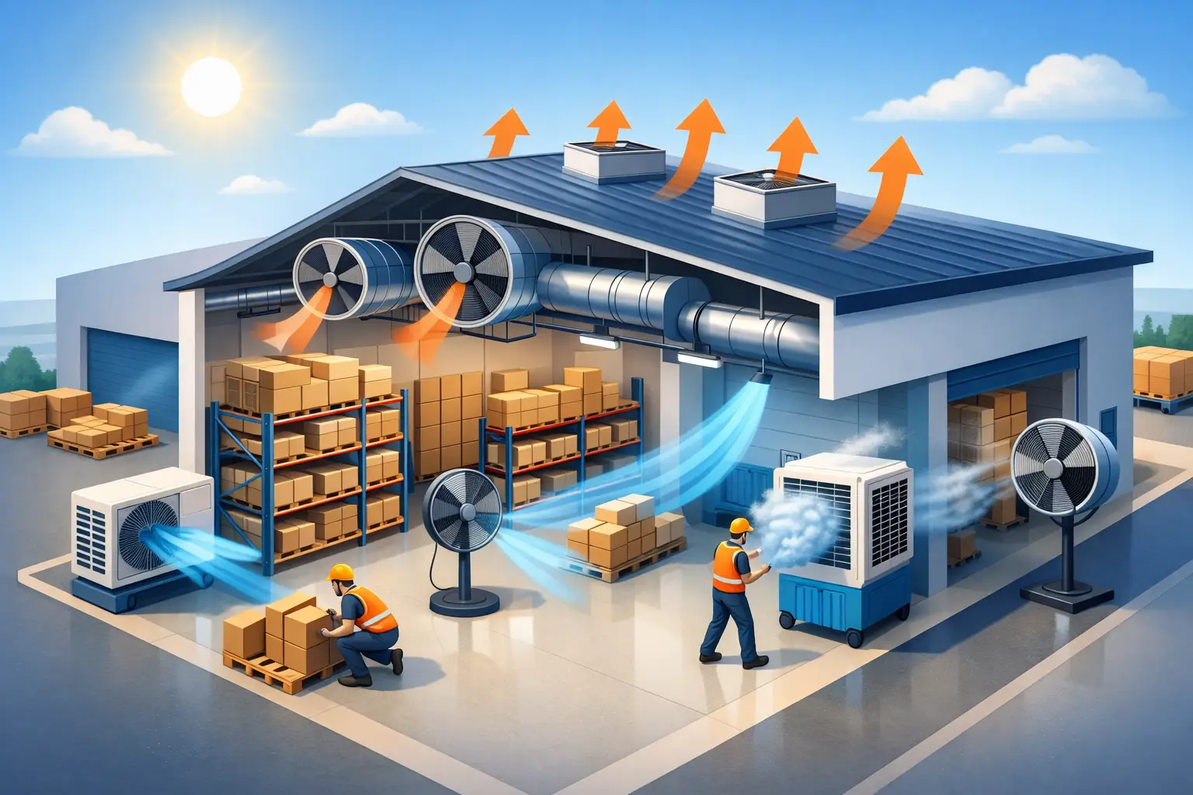
A complete warehouse cooling plan often combines several equipment types because each solves a different problem. Exhaust fans remove heat and contaminants. Supply or make-up air units replace exhausted air. HVLS fans create broad, low-speed air movement across occupied areas. Directional fans improve comfort at loading stations, packing lines, and hot equipment zones.
HVLS fans are highly effective for destratification and perceived cooling, especially in high-bay buildings. They do not replace exhaust ventilation where the facility needs air exchange, fume removal, or heat rejection. Likewise, a large roof exhaust fan may lower ceiling temperatures while leaving workers uncomfortable if no air movement reaches the floor.
Roof-mounted fans are often preferred when heat naturally collects at the ceiling and roof penetration is practical. Wall-mounted exhaust fans can work well for crossflow ventilation, particularly when intake openings are located on the opposite side of the building. The best configuration depends on roof height, bay layout, dock locations, prevailing winds, equipment placement, and whether the building has clear pathways for incoming air.
Use Controls to Handle Changing Loads
Warehouses rarely operate at one fixed heat load. Dock doors open and close, outdoor temperatures change, production shifts vary, and equipment may run only during peak periods. Running every fan at full speed all day can waste energy and create excessive drafts.
Variable frequency drives and staged controls allow ventilation capacity to follow conditions. Temperature sensors near the ceiling can activate roof exhaust as heat accumulates, while floor-level sensors and occupant feedback help prevent overcooling work areas. For more demanding applications, building pressure monitoring helps confirm that exhaust and make-up air remain balanced.
Controls should be specified with the motor type and electrical requirements in mind. Not every motor is compatible with every speed controller. Motor horsepower, voltage, phase, service factor, and listed control compatibility should be confirmed before installation.
What to Have Ready for a Warehouse Evaluation
A productive ventilation evaluation begins with usable field information. Facility managers and contractors should gather building length, width, clear height, roof type, current fan sizes and locations, electrical service, operating schedule, and photographs of likely intake and exhaust locations. Identify major heat sources, existing complaints, and any areas where fumes, dust, humidity, or product temperature are concerns.
Also note what cannot change. A restricted roof, limited wall openings, fire separation requirements, conditioned office areas, forklift traffic, and noise limits can all reshape the design. Good engineering is not simply choosing the biggest fan. It is selecting equipment that can deliver the required airflow through the real building constraints.
Bring your building dimensions, heat sources, and current equipment details so the recommended CFM, fan type, make-up air, and controls match the job.
Factory Fans Direct - Commercial & Industrial Ventilation & Cooling Experts | Contact Mike Miller VP Engineering at Factory Fans Direct for a FREE Project Evaluation 888-849-1233 | Mike@FactoryFansDirect.com
Recent Posts
-

Smart Buildings Architects Recommend Edmonds ecoPOWER Hybrid Ventilation
A rooftop ventilator should not force an all-or-nothing energy decision. Smart Buildings Architects …7th Sep 2026 -
Smart Industrial Buildings Use Edmonds ecoPOWER Hybrid Ventilation
A roof exhaust system can be the difference between a plant that controls heat at the source and one …7th Sep 2026 -
Smart Commercial Buildings Use Edmonds Hybrid Ventilation
A rooftop exhaust fan that only performs when the wind blows is not a complete ventilation strategy. …7th Sep 2026