
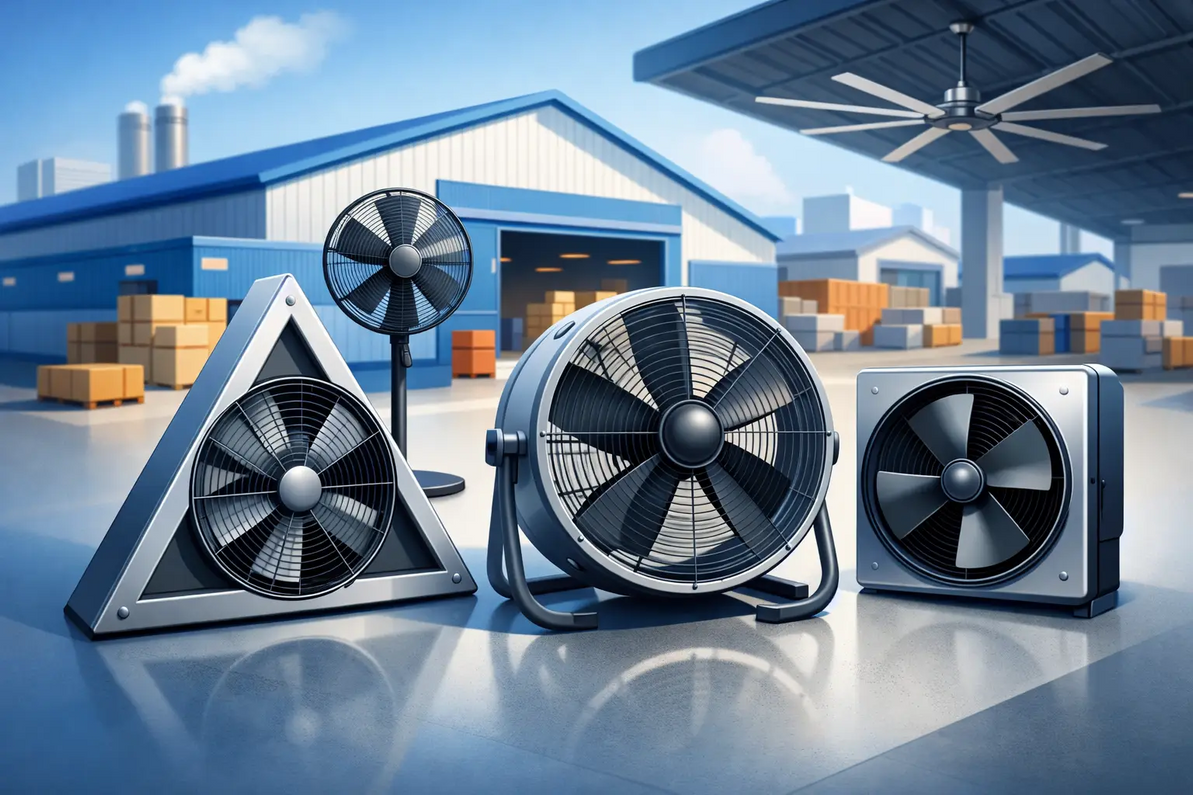
Factory Fans Direct Triangle Engineering National Dealer
A fan that looks adequate on a submittal sheet can still fail the building when static pressure, heat load, duct losses, or operating conditions were not accounted for. Industrial ventilation equipment must be matched to the actual application, not selected by diameter alone.
Factory Fans Direct is a national dealer for Triangle Industrial Fans & Equipment, supporting facility managers, contractors, engineers, and operations teams that need dependable airflow equipment with practical selection guidance. Whether the project involves a manufacturing floor, warehouse, agricultural building, loading area, process exhaust system, or make-up air requirement, the objective is measurable performance: the required CFM at the pressure the system will actually see.
Triangle Industrial Fans and Equipment for Real Conditions
Industrial ventilation is rarely a simple open-wall exhaust application. Louvers, dampers, bird screens, filters, duct transitions, elbows, discharge stacks, and weather hoods all add resistance. That resistance is static pressure, and it directly affects delivered airflow.
A fan rated at a high free-air CFM may produce substantially less airflow once installed in a restrictive system. This is why the fan curve matters. The correct selection point considers the required CFM, expected static pressure, air temperature, elevation, motor enclosure, power supply, mounting arrangement, and duty cycle. For corrosive, dusty, humid, or high-temperature environments, construction materials and motor protection can be just as important as airflow capacity.
Triangle Industrial Fans & Equipment can be considered across a range of commercial and industrial ventilation needs, including wall exhaust, roof exhaust, supply air, circulation, and process-related airflow applications. The right configuration depends on where air must enter, where it must leave, and what pressure losses exist between those two points.
Start With the Heat and Air-Exchange Requirement
For many facilities, the first question is not "What size fan do I need?" It is "What problem must the fan solve?" Heat removal, contaminant control, building pressurization, moisture control, and worker comfort each require a different design approach.
A warehouse with forklift traffic and accumulated roof heat may need high-volume exhaust paired with properly sized intake openings. A manufacturing process producing fumes or fine particulates may require source capture and ducted exhaust rather than general building ventilation. Agricultural structures often need air exchange that accounts for livestock heat, moisture, and seasonal operation. In each case, the exhaust fan is only one component of the air-management system.
Make-up air deserves special attention. Exhausting large volumes of air without a planned intake path can create negative building pressure, reduce fan output, pull in unconditioned air through openings, interfere with combustion equipment, and make doors difficult to operate. A properly designed system provides a controlled path for replacement air, whether through gravity intake louvers, powered supply fans, or dedicated make-up air equipment.
What to Confirm Before Selecting a Triangle Industrial Fan
A productive equipment review begins with field information. Facility teams and contractors should document building dimensions, ceiling height, process heat sources, desired temperature reduction, existing fan locations, electrical service, roof or wall construction, and available intake area. Photographs, plans, and equipment cut sheets can prevent expensive selection errors before installation begins.
For a replacement fan, verify more than the existing fan's diameter. Confirm the curb or wall opening, mounting dimensions, voltage, phase, motor horsepower, drive arrangement, and whether the installed fan met the required performance. Replacing a failed 36-inch unit with another 36-inch unit may preserve the original sizing mistake.
Variable frequency drives and fan speed controls can add useful operating flexibility, particularly where heat load changes by shift, season, or production level. However, controls must be compatible with the motor and application. Slowing a fan reduces noise and energy use, but it also reduces airflow and static-pressure capability. Controls are a tool for managing a correctly designed system, not a substitute for adequate fan capacity.
National Dealer Support for Triangle Industrial Fans & Equipment
Equipment selection should be based on the fan curve, not a catalog headline. Factory Fans Direct helps evaluate airflow requirements, static pressure, motor options, mounting needs, and practical installation constraints before equipment is ordered. That technical review is especially valuable on projects where downtime, overheating, poor air quality, or failed inspections carry real operational cost.
For straightforward open-wall ventilation, selection may be relatively simple. For ducted exhaust, multi-fan systems, high-temperature applications, or facilities with pressure-sensitive areas, a project evaluation can identify issues that are easy to miss during a quick online purchase. The goal is to specify equipment that performs as intended after it is installed.
Call are Engineering Team at 888-849-1233 before an undersized intake or overlooked pressure loss turns a fan purchase into a ventilation problem.
Factory Fans Direct - Commercial & Industrial Ventilation & Cooling Experts | Contact Mike Miller VP Engineering at Factory Fans Direct for a FREE Project Evaluation 888-849-1233 | Mike@FactoryFansDirect.com
Recent Posts
-

Smart Buildings Architects Recommend Edmonds ecoPOWER Hybrid Ventilation
A rooftop ventilator should not force an all-or-nothing energy decision. Smart Buildings Architects …7th Sep 2026 -
Smart Industrial Buildings Use Edmonds ecoPOWER Hybrid Ventilation
A roof exhaust system can be the difference between a plant that controls heat at the source and one …7th Sep 2026 -
Smart Commercial Buildings Use Edmonds Hybrid Ventilation
A rooftop exhaust fan that only performs when the wind blows is not a complete ventilation strategy. …7th Sep 2026