Factory Fans Direct: Data Center and Crypto Cooling Experts
A mining container can go from acceptable inlet temperatures to repeated thermal throttling in a single hot afternoon. A data hall can lose cooling margin when a new rack row changes return-air paths. These are not generic ventilation problems. Factory Fans Direct - Data Center & Crypto Mining Cooling Experts approach them as heat-rejection, airflow-path, and equipment-matching problems, where fan CFM alone is never the full answer.
High-density computing facilities need a cooling plan that accounts for real heat load, local climate, elevation, equipment layout, filtration, electrical capacity, and operating risk. Whether the project is a small ASIC mining operation, a modular container, a GPU deployment, or a larger data center support space, the goal is the same: remove heat predictably without creating avoidable energy use, recirculation, pressure problems, or equipment exposure.
Why Cooling Capacity Is Not the Same as Fan CFM
Every watt consumed by servers, ASIC miners, power supplies, and associated electrical equipment ultimately becomes heat. That basic fact makes a credible heat-load calculation the starting point. A site with 1 MW of operating IT load produces approximately 3.412 million BTU per hour of heat before adding lighting, transformer losses, personnel, or solar gain through the building envelope.
Airflow is then sized around the allowable temperature rise across the equipment. A common engineering relationship for sensible heat is:
BTU/hr = 1.08 x CFM x temperature rise in degrees F
The equation is useful, but only when the design temperature rise is realistic. Designing for a 20-degree rise requires substantially less airflow than designing for a 10-degree rise. Lower airflow may reduce fan horsepower and first cost, but it can also leave less temperature margin during summer peaks, high-load periods, or partial equipment failures.
The right answer depends on the equipment manufacturer’s inlet-temperature limits, local ambient conditions, redundancy expectations, and the facility’s tolerance for curtailment. A mining operation in a dry climate may accept a different operating strategy than a data center supporting business-critical applications.
Data Center and Crypto Mining Cooling Starts With Airflow Paths
A fan cannot correct a poor airflow path. If hot exhaust air has a route back to equipment intakes, more fan capacity may simply move more hot air around the room or container. That is one of the most expensive mistakes in high-density cooling.
For air-cooled ASIC and server installations, the preferred path is clear and directional: cool intake air enters at the equipment inlet, passes through the hardware once, and exits through a controlled hot-air zone. The intake and exhaust sides must remain separated. In a containerized mining application, that often means a filtered intake wall or louver bank on one end and high-capacity exhaust fans at the opposite end.
In data centers, hot-aisle and cold-aisle containment can reduce bypass air and recirculation. Containment is not automatically necessary for every room, but it becomes increasingly valuable as rack density rises and cooling margin narrows. Even simple barriers, blanking panels, cable-opening seals, and disciplined rack orientation can materially improve the performance of the installed cooling equipment.
Outdoor air systems also need attention to building pressure. Excessive exhaust without adequate intake area creates negative pressure, increasing fan static pressure and pulling unfiltered air through gaps. Too much uncontrolled intake can compromise intended airflow direction and introduce weather, dust, or humidity issues.
Static Pressure Determines What the Fan Can Actually Deliver
Published fan CFM is often quoted at free air, meaning little or no resistance. Real installations are not free air. Guards, louvers, motorized dampers, weather hoods, filters, duct transitions, silencers, light traps, and restrictive wall openings all add static pressure.
If the selected exhaust fan cannot produce its required CFM at the system’s actual static pressure, the facility will miss its cooling target. The fan may run continuously, draw power, and sound busy while delivering far less air than expected.
This is why a fan curve matters. The curve shows delivered airflow at various static-pressure levels, along with brake horsepower, efficiency, and operating point. For a high-temperature mining exhaust application, engineers should also verify the motor type, temperature rating, drive arrangement, belt maintenance requirements where applicable, and suitability for continuous-duty operation.
Selecting Exhaust, Intake, and Make-Up Air Equipment
High-temp exhaust fans are commonly selected for mining rooms and containers because they move large volumes of hot air directly from the discharge side of the equipment. The selection should consider whether the application needs wall-mounted propeller fans, direct-drive axial fans, centrifugal equipment, roof exhaust units, or a mixed system.
Wall and axial fans can be effective where air has a short, straight path and system resistance is low. Centrifugal equipment is often more appropriate where ductwork, filtration, or higher static pressure is unavoidable. Roof-mounted exhaust may preserve wall space and support vertical discharge, but roof penetrations, curb details, weather exposure, and service access must be addressed early.
Make-up air is equally important. A large exhaust system needs a low-resistance source of replacement air. The intake opening, louver free area, and filtration system must be sized so the exhaust fans are not starved. If outside air is acceptable for the equipment and local conditions, properly designed intake systems can be a cost-effective approach. If humidity, smoke, salt air, dust, or extreme temperatures are concerns, the intake strategy becomes more complex.
Variable frequency drives can improve control when loads or outdoor conditions change. Rather than operating every fan at full speed all year, a VFD can stage or modulate airflow based on temperature, differential pressure, or equipment load. The trade-off is that controls must be commissioned correctly. A poorly located sensor or an aggressive control sequence can cause fans to hunt, cycle excessively, or respond too slowly to a heat event.
Cooling Methods Must Match the Operating Environment
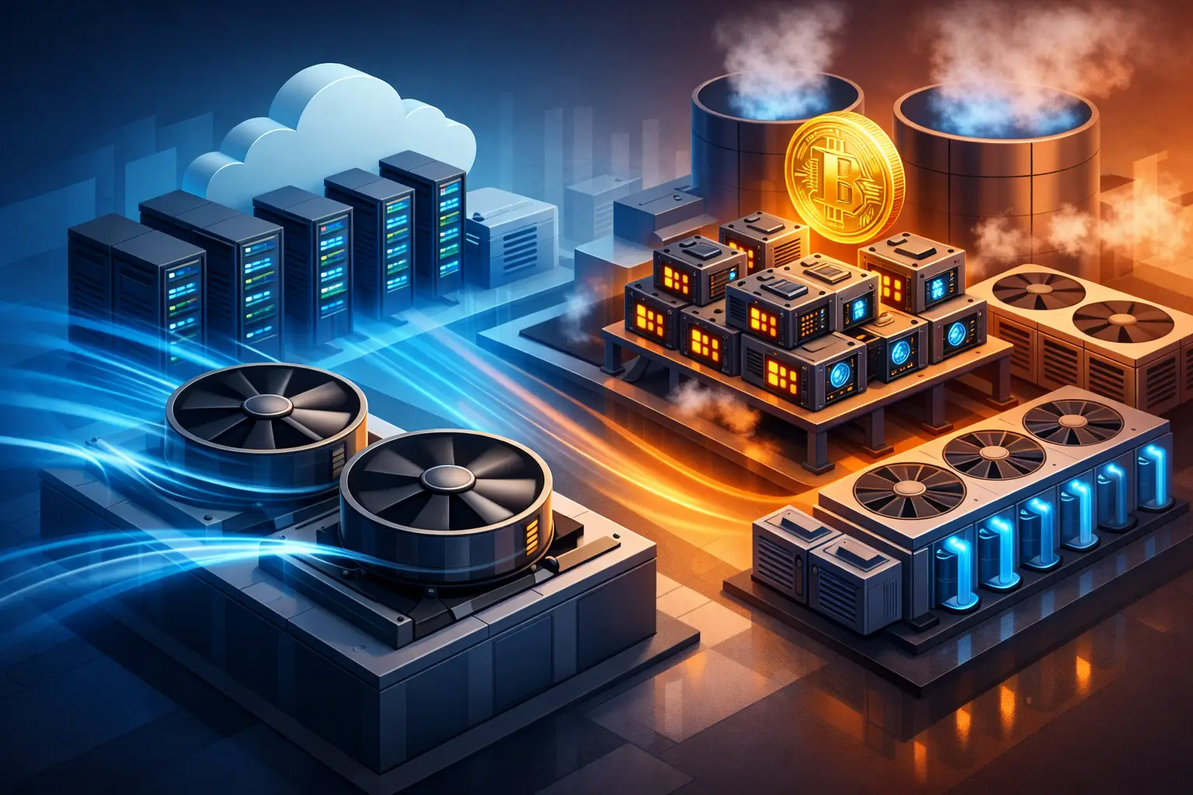
Direct outside-air ventilation is often the simplest solution for crypto mining, particularly in cooler or dry climates. It has fewer mechanical components than compressor-based cooling and can provide strong heat rejection when intake air is within acceptable limits. Its limitations are weather exposure, airborne contaminants, seasonal temperature swings, and potential humidity concerns.
Evaporative or adiabatic cooling can reduce intake-air temperature in dry regions, but it adds water treatment, maintenance, and moisture-management considerations. It should not be treated as a universal answer. In humid climates, its cooling benefit can be limited, and added moisture may create unacceptable operating conditions depending on the equipment and design.
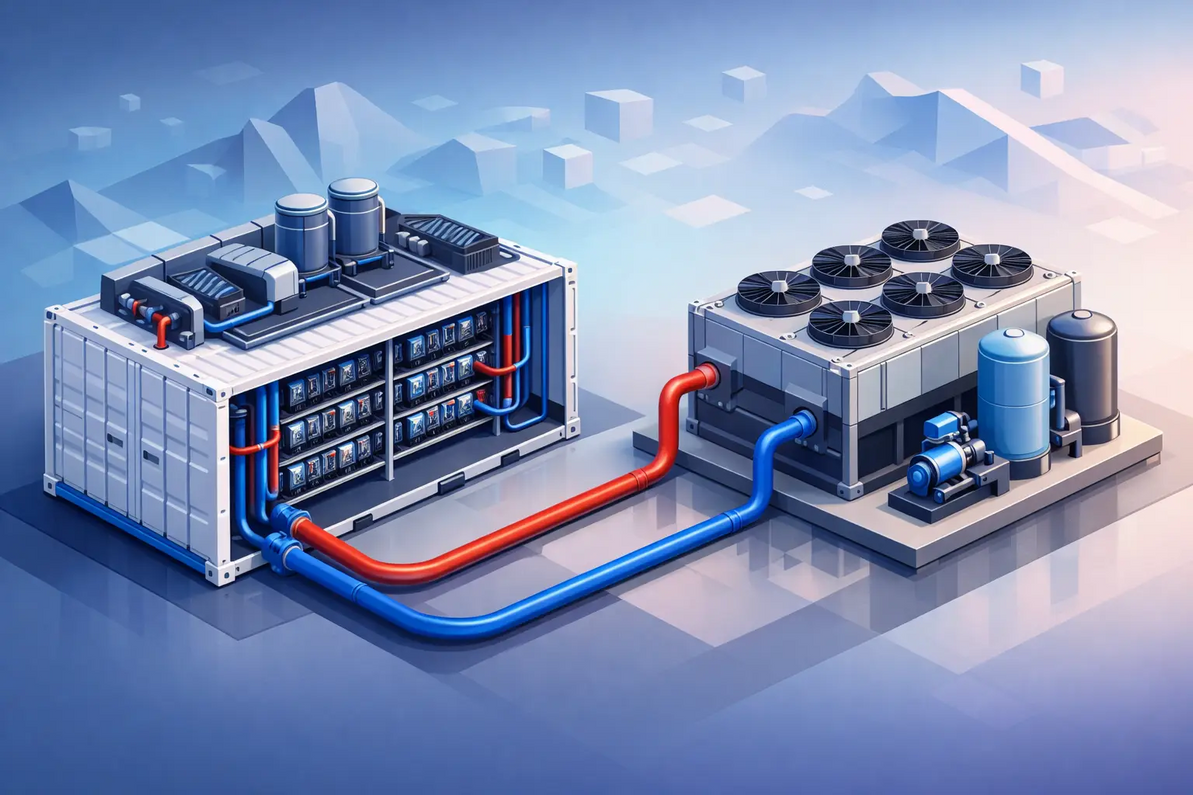
Immersion and hydro cooling change the thermal-management strategy. Instead of pushing large quantities of air through every computing device, heat is transferred into a fluid loop and then rejected through dry coolers, heat exchangers, or other plant equipment. These systems can support very high power densities and may reduce fan noise and airborne-dust exposure at the hardware level. They also require careful fluid selection, leak management, pumping capacity, heat-exchanger sizing, service procedures, and a dependable secondary heat-rejection plan.
For some operations, a hybrid approach makes sense: air cooling for lower-density equipment and immersion or hydro cooling for the highest-density hardware. The best choice depends on power density, water availability, site temperature profile, labor capability, capital budget, and uptime requirements.
Design for Summer Peaks, Dirty Filters, and Fan Failure
A cooling plan that works only under clean, mild, full-fan conditions is not a dependable cooling plan. Design evaluation should test the operating case that creates the highest risk: maximum equipment load, high outdoor ambient, solar exposure, partially loaded filters, and one fan unavailable if redundancy is required.
Filter selection is a practical example. Higher-efficiency filters protect equipment from dust, but they impose more resistance and need a maintenance plan. Differential-pressure monitoring helps facility teams replace filters based on actual loading rather than a calendar guess. In dusty agricultural, industrial, or roadside locations, filtration can become the deciding factor in fan selection and intake size.
Electrical planning also deserves early attention. Fan motors, VFDs, controls, dampers, pumps, and cooling equipment all need coordinated power distribution and protection. A staged restart sequence after a power interruption can prevent a large inrush event and restore cooling before computing equipment reaches its thermal limits.
What a Useful Cooling Project Evaluation Should Cover
A serious ventilation evaluation begins with more than a building footprint. The available data should include total operating kW, equipment type and quantity, room or container dimensions, layout, intake and exhaust locations, local summer design temperatures, elevation, existing fan data, desired indoor temperatures, and any limits on noise, water use, or building modifications.
It should also identify restrictions that affect the system curve: louver sizes, filter banks, duct runs, roof curbs, discharge hoods, sound attenuation, and security screening. Photos, cut sheets, and a basic floor plan can often reveal recirculation paths or intake restrictions before equipment is ordered.
The deliverable should be equipment matched to the application, not a generic fan recommendation. That means reviewing expected CFM at operating static pressure, motor and voltage requirements, speed control compatibility, mounting details, service access, and the make-up-air path. For critical sites, it also means discussing fan staging, alarm points, temperature sensors, and failure response.
A cooling system should give operators measurable margin, not hope. Start with the heat load, protect the intake path, separate hot exhaust from cool supply air, and select fans from their actual performance curves. Contact Mike Miller, VP Engineering, for a FREE Project Evaluation at 888-849-1233 or Mike@FactoryFansDirect.com.
Factory Fans Direct - Crypto Mining & Data Center Cooling Experts
Factory Fans Direct - Crypto Mining & Data Center Cooling Experts Contact Mike Miller VP Engineering at Factory Fans Direct for a FREE Project Evaluation 888-849-1233 | Mike@FactoryFansDirect.com
Recent Posts
-

Factory Fans Direct: Data Center and Crypto Cooling Experts
A mining container can go from acceptable inlet temperatures to repeated thermal throttling in a sin …8th Aug 2026 -
How to Select a Hydro-Cooled Mining Container & Dry Cooler
A mining container can look complete on a quotation and still fail the only test that matters: maint …8th Aug 2026 -
How to Design a Profitable Air-Cooled Crypto Mining Container
A mining container can have efficient ASICs, low-cost power, and a strong site agreement, then still …8th Aug 2026