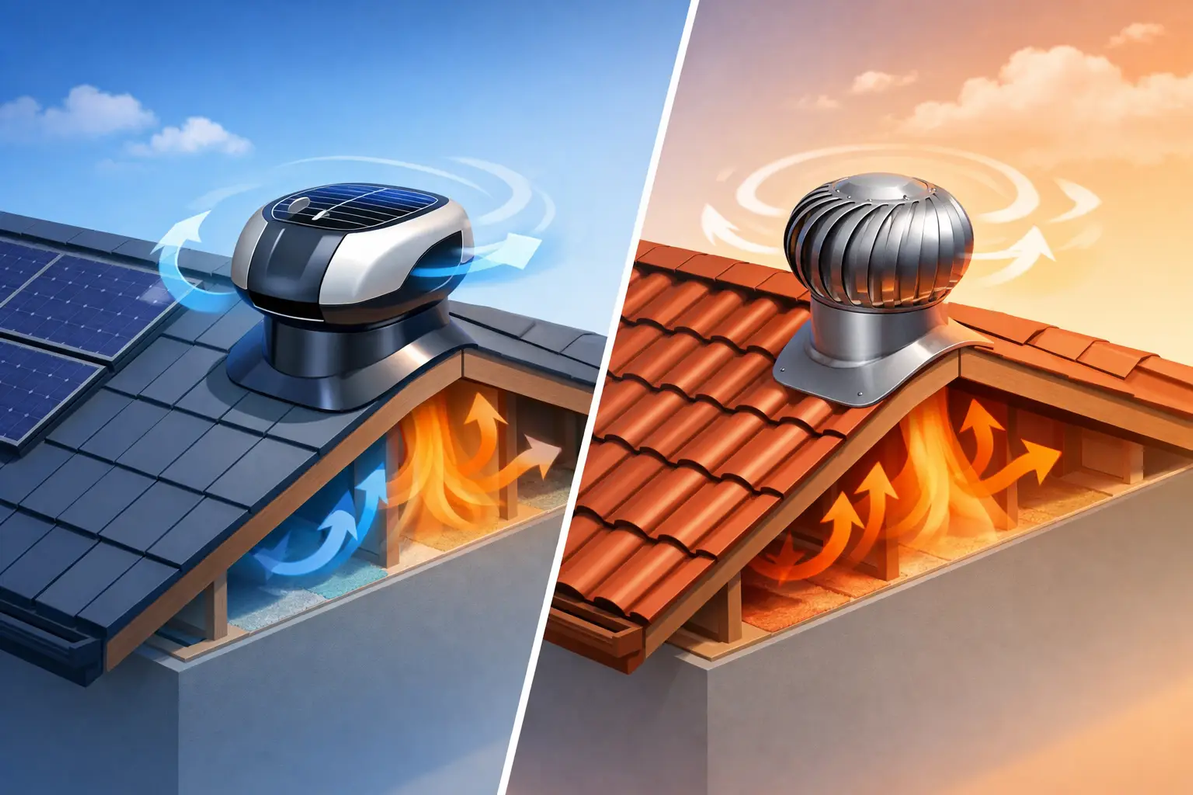
Edmonds Hybrid ecoPOWER vs Traditional Roof Ventilation
A roof ventilator that only moves air when wind and temperature conditions cooperate can become a bottleneck when a building needs predictable heat removal. In the Edmonds Hybrid ecoPOWER Ventilation vs Traditional Roof Ventilation decision, the central question is not simply which unit costs less at purchase. It is whether the roof exhaust system can maintain the required airflow when production, occupancy, solar gain, or equipment heat peaks.
Traditional Roof Ventilation: Effective, but Condition-Dependent
Traditional roof ventilation generally refers to passive ventilators such as turbine vents, gravity ventilators, ridge vents, and static roof louvers. These products can be an excellent fit for buildings with modest heat loads, available intake air, and favorable wind exposure. With no motor, passive equipment has minimal electrical demand and fewer powered components to service.
The engineering limitation is that passive airflow is variable. Stack effect depends on the temperature difference between indoor and outdoor air. Wind-driven performance depends on wind speed, wind direction, roof location, and nearby obstructions. On a hot, still day - often when an attic, warehouse, barn, or manufacturing area most needs relief - passive airflow may be limited.
A conventional powered roof exhaust fan solves part of that problem by delivering mechanical airflow. However, it uses electrical energy whenever it operates and may not take advantage of wind-assisted exhaust when conditions are favorable.
How Edmonds ecoPOWER Hybrid Ventilation Works
Edmonds ecoPOWER is not a solar-powered roof ventilator. It is a true hybrid rooftop exhaust ventilator that combines powered operation with non-powered, wind-driven operation. Its high-performance EC brushless DC motor provides continuous mechanical exhaust when needed, while the aerodynamic ventilator design can continue operating from wind energy without relying on electrical power.
That distinction matters for facilities pursuing lower operating energy without accepting the performance uncertainty of a passive-only ventilator. The system is designed to provide controlled, dependable exhaust during low-wind periods and use natural wind energy when conditions support it. This hybrid operating principle makes ecoPOWER particularly relevant for LEED and Net-Zero-oriented projects where ventilation performance and energy consumption must be considered together.
Edmonds Hybrid ecoPOWER Ventilation vs Traditional Roof Ventilation
The practical difference is airflow reliability. A traditional passive ventilator has no electrical operating cost, but it cannot guarantee a target CFM at a particular time. A standard powered exhaust fan can be selected for a defined CFM and static-pressure requirement, but its energy use is tied to runtime. The ecoPOWER hybrid approach is intended to bridge those operating modes: powered EC motor performance when the building requires it, with wind-assisted operation when conditions allow.
Motor technology also affects the comparison. EC brushless DC motors are known for efficient operation, speed control capability, and reduced maintenance compared with some traditional motor arrangements. That does not mean every project should replace all passive vents with hybrid units. A low-load storage building with excellent natural ventilation may still be well served by gravity or turbine ventilation. Conversely, a facility with a continuous internal heat load should not depend solely on weather conditions to protect people, inventory, livestock, or equipment.
Selection Requires More Than Roof Area
Roof ventilator sizing should start with the heat load and required air exchange, not the number of existing roof openings. For a warehouse or manufacturing facility, calculate heat generated by process equipment, lighting, occupants, solar roof gain, and any combustion or moisture sources. For agricultural buildings, livestock density, moisture, ammonia management, and seasonal operating conditions affect the design. For specialty cultivation, vapor pressure deficit, humidity removal, filtration, odor control, and room pressurization can make a simple roof-exhaust calculation inadequate.
Intake air is equally critical. An exhaust unit cannot move its rated airflow if replacement air has no adequate path into the building. Undersized wall louvers, closed doors, restrictive bird screens, or insufficient ridge and soffit intake can raise static pressure and reduce delivered CFM. The result may be poor airflow, excessive fan runtime, and complaints that the roof ventilator is underperforming when the real problem is make-up air design.
Controls deserve attention as well. A hybrid roof system may be paired with thermostats, speed controls, building automation, or staged ventilation logic based on indoor temperature and operating schedule. The best control strategy depends on whether the goal is general heat relief, continuous process exhaust, nighttime cooling, or a defined air-change rate.
Where Hybrid Roof Exhaust Makes the Most Sense
ecoPOWER is strongest where a project needs more dependable performance than passive roof ventilation can provide, but energy reduction remains a priority. Common applications include warehouses, manufacturing plants, schools, sports facilities, agricultural structures, and commercial buildings with large roof areas and recurring heat buildup.
Before specifying equipment, review required CFM, roof curb dimensions, discharge location, intake area, local wind exposure, electrical availability, control requirements, and roof loading. A cut sheet confirms equipment data, but it does not replace a ventilation design. Factory Fans Direct can provide a free project evaluation to help match roof exhaust, make-up air, and controls to the actual building load.
Factory Fans Direct/Edmonds US - Hybrid Commercial & Industrial Ventilation & Cooling Experts | Contact Mike Miller VP Engineering at Factory Fans Direct for a FREE Project Evaluation 888-849-1233 | Mike@FactoryFansDirect.com
Recent Posts
-

AI Mega Factories Use Edmonds ecoPOWER Hybrid Ventilation
AI Mega Factories use Edmonds ecoPOWER Hybrid Turbine Ventilation because heat rejection cannot be t …4th Oct 2026 -
AI Cooling for High-Heat Facilities
A server aisle running 12°F hotter than its neighboring aisle, a crypto container recirculating exha …4th Oct 2026 -
AI Ventilation: Better Control Starts With Data
A warehouse can look adequately ventilated on paper and still have a 15-degree temperature differenc …4th Oct 2026