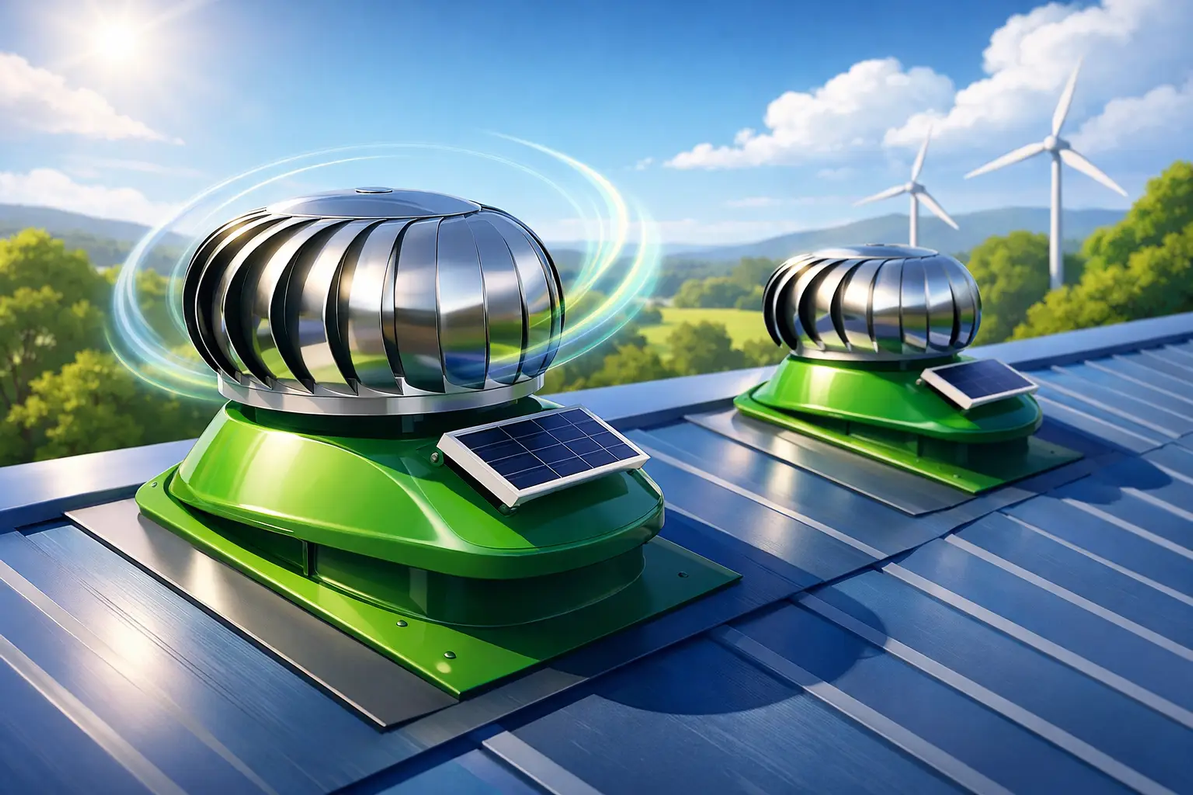
Edmonds ecoPOWER Hybrid Roof-Mount Exhaust Fans
A roof exhaust system should not become an energy penalty every time the sun rises. Edmonds ecoPOWER hybrid roof-mount exhaust fans are designed to use wind energy first, then automatically draw supplemental grid power when site conditions demand dependable airflow. For facility managers, engineers, and contractors balancing ventilation performance against operating cost, that hybrid operating principle is the point: ventilation continues when wind output alone is not enough.
These units are not a substitute for ventilation design. They are a high-efficiency roof exhaust option that must be matched to required CFM, building use, intake-air capacity, roof layout, and real operating conditions. Properly applied, they can reduce heat buildup and support code-conscious, low-energy ventilation strategies on commercial, industrial, agricultural, and specialty buildings.
What Makes ecoPOWER a Hybrid Ventilator?
Many products are described as hybrid because they combine a fan with a solar panel, battery option, or optional control package. That is not the operating principle behind the Edmonds ecoPOWER system. ecoPOWER is a true hybrid because it uses two independent methods of moving air through the same rooftop ventilator.
First, wind passing over the ventilator creates a low-pressure zone that induces exhaust airflow. This is passive operation. When outside wind conditions are favorable, the ventilator can move air without relying on electrical motor power. That passive contribution is valuable because rooftop wind is a free energy source that can support continuous building exhaust.
Second, the high-performance EC brushless DC motor provides powered exhaust operation. When wind speed is low, internal heat load rises, or controlled airflow is required, the motor maintains ventilation performance. EC motor technology is a major part of the value proposition. Compared with conventional AC motor approaches, EC motors are well suited to efficient speed control, lower operating wattage at reduced speeds, and continuous-duty applications.
The hybrid design is not an either-or compromise. It is a ventilation strategy that captures wind assistance whenever it is available while retaining the control and reliability of powered mechanical exhaust.
Edmonds ecoPOWER Ventilation Is Not Solar Powered
This point needs to be stated clearly because solar attic and roof ventilators are often grouped into the same conversation. Edmonds ecoPOWER is not solar powered. It does not depend on photovoltaic output to run its motor, and it is not limited by cloud cover, roof orientation, seasonal daylight hours, or nighttime operation.
Solar-powered ventilation can make sense for certain light-duty or remote applications where electrical service is difficult to install. However, solar output and building ventilation demand do not always occur at the same time. A building may need exhaust early in the morning, after sunset, during a storm, or on a hot but overcast day. A solar-only fan may reduce airflow precisely when dependable mechanical ventilation is needed.
The ecoPOWER approach uses wind energy aerodynamically, rather than converting sunlight into electricity. Its EC motor then supplies controlled, continuous operation as needed. For commercial and industrial design work, this makes the unit easier to evaluate against actual ventilation requirements rather than ideal solar conditions.
Why Wind-Assisted Exhaust Changes the Energy Equation
A powered roof exhaust fan consumes energy every hour its motor runs. An ordinary passive ventilator consumes no electrical energy, but airflow changes with wind conditions and may fall short when the facility needs a predictable exhaust rate. ecoPOWER sits between these two conventional choices while addressing their weaknesses.
When wind creates sufficient induced draft, the ventilator can contribute airflow with little or no motor energy. When wind declines, the EC motor carries the airflow requirement. This operating behavior can reduce electrical demand compared with a conventional fan that must deliver all airflow mechanically at all times.
Actual savings depend on the application. Roof exposure, prevailing wind, internal heat generation, building leakage, makeup-air paths, controls, operating hours, and the selected fan size all affect results. A wind-assisted ventilator is not a substitute for load calculations. It is an efficient exhaust component that must be matched to the building envelope and the required CFM.
That is especially relevant in facilities where exhaust operates for long hours. Warehouses with high roof temperatures, manufacturing areas with process heat, agricultural buildings managing moisture and animal heat, and large commercial spaces can all benefit from equipment that uses passive airflow when the weather allows without sacrificing powered operation.
Start With the Airflow Problem, Not the Fan Model
The most common ventilation mistake is selecting equipment from a catalog before defining the heat, moisture, contaminant, or pressure problem. A roof fan can only exhaust the air that the building can replace through properly sized intake openings. It also must overcome the resistance created by louvers, screens, ducts, dampers, and building pressure.
For general heat relief, the design team may begin with a target number of air changes per hour or calculate required airflow from the sensible heat load. For manufacturing and equipment rooms, the heat-load method is often more meaningful because it relates airflow directly to the Btu load that must be removed. Agricultural buildings require added attention to animal heat, moisture, seasonal conditions, and inlet placement. A fan selected strictly by a free-air CFM number can fall short once it sees actual static pressure.
Before specifying an Edmonds ecoPOWER unit, establish the required design CFM, expected external static pressure, available intake square footage, roof curb dimensions, electrical provisions, and the intended control sequence. Those details determine whether the fan will perform as expected rather than merely spin on the roof.
Intake Air Is a Non-Negotiable Part of the Design
Exhaust without makeup air creates negative pressure. In a lightly sealed building, that may pull air through doors, wall gaps, and unwanted leakage points. In a tighter commercial envelope, it can reduce fan airflow substantially, make doors difficult to open, and draw in dust or unconditioned air from the wrong areas.
Planned intake locations give the airflow a path across the heat source or occupied zone. Wall louvers, ridge openings, soffit intake, powered makeup air, or controlled building openings may all be appropriate depending on the application. The right choice depends on whether the priority is heat removal, source capture, moisture control, or maintaining a specific pressure relationship between rooms.
Where Hybrid Roof Exhaust Makes Sense
Hybrid roof ventilation is particularly useful where daytime solar gain drives the largest load, but the building cannot accept a complete loss of mechanical exhaust when sunlight changes. Warehouses with hot upper roof decks, workshops, maintenance buildings, barns, greenhouses, utility structures, and commercial facilities with large roof exposures are common candidates.
For a warehouse, the goal may be to pull accumulated ceiling-level heat out while introducing lower-temperature outside air through properly placed wall louvers. In a barn or agricultural structure, the design may focus on air freshness and moisture removal as well as temperature. In greenhouse and cultivation applications, the system must be evaluated alongside evaporative cooling, shade systems, light-deprivation requirements, odor-control equipment, and the risk of upsetting a carefully managed temperature or humidity setpoint.
Hybrid units are also worth evaluating for projects pursuing LEED or Net-Zero aligned design goals. Energy-efficient ventilation supports these objectives, but documentation, controls, envelope performance, and the overall HVAC strategy determine the final project outcome. A fan alone does not make a building Net-Zero compliant.
What to Check on the Cut Sheet
A roof-mount exhaust fan should be reviewed as engineered equipment, not a commodity appliance. The published cut sheet should be used to confirm performance at the expected operating condition, not only the headline airflow rating.
Verify fan diameter, airflow range, motor type, solar input arrangement, AC electrical requirements, roof curb compatibility, overall height, weight, weather protection, and control options. Also review whether the fan includes a backdraft damper or requires a separate damper arrangement. Uncontrolled reverse airflow through an idle roof opening can affect heat loss, weather protection, and indoor comfort.
Sound can matter as well. A fan installed over office areas, classrooms, residences, or close property lines needs a more careful acoustic review than a unit mounted above a remote warehouse bay. Location, roof construction, discharge direction, and the number of fans operating together all influence perceived sound.
For corrosive, humid, or high-particulate environments, material selection is equally important. Agriculture, coastal sites, washdown-adjacent spaces, and certain manufacturing processes can shorten the life of poorly specified equipment. The correct fan may need enhanced corrosion resistance, a different screen configuration, or a maintenance plan that accounts for dirt buildup and seasonal inspection.
Controls Determine Whether Savings Become Real
The solar and hybrid power arrangement is only part of the efficiency equation. Controls determine when and why the system runs. A simple thermostat can operate exhaust based on upper-level temperature. A humidistat may be appropriate where moisture is the concern. For larger facilities, a building automation system can coordinate roof exhaust with louvers, makeup-air units, destratification fans, and HVAC equipment.
Avoid control sequences that make competing equipment fight each other. For example, uncontrolled roof exhaust can pull expensive conditioned air from a cooled facility if it runs while doors are closed and makeup air is not intentionally managed. Conversely, shutting exhaust down too early can trap roof-level heat and force cooling equipment to work harder.
The practical approach is to define operating modes: occupied versus unoccupied, warm-weather ventilation, nighttime purge, high-temperature override, and seasonal shutdown. Then confirm how the hybrid fan responds under each mode. This is where application-specific engineering support adds value beyond selecting a fan from a product page.
Installation Details That Affect Performance
Roof installation quality has a direct impact on fan reliability. The curb must match the unit, be level and properly flashed, and provide a stable mounting surface. Electrical work should follow applicable codes, disconnect requirements, and manufacturer instructions. Solar components need an orientation and installation approach that avoids unnecessary shading from adjacent units, parapets, trees, or future rooftop equipment.
Inside the building, keep the discharge path clear. Structural members, suspended ceilings, duct transitions, or internal obstructions can add resistance and disrupt the intended airflow pattern. If the fan is part of a larger exhaust bank, spacing and control coordination should prevent one unit from short-circuiting another or drawing air back through an adjacent opening.
Commissioning should include verifying rotation where applicable, confirming damper operation, checking actual control response, and measuring airflow or pressure when the project requires documented performance. A quick startup is not the same as a verified ventilation system.
The Right Fan Is the One That Matches the Building
Edmonds ecoPOWER hybrid roof-mount exhaust fans can be a strong choice for projects where wind-assisted ventilation and dependable supplemental power both matter. Their value is greatest when the system is designed around actual heat load, required air exchange, intake capacity, static pressure, and operating schedule.
Factory Fans Direct provides commercial and industrial ventilation support with a free project evaluation. Contact Mike Miller, VP Engineering, at 888-849-1233 to review CFM requirements, roof-mount selection, intake air, controls, and project-specific installation conditions before equipment is ordered.
Factory Fans Direct/Edmonds US - Hybrid Commercial & Industrial Ventilation & Cooling Experts | Contact Mike Miller VP Engineering at Factory Fans Direct for a FREE Project Evaluation 888-849-1233 | Mike@FactoryFansDirect.com
Recent Posts
-

AI Mega Factories Use Edmonds ecoPOWER Hybrid Ventilation
AI Mega Factories use Edmonds ecoPOWER Hybrid Turbine Ventilation because heat rejection cannot be t …4th Oct 2026 -
AI Cooling for High-Heat Facilities
A server aisle running 12°F hotter than its neighboring aisle, a crypto container recirculating exha …4th Oct 2026 -
AI Ventilation: Better Control Starts With Data
A warehouse can look adequately ventilated on paper and still have a 15-degree temperature differenc …4th Oct 2026