
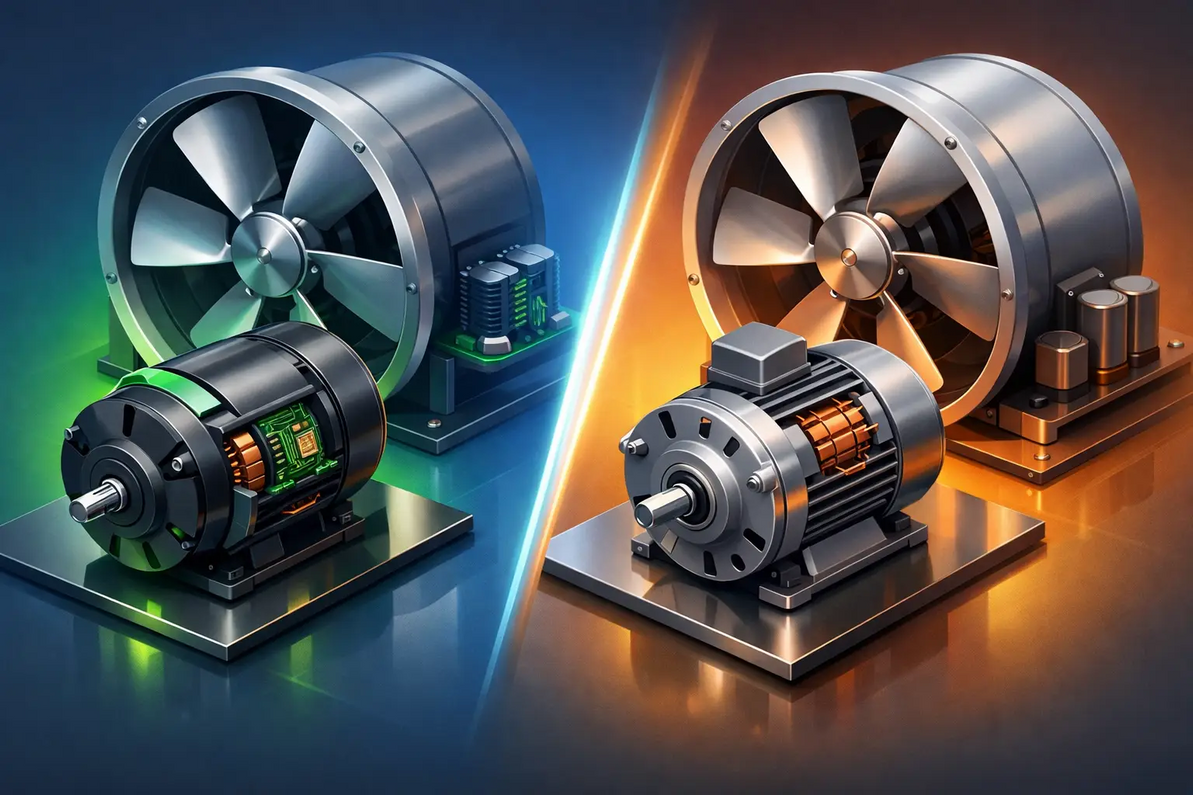
EC Motor Versus AC Motor for Ventilation Fans
A fan can have the correct blade diameter and still be the wrong ventilation solution if its motor does not match the operating profile. The EC motor versus AC motor decision affects more than electrical consumption. It affects controllability, noise, maintenance planning, startup behavior, control integration, and the ability to maintain required airflow as static pressure changes.
For a warehouse exhaust system running seasonally at one fixed speed, a conventional AC motor may be a practical and economical fit. For a greenhouse, cultivation room, data center, or continuously operating rooftop ventilator that must respond to changing temperature and pressure, an EC motor can justify its higher initial cost quickly. The right answer depends on the fan curve, hours of operation, control requirements, installation environment, and cost of poor airflow performance.
EC Motor Versus AC Motor: The Core Difference
An AC motor uses alternating current directly to create rotation. In ventilation equipment, common designs include permanent split capacitor (PSC), shaded-pole, split-phase, and three-phase induction motors. These motor types have served commercial, agricultural, and residential ventilation applications for decades because they are familiar, widely available, and generally straightforward to service.
An electronically commutated, or EC, motor is a brushless DC motor with integrated electronic controls. It receives AC power but internally converts and electronically commutates that power to drive the motor. The controller continuously manages the motor's operation, which gives EC fans precise speed control and substantially better part-load efficiency than many conventional single-phase AC fan motors.
The term ECM is often used interchangeably with EC motor. In practice, purchasers should review the cut sheet rather than rely on terminology alone. Confirm the motor input voltage, full-load wattage, speed-control method, environmental rating, maximum ambient temperature, and whether the controller is integral to the motor or requires an external device.
Efficiency Is Usually the Deciding Factor
Motor efficiency matters most when the fan runs for long periods or spends much of its life below full speed. EC motors are especially effective in variable-airflow applications because reducing speed reduces power demand dramatically. Under the fan laws, airflow changes approximately in direct proportion to fan speed, while power changes roughly with the cube of speed. A modest speed reduction can therefore produce a significant reduction in electrical demand.
That does not mean every EC fan automatically provides the lowest operating cost. Compare the complete fan assembly at the actual duty point, not just the motor label. A poorly selected EC fan operating against excessive static pressure can waste energy and fail to achieve required CFM. Conversely, a properly selected belt-drive or direct-drive AC fan can be a sound value where airflow demand is stable and runtime is limited.
For facilities with multiple exhaust fans, even small wattage differences add up. This is common in cultivation facilities, poultry and livestock barns, enclosed manufacturing areas, and equipment rooms where fans may run 12 to 24 hours per day. The annual energy calculation should use actual hours, anticipated speed settings, electricity rate, and the fan's watt draw at the expected static pressure.
Speed Control and Ventilation Performance
EC motors are built for controllability. Depending on the fan and control package, they can accept a 0-10 V signal, PWM signal, temperature sensor, pressure sensor, building automation command, or a simple variable-speed dial. This allows the ventilation system to react to heat load instead of operating at full capacity whenever it is switched on.
That is valuable when airflow demand moves throughout the day. A greenhouse may need low-speed air exchange on a cool morning and maximum exhaust during afternoon solar gain. A warehouse may need more exhaust during production shifts than during off-hours. A crypto mining or data center application may require fan response based on equipment load and intake or discharge temperature.
Traditional AC motors can also be speed controlled, but the method matters. PSC motors may work with approved voltage controllers, while three-phase induction motors are commonly controlled with a variable frequency drive (VFD). Not every AC motor can be safely operated with every speed controller. Incorrect control pairing can create motor overheating, hum, poor starting torque, reduced bearing life, and premature failure.
An EC fan should likewise be matched to its intended controller. Do not assume a wall-mounted speed control designed for a PSC fan will operate an EC motor correctly. Review the manufacturer's wiring diagram and control requirements before ordering equipment.
Static Pressure Still Governs Airflow
Motor technology does not eliminate the need for proper ventilation design. The fan must overcome the total system resistance created by louvers, shutters, insect screens, light traps, ductwork, filters, dampers, coils, turns, and discharge conditions. That resistance is measured as static pressure, typically inches of water gauge.
An open-wall agricultural exhaust fan may operate at very low static pressure. Add a restrictive light trap or a bank of dirty filters, and the actual operating point moves on the fan curve. Airflow falls unless the fan has adequate pressure capability. This is a frequent issue in cannabis cultivation, process ventilation, and make-up air systems where accessory pressure losses are underestimated.
EC controls can help maintain performance in some fan designs by increasing motor speed as resistance rises. But there are limits. If a fan is undersized for the required static pressure, electronics cannot create a proper fan curve. Select the fan based on required CFM at the calculated design static pressure, then evaluate the motor and control package.
Where AC Motors Still Make Sense
AC motors remain a strong choice in many ventilation projects. Their purchase price is typically lower, replacement parts are familiar to local service personnel, and many models are well suited to fixed-speed operation. In a simple application with a reliable on-off control, low annual runtime, and modest energy costs, the payback for EC equipment may be slow.
AC equipment can also be preferable where the project requires a specific motor configuration, a particular voltage, or easy field service with standard components. Three-phase motors paired with correctly sized VFDs provide excellent control range in larger commercial and industrial fan systems. They are not obsolete technology. They are a proven solution when selected and commissioned correctly.
The trade-off is that a VFD, motor, and external controls can add panel space, programming needs, and installation complexity. For smaller variable-speed fans, an integrated EC solution may offer a cleaner package.
Where EC Motors Earn Their Cost
EC motors are often the better investment when continuous operation, variable demand, and low-speed operation are central to the application. They are well suited for electronically controlled inline fans, mixed-flow duct fans, variable-speed exhaust systems, high-efficiency air handlers, and specialty rooftop ventilation.
They can also reduce noise in occupied or sensitive areas because lower fan speed generally means lower sound levels. In residential whole-house ventilation, office applications, grow rooms, and climate-controlled production spaces, that operating flexibility can be as valuable as energy savings.
A specialized example is a hybrid rooftop ventilator designed to operate with both wind assistance and an EC brushless DC motor. In suitable conditions, wind can provide non-powered extraction; when natural ventilation is insufficient, the EC motor maintains controlled airflow. This approach is different from a solar-powered fan and should be evaluated based on building pressure, roof location, weather exposure, and required continuous ventilation rate.
Specify the Motor as Part of the System
Before choosing an EC or AC motor fan, establish the required airflow, design static pressure, voltage, available controls, operating temperature, duty cycle, and target sound level. Identify whether the fan must coordinate with make-up air equipment, dampers, fire systems, dehumidification, or building automation.
Also account for the installation environment. Agricultural, washdown, corrosive, high-dust, high-heat, and hazardous locations may require specific enclosures, coatings, bearings, or motor certifications. An efficient motor is not a good investment if its electronics are exposed to conditions outside their rated limits.
The most useful comparison is not EC versus AC in isolation. It is the cost and performance of the complete ventilation system over its expected service life. A fan selection should show CFM at static pressure, brake horsepower or wattage, motor type, controls, sound data when applicable, and installation requirements.
A short review of the fan curve, pressure losses, and operating schedule can prevent years of excess energy use and inadequate airflow.
Factory Fans Direct - Commercial & Industrial Ventilation & Cooling Experts | Contact Mike Miller VP Engineering at Factory Fans Direct for a FREE Project Evaluation 888-849-1233 | Mike@FactoryFansDirect.com
Recent Posts
-

Smart Buildings Architects Recommend Edmonds ecoPOWER Hybrid Ventilation
A rooftop ventilator should not force an all-or-nothing energy decision. Smart Buildings Architects …7th Sep 2026 -
Smart Industrial Buildings Use Edmonds ecoPOWER Hybrid Ventilation
A roof exhaust system can be the difference between a plant that controls heat at the source and one …7th Sep 2026 -
Smart Commercial Buildings Use Edmonds Hybrid Ventilation
A rooftop exhaust fan that only performs when the wind blows is not a complete ventilation strategy. …7th Sep 2026