Do VFDs Save Energy? The Fan System Answer
A 100-horsepower exhaust fan running flat out to handle a few hours of peak heat is one of the most common energy penalties in industrial ventilation. The question, do VFDs save energy, has a clear answer: yes, often dramatically - but only when the fan, motor, controls, and actual ventilation demand are matched correctly.
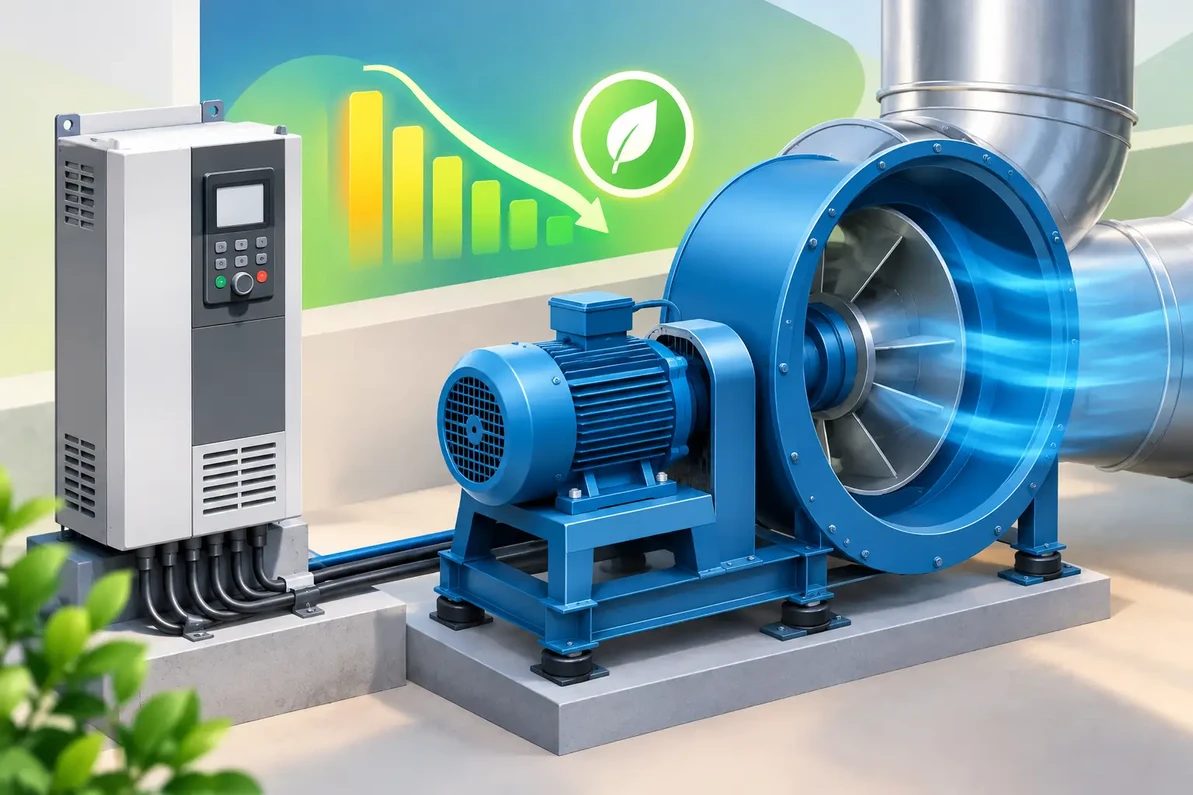
A variable frequency drive, or VFD, changes the frequency supplied to an AC motor so the motor and fan can run at less than full speed. For warehouses, manufacturing plants, agricultural buildings, greenhouses, cannabis cultivation rooms, data centers, and crypto mining operations, that capability can turn a fixed-speed ventilation system into a demand-based system. The savings are real, but a VFD is not a magic box that makes an undersized, poorly selected, or improperly controlled fan efficient.
Do VFDs Save Energy on Fan Systems?
They can save substantial energy because centrifugal fans follow the fan affinity laws. As fan speed changes, airflow changes roughly in direct proportion to speed. Static pressure changes by the square of speed. Fan power changes by the cube of speed.
That cubic relationship is where the opportunity sits. If a fan can be reduced from 100% speed to 80% speed, the theoretical power requirement drops to about 51% of full-speed power. At 70% speed, the theoretical fan power is about 34% of full power. A moderate reduction in speed can therefore produce a much larger reduction in kW demand.
Consider a 20-horsepower centrifugal exhaust fan that would otherwise run at full speed for 16 hours per day. If the building only needs 80% of design airflow during much of that period, a properly controlled VFD may cut fan energy nearly in half during those hours. The actual result will depend on brake horsepower, belt losses, motor efficiency, static pressure, drive losses, and the control sequence, but the principle remains strong.
This is why VFDs are especially effective on systems with variable airflow requirements. Heat load, occupancy, outside temperature, process operation, humidity, and equipment runtime are rarely constant. Fixed-speed fans treat every operating hour as a peak-load hour. A VFD allows the system to respond to what the facility actually needs.
Where VFD Energy Savings Are Strongest
The best VFD candidates are generally centrifugal fans operating for long hours with a meaningful range between minimum and peak airflow demand. Roof exhaust fans, ducted supply fans, make-up air systems, plenum fans, air handlers, cooling-tower fans, and many process-exhaust systems fit this profile.
A warehouse may require full exhaust capacity during afternoon heat buildup, loading activity, or a high-occupancy event, but need far less airflow overnight. A greenhouse may require staged ventilation based on temperature, humidity, solar load, and crop conditions. A manufacturing facility may see major shifts in heat and contaminant load as production lines cycle. In each case, reducing speed instead of cycling a large fan on and off can improve both energy performance and environmental stability.
For data center and crypto mining ventilation, VFD control can be valuable when it follows measured inlet temperature, hot-aisle temperature, container temperature, differential pressure, or equipment load. The goal is not simply to run fans slower. The goal is to maintain the required equipment operating envelope with the least fan power possible.
A VFD can also reduce startup stress. Instead of applying full voltage and full torque instantly, the drive ramps the motor to speed. That can reduce inrush current, mechanical shock, belt slip, and stress on shafts, bearings, and dampers. Those benefits do not always appear as a direct utility-bill reduction, but they can improve system life and maintenance planning.
The Fan Affinity Laws Have Limits
The fan affinity laws are a useful design tool, not a substitute for a field evaluation. They apply most cleanly to centrifugal fans moving through similar system conditions. Real installations introduce variables that change the outcome.
Dirty filters, restrictive louvers, backdraft dampers, undersized ductwork, clogged shutters, and poor discharge locations increase static pressure. If a fan must run faster than expected to overcome these losses, expected savings shrink. Belt-driven fans add another consideration: belt condition and pulley alignment affect delivered airflow and energy use.
Fan type matters as well. Axial fans do not always produce the same predictable cube-law savings as centrifugal fans, particularly when operating against changing static pressure. Many agricultural, wall-mounted, and high-volume axial fans can still benefit from speed control, but the fan curve, motor compatibility, blade design, and shutter performance must be reviewed.
Do not assume a VFD should run every fan down to the lowest possible frequency. At very low speed, airflow patterns may collapse, motor cooling can become inadequate on certain motor types, dampers may not open reliably, and the system may fail to maintain pressure control or contaminant capture. In a process exhaust application, that is a production and safety concern, not merely an efficiency concern.
Controls Determine Whether the VFD Actually Saves
A VFD without a meaningful control signal may simply create a more expensive manual speed switch. To generate measurable savings, the drive needs to respond to the operating condition that truly represents ventilation demand.
For general heat removal, that may be a temperature sensor placed in the occupied or equipment zone rather than near the roof deck. For a greenhouse, it may be a coordinated temperature and humidity strategy. For a dust or fume exhaust system, maintaining duct static pressure or capture velocity may be more appropriate. For make-up air, supply airflow must be coordinated with exhaust airflow so the building does not become excessively negative or positive.
Static-pressure reset is often one of the most productive control strategies in ducted systems. Rather than holding a high static-pressure setpoint at all times, the building automation system adjusts the setpoint as dampers and zones change. The fan then runs only as fast as necessary to serve the most demanding active zone.
For facilities using AI-enabled monitoring and controls, trend data can expose operating hours when full fan speed adds no measurable thermal or process benefit. However, automation should support engineering judgment, not replace it. Sensor placement, calibration, minimum airflow limits, alarm logic, and manual override capability still matter.
VFDs Versus EC Motors and Hybrid Ventilation
A VFD is not the only path to variable airflow. Electronically commutated, or EC, motors use integrated electronic controls and are highly efficient across a broad operating range. For smaller direct-drive fans, EC motor equipment can be an excellent option because it combines motor efficiency and speed control in a compact package.
For larger belt-drive or three-phase fan systems, a VFD paired with an appropriately selected inverter-duty motor is often the more practical solution. The correct choice depends on motor horsepower, available voltage, environmental conditions, control requirements, service access, and the expected operating profile.
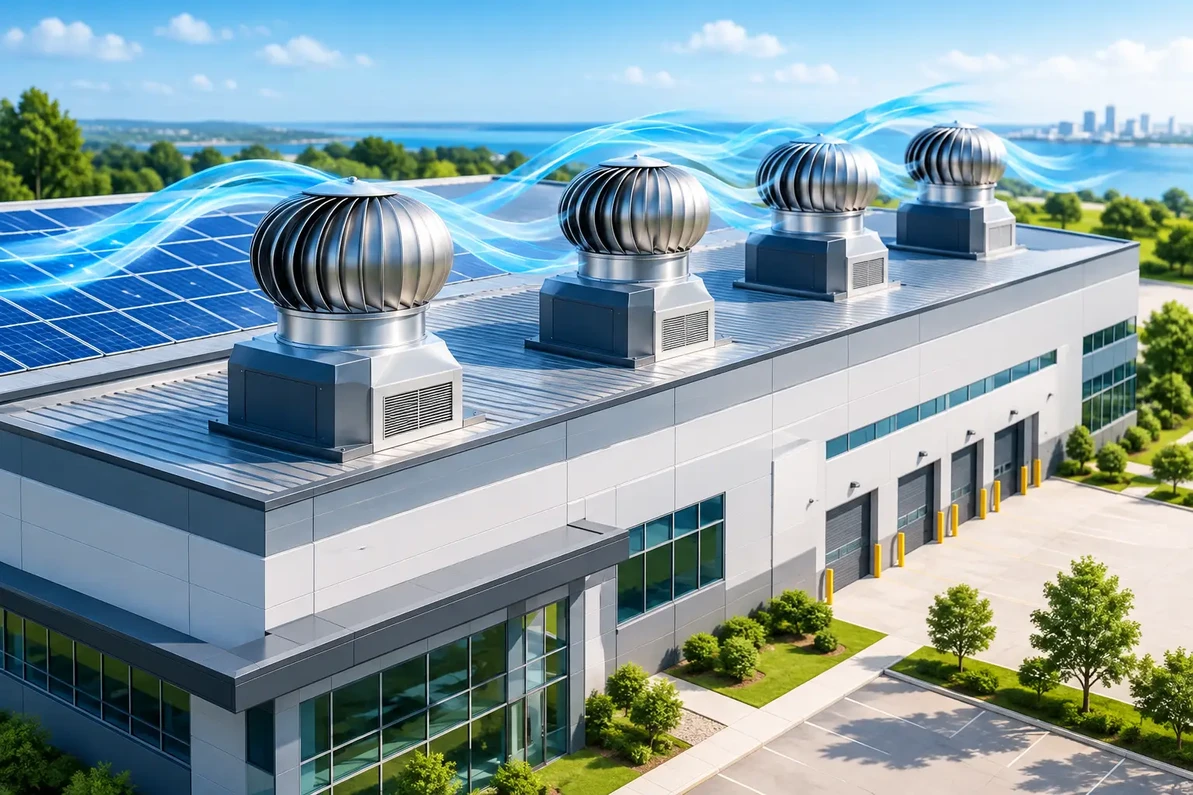
Hybrid ventilation adds another option for applications that can use natural driving forces. Edmonds ecoPOWER Hybrid rooftop ventilators combine wind-assisted operation with a high-performance EC brushless DC motor for continuous powered operation when conditions require it. They are not solar-powered units. Their value comes from using wind operation when available while retaining controlled mechanical ventilation capability, supporting energy-conscious and Net-Zero project goals.
Common VFD Mistakes That Erase Savings
The largest mistake is installing a drive before confirming that the fan is properly sized. An oversized fan throttled by dampers or operated against excessive static pressure may benefit from speed control, but the project should begin with airflow, static pressure, and brake horsepower verification.
Another mistake is overlooking motor and drive compatibility. Older motors may require insulation review, output filtering, or replacement when subjected to VFD switching frequencies. Long motor leads can create reflected-wave voltage stress. Outdoor and dirty industrial locations may require suitable NEMA enclosures, cooling provisions, and protection from moisture, dust, and corrosive contaminants.
Harmonics, electrical service capacity, bypass requirements, and emergency-operation sequences also deserve attention. In life-safety smoke control or critical process applications, the VFD control design must meet the applicable code, sequence, and authority requirements. Energy optimization cannot compromise required emergency airflow.
Finally, avoid setting a drive to one speed during commissioning and calling it variable control. Trend kW, fan speed, temperature, pressure, and runtime after startup. If the fan spends nearly every hour at 60 Hz, either the system genuinely needs full capacity or the control strategy needs correction.
How to Evaluate a VFD Project
Start with measured or documented design conditions: required CFM, external static pressure, fan curve, motor nameplate data, operating hours, utility rate, and the minimum versus peak ventilation requirement. A useful evaluation also considers whether airflow demand changes by season, shift, crop cycle, equipment load, or outdoor weather.
Then determine what signal should control speed and what minimum speed protects the process. A warehouse exhaust fan may use space temperature with a minimum ventilation setting. A cultivation room may require coordinated humidity control and pressure balance. A crypto mining site may need staged control tied to rack inlet temperatures and outside-air conditions.
The payback calculation should use measured kW where possible, not horsepower alone. Motor horsepower indicates maximum rated output, not actual input power at the current fan operating point. A clamp meter, power meter, VFD trend data, or commissioning test can establish a much more reliable baseline.
Factory Fans Direct provides commercial and industrial ventilation and cooling project evaluations for facilities that need fan selection, VFD sizing, airflow control, and heat-load guidance. Before purchasing a drive, verify the full system curve and control objective. The most valuable energy savings come from delivering exactly the airflow the building needs - no more, no less.
Factory Fans Direct - Commercial & Industrial Ventilation & Cooling Experts | Contact Mike Miller VP Engineering at Factory Fans Direct for a FREE Project Evaluation 888-849-1233 | Mike@FactoryFansDirect.com
Recent Posts
-

The BLUE WAVE Supports Commercial & Industrial ecoPOWER Hybrid Turbine Ventilation
A hot production floor, warehouse, or agricultural building rarely has one ventilation problem. Heat …8th Nov 2026 -
AI Smart ecoPOWER Hybrid Turbine Ventilation for LEED Projects
A LEED ventilation strategy cannot be built around a brochure claim or a fan wattage number alone. A …8th Nov 2026 -
AI LEED Projects Specify ecoPOWER Hybrid Ventilation
A rooftop exhaust strategy can make or break a net-zero model long before a building opens. When AI …8th Nov 2026