
Do Solar Attic Fans Really Work? Engineering Answer
A roof-mounted solar attic fan can be spinning hard at 2:00 p.m. while the attic remains hot, the upstairs rooms remain uncomfortable, and the homeowner sees little change in utility costs. That does not automatically mean the fan failed. It usually means the ventilation system was evaluated as a single product instead of as an airflow design. So, do solar attic fans really work? Yes, when the attic has adequate intake ventilation, the fan is properly matched to the space, and the home’s ceiling plane is air-sealed. No, they are not a universal cure for heat, humidity, ice dams, or high cooling bills.
What a Solar Attic Fan Is Designed to Do
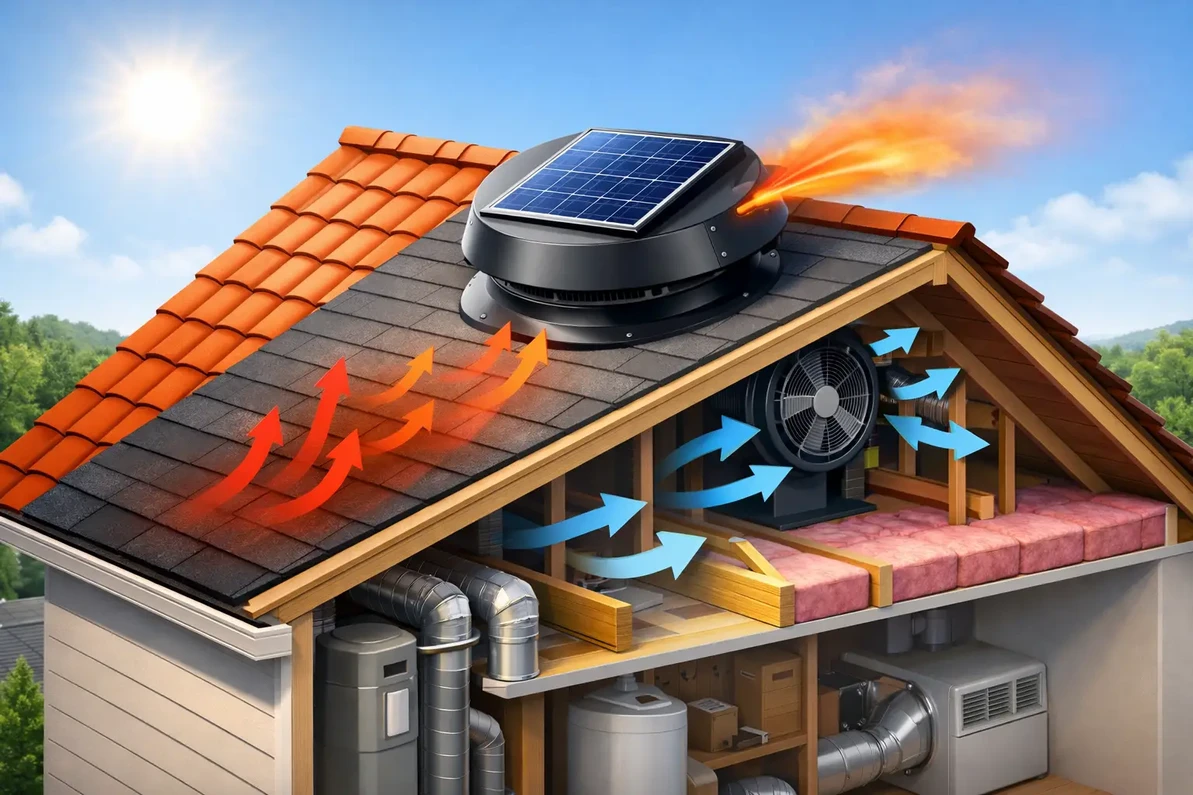
A solar attic fan uses a photovoltaic panel to power a DC motor that exhausts hot attic air. As solar intensity rises, the panel produces more power and the fan generally runs faster. The fan pulls hot air from the attic and discharges it outside through a roof- or gable-mounted housing. Replacement air must then enter through soffit vents or other low-level intake openings.
That operating sequence matters. An attic exhaust fan does not create ventilation by itself. It creates negative pressure in the attic. If the attic does not have enough dedicated intake area, the fan will pull replacement air through the easiest available path. That can be outside air through random roof openings, but it can also be conditioned air from the house through recessed lights, attic hatches, plumbing penetrations, duct chases, and ceiling leaks.
In a well-designed attic, the fan can reduce peak attic temperature, help move moisture, and reduce heat exposure on ducts and mechanical equipment located above the ceiling. In a poorly sealed or poorly vented attic, it may produce less benefit than expected and can create comfort or energy penalties.
Do Solar Attic Fans Really Work in Hot Climates?
They can be effective in hot, sunny locations because their operating profile follows the primary heat load. When the roof receives maximum solar gain, the panel receives maximum sunlight and the fan operates at its highest output. That makes solar ventilation a practical option for garages, workshops, sheds, barns, and residential attics where electrical access is difficult or where the owner wants to avoid adding branch-circuit power.
The key performance benefit is reduced attic air temperature during peak sun. A cooler attic can lower the temperature surrounding ductwork, insulation, and air handlers. It can also reduce thermal stress on roofing materials. But expectations need to be realistic: the attic fan does not directly cool living space. Ceiling insulation level, duct leakage, attic bypasses, window gain, and air conditioning capacity usually have a larger effect on indoor comfort and energy consumption.
A solar attic fan is most likely to deliver a noticeable improvement when the attic is unusually hot, ducts are located in the attic, the roof has strong sun exposure, and the attic already has a viable path for outdoor makeup air. It is less likely to make a major difference in a tightly built, deeply insulated home with well-sealed ducts and good passive ridge-and-soffit ventilation.
The nighttime limitation
Solar-only fans do not run after sunset and may operate at reduced speed during cloudy weather, smoke events, or shade from trees and neighboring structures. That is not necessarily a defect. Attic heat gain is usually highest when solar radiation is strongest.
However, a solar-only fan may not meet the needs of an attic with moisture concerns, heat-generating equipment, or an application requiring controlled ventilation independent of sunlight. In those cases, an AC-powered, hybrid, or thermostatically controlled system may be a better engineering choice.
Airflow Is Only One Part of the Design
Fan advertisements often emphasize CFM, but stated CFM alone is not enough to select attic ventilation equipment. The useful question is how much airflow the fan can deliver against the actual resistance of the installation, while the attic receives sufficient intake air.
A fan with a high free-air CFM rating may underperform if its roof cap, insect screen, backdraft damper, duct connection, or available intake creates excessive static pressure. Solar fan output can also vary with panel wattage, panel orientation, controller design, motor efficiency, and solar conditions. Look for product cut sheets that identify motor type, rated airflow, solar panel capacity, roof opening requirements, and any thermostat or humidistat controls.
Intake ventilation is equally important. Soffit vents are often the preferred intake location because they introduce outside air low in the attic, allowing it to travel upward through the space before exiting at the roof or gable. If insulation blocks the soffit openings, if baffles are missing, or if the vented area is insufficient, the exhaust fan cannot perform as intended.
A practical inspection should verify that soffit intake is open, continuous where possible, and protected from insulation blockage. It should also check whether existing ridge vents, gable vents, and powered exhaust are competing with one another. Combining several exhaust paths without a plan can short-circuit airflow, with replacement air entering through the nearest high-level opening rather than sweeping heat from the lower attic area.
The Biggest Risk: Pulling Air From the House
The most important caution with powered attic ventilation is house-to-attic leakage. If a ceiling plane is leaky, a powered fan can draw cooled indoor air into the attic during summer. That is the opposite of what the homeowner wants. It may also pull humid indoor air into the attic in certain climates and seasons.
Before adding any powered attic fan, address major air leaks at attic access doors, recessed fixtures not rated for insulation contact, top plates, wiring penetrations, bath fan housings, plumbing stacks, and open wall cavities. Bath fans and kitchen exhaust should terminate outdoors, never into the attic.
This is why an attic ventilation recommendation should not be based only on attic square footage. A quick field evaluation should consider insulation depth, duct condition, roof configuration, soffit vent area, existing exhaust openings, shade exposure, ceiling leakage, and local climate. A fan can be correctly installed and still be the wrong solution for the building.
When Passive Ventilation May Be Better
A balanced passive system using soffit intake and ridge exhaust has no electrical components, operates quietly, and continues to work whenever wind and buoyancy conditions support airflow. For many residential attics, it is the simplest and most durable starting point.
Passive ventilation may be the better choice when the attic is already well designed, the roof has continuous ridge venting, adequate soffit intake exists, and the goal is standard code-compliant moisture and heat relief rather than aggressive peak-temperature reduction. It also avoids the risk of a powered fan depressurizing the attic if the ceiling air barrier is not yet corrected.
Solar attic fans make more sense when passive ventilation is limited by roof geometry, a large attic has persistent heat buildup, electrical power is impractical, or the application is a detached structure such as a garage, outbuilding, livestock shelter, or workshop. Each case depends on the available intake path and the actual heat load.
Solar Attic Fan Selection Questions
Before selecting a unit, confirm the attic floor area and roof configuration, then evaluate the available intake and exhaust openings. Verify that the proposed fan location receives unobstructed solar exposure for the hours when attic temperatures peak. A panel placed on a shaded roof plane will not provide the expected airflow.
Also consider serviceability. The fan should have a weather-resistant housing, quality flashing, a corrosion-resistant screen, and a motor designed for high-temperature attic duty. Brushless DC motors are commonly preferred for efficiency and long service life. If controls are included, confirm whether the thermostat, humidistat, or fire-safety shutdown function is appropriate for the application.
Do not select solely by the largest CFM claim. An oversized powered fan connected to inadequate intake can create more negative pressure without creating better attic airflow. Proper matching is the objective.
A Better Way to Solve an Overheated Attic
Start with the building envelope. Air-seal the ceiling plane, verify insulation levels, repair disconnected or leaking ducts, and make sure bath exhaust is routed outdoors. Next, inspect soffit intake and existing ridge or gable exhaust. Only then determine whether a solar attic fan will add useful airflow.
For homes with severe upstairs heat, consider whether the actual issue is attic ventilation, undersized air conditioning, inadequate return air, duct leakage, solar gain through windows, or insufficient insulation. An attic fan can be part of the solution, but it should not be asked to correct every comfort problem in the house.
Factory Fans Direct provides ventilation design guidance for homeowners who need more than a generic fan recommendation. A proper evaluation can identify whether solar attic ventilation, balanced passive venting, a powered gable fan, or a whole house fan is the better fit for the building and climate.
Factory Fans Direct - Whole House Fans Experts | Contact Mike Miller at Factory Fans Direct for a FREE Home Evaluation 888-849-1233 and a $50 discount Coupon and Live Support on the Centric Air Whole House Fans.
Recent Posts
-

Smart Buildings Architects Recommend Edmonds ecoPOWER Hybrid Ventilation
A rooftop ventilator should not force an all-or-nothing energy decision. Smart Buildings Architects …7th Sep 2026 -
Smart Industrial Buildings Use Edmonds ecoPOWER Hybrid Ventilation
A roof exhaust system can be the difference between a plant that controls heat at the source and one …7th Sep 2026 -
Smart Commercial Buildings Use Edmonds Hybrid Ventilation
A rooftop exhaust fan that only performs when the wind blows is not a complete ventilation strategy. …7th Sep 2026