Data Center Cooling Guide for High-Density IT
A data center can have ample floor space and still overheat if the cooling path is wrong. Rack density, server fan demand, room pressure, outdoor conditions, and obstructions all determine whether heat leaves the facility or recirculates directly back into IT equipment. This Data Center Cooling Guide outlines the engineering questions that should be answered before selecting exhaust fans, make-up air equipment, containment, or liquid cooling.
Start With the Actual Heat Load
Nearly all electrical power consumed by servers, networking gear, UPS equipment, and mining hardware becomes heat. A 100 kW IT load produces approximately 341,200 BTU per hour of heat. If the load is expanding in phases, size the infrastructure around the realistic near-term load while confirming that ductwork, wall openings, electrical service, and controls can support the planned buildout.
Do not calculate cooling from square footage alone. A lightly loaded 2,000-square-foot room and a 2,000-square-foot high-density GPU or ASIC mining operation can have radically different cooling requirements. The useful starting point is total kW, expected rack density, equipment inlet temperature limits, and the maximum acceptable temperature rise through the room.
For air-based heat removal, the basic airflow relationship is:
CFM = BTU/hr ÷ (1.08 × allowable temperature rise in °F)
For example, removing 100 kW of heat with a 15°F air temperature rise requires roughly 21,000 CFM. That number is only a starting point. Fan performance must then be checked against the system's static pressure, including louvers, filters, screens, duct transitions, dampers, light traps, and discharge restrictions.
Airflow Direction Matters More Than Fan Count
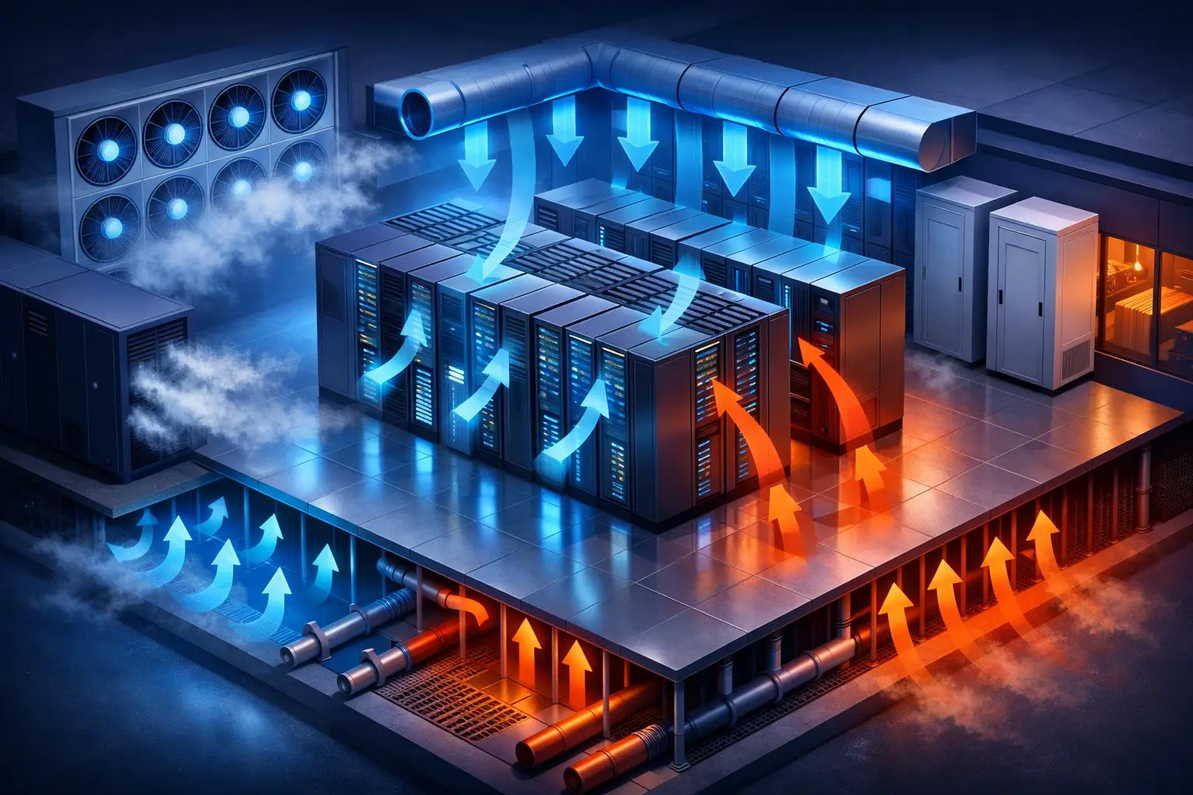
Adding more fans does not automatically fix a hot room. The goal is to create a controlled path from the cool-air source, through the equipment, and out of the hot-air discharge zone. When supply air bypasses the server inlets or exhaust air folds back into the intake side, the facility pays for airflow without receiving useful cooling.
In a conventional rack layout, cold-aisle and hot-aisle separation should be maintained as completely as practical. Blank panels, sealed cable openings, brush grommets, end-of-row doors, and overhead or chimney returns reduce bypass and recirculation. These details often improve inlet temperatures before a larger cooling unit is required.
For crypto mining operations, equipment orientation is equally critical. ASIC exhaust should be directed into a hot-side plenum or contained exhaust path, not discharged into the same open room that feeds the machine intakes. High-temperature exhaust fans can be effective for this application, but only when replacement air has a defined path into the building.
The Data Center Cooling Guide to Make-Up Air and Pressure
Every exhaust system needs make-up air. A 20,000 CFM exhaust fan pulling against undersized intake louvers will not deliver its published airflow. Instead, static pressure rises, fan amperage and noise can increase, doors become difficult to open, and uncontrolled air enters through cracks, loading the facility with dust, humidity, or hot outdoor air.
Make-up air openings should be sized for low face velocity and matched to the fan's operating point. In dusty industrial areas, filtration may be necessary, but filters add pressure drop and require a maintenance plan. In humid climates, introducing large volumes of untreated outdoor air can create moisture risk, especially during low-load periods or when equipment cycles down.
Economizer-style ventilation can reduce mechanical cooling hours in favorable climates. It is not a universal answer. Outdoor temperature, dew point, airborne contaminants, smoke exposure, corrosion risk, and filtration requirements determine whether direct outside-air cooling is appropriate.
Choose Cooling Equipment Around Density and Failure Risk
Traditional computer room air conditioners and air handlers remain practical for many facilities with moderate rack densities and strict temperature and humidity requirements. Their limitations become more apparent as rack loads climb, because air has limited heat-carrying capacity and distribution losses grow quickly.
Higher-density deployments may need a hybrid approach: room cooling for background load, containment to prevent recirculation, and targeted liquid cooling for the highest-load racks. Rear-door heat exchangers and direct-to-chip liquid systems remove heat close to the source, reducing the volume of hot air released into the room. Immersion cooling can support very high densities, including specialized computing and mining applications, but it changes maintenance procedures, equipment compatibility, fluid management, and capital planning.
The right choice depends on the load profile. A facility with a steady 24/7 mining load has different priorities than an enterprise data center with variable workloads, redundancy requirements, and sensitive network equipment. Avoid selecting equipment based only on a nameplate CFM or tonnage rating. Verify the rating at the actual static pressure, entering-air condition, altitude, and duty cycle.
Controls and Monitoring Protect the Design
Cooling capacity without controls is difficult to manage efficiently. Variable frequency drives can modulate fan speed as inlet temperatures or differential pressure change, reducing unnecessary energy use during partial loads. Temperature sensors should be placed at server inlets, hot aisles, equipment exhaust, and outdoor intake points, rather than relying on one wall-mounted thermostat.
Track fan status, filter differential pressure, room pressure, supply and return temperatures, and electrical demand. Trending these points identifies a fouled filter, failed fan, blocked louver, or expanding IT load before it becomes a shutdown event. For critical environments, design for maintenance access and define what happens if a fan, cooling unit, pump, or control component fails.
A cooling system should be engineered as a complete heat-removal path, not assembled as separate fans and air conditioners.
Factory Fans Direct - Crypto Mining & Data Center Cooling Experts Contact Mike Miller VP Engineering at Factory Fans Direct for a FREE Project Evaluation 888-849-1233 | Mike@FactoryFansDirect.com
Recent Posts
-

Smart Buildings Architects Recommend Edmonds ecoPOWER Hybrid Ventilation
A rooftop ventilator should not force an all-or-nothing energy decision. Smart Buildings Architects …7th Sep 2026 -
Smart Industrial Buildings Use Edmonds ecoPOWER Hybrid Ventilation
A roof exhaust system can be the difference between a plant that controls heat at the source and one …7th Sep 2026 -
Smart Commercial Buildings Use Edmonds Hybrid Ventilation
A rooftop exhaust fan that only performs when the wind blows is not a complete ventilation strategy. …7th Sep 2026