
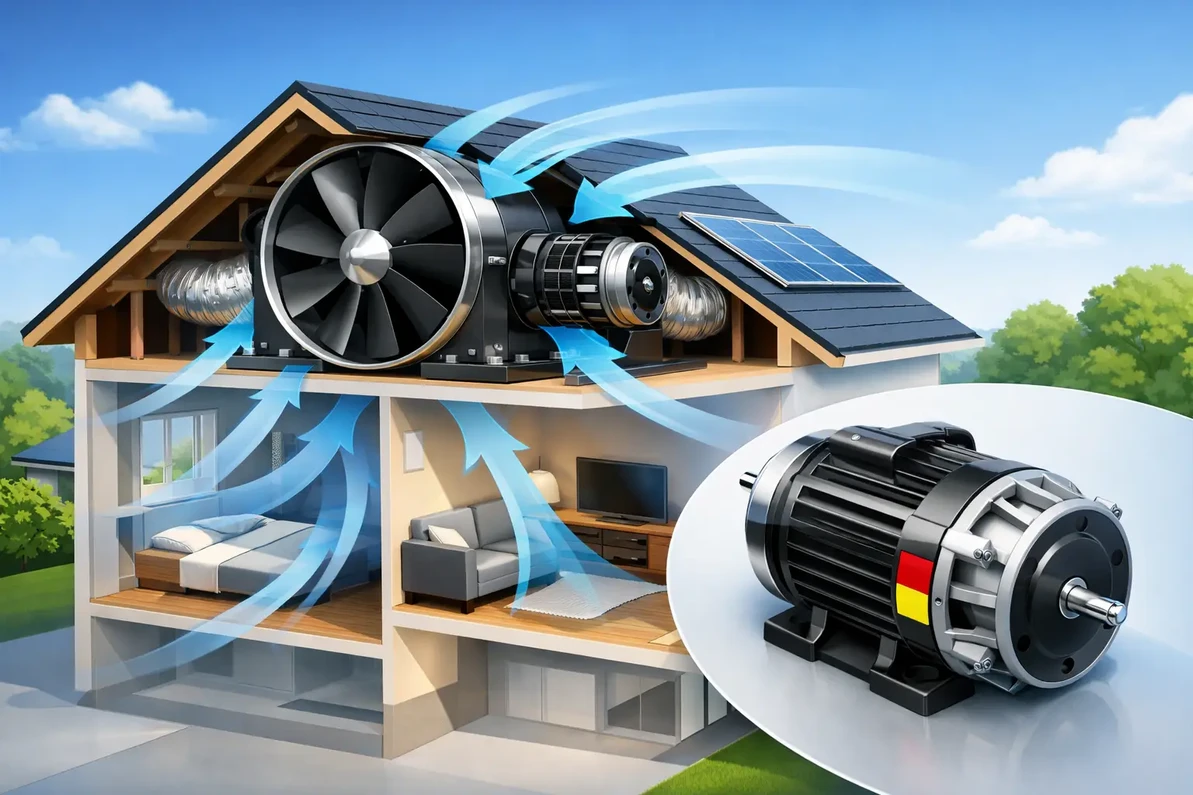
Centric Air Whole House Fans with German Motor
A whole house fan is only as good as the motor driving it, the attic path carrying the air, and the open-window area supplying it. Centric Air whole house fans with German motor technology are built for homeowners who want serious nighttime cooling performance without treating fan selection as a guesswork purchase. When outdoor air is cooler than indoor air, a properly sized system can replace stale, heated indoor air quickly while pulling fresh air through occupied rooms.
The appeal is straightforward: move a high volume of air at lower operating cost than compressor-based cooling during suitable weather. The engineering is less simple. Fan CFM, motor efficiency, acoustics, attic exhaust capacity, grille location, and controls all affect whether the system feels powerful and quiet or becomes an underperforming attic project.
What a German Motor Means in a Centric Air Whole House Fan
The phrase “German motor” is often used to describe the premium motor technology associated with Centric Air whole house fan systems. Buyers should look beyond the label and evaluate the actual motor type, electrical requirements, speed control, rated airflow, watts, sound data, and warranty details shown on the applicable product cut sheet.
Motor quality matters because the fan may operate for hours during spring, summer, and fall evenings. A well-designed, efficient motor supports high airflow with controlled energy draw and dependable operation. It also contributes to the quiet character homeowners expect from a premium whole house fan package.
That does not mean motor origin alone determines performance. A fan with an excellent motor can still disappoint if it is undersized for the home, installed with restricted ducting, or exhausting into an attic that cannot release the air volume. The system must be evaluated as an airflow package.
The Cooling Principle: Use the Night Air, Not the Compressor
A whole house fan works when the outside air is cooler than the indoor air. Homeowners open selected windows, turn on the fan, and allow the system to draw cool outdoor air through the living space. The fan then pushes the warmer indoor air into the attic, where it must leave through properly sized roof, ridge, gable, or other approved attic vents.
This process creates a noticeable indoor breeze and can cool building materials that absorbed heat during the day. Walls, floors, furniture, and attic framing retain heat long after sunset. Moving cooler air through the home helps reduce that stored heat load before the next day begins.
The best operating window varies by climate. Dry regions with large day-to-night temperature swings are often excellent candidates. Many mixed-climate and northern locations also benefit during shoulder seasons and cooler summer nights. In hot, humid conditions, the temperature may be favorable while humidity is not. Bringing in moist outdoor air can reduce comfort and increase indoor moisture load, so homeowners need to operate the fan based on actual outdoor conditions rather than temperature alone.
Size the Fan by CFM, Then Verify Attic Relief
Whole house fan sizing starts with home volume and cooling objectives. A common initial approach uses home square footage, ceiling height, and desired air changes per hour. But a simple square-foot rule is not sufficient for every project. Open floor plans, vaulted ceilings, multiple stories, closed bedrooms, long hallways, and high internal heat loads can change the required airflow and the way air travels through the home.
A fan that is too small may not create enough air movement to provide meaningful overnight cooling. A fan that is excessively large can create unnecessary noise, require more open-window area, and overwhelm inadequate attic venting. More CFM is not automatically better when the rest of the system cannot support it.
Attic ventilation is the critical calculation many installations miss. When a whole house fan moves thousands of cubic feet per minute into an attic, that same volume must have a low-resistance route outdoors. Restricted exhaust area creates backpressure. Backpressure can increase sound, reduce delivered airflow, add heat to the attic, and place the motor under less favorable operating conditions.
A project evaluation should review existing net free vent area, vent type, roof configuration, duct routing where applicable, and any obstructions such as insulation dams or stored materials. Standard passive attic ventilation designed only for summertime attic heat relief may not be adequate for a high-CFM whole house fan.
Window Area Also Affects Performance
The fan cannot pull air that the home will not allow in. Windows should be opened in the rooms where occupants want airflow, with enough total opening area to prevent excessive inlet velocity and whistling. Opening every window is not always necessary. In many homes, strategic window selection gives better airflow through bedrooms and common areas.
As a practical operating method, begin with windows in the most occupied rooms and adjust based on comfort. If bedroom doors are closed, the room needs an airflow path through an open window, transfer grille, or door undercut. A fan can be moving substantial CFM while a closed-off room remains warm.
Noise, Controls, and Installation Details Matter
Premium whole house fans are selected partly for quiet operation, but “quiet” depends on installation. Noise can come from motor operation, air movement at the ceiling grille, duct turbulence, vibration transmission, and attic backpressure. Proper mounting, correctly supported ducting, tight fasteners, and adequate attic relief all help preserve the system’s intended sound performance.
Controls should match how the home is used. Multi-speed control gives homeowners the ability to start at a higher airflow setting for rapid purge cooling, then reduce speed later for overnight comfort. Timers and temperature-based operating strategies can help prevent the fan from running after outdoor conditions have become unfavorable.
For homes with air conditioning, a whole house fan is usually a complement rather than a replacement. It can reduce reliance on AC during appropriate weather, but it should not be operated with windows closed or as a substitute for humidity control when outdoor dew points are high. Homeowners should also understand how fireplace dampers, combustion appliances, and naturally drafted equipment may be affected by house depressurization. Those conditions deserve a careful installation review.
When a Centric Air System Is a Strong Fit
Centric Air whole house fans are a strong option for homeowners who prioritize high airflow, energy-conscious operation, and a more engineered approach to whole-home ventilation. They can be particularly effective in homes where air conditioning runs late into the evening even though outdoor temperatures have dropped substantially.
They are not the right answer for every building. Homes in persistently humid climates may benefit more from efficient air conditioning, dehumidification, and targeted attic ventilation. Homes with limited attic access, complicated roof geometry, inadequate vent area, or combustion-safety concerns may require modifications before installation. A professional evaluation should identify those constraints before equipment is ordered.
The best purchase decision comes from matching the fan to the house, not from selecting a model solely by price or advertised CFM. Confirm the electrical circuit, ceiling opening requirements, attic access, venting capacity, available window area, and desired control method. Review the cut sheet and make sure the stated performance aligns with the actual installation conditions.
A whole house fan should make the home easier to cool at night, not create a new noise, moisture, or attic-ventilation problem. When the motor, fan capacity, inlet path, and attic exhaust are all matched, the result is direct: cooler rooms, stronger air movement, and fewer hours of compressor operation when the weather cooperates.
Factory Fans Direct - Whole House Fans Experts | Contact Mike Miller at Factory Fans Direct for a FREE Home Evaluation 888-849-1233 and a $50 discount Coupon and Live Support on the Centric Air Whole House Fans.
Recent Posts
-

Smart Buildings Architects Recommend Edmonds ecoPOWER Hybrid Ventilation
A rooftop ventilator should not force an all-or-nothing energy decision. Smart Buildings Architects …7th Sep 2026 -
Smart Industrial Buildings Use Edmonds ecoPOWER Hybrid Ventilation
A roof exhaust system can be the difference between a plant that controls heat at the source and one …7th Sep 2026 -
Smart Commercial Buildings Use Edmonds Hybrid Ventilation
A rooftop exhaust fan that only performs when the wind blows is not a complete ventilation strategy. …7th Sep 2026