Can an AI Hyperscale Facility Use Grid Power Only?
A single utility outage can cost an AI facility far more than lost compute time. Training runs can fail, clusters may require controlled restart sequences, and cooling equipment can lose the power needed to protect high-density GPU racks. The question, “Can an AI Hyperscale Facility rely on Grid Power only?”, is therefore not just about whether the utility can deliver megawatts. It is about whether the site can maintain power quality, cooling continuity, and operational availability under normal conditions and during grid events.
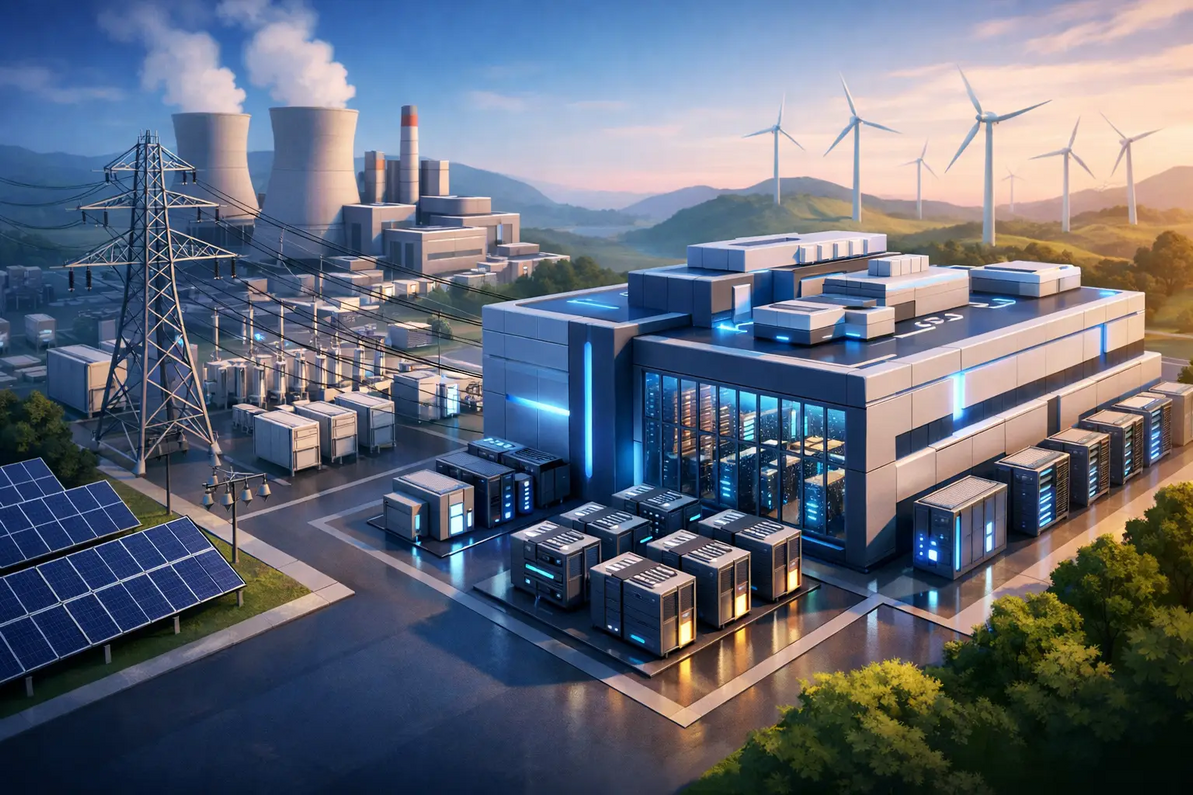
The short answer is yes, in limited circumstances. A hyperscale AI facility can use the grid as its only energy source, but it should not assume that one grid connection provides the reliability required for critical AI workloads. The correct design depends on the utility service configuration, available transmission capacity, local grid performance, compute density, cooling architecture, and the facility’s uptime commitment.
Grid-only power is possible, but not automatically resilient
A grid-only facility has no onsite engine generators, gas turbines, fuel cells, or other independent long-duration generation source. It may still use UPS systems and battery energy storage to ride through short interruptions and bridge transfers. That distinction matters. Batteries can provide seconds or minutes of support, while a true utility outage may last hours or longer.
For a noncritical warehouse, an outage may be a business interruption. For an AI hyperscale facility operating tens or hundreds of megawatts of GPU capacity, it can become an equipment-protection and thermal-management event. Servers do not simply stop drawing power. They also stop generating the airflow, liquid pumping, fan energy, and heat rejection needed to control temperatures.
A grid-only strategy can make sense when the facility has access to highly reliable utility infrastructure, such as two independent utility substations fed by separate transmission paths. It is more defensible when the AI workload can be interrupted, shifted to another region, or restarted without severe business consequences. It is much less appropriate for a site marketed as continuously available, mission-critical compute capacity.
Utility capacity is the first gating item
AI campuses are changing the power conversation. A conventional enterprise data center may have a substantial load, but large AI deployments can require 50 MW, 100 MW, or several hundred megawatts as GPU clusters expand. The utility must be able to provide that capacity on the schedule required, not merely identify it as a future planning possibility.
Facility planners should evaluate the firm capacity available at the point of interconnection, the timeline for substation and transmission upgrades, and whether the utility can support staged load growth. A site may initially receive 20 MW but require 100 MW within two years. That gap can determine whether the project is viable.
The quality of the service matters as much as its nameplate capacity. Engineering teams should request data on historical outages, voltage sags, switching events, fault-clearing performance, and feeder reliability. A large service entrance does not protect the facility from a single point of failure upstream.
For meaningful resilience, the preferred arrangement is separate utility feeds that do not share the same vulnerable equipment or transmission corridor. Two feeders originating from the same substation may provide operational flexibility, but they are not necessarily independent. The utility one-line diagram should be reviewed with the same discipline applied to the facility’s own electrical one-line.
AI loads create unusual power and cooling consequences
AI compute is not a static load. GPU clusters can ramp quickly as jobs start, model workloads change, or capacity is brought online. That behavior can create demand spikes, harmonic concerns, and cooling-load changes that affect both electrical and mechanical infrastructure.
A grid-only design must account for the total facility load, not just IT power. At high rack densities, cooling can represent a major electrical requirement. Liquid-cooled servers reduce some fan energy at the rack level, but they add pumps, coolant distribution units, heat exchangers, cooling towers, dry coolers, and water-treatment systems. Air-cooled GPU deployments can require substantial fan horsepower and high-volume containment airflow.
If utility power is interrupted, the mechanical system must have a defined response. Chilled-water pumps, condenser-water pumps, air handlers, ventilation fans, exhaust systems, controls, and make-up air equipment may all be needed to keep temperatures within safe limits during a controlled IT shutdown. This is why a power study cannot be separated from the cooling design.
For airside or hybrid-cooled data halls, ventilation design should be based on calculated heat load, required CFM, external static pressure, filtration losses, louver pressure drop, and fan operating curves. Simply adding large exhaust fans does not solve a high-density AI heat problem. Without properly sized make-up air and controlled airflow paths, the facility can pull unfiltered hot air through openings, create recirculation, or lose cooling effectiveness when it matters most.
What “grid only” should mean in the design review
Project teams often use the phrase grid only when they mean different things. Clarifying the operating definition early prevents expensive design changes later.
A facility may be grid-only for normal operation while retaining standby generators for outages. That is common. Another facility may use utility power plus battery storage, with no combustion-based backup. A third may have two utility feeds and no onsite backup at all. These are materially different resilience profiles.
The decision should start with an outage tolerance statement. How long can the IT load operate without utility power? Can workloads be shed automatically? Can critical control systems remain energized? What temperature rise is acceptable after chillers or ventilation fans stop? Can the facility restart safely after a full shutdown?
For some AI training environments, a controlled loss of compute may be acceptable if workloads are checkpointed and redirected to another campus. For inference environments supporting real-time services, even a short interruption may be unacceptable. The business case should drive the electrical architecture, not the other way around.
When grid-only power can be a practical choice
Grid-only power is most practical when the site has exceptional utility reliability, geographically distributed compute capacity, and a workload profile that supports interruption or rapid failover. It can also be viable where local emissions restrictions, fuel availability, permitting limitations, or corporate sustainability requirements make onsite generators difficult to justify.
Battery energy storage can improve the grid-only case by supporting short-duration ride-through, reducing peak demand, and allowing orderly shutdown. However, batteries should not be mistaken for unlimited outage protection. Their usable duration depends on the critical load, discharge rate, ambient temperature, inverter capacity, and operational reserve policy. Supporting an entire 100 MW campus for even a short period requires a very large and expensive storage system.
Demand response programs and curtailment agreements also require caution. An AI facility may be paid to reduce load during grid stress, but it needs an automated and tested plan for shedding noncritical compute before cooling, control power, fire and life safety systems, or essential network infrastructure are affected.
Where grid-only designs commonly fail
The most common failure is treating redundant-looking equipment as truly independent infrastructure. Two transformers, two switchboards, or two utility feeders do not provide full redundancy if they share the same upstream substation, protection scheme, fuel supply, floodplain, or transmission route.
Another failure is undersizing the cooling support load during an outage scenario. Designers may calculate normal operating cooling but overlook the power required for pumps, controls, minimum ventilation, and emergency heat rejection while compute is being ramped down. High-temperature AI racks can create a narrow response window.
A third issue is poor coordination between electrical and mechanical controls. The UPS may keep IT hardware energized, but a voltage event can still trip variable frequency drives, pump controls, cooling-tower controls, or ventilation equipment. Restart sequencing must be tested under realistic conditions, including partial utility loss and rapid load restoration.
Commissioning is where assumptions become measurable. The facility should test utility transfer logic, battery ride-through, load shedding, fan and pump restart behavior, alarm escalation, temperature response, and recovery procedures. A written resilience plan that has not been tested with actual heat load is not a resilience plan.
Design the power and airflow systems as one operating system
An AI hyperscale facility should not select utility architecture, rack density, and ventilation equipment as separate projects. Electrical capacity determines how much cooling can run. Cooling performance determines how much compute can safely operate. The control sequence connects the two.
For facilities using high-volume air movement, evaporative assistance, hot-aisle containment, exhaust plenums, or hybrid cooling strategies, fan selection must include motor type, VFD compatibility, pressure capability, redundancy, maintenance access, and emergency operating sequence. EC motors and properly applied variable-speed controls can help reduce energy use during normal operation, but they also must be evaluated for restart behavior and control stability after a power disturbance.
The best answer is not always generators, and it is not always grid only. It is a site-specific design that quantifies utility risk, electrical topology, thermal response, and acceptable downtime before equipment is ordered. Call the engineering team at Factory Fans Direct 888-849-1233 for a Free Project Evaluation.
Factory Fans Direct - Crypto Mining & Data Center Cooling Experts Contact Mike Miller VP Engineering at Factory Fans Direct for a FREE Project Evaluation 888-849-1233 | Mike@FactoryFansDirect.com
Recent Posts
-

Smart Buildings Architects Recommend Edmonds ecoPOWER Hybrid Ventilation
A rooftop ventilator should not force an all-or-nothing energy decision. Smart Buildings Architects …7th Sep 2026 -
Smart Industrial Buildings Use Edmonds ecoPOWER Hybrid Ventilation
A roof exhaust system can be the difference between a plant that controls heat at the source and one …7th Sep 2026 -
Smart Commercial Buildings Use Edmonds Hybrid Ventilation
A rooftop exhaust fan that only performs when the wind blows is not a complete ventilation strategy. …7th Sep 2026