Best Fans for Metal Buildings That Actually Work
A metal building can become an oven quickly. Solar gain through the roof and walls, process equipment, vehicles, livestock, or a packed work crew can push indoor temperatures far above outdoor conditions. The best fans for metal buildings are not simply the largest fans available. They are matched to the building's heat load, air volume, inlet area, static pressure, and how the space is actually used.
A 10,000-square-foot warehouse with open loading doors needs a different design than a fully enclosed fabrication shop, equipment storage building, riding arena, greenhouse headhouse, or agricultural structure. Fan selection starts with airflow engineering, not a catalog page.
Start With the Ventilation Problem
Before selecting fan diameter, horsepower, or motor type, identify what the system must accomplish. Exhaust ventilation removes hot, contaminated, humid, or dusty air and creates a slight negative pressure that pulls replacement air through planned intake openings. Circulation fans move air across people, products, animals, or equipment without necessarily changing the building's air.
Many metal buildings need both. A roof or wall exhaust system handles heat and air exchange, while HVLS fans, industrial ceiling fans, or directional circulation fans break up hot spots and improve perceived comfort at floor level. Installing circulation fans without adequate exhaust can merely move hot air around. Installing powerful exhaust fans without enough intake area can starve the fans and reduce delivered CFM.
For a warehouse with moderate heat, the design may be based on air changes per hour. For a welding, woodworking, chemical, or cultivation application, contaminant source control and filtration may drive the design. In a livestock building, moisture removal and animal-level air speed can be more important than a simple air-change target. The application determines the calculation.
Best Fans for Metal Buildings by Application
There is no single best fan type for every steel structure. The right equipment depends on the ventilation duty and installation location.
Wall-Mount Exhaust Fans for General Ventilation
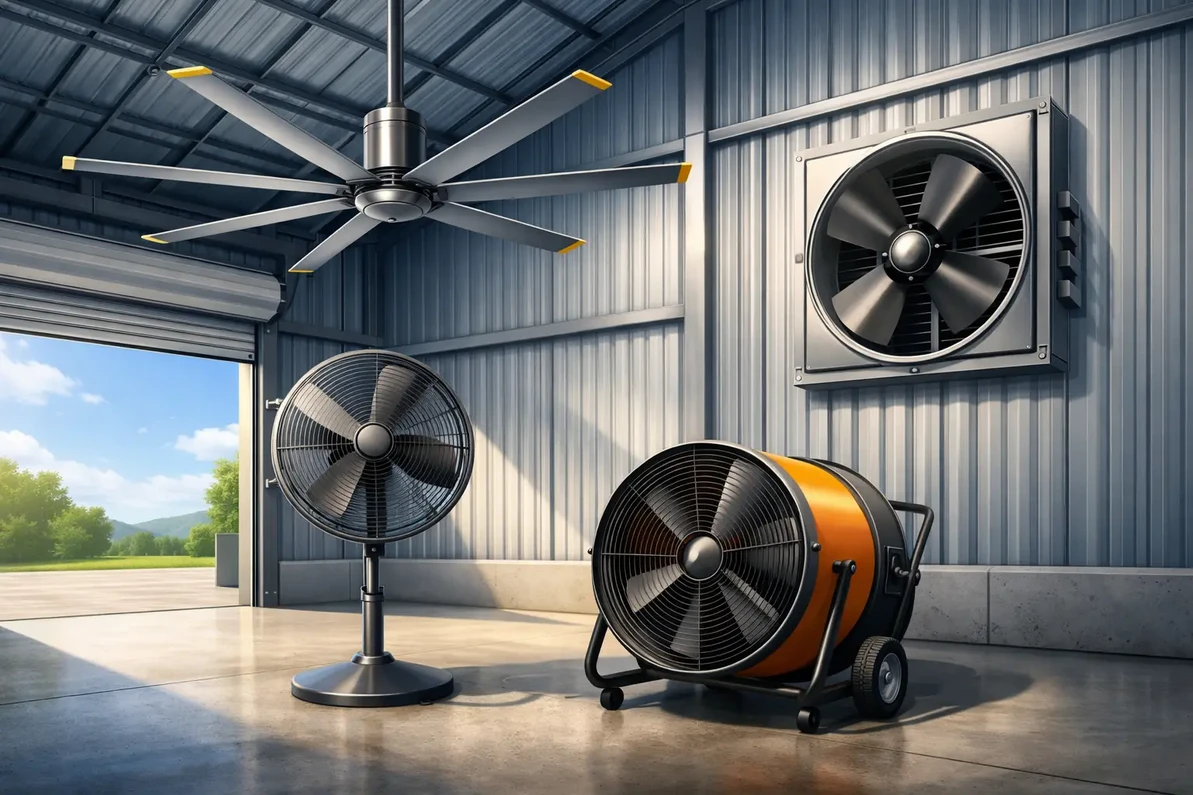
Shuttered wall exhaust fans are often the workhorse solution for metal workshops, barns, warehouses, garages, and light manufacturing spaces. They provide high airflow at practical installed cost and are available with belt-drive or direct-drive motors, single-phase or three-phase power, guards, shutters, and speed-control options.
Belt-drive exhaust fans are commonly chosen for larger capacities because the blade speed can be matched to the required duty point. They also allow service access to belts and bearings. Direct-drive models have fewer moving parts and can be a sensible choice for smaller buildings or intermittent operation. The trade-off is that direct-drive fans may offer less flexibility when a project needs a precise airflow and pressure match.
For exposed wall locations, specify corrosion-resistant components, weather hoods where appropriate, and shutters that close reliably when the fan is off. Loose or poorly sealed shutters create drafts, heat loss, and unwanted water entry.
Roof-Mount Exhaust Fans for Clear Wall Space
Roof exhaust fans are valuable when sidewalls are occupied by racking, equipment, property-line restrictions, or large doors. Upblast roof ventilators discharge air away from the roof surface and are frequently used where grease-laden or contaminated air must not be pulled back into the building. Centrifugal roof fans can also maintain performance when ductwork, filters, dampers, or louvers add static pressure.
Roof-mounted equipment must be selected with the roof curb, flashing, wind loading, access requirements, and structural capacity in mind. A fan that performs well on paper can become an expensive problem if it is installed on an undersized curb or placed where make-up air cannot reach the occupied zone.
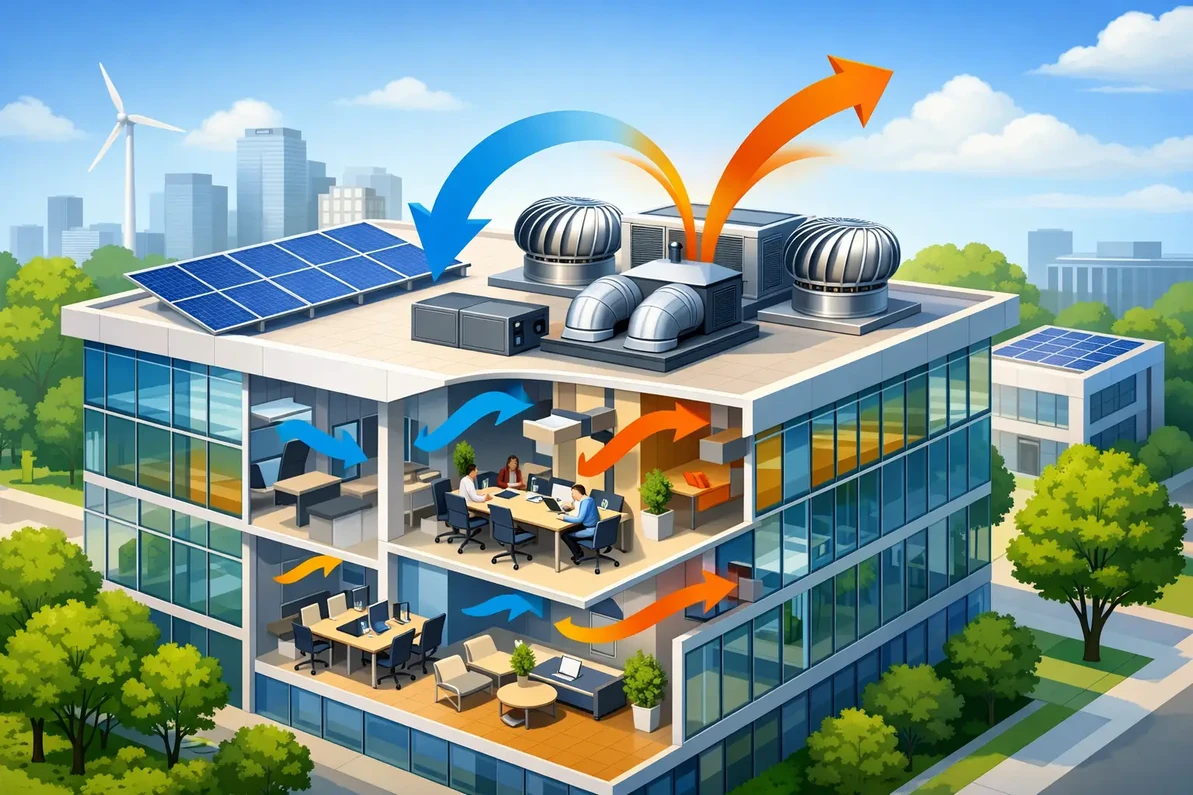
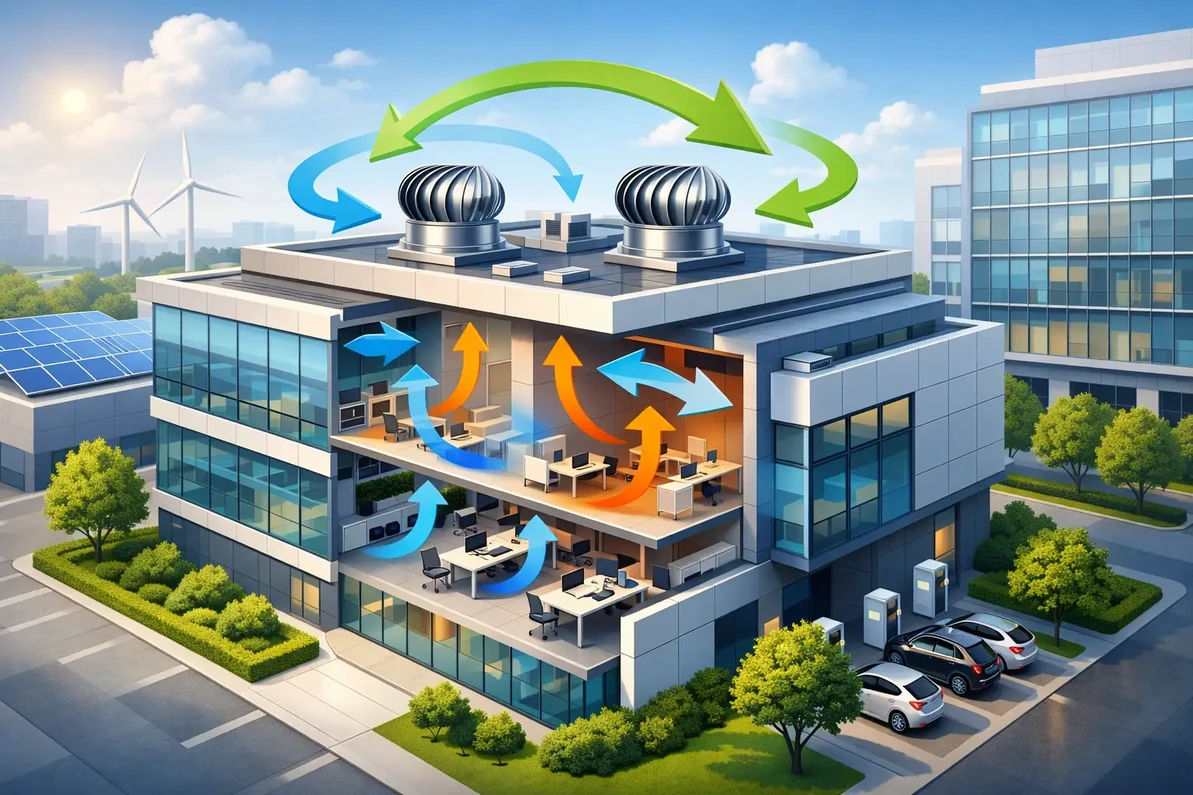
Hybrid rooftop ventilation can be a strong option for facilities pursuing lower operating energy. Edmonds ecoPOWER hybrid ventilators combine wind-driven operation with an EC brushless DC motor for continuous powered ventilation when natural wind conditions are not enough. They are true hybrid ventilators, not solar-powered fans, and should be evaluated based on building pressure, roof layout, and required airflow.
HVLS Fans for Air Movement and Destratification
High-volume, low-speed fans are designed to move large columns of air with low energy use. In metal warehouses, shops, gymnasiums, aircraft hangars, and agricultural buildings, they can reduce stagnant zones and push trapped ceiling heat downward during cooler months.
HVLS fans do not replace exhaust fans when the building needs air exchange. Their strength is circulation, destratification, and occupant comfort. They are especially effective in tall buildings with clear floor space, but blade clearance, sprinkler coordination, roof structure, and crane travel must be reviewed before installation.
High-Pressure Fans for Restricted Systems
When air must travel through ductwork, evaporative pads, filters, sound attenuators, louvers, or light traps, a standard propeller fan may not hold its advertised airflow. This is where static pressure becomes decisive. Tube axial, vane axial, centrifugal, and specialty high-pressure fans are selected from performance curves at the actual system resistance.
Do not size from free-air CFM alone. A fan rated at 20,000 CFM at 0 inches static pressure may deliver far less once it faces restrictive intake louvers and duct losses. Cut sheets and fan curves should be reviewed before equipment is released for production.
Size the System Around CFM and Intake Air
Airflow requirements are normally expressed in CFM. A simple starting point is building volume multiplied by desired air changes per hour, then divided by 60. A 100-foot by 50-foot building with a 16-foot average ceiling has 80,000 cubic feet of volume. At six air changes per hour, the starting airflow target is 8,000 CFM.
That is only a starting point. A building with high solar load, hot machinery, ovens, forklifts, people, or livestock may require substantially more airflow. Heat-load calculations can refine the design by accounting for the sensible heat being added to the space and the temperature rise the owner can accept.
Make-up air must support the exhaust capacity. As a practical rule, intake openings should be generous enough to keep inlet velocity reasonable and avoid excessive static pressure, noise, and drafts. Motorized louvers, wall louvers, ridge openings, open doors, or dedicated make-up air units can provide replacement air. In conditioned buildings, uncontrolled outdoor air may create a major cooling or heating penalty, so the solution may require tempered make-up air rather than simple passive louvers.
Fan placement matters as much as total CFM. Exhaust should pull air across the heat source or occupied area, not short-circuit directly from an intake located beside the fan. In a long metal building, distributing fans and inlets across zones is often more effective than putting all capacity at one end.
Specify for the Environment, Not Just the Airflow
Metal buildings often operate in tough conditions. Dust, fertilizer, moisture, washdown, welding fumes, chemicals, and temperature swings can shorten equipment life when the fan construction is not appropriate. Galvanized housings are common for general-duty installations, while stainless steel, fiberglass, aluminum, coated components, or specialized agricultural construction may be justified in corrosive environments.
Motor selection should reflect runtime and controls. TEFC motors help protect against dust and moisture. Variable frequency drives allow staged operation, reduced noise, and better seasonal control, but the motor and drive must be compatible. EC motors can provide efficient speed control in applications where ventilation demand changes throughout the day.
Also consider service access. A fan installed 25 feet above a production floor may be economical to purchase but costly to maintain. Belt access, shutter service, grease points, disconnect location, safety guards, and roof access should be addressed during design rather than after commissioning.
Controls Turn Fans Into a Working System
A manually switched fan bank is simple, but it is rarely the most efficient operating strategy. Thermostats can stage exhaust as indoor temperature rises. Humidistats are useful in agricultural and moisture-sensitive spaces. VFD controls can ramp fans based on temperature, pressure, or production demand. Interlocks can prevent exhaust operation until motorized intake louvers open.
For large facilities, staged controls avoid the power surge and noise of starting every fan at once. They also provide redundancy. If one fan requires service, the building still retains partial ventilation capacity instead of losing the entire system.
Avoid the Common Metal-Building Fan Mistakes
The most frequent error is buying fans based only on building square footage. Ceiling height, heat load, insulation, occupancy, process equipment, and air-path restrictions can change the required CFM dramatically. The next mistake is undersizing intake. Exhaust fans need a planned path for replacement air, or performance falls off quickly.
Other costly problems include selecting free-air ratings instead of static-pressure performance, putting all exhaust capacity in one location, ignoring corrosion exposure, and treating HVLS fans as a substitute for ventilation. A final concern is electrical capacity. Verify voltage, phase, amp draw, disconnect requirements, and controller compatibility before specifying equipment.
For projects where heat, moisture, fumes, production equipment, or building layout create uncertainty, a free project evaluation can prevent a costly mismatch. Factory Fans Direct can review dimensions, application details, available power, intake locations, and target operating conditions to help match the fan type and control strategy to the building.
The right fan system should leave your building with a clear air path, measurable airflow, manageable operating cost, and equipment that can be serviced for years instead of replaced after one difficult season.
Factory Fans Direct - Commercial & Industrial Ventilation & Cooling Experts | Contact Mike Miller VP Engineering at Factory Fans Direct for a FREE Project Evaluation 888-849-1233 | Mike@FactoryFansDirect.com
Recent Posts
-

Smart Buildings Architects Recommend Edmonds ecoPOWER Hybrid Ventilation
A rooftop ventilator should not force an all-or-nothing energy decision. Smart Buildings Architects …7th Sep 2026 -
Smart Industrial Buildings Use Edmonds ecoPOWER Hybrid Ventilation
A roof exhaust system can be the difference between a plant that controls heat at the source and one …7th Sep 2026 -
Smart Commercial Buildings Use Edmonds Hybrid Ventilation
A rooftop exhaust fan that only performs when the wind blows is not a complete ventilation strategy. …7th Sep 2026