AI Smart Greenhouse Ventilation - Ask an Expert
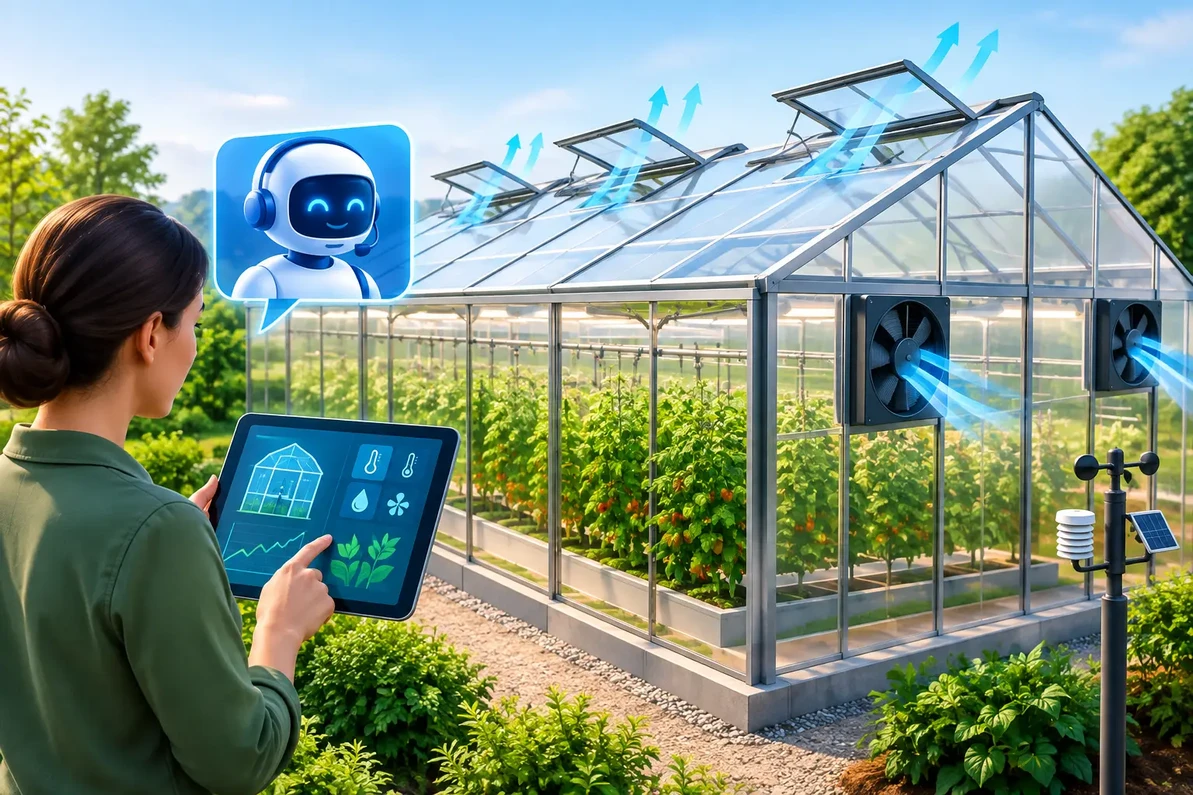
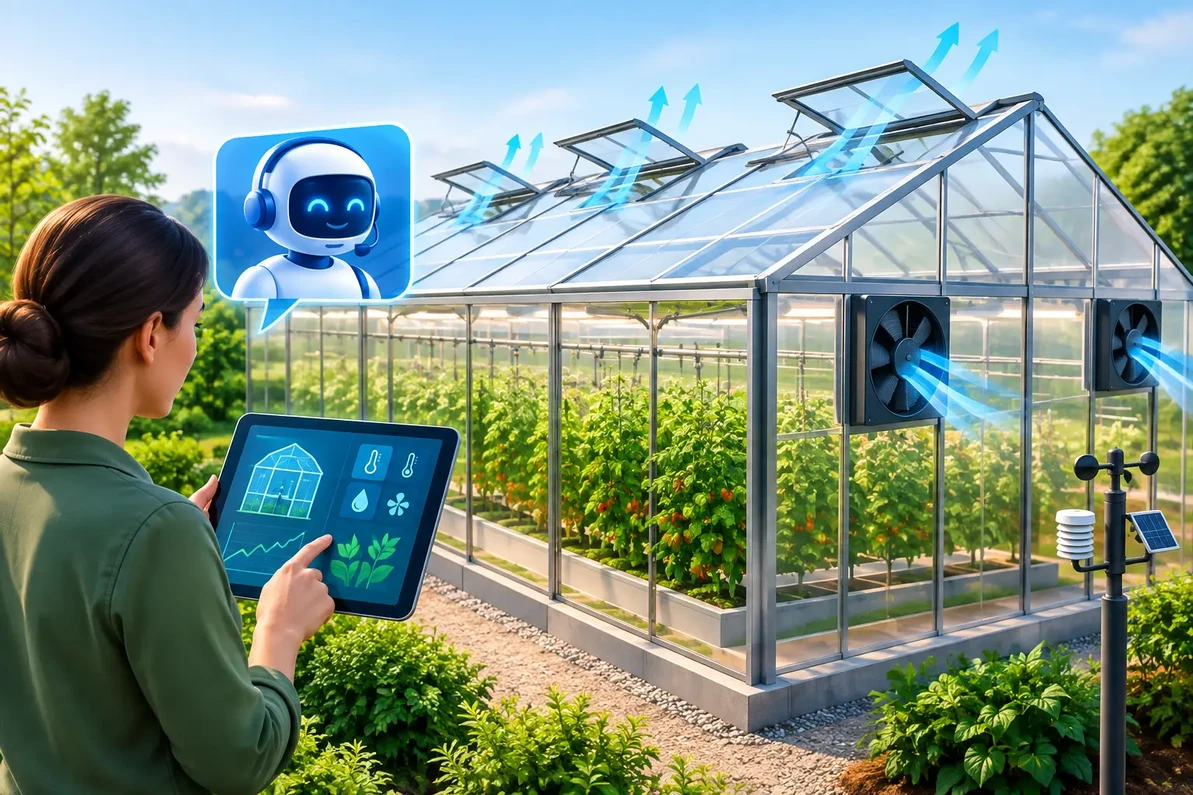
A greenhouse can move plenty of air and still have a crop problem. Hot spots above the canopy, wet corners near sidewalls, stagnant air under benches, and pressure loss through restrictive shutters can defeat a ventilation plan that looked adequate on paper. AI Smart Greenhouse Ventilation - Ask an Expert is not simply a question of adding sensors and automating exhaust fans. It is a ventilation design question first, then a controls question.
For commercial growers, specialty cultivation facilities, hemp and cannabis operators, and greenhouse managers, the goal is measurable: maintain crop-appropriate temperature, humidity, air movement, and pressure conditions while controlling energy use. AI can help interpret changing conditions faster than a manual thermostat approach, but it cannot correct undersized fan capacity, inadequate intake area, poor equipment placement, or a greenhouse envelope with uncontrolled leakage.
AI Smart Greenhouse Ventilation Starts With Airflow Design
A smart controller needs a system worth controlling. Before selecting AI-enabled sensors, variable frequency drives, or cloud-based controls, establish the required airflow at peak operating conditions. That means evaluating greenhouse length, width, gutter height, roof geometry, glazing type, solar load, crop density, local summer design temperature, and the available intake path.
Fan capacity is typically discussed in CFM, but the correct CFM target depends on the facility and production method. A propagation house with young plants has different airflow and humidity needs than a high-light flowering room or a large seasonal vegetable greenhouse. The design must also account for static pressure. A fan tested in open air may deliver substantially less airflow after louvers, insect screens, light traps, evaporative cooling pads, duct transitions, and dirty filters are added.
This is where many automated systems underperform. The control screen may report that all fans are operating, while actual airflow through the house is below the required volume. A ventilation design review should identify the fan performance curve, expected system resistance, motor type, shutter losses, and the free area of every intake opening. Equipment should be selected for delivered CFM, not just a catalog's free-air rating.
Intake Air Is Part of the Fan System
Exhaust ventilation only works when replacement air can enter the greenhouse with minimal restriction. Undersized intake louvers, clogged insect screening, and poorly managed pad walls increase negative pressure and reduce fan output. Excessive pressure can pull doors open, strain shutters, and create uneven airflow patterns that leave crop zones untreated.
For naturally ventilated houses, ridge vents, sidewall curtains, and wind conditions add another layer of variability. An AI platform can recognize patterns and respond to them, but the physical system still needs enough opening area and a reliable method of moving air during low-wind, high-heat conditions. Hybrid strategies often work best: natural ventilation when outdoor conditions support it, then staged mechanical exhaust and circulation when they do not.
What AI Can Actually Improve
The useful role of AI is not marketing language. It is pattern recognition, predictive control, alarm prioritization, and better use of operating data. A well-configured system can compare indoor temperature, leaf-zone humidity, outdoor conditions, solar radiation, CO2 concentration, fan status, VFD speed, and historical crop data to make more informed control decisions.
Instead of waiting for a greenhouse to exceed a high-temperature setpoint, predictive controls may begin staging ventilation as solar load climbs. Instead of operating all exhaust fans at full speed, a VFD-based system can modulate fan speed to hold a tighter temperature band. This can reduce motor energy use and prevent the constant on-off cycling that wears contactors, belts, shutters, and motors.
AI also helps identify abnormalities. If a fan's commanded speed increases but the temperature response remains weak, the system may flag a failed belt, closed shutter, obstructed intake, sensor issue, or a change in weather conditions beyond the equipment's capacity. That is valuable for facilities with multiple zones or limited staff, provided personnel verify alarms rather than treating the dashboard as a substitute for inspection.
The best systems use AI as an operational assistant. They do not give away responsibility for crop decisions or safety interlocks.
Control Temperature, Humidity, and Air Movement Together
Temperature is the obvious ventilation trigger, but it is rarely the only one that matters. Greenhouse ventilation directly affects relative humidity, vapor pressure deficit, disease pressure, CO2 retention, and irrigation demand. Pulling in outside air can lower humidity quickly, but it can also introduce very hot, cold, dry, or humid air depending on the season and climate.
For example, a grower may need exhaust airflow to remove daytime heat, yet aggressive exhaust operation can waste enriched CO2. In a humid climate, bringing in outdoor air may not solve a high-humidity issue during certain morning or nighttime periods. Supplemental dehumidification, heat, horizontal airflow fans, and carefully scheduled ventilation may be required. The correct sequence depends on the crop, production stage, local weather, and the facility's heating and cooling equipment.
Horizontal airflow fans are frequently overlooked in smart greenhouse projects. Exhaust fans exchange air between the greenhouse and outdoors; circulation fans manage air distribution within the crop zone. Even temperature sensors will not tell the whole story if canopy-level air is stagnant. Properly spaced circulation fans help reduce leaf-surface moisture, improve uniformity, and prevent a single sensor location from driving decisions for the entire structure.
Sensor Placement Determines Control Quality
A control system only knows what its sensors report. Mounting a temperature and humidity sensor near a heater, wet pad, roof peak, exterior wall, or direct sunlight can produce misleading data. Sensors should represent the crop environment, not the most convenient place to run a wire.
Use multiple sensing points in larger houses and compare zones. Consider canopy-level temperature and humidity, outdoor dry-bulb temperature, radiation, differential pressure where appropriate, and equipment run status. Calibrate sensors on a scheduled basis. A drifting humidity sensor can cause unnecessary fan runtime, poor dehumidification decisions, and crop stress long before the problem becomes obvious.
Data ownership and access also matter. Before committing to a cloud-connected platform, determine who can change setpoints, who receives alarms, whether the system can operate locally if internet service fails, and whether historical data can be exported. A reliable local control fallback is critical. Greenhouse ventilation cannot wait for a software update or a lost network connection during a summer heat event.
Equipment Choices That Support Smart Controls
Not every greenhouse requires the same level of automation. A small seasonal structure may benefit from staged thermostatic exhaust fans and reliable circulation fans. A larger commercial facility may justify EC motors, VFDs, motorized louvers, weather stations, automated curtains, evaporative cooling controls, and zone-based sensors.
EC and variable-speed fan systems can offer precise modulation and lower energy draw at partial load, but they require compatible controls and qualified electrical installation. Traditional belt-drive or direct-drive exhaust fans can still be the right answer where serviceability, budget, and straightforward staged operation take priority. The right choice is based on operating hours, climate, utility cost, maintenance capability, redundancy requirements, and expected crop value.
Redundancy should be planned, not improvised. If one large fan fails, can remaining equipment hold safe conditions long enough for a service response? Are high-temperature alarms independent of the primary controller? Is there backup power for controls, louvers, critical exhaust, and communications? These questions matter most in high-value cultivation and during extreme weather.
Ask an Expert Before You Automate a Bad Design
An AI controller cannot overcome a ventilation system that lacks intake area, has inadequate CFM, or is fighting excessive static pressure. Start with the greenhouse dimensions, crop type, cooling method, existing fan specifications, louver and pad dimensions, climate location, and any recurring problems. That information allows an engineer to evaluate whether the solution is additional exhaust capacity, improved intake design, circulation fans, VFD control, sensor zoning, evaporative cooling, or a combination of measures.
Factory Fans Direct provides ventilation design engineering support and a FREE Project Evaluation for greenhouse, cannabis, hemp, flower, and specialty cultivation applications. Contact Mike Miller, VP Engineering, at 888-849-1233 for a FREE Project Evaluation.
The strongest smart greenhouse systems are built around honest field conditions: the heat load is calculated, the CFM is delivered at operating static pressure, the sensors are placed where the crop lives, and the controls are configured to support people who understand the facility. That is how automation becomes a practical production tool rather than an expensive screen on the wall.
Factory Fans Direct - Greenhouse, Cannabis & Hemp Ventilation & Cooling Experts | Contact Mike Miller VP Engineering at Factory Fans Direct for a FREE Project Evaluation 888-849-1233 | Mike@FactoryFansDirect.com
Recent Posts
-

AI Smart Commercial & Industrial Building Ventilation - Ask an Expert
A warehouse can show a reasonable thermostat reading at the office while the loading docks, roof lin …25th Sep 2026 -
AI Smart Greenhouse Ventilation - Ask an Expert
A greenhouse can move plenty of air and still have a crop problem. Hot spots above the canopy, wet c …25th Sep 2026 -
AI Smart Crypto Mining Hydro-Cooling - Ask an Expert
A mining facility can have efficient ASIC hardware, competitive power pricing, and a well-designed e …25th Sep 2026