AI Smart ecoPOWER Hybrid Turbine Ventilation for Manufacturing Facilities
A production line can be running within specification while the building around it steadily loses control of heat. Roof-level temperatures climb, air stratifies above occupied zones, process moisture lingers, and exhaust demand changes by shift, season, and equipment load. AI Smart ecoPOWER Hybrid Turbine Ventilation for Manufacturing Facilities addresses that problem with a practical premise: use natural wind energy when available, then apply efficient powered exhaust when wind conditions cannot carry the load.
For plant managers and design teams, the value is not a novelty control package or a roof turbine with a motor attached. The value is a ventilation strategy that can be matched to actual heat loads, building geometry, static pressure, operating schedules, and energy targets.
Why conventional roof ventilation can fall short
A passive turbine ventilator can move useful air when outdoor wind conditions are favorable. But manufacturing plants do not operate only when the wind is favorable. Heat-producing equipment, welding areas, ovens, compressors, packaging lines, and occupied work zones may need exhaust during still, humid, or hot conditions when natural draft is limited.
Conventional powered roof exhaust solves part of that problem by providing predictable airflow, but it consumes electrical energy whenever it operates. In facilities with long operating hours, that operating cost deserves close attention. It also makes control strategy critical. A fan that runs at full output regardless of actual temperature or process demand can waste energy while pulling conditioned makeup air through the facility.
The best answer depends on the application. A building with large internal heat gains may require continuous mechanical exhaust. A plant with variable production schedules may benefit from demand-based operation. A facility in a windy location with moderate heat loads may gain meaningful value from wind-assisted ventilation. Hybrid design gives engineers another operating mode instead of forcing an either-or choice.
How ecoPOWER hybrid turbine ventilation works
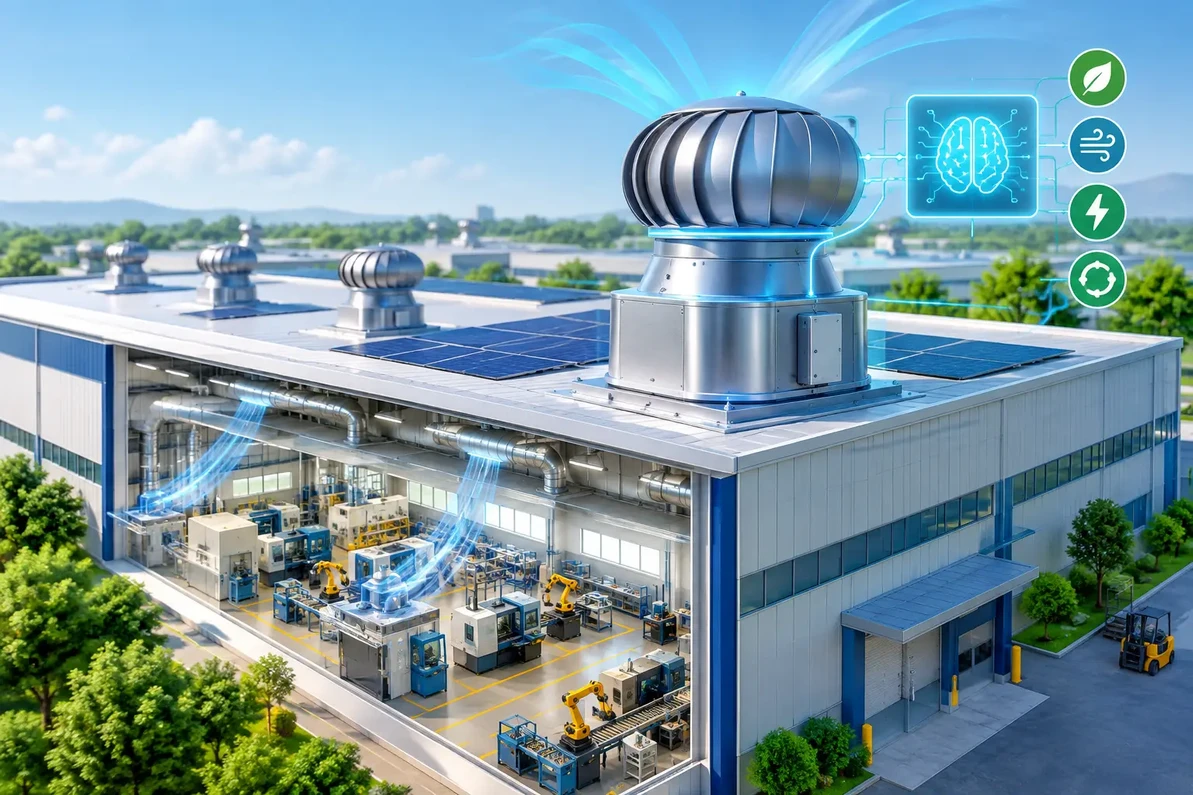
The Edmonds ecoPOWER Hybrid Rooftop Exhaust Fan is a true hybrid ventilator. Its turbine captures wind energy for non-powered ventilation, while its high-performance EC brushless DC motor provides powered exhaust for continuous, controlled operation. It is not a solar-powered fan.
That distinction matters. Solar ventilation depends on irradiance, panel placement, battery design if included, and the mismatch that can occur when a hot building needs air movement after sunset or during cloud cover. ecoPOWER operates through wind when the wind is available and through an electric EC motor when controlled mechanical ventilation is needed.
The wind-driven turbine and the motor are not competing systems. They support the same goal: moving hot, stale, or process-affected air out of the building with less reliance on electrical power than a powered-only approach may require. When properly specified, that operating flexibility supports LEED and Net-Zero project objectives while keeping the focus on measurable airflow performance.
The EC motor advantage
An electronically commutated, brushless DC motor is well suited to variable ventilation demand. EC motors are efficient at part-load operation and can be integrated with speed control strategies more effectively than a basic on-off motor arrangement. That gives a design team the ability to avoid treating every hour like peak-load conditions.
The motor is only one part of the equation. Fan selection still requires review of the required CFM, roof opening, duct or plenum losses, discharge arrangement, local weather exposure, and makeup-air path. A highly efficient motor cannot correct a system that is undersized, short-circuited, or starved for replacement air.
Where AI-smart controls add real facility value
AI-assisted ventilation should be applied as an operating tool, not as a vague promise. In a manufacturing environment, controls can use data from temperature sensors, humidity sensors, differential pressure readings, production schedules, weather conditions, utility demand periods, and VFD or building-management-system signals to adjust ventilation operation.
For example, a plant may see predictable roof-level heat buildup after certain equipment starts. A control sequence can anticipate that load and increase exhaust before workers experience elevated temperatures on the floor. If outdoor conditions are favorable and turbine action is contributing airflow, powered operation can be reduced rather than held at a fixed setting.
AI interfaces can also identify patterns that a manual control approach misses. Repeated high-temperature alarms in one zone may point to blocked makeup air, an undersized exhaust path, a changed process load, or a failed damper. The intelligence is useful when it turns operating data into a maintenance or design decision.
That said, controls do not eliminate the need for engineering. Sensors need proper locations and calibration. A temperature sensor mounted near a roof deck can overreact to stratified heat, while one placed too close to a supply opening may underreport the actual work-zone condition. Good control logic starts with good airflow design.
Start with the heat load and airflow path
Manufacturing ventilation projects should begin with the source of the problem, not a fan diameter. Determine whether the facility needs general heat relief, process exhaust, contaminant capture, humidity management, or a combination of these functions. General roof exhaust is not a substitute for source capture where welding fumes, dust, chemicals, oil mist, or other regulated contaminants must be controlled.
For heat relief, estimate the sensible heat load from equipment, lighting, solar gain, and people. Then calculate the airflow required to maintain the desired temperature rise. The required CFM must be evaluated against the building’s ability to bring in makeup air. Exhaust without a planned inlet path can create excessive negative pressure, reduce fan performance, pull dust through openings, interfere with combustion equipment, and make doors difficult to operate.
Roof-mounted hybrid ventilation is especially effective when the building can use the natural tendency of hot air to rise. High-bay plants, warehouses with production zones, fabrication shops, and facilities with roof-level heat accumulation are common candidates. However, complex partitions, low ceilings, multiple roof elevations, or tightly enclosed process rooms can require zoned exhaust and dedicated makeup-air equipment instead of a single general roof strategy.
Questions that should be answered before equipment selection
A sound evaluation looks at more than nameplate airflow. The design team should confirm:
- Required CFM at the actual static pressure, not free-air performance alone.
- Heat load by zone and the hours when that load occurs.
- Available makeup-air openings, louvers, dampers, or dedicated supply equipment.
- Roof construction, curb dimensions, structural loading, weathering details, and service access.
- Required controls, including thermostat staging, BMS connection, VFD coordination, and sensor inputs.
- Whether process exhaust requires special materials, filtration, capture hoods, or code-driven discharge clearances.
These details determine whether a hybrid turbine unit is the right primary solution, a supplemental heat-relief device, or one component in a broader ventilation package.
Design trade-offs facility teams should consider
Hybrid ventilation can reduce electrical dependence, but it should not be sold as zero-energy ventilation under all conditions. Wind speed and direction vary. The powered EC motor provides dependable operation when natural wind is insufficient, yet electrical consumption still exists during powered operation. The potential savings depend on climate, roof exposure, operating hours, control setpoints, and the amount of wind-assisted airflow achieved at the site.
Noise, maintenance access, and roof layout also deserve attention. A rooftop system must be placed to avoid interference from parapets, adjacent structures, stacks, and equipment that can affect airflow. Facilities should maintain safe access for inspection, cleaning, and motor service. In dirty industrial environments, maintenance planning is part of performance planning.
There is also a difference between reducing building heat and controlling worker comfort. Roof exhaust removes hot air from the upper building volume, but work-zone cooling may still require HVLS fans, directional air movement, evaporative cooling where climate conditions allow, or conditioned makeup air. Many facilities get the strongest result from combining these tools rather than expecting one fan type to solve every thermal problem.
A better path to a measurable ventilation project
The practical approach is to establish a baseline before finalizing equipment. Record roof and work-zone temperatures, current fan operation, production schedules, existing CFM, utility usage, and known comfort or equipment issues. Then define the result the project must deliver: a target temperature reduction, a specific number of air changes, improved process stability, lower powered fan runtime, or a pathway toward LEED and Net-Zero performance goals.
From there, ventilation equipment and controls can be selected around the actual facility instead of around a catalog listing. Cut sheets, motor data, airflow curves, roof curb details, and control sequences should all be reviewed before purchase and installation.
Factory Fans Direct - Commercial & Industrial Ventilation & Cooling Experts. Contact Mike Miller, VP Engineering, for a FREE Project Evaluation at 888-849-1233 or Mike@FactoryFansDirect.com. A properly evaluated hybrid ventilation design can turn roof-level heat and unpredictable weather into a controllable operating advantage.
Factory Fans Direct/Edmonds US - Hybrid Commercial & Industrial Ventilation & Cooling Experts | Contact Mike Miller VP Engineering at Factory Fans Direct for a FREE Project Evaluation 888-849-1233 | Mike@FactoryFansDirect.com
Recent Posts
-

AI Mega Factories Use Edmonds ecoPOWER Hybrid Ventilation
AI Mega Factories use Edmonds ecoPOWER Hybrid Turbine Ventilation because heat rejection cannot be t …4th Oct 2026 -
AI Cooling for High-Heat Facilities
A server aisle running 12°F hotter than its neighboring aisle, a crypto container recirculating exha …4th Oct 2026 -
AI Ventilation: Better Control Starts With Data
A warehouse can look adequately ventilated on paper and still have a 15-degree temperature differenc …4th Oct 2026